Digest — 2026-11-02
Curated America/New_York (ET). Prefer arXiv / open sources. Verified via the arXiv API, a Crossref date-window keyword query (journal articles published online 2026-10-31 to 2026-11-02), Crossref metadata and abstracts, and DOI resolution.
Focus: items since the 2026-10-30 digest. Items covered on 2026-10-30 and earlier are not repeated. Journal items are read at abstract level.
Frame these as frontier progress, not finished technology. Applications remain mostly simulation, tabletop hardware, or lab-scale experiments.
At a glance
Diagram: original illustration of this digest’s key idea (not from the papers).
Highlights
1. Chirality inversion and odd transport in a suspension of living rotors
- Authors: Isabelle Eisenmann, Pedro Cosme, Hannah van Sterkenburg, Hugo Franca, Titouan Seguy, Maria Tatulea-Codrean, Maziyar Jalaal
- Date / venue: arXiv preprint, submitted 2026-10-29 (cond-mat.soft)
- Link: https://arxiv.org/abs/2610.41016
- Tidbits:
- The team built a new experiment with microalgae that spin in place, like tiny living tops.
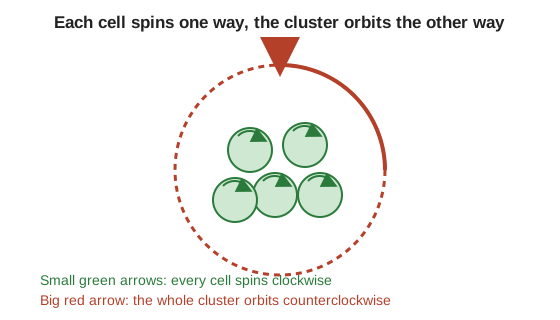
- As the cells get more crowded, the swirling water they stir up pulls them into small rotating clusters, which then merge into one connected spinning fluid.
- The surprise: every cell spins clockwise, yet the clusters orbit counterclockwise. Experiments, theory, and simulations trace this flip to the fact that the cells power themselves rather than being spun by an outside magnet or field.
- Once the clusters connect into a network, the way things spread through the fluid changes too.
- Why a beginner should care: It is a clean example of self-assembly in living, self-powered matter, where the group can behave opposite to its members.
- Caveat: A preprint (not yet peer reviewed) about a lab experiment; no application is claimed.
2. Self-Assembled hBN Wrinkles as Planar Optofluidic Channels
- Authors: Xiliang Yang, Tetsuo Martynowicz, Allard J. Katan, Kenji Watanabe, Takashi Taniguchi, Sabina Caneva
- Date / venue: Small, published online 2026-10-31 (CC BY 4.0)
- Link: https://doi.org/10.1002/smll.76515
- Tidbits:
- Hexagonal boron nitride (hBN) is an atom-thin, flat crystal. When a flake on a surface is heated and cooled, it wrinkles, and the wrinkles join up into a network of tunnels, with no stencils or lithography needed.
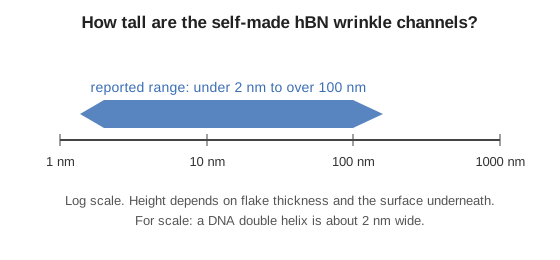
- Channel heights ranged from under 2 nm to over 100 nm depending on how thick the flake was and what it sat on.
- Water seeped into the wrinkles after a droplet touched them and stayed there for more than 10 hours, and fluorescent DNA could be seen lined up along the channels.
- Why a beginner should care: Instead of carving nanochannels one by one, the material makes them itself as it buckles.
- Caveat: A proof-of-concept lab platform; read at abstract level.
3. Early Pathway Selection Precedes Conformational Locking in Protein Self-Assembly
- Authors: Ruoxuan Peng, Lele Zhou, Runnan Bai, Yunhao Yang, Yi Zhou, Hao Zhang, Xinyan Wang, Jing Ren, Jian Li, Yifan Liu, Shengjie Ling
- Date / venue: ACS Nano, published online 2026-11-02
- Link: https://doi.org/10.1021/acsnano.6c13997
- Tidbits:
- Using silk protein, the team caught a short early window when small clumps (intermediates) first form, before the protein folds into its final locked structure.
- Applying an electric field during that window nudged how the clumps formed and competed, and the effect was not simply “more field, more effect”.
- Later growth mostly happened by existing clumps lengthening and fusing; the stiff beta-sheet structure appeared only at the end and locked in the path chosen early.
- Why a beginner should care: It suggests the best time to steer self-assembly is at the very start, not after the structure has set.
- Caveat: Lab study on one model protein; read at abstract level.
Diagram: original sketch of the sequence described in the abstract.
Stretch (adjacent)
- Swimming versus Screening: How Activity Reshapes the Ionic Cloud of a Charged Particle (Tanmoy Chakraborty, Tomer Markovich, Ram M. Adar; arXiv, submitted 2026-10-28): https://arxiv.org/abs/2610.38594 — theory showing that a fast-swimming charged particle changes the cloud of ions around it, so its electric influence reaches farther than for a still particle.
- Advances on triply periodic hyperbolic surface structures: from biological inspiration to artificial self-assembly (Shuai Ye, Lu Han; Micro Nano Science, published online 2026-11-02): https://doi.org/10.20517/mns.2026.09 — a review of saddle-shaped, endlessly repeating 3D surfaces found in butterfly wing scales and beetle shells, and how chemists self-assemble similar structures.
Safe classroom / discussion follow-ons
- Spinners in a crowd (inspired by item 1): Put several fidget spinners or spinning tops on a tray, or watch a video of them, and ask: if every spinner turns one way, which way would you guess a group drifts? Then sketch the flow around two neighbouring spinners to see why the answer can flip.
- Wrinkle channels (inspired by item 2): Stretch a balloon or a sheet of plastic wrap over a bowl, let it relax, or push a sheet of cling film across a table to make wrinkles. Drip a drop of coloured water at one edge and watch it run along the wrinkles.
- Steer early (inspired by item 3): Make two batches of gelatin or jelly (food-safe), and stir one only during the first few minutes of cooling and the other only once it starts to set. Compare textures and discuss why timing matters.
- Saddle shapes (stretch): Fold a sheet of paper into a hyperbolic paraboloid (a saddle-shaped pleated square) and look at butterfly-wing photos; spot where curved surfaces repeat.
Key idea of the day
Self-assembly often surprises us at the group level and depends on timing: self-powered algae gather into clusters that turn the opposite way to each cell, a crumpling crystal sheet builds its own nanoscale water channels, and silk protein picks its path early before locking it in. All of this is still lab-scale research, so treat it as a starting point, not finished technology.