Digest — 2026-09-28
Curated America/New_York (ET). Prefer arXiv / open sources. Verified via arXiv Atom API and cond-mat.soft / active-matter keyword listings.
Focus: roughly since the 2026-09-25 digest (Fri→Mon weekend gap). Prior items are not re-listed as “new today.”
Frame these as frontier progress, not finished technology. Applications remain mostly lab-scale.
At a glance
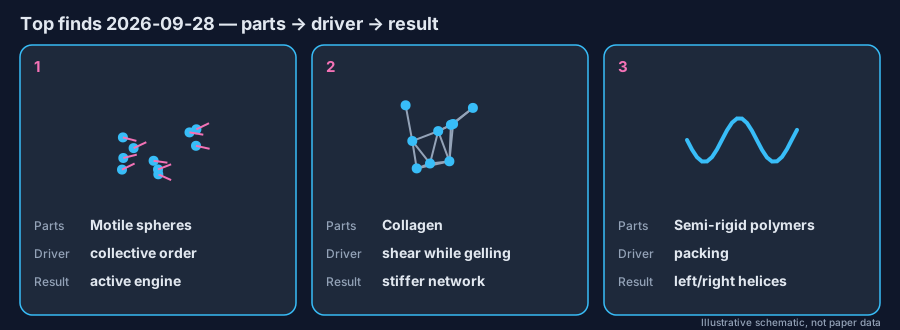
Diagram: original illustration of this digest’s key idea (not from the papers).
Highlights
1. Collective order reorganizes dissipation and powers an active engine
- Authors: Michael Riedl, Vincent Wattiez, Étienne Fodor, Jan Brugués, Francesco Romanò
- Submitted: 2026-09-25
- Link: https://arxiv.org/abs/2609.31059
- Why newsworthy: Minimal experiment with synthetic motile spheres yields a time-resolved power budget of collective motion. Ordering increases locomotion efficiency and reorganizes dissipation from internal friction toward external slip — enabling an active engine that extracts mechanical work from collective order.
- Beginner hook: When self-propelled beads get organized, how they burn energy changes — and that change can power a tiny engine.
- Caveat: Soft-matter experiment (lab-scale active matter).
2. Shear stress during self-assembly encodes stiffness of network-based materials
- Authors: Lens M. Dedroog, Olivier Deschaume, Carmen Bartic, Yovan de Coene, Erin Koos, Minne P. Lettinga, Mehdi Bouzid
- Submitted: 2026-09-24
- Link: https://arxiv.org/abs/2609.30520
- Why newsworthy: Shear during collagen gelation first aligns the network, then irreversibly boosts the elastic modulus if stress is held to maturation. Simulations point to orientation plus permanent-contact topology; rigidity percolation suggests a distinct universality class from quiescent gels. Late Thu submission missed by the Fri digest.
- Beginner hook: How hard you pull on a gel while it cooks can permanently decide how stiff it becomes.
- Caveat: Experiment + simulation — we propose only dry discussion/drawing follow-ons, not wet collagen chemistry.
3. Shape enantiomerism in semi-rigid polymer liquid crystals
- Authors: S. Biswas, W. S. Fall, H. H. Wensink
- Submitted: 2026-09-25
- Link: https://arxiv.org/abs/2609.31143
- Why newsworthy: Achiral semi-rigid polymers can adopt weakly helical conformations of either handedness. Theory + MD show crowding-induced stiffening and pronounced enantiomeric shapes without spontaneous global chiral symmetry breaking; weak vs strong enantiomerism crossover near persistence length ≈ 3× contour length.
- Beginner hook: Flexible rods can wiggle into temporary left/right twists even when the overall fluid stays racemic.
- Caveat: Theory + simulation.
4. Realignment of ferroelectric nematic by photoinduced electric field
- Authors: Sathyanarayana Paladugu, Oleksandr Kurochkin, Ruslan Kravchuk, Mykola Kravets, Volodymyr Sashuk, Bijaya Basnet, Vassili G. Nazarenko, Sergij V. Shiyanovskii, Oleg D. Lavrentovich
- Submitted: 2026-09-25
- Link: https://arxiv.org/abs/2609.30673
- Why newsworthy: Low-power light creates an intrinsic electric field that realigns a ferroelectric nematic (NF) between ITO electrodes — strong enough for NF, too weak for ordinary paraelectric nematics used in LCDs.
- Beginner hook: A special liquid crystal lets dim light steer molecules the way a display voltage usually does.
- Caveat: Soft-matter experiment (lab LC / optics).
5. Emergence of Nanoscale Modulation in Liquid Crystals as a Result of Short-Range Order Parameter Condensation
- Authors: E. I. Kats
- Submitted: 2026-09-25
- Link: https://arxiv.org/abs/2609.30916
- Why newsworthy: Landau note on twist-bend nematics: nanoscale heliconical order without molecular chirality arises from condensation of a short-range orientational order parameter at finite wave vector (not merely Frank softening). de Gennes analogy; fluctuations → weakly first order; extra Goldstone mode.
- Beginner hook: A “hidden” local order can wake up inside an already-ordered liquid crystal and lock into a tiny corkscrew.
- Caveat: Theory note.
Stretch
- Vertebraic soft robotic tail pressure predictive control (2026-09-24): https://arxiv.org/abs/2609.30479
- Paper-stack trampoline / acoustic restitution (2026-09-25): https://arxiv.org/abs/2609.31213
- Rubble-pile asteroid bonded-particle reaccumulation (2026-09-25): https://arxiv.org/abs/2609.30903
- Geometric difference families / DNA-origami GOCs (2026-09-24): https://arxiv.org/abs/2609.29202
Safe classroom / discussion follow-ons
- Paper-stack bounce demo: Drop a small hard ball from a fixed height onto printer-paper stacks of different sheet counts (e.g. 1, 10, 50, ~60) and compare bounce height (inspired by arXiv:2609.31213). Dry materials only — discuss why “more cushion” is not always “less bounce.”
- Ordered vs disordered “engine” sketch: Sketch random vs aligned self-propelled dots and annotate where energy might go (internal rubbing vs pushing the surroundings) (inspired by arXiv:2609.31059). Pencil/paper or whiteboard; no chemistry.
Corpus mirror: /workspace/self-assembly-corpus/digests/2026-09-28.md.
Last updated on