Digest — 2026-09-25
Curated America/New_York (ET). Prefer arXiv / open sources. Verified via arXiv Atom API and cond-mat.soft / active-matter keyword listings.
Focus: roughly since the 2026-09-24 digest. Prior items are not re-listed as “new today.”
Frame these as frontier progress, not finished technology. Applications remain mostly lab-scale.
At a glance
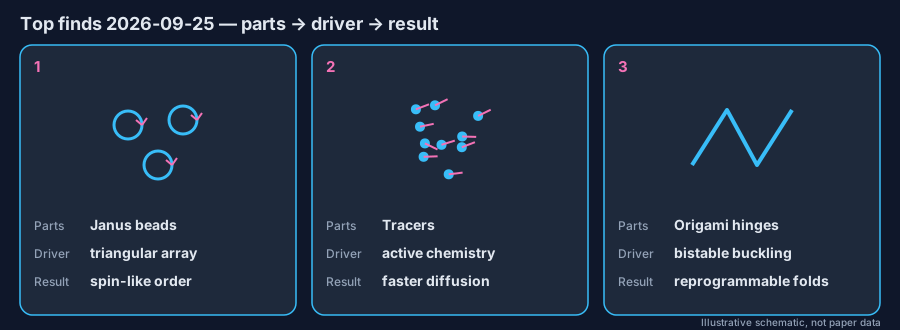
Diagram: original illustration of this digest’s key idea (not from the papers).
Highlights
1. Orientational Ordering of Janus Particle Arrays as Classical Compass Spin Systems
- Authors: Zhijie Fan, Myeonggon Park, Marija Vucelja, Gia-Wei Chern
- Submitted: 2026-09-24
- Link: https://arxiv.org/abs/2609.30025
- Why newsworthy: Classical 120° compass and Kern–Frenkel models for triangular metallodielectric Janus arrays. Monte Carlo shows sixfold order via thermal order-by-disorder, with an intermediate quasi-long-range regime consistent with two BKT transitions — matching the experimental motif of sixfold order plus vortices/antivortices.
- Beginner hook: Two-faced beads on a grid act like compass needles — heat can pick a preferred pattern from many equal-looking options.
- Caveat: Theory / Monte Carlo (experiment-motivated).
2. Speed up of passive tracers in mixtures with active chemical reactions
- Authors: Filipe C. Thewes, Chengjie Luo, David Zwicker
- Submitted: 2026-09-24
- Link: https://arxiv.org/abs/2609.29416
- Why newsworthy: Thermodynamically consistent reactions open a relaxation pathway that suppresses interaction-induced memory drag and restores tracer diffusivity; actively driven reactions can push diffusivity beyond the empty-solvent limit (confirmed in particle simulations).
- Beginner hook: Chemistry that converts particles can make a wandering probe move faster, not slower.
- Caveat: Theory + simulation.
3. Reprogrammable origami through bistable buckled hinges
- Authors: Leon M. Kamp, Lucy Liu, Ella McRitchie, Damien Rouchouse, Orel Mazor, Davood Farhadi, L. Mahadevan, Katia Bertoldi
- Submitted: 2026-09-23
- Link: https://arxiv.org/abs/2609.28790
- Why newsworthy: Bistable buckled shims across origami hinges create an asymmetric torque–angle preference for mountain vs valley. Flipping a shim reprograms that hinge after fabrication; self-switching hinges let global boundary inputs rewrite the folding pathway.
- Beginner hook: Flip tiny memory springs in the hinges so the same crease pattern prefers a different 3D shape.
- Caveat: Soft-matter mechanics / experiment — we propose only dry paper/card demos, not lab fabrication of buckled shims.
4. Superadiabatic Dynamical Density Functional Theory for One-Dimensional Brownian Hard-Rod Fluids
- Authors: Jens Weimar, Daniel de las Heras, Martin Oettel
- Submitted: 2026-09-24
- Link: https://arxiv.org/abs/2609.29838
- Why newsworthy: Superadiabatic DDFT with exact equilibrium excess free energy and a three-particle adiabatic closure matches Brownian-dynamics superadiabatic response when initial ensembles align; a velocity-gradient power functional also works with a simulation memory kernel.
- Beginner hook: When hard beads rearrange, extra nonequilibrium forces appear that sleepy equilibrium recipes miss — this theory catches them in a clean 1D testbed.
- Caveat: Theory / simulation.
5. Boundary and bulk perturbations in vectorial active matter
- Authors: Giuseppe Fava
- Submitted: 2026-09-23
- Link: https://arxiv.org/abs/2609.28593
- Why newsworthy: Thesis on how explicit rotational-symmetry breaking — global environmental anisotropy or boundary-induced local anisotropies — reshapes dry flocking relative to free bulk collective motion.
- Beginner hook: Walls and preferred “wind” directions are not decorations — they change how active flocks dance.
- Caveat: Theory thesis overview.
Stretch
- Temperament engineering for robot swarms (2026-09-24): https://arxiv.org/abs/2609.29423
- Anthropomimetic soft robotic forearm (2026-09-24): https://arxiv.org/abs/2609.29176
- Hydrogel particles migrating through ice (cryosuction microrheology) (2026-09-24): https://arxiv.org/abs/2609.29904
- Charged rods in 3D varying-section channels (2026-09-24): https://arxiv.org/abs/2609.29427
- Collocated soft-robot shape regulation (2026-09-23): https://arxiv.org/abs/2609.27469
Safe classroom / discussion follow-ons
- Preferred-fold origami demo: Paper/card crease with tape or a small pre-bent strip biasing mountain vs valley; flip the bias and compare which 3D fold wins (inspired by arXiv:2609.28790). Dry materials only.
- Janus-compass grid sketch: Triangular lattice of two-tone discs/arrows; score neighbor alignments under bond-direction rules and ask whether a shared sixfold pattern emerges from random starts (inspired by arXiv:2609.30025). Pencil/paper or intro coding; no chemistry.
Corpus mirror: /workspace/self-assembly-corpus/digests/2026-09-25.md.
Last updated on