Digest — 2026-09-24
Curated America/New_York (ET). Prefer arXiv / open sources. Verified via arXiv Atom API and cond-mat.soft / active-matter keyword listings.
Focus: roughly since the 2026-09-23 digest. Prior items are not re-listed as “new today.”
Frame these as frontier progress, not finished technology. Applications remain mostly lab-scale.
At a glance
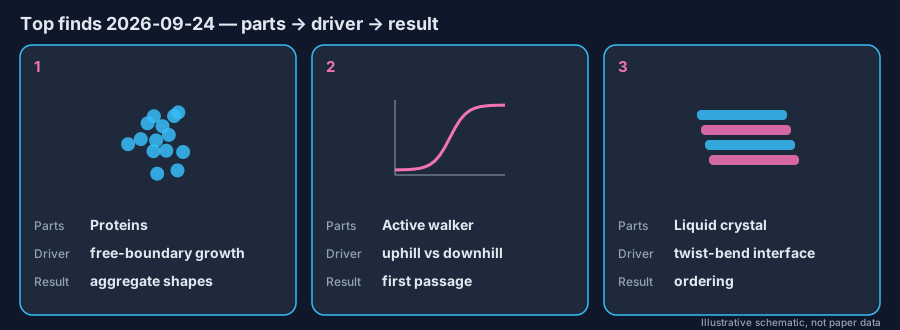
Diagram: original illustration of this digest’s key idea (not from the papers).
Highlights
1. Spatially Resolved Nucleated Polymerization: A Free-Boundary Model of Protein Aggregation in Concentrated Solutions
- Authors: Pouria A. Mistani
- Submitted: 2026-09-23
- Link: https://arxiv.org/abs/2609.27185
- Why newsworthy: Extends Lumry–Eyring nucleated polymerization so aggregates are spatial regions (level sets) with growth/condensation set by surface bonding sites. Collision efficiency and Fuchs stability ratio are computed from Wertheim theory, not fitted; well-mixed averages recover classic rate equations; many-body merge rates run 2.2–3.8× faster than two-body.
- Beginner hook: Protein clumps are growing blobs with surfaces that bump and fuse — modeling those surfaces connects math to real shapes.
- Caveat: Continuum theory / simulation; not a classroom wet lab.
2. Uphill and downhill first passage of an active Brownian particle: Asymmetry and exact path reweighting
- Authors: Mykola Tasinkevych, Xuan My Le, Artem Ryabov
- Submitted: 2026-09-23
- Link: https://arxiv.org/abs/2609.27425
- Why newsworthy: Self-propulsion breaks the passive result that uphill and downhill first-passage time distributions match. An exact spatial-reflection reweighting still relates the two path ensembles and lets rare uphill statistics be reconstructed from common downhill trajectories.
- Beginner hook: Self-powered walkers take different kinds of paths against a push — a clever mirror trick still connects uphill and downhill.
- Caveat: Theory + simulation.
3. Insight into ordering at nematic twist-bend interfaces
- Authors: Szymon Drzazga, Piotr Kubala, Lech Longa
- Submitted: 2026-09-23
- Link: https://arxiv.org/abs/2609.28012
- Why newsworthy: Monte Carlo + MD of repulsive bent particles: opposite-handedness twist-bend domains meet in a density-modulated splay-bend-twist interface (period ~½ bulk pitch) with an undulating zero-twist surface — not a gradual untwist.
- Beginner hook: Left- and right-corkscrew liquid-crystal domains do not shake hands smoothly — the border builds its own ripple pattern.
- Caveat: Simulation of repulsive bent rods.
4. Control of filament network rigidity by the condensation of crowding molecules
- Authors: Jiyong Cheon, Zhengyan Lin, Dean Kim, Anirudh Malli, Itamar Kolvin
- Submitted: 2026-09-22
- Link: https://arxiv.org/abs/2609.26983
- Why newsworthy: Soft-matter experiment: dissolved crowders keep a helical-filament network rigid; when crowders condense into droplets, rigidity collapses by ~an order of magnitude and returns when condensates dissolve — osmotic-pressure tuning as a design principle.
- Beginner hook: Crowding molecules can act like invisible glue pressure — gather into droplets and the filament scaffolding goes limp, then stiffens again when remixed.
- Caveat: Lab filament + crowder gels; we do not propose classroom LLPS chemistry.
5. Active Self-Consistent Field Theory for Ornstein-Uhlenbeck Polymers
- Authors: Yuliang Huang, Chun-Lai Ren, Qiyun Tang
- Submitted: 2026-09-23
- Link: https://arxiv.org/abs/2609.28124
- Why newsworthy: Active extension of polymer SCFT (χN + persistence time τ). Increasing activity suppresses microphase separation; density-modulation amplitude decays as Δφ ∝ τ^-0.5 at large τ, independent of composition.
- Beginner hook: Classic block-copolymer stripe recipes assume sleepy chains — give them persistent kicks and the stripes fade on a clean power law.
- Caveat: Field theory / simulation.
Stretch
- Multi-site polymer adsorption (SR-IFS) (2026-09-23): https://arxiv.org/abs/2609.28186
- Viscous dissipation & bubble morphology in soft gels (2026-09-22): https://arxiv.org/abs/2609.26943
- Centipede water-surface swimming + robophysical model (2026-09-22): https://arxiv.org/abs/2609.27088
- LDL adsorption on micropatterned polymer brushes (2026-09-22): https://arxiv.org/abs/2609.26613
- BrickCraft-Duo dual-arm brick assembly (2026-09-23): https://arxiv.org/abs/2609.28281
- OCDMA LiDAR code reuse for robot swarms (2026-09-23): https://arxiv.org/abs/2609.28172
Safe classroom / discussion follow-ons
- Persistent vs random walk demo: Sketch or code a biased random walk vs a self-propelled “active” walker between two exits; compare uphill frequency and timing (inspired by arXiv:2609.27425). Pencil/paper or intro coding only; no chemistry.
- Crowder thought experiment (dry materials): Yarn/string “filaments” in a tray with dry beads as crowders — ask how tightly packed vs piled-aside beads might change how stiff the tangle feels when pushed (conceptual echo of arXiv:2609.26983). No gels, solvents, or phase-separation chemistry.
Corpus mirror: /workspace/self-assembly-corpus/digests/2026-09-24.md.
Last updated on