Digest — 2026-10-01
Curated America/New_York (ET). Prefer arXiv / open sources. Verified via arXiv Atom API and cond-mat.soft / active-matter / colloidal keyword listings.
Focus: roughly since the 2026-09-30 digest (Wed→Thu). Prior items are not re-listed as “new today.”
Frame these as frontier progress, not finished technology. Applications remain mostly lab-scale.
At a glance
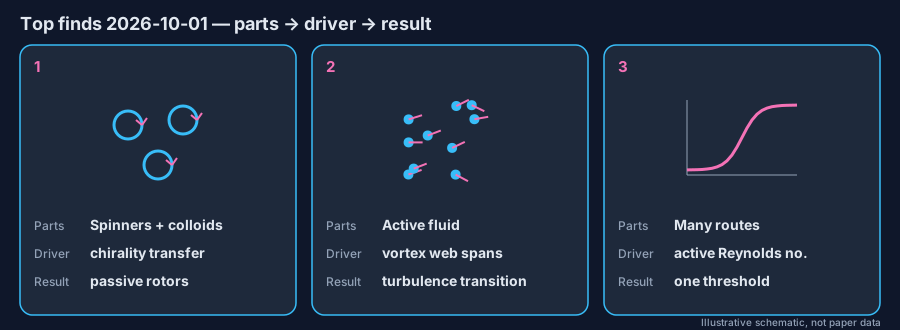
Diagram: original illustration of this digest’s key idea (not from the papers).
Highlights
1. Active spinners drive passive matter into chiral rotors
- Authors: Dennis Schorn, Anpuj Nair S, Stijn van der Ham, Benno Liebchen, Hanumantha Rao Vutukuri
- Submitted: 2026-09-30
- Link: https://arxiv.org/abs/2609.39439
- Why newsworthy: Purely rotational magnetic spinners transfer chirality and edge currents to passive colloids; changing composition/attraction flips the organization inside-out so passive clusters rotate (with shared |Ω|∼R⁻² scaling) inside a chiral spinner fluid.
- Beginner hook: Spinning beads that never swim can still lend handedness and rim currents to quiet beads.
- Caveat: Magnetic-spinner / colloidal experiment + simulation.
2. Fully developed active turbulence defined through a nonequilibrium phase transition
- Authors: Lasse Bonn, Tianxiang Ma, Olga Bantysh, Wei Feng, Martin Cramer Pedersen, Guangyin Jing, Jordi Ignés-Mullol, Francesc Sagués, Nuno A. M. Araujo, Amin Doostmohammadi
- Submitted: 2026-09-30 (accepted Nature Physics)
- Link: https://arxiv.org/abs/2609.39348
- Why newsworthy: Critical activity where vorticity nodal lines percolate (SLE₆ / critical percolation) and vortex centres form a rigid system-spanning cluster — an experimentally accessible definition of fully developed active turbulence (MT–kinesin + bacteria + simulations).
- Beginner hook: When opposite-spin regions knit into one system-spanning web, active turbulence has crossed a critical line.
- Caveat: Active-nematic / bacterial experiments + simulations.
3. A Reynolds-like criterion for the onset of universal active turbulence
- Authors: Kunal Kumar, Sandip Sahoo, Kirti Kashyap, Amal Manoharan, Siddhartha Mukherjee, Anupam Gupta, Samriddhi Sankar Ray
- Submitted: 2026-09-30
- Link: https://arxiv.org/abs/2609.39999
- Why newsworthy: In TTSH dynamics, the universal spectrum E(k)∼k⁻³/² is reachable via multiple parameter routes that collapse onto a single Reynolds-like Re_act threshold.
- Beginner hook: One dial can mark membership in the universal active-turbulence club even when you turn different knobs.
- Caveat: Continuum theory / numerics.
4. Curvature-induced migration of small domains on lipid membranes
- Authors: Jaime Agudo-Canalejo
- Submitted: 2026-09-30
- Link: https://arxiv.org/abs/2609.39772
- Why newsworthy: Small-domain energy on fixed curved membranes; size-dependent line-tension coupling can switch preferred seats (e.g. poles → equator on oblates) as domains grow and coalesce.
- Beginner hook: Shape alone seats membrane islands — and growing bigger can move your preferred seat.
- Caveat: Theory (Biophysical Journal Helfrich special-issue invite).
5. Training and memory in a randomly driven fractal gel
- Authors: Chloe W. Lindeman, Joshua D. Clugston, Justin C. Goodrich, Mark Sutton, James L. Harden, Robert L. Leheny
- Submitted: 2026-09-30
- Link: https://arxiv.org/abs/2609.40010
- Why newsworthy: XPCS shows both cyclic and random shear train microstructural reversibility in a fractal nanoparticle gel; random-drive memory is readable with a standard amplitude protocol.
- Beginner hook: Messy random shaking can still teach a soft gel to remember how hard it was shoved.
- Caveat: Synchrotron XPCS / shear-cell experiment.
Stretch
- Ribbon gridshell metamaterials (2026-09-29): https://arxiv.org/abs/2609.38365
- Cyclic active Brownian ratchet (2026-09-30): https://arxiv.org/abs/2609.39255
- LC order + lipid membrane morphodynamics (2026-09-30): https://arxiv.org/abs/2609.40113
- Density-aware MT active nematics (2026-09-29): https://arxiv.org/abs/2609.38520
- Osmotically forced vesicle morphodynamics (2026-09-29): https://arxiv.org/abs/2609.38464
- Packaged DNA sets virus electrostatic anisotropy (2026-09-29): https://arxiv.org/abs/2609.38429
Safe classroom / discussion follow-ons
- Inside-out spinner storyboard: Sketch CW spinners around a passive cluster, then flip to an active cluster in a passive matrix; annotate opposite rotation and a rim edge current (inspired by arXiv:2609.39439). Pencil/paper only — no magnets.
- Ribbon gridshell angle sketch: On graph paper, draw two strip families crossing at fixed vs varying angles; discuss soft vs rigid sheets (inspired by arXiv:2609.38365). Paper/pencil only — no laser cutting.
Corpus mirror: /workspace/self-assembly-corpus/digests/2026-10-01.md.
Last updated on