Digest — 2026-09-22
Curated America/New_York (ET). Prefer arXiv / open sources. Verified via arXiv Atom API and cond-mat.soft / cs.RO recent listings.
Focus: roughly since the 2026-09-21 digest. Prior items are not re-listed as “new today.”
Frame these as frontier progress, not finished technology. Applications remain mostly lab-scale.
At a glance
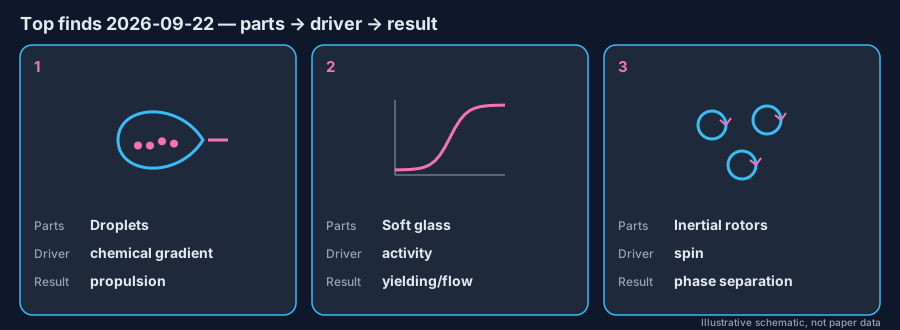
Diagram: original illustration of this digest’s key idea (not from the papers).
Highlights
1. Phase diagram morphology shapes droplet propulsion in chemical gradients
- Authors: Stefan Köstler, Malcolm Steen, David Zwicker
- Submitted: 2026-09-21
- Link: https://arxiv.org/abs/2609.24529
- Why newsworthy: Surfactant-free thin-interface theory: droplet velocity from size, viscosity, surface-tension sensitivity to a regulating component, and that component’s chemical-potential gradient. Droplets move toward regions of lower stability as encoded in phase-diagram morphology (especially near critical points); numerics confirm.
- Beginner hook: The environment’s phase diagram can steer a soft droplet — continuing yesterday’s “soft bag that swims” theme without needing a propeller or engineered surfactant.
- Caveat: Theory + simulation; not a classroom chemistry kit.
2. An active soft glassy rheology model
- Authors: Raffaele Mendozza, Tobias Müller, Peter Sollich
- Submitted: 2026-09-19
- Link: https://arxiv.org/abs/2609.23168
- Why newsworthy: Soft Glassy Rheology extended with a persistent stochastic active strain rate on mesoscopic elements. Activity opens a long-time relaxation channel — crossover from SGR power-law rheology to Maxwell-like fluidisation — with a fluidisation timescale analogous to effective-temperature pictures of active matter.
- Beginner hook: Being “alive” inside a jammed soft material can unjam it on long timescales — relevant wherever self-assembly and collective motion live in dense soft media.
- Caveat: Mesoscopic theory/simulation.
3. Phase separation in a system of Brownian inertial rotors
- Authors: Lucio Mauro Carenza, Pasquale Digregorio, Massimiliano Semeraro, Antonio Suma, Ignacio Pagonabarraga, Giuseppe Gonnella
- Submitted: 2026-09-18
- Link: https://arxiv.org/abs/2609.21556
- Why newsworthy: Torque-driven inertial dumbbells (chiral rotors) with hard-core repulsion only phase-separate into dense liquid + hexatic regions via an inertia-controlled hot-dilute / cool-dense mechanism; clusters spontaneously rigid-rotate about their centers of mass.
- Beginner hook: Spinning parts that only bounce off each other can still assemble rotating “machines” — chirality + inertia as knobs, no glue required.
- Caveat: Simulation only.
4. Transport of deformable vesicles driven by chiral active Brownian particles
- Authors: Dipak Patra, Anil Kumar Dasanna
- Submitted: 2026-09-16
- Link: https://arxiv.org/abs/2609.18743
- Why newsworthy: Fixed-area vesicle filled with chiral active particles shows run-and-tumble-like migration, rotors, and persistent spinning. Vesicle rotation is non-monotonic in chirality — an optimal twist maximizes spin — with a scaling collapse across activity strengths.
- Beginner hook: Twist inside a soft bag can optimally spin or ferry the bag — same soft-boundary motif as rafts and phase-diagram droplets.
- Caveat: Simulation only.
Stretch
- Two-stage ordering kinetics in binary ellipsoidal mixtures (2026-09-18): https://arxiv.org/abs/2609.22533
- Homopolymer-tuned micelle aggregation of coil/rod/coil BAB triblocks (2026-09-20): https://arxiv.org/abs/2609.23626
- Dilatable DNA origami nanopores as nuclear pore mimics (bioRxiv 2026-09-03): https://www.biorxiv.org/content/10.64898/2026.09.03.749129v1
- MFPS monolithic force-proprioception soft actuator (2026-09-21): https://arxiv.org/abs/2609.24499
Safe classroom / discussion follow-ons
- Phase-diagram motility: Sketch a simple binary-mixture phase diagram and ask which way a droplet should swim if it prefers the less-stable side of a gradient (inspired by arXiv:2609.24529). Whiteboard only; no chemistry.
- Spinning-swarm mini demo: Slightly weight-bias bristlebots so they curve; watch whether denser clusters form and rotate as a unit (echo of arXiv:2609.21556). Supervise batteries; no chemistry.
Corpus mirror: /workspace/self-assembly-corpus/digests/2026-09-22.md.
Last updated on