Digest — 2026-09-21
Curated America/New_York (ET). Prefer arXiv / open sources. Verified via arXiv Atom API and PDF link scrape.
Focus: roughly since the 2026-09-18 digest (weekend gap). Prior items are not re-listed as “new today.”
Frame these as frontier progress, not finished technology. Applications remain mostly lab-scale.
Highlights
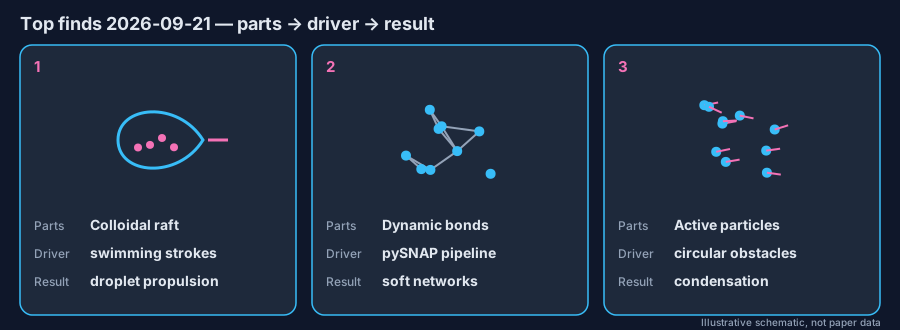
1. Active colloidal rafts perform swimming strokes that propel their host droplets
- Authors: Airi N. Kato, Julien Brémont, Etienne Harté, Jean-Michel Rampnoux, Jean-François Joanny, Hamid Kellay
- Submitted: 2026-09-18
- Link: https://arxiv.org/abs/2609.21963
- Why newsworthy: A self-propelled raft of active colloids inside a thin oil droplet on water follows an off-centered orbit, periodically deforming the contact line in a non-reciprocal “swimming stroke” that locomotes the whole droplet at low Reynolds number. The effect needs many-body raft dynamics — a single colloid is not enough — and the main drive is soft-boundary deformation rather than direct hydrodynamic push from each particle.
- Beginner hook: Stuff swimming inside a soft bag can move the bag itself — collective activity plus a deformable boundary, not a propeller.
- Caveat: Soft-matter experiment + theory; not a classroom chemistry kit.
2. pySNAP — Simulation and Network Assembly Pipelines for Dynamically Bonded Soft Materials
- Authors: Tanner A. Wilcoxson, Tianhao Li, Tyla R. Holoman, Gaurav Mitra, Thomas M. Truskett, Glen M. Hocky
- Submitted: 2026-09-18
- Links: https://arxiv.org/abs/2609.21204 · pySNAP GitHub · docs · DyBond-v2
- Why newsworthy: Open Python platform on GPU HOOMD-blue with DyBond for coarse-grained MD of soft materials that form and break reversible bonds. Declarative parameter files and workflow tools run sweeps on workstations or HPC, bridging microscopic bonding kinetics to bulk assembly and rheology.
- Beginner hook: A shared simulation toolkit for sticky, breakable bonds — the computational twin of many self-assembly recipes — with real GitHub you can open.
- Caveat: Research MD software; GPU/HPC for serious runs.
3. Active hydrodynamics couples polymer organization, shape, and motility in deformable droplets
- Authors: Ritu Raj, P. B. Sunil Kumar
- Submitted: 2026-09-17
- Link: https://arxiv.org/abs/2609.20730
- Why newsworthy: DPD of semiflexible active polymers inside a soft droplet: extensile vs contractile force dipoles produce different internal organization, interface fluctuation modes, and whole-droplet motility (persistent vs near-ballistic runs).
- Beginner hook: The kind of activity inside a soft bag changes how the bag wriggles and travels.
- Caveat: Simulation only.
4. Scaling and condensation of dry active matter around circular obstacles
- Authors: Felipe P. S. Júnior, F. Q. Potiguar, Jorge L. C. Domingos, W. P. Ferreira
- Submitted: 2026-09-17
- Link: https://arxiv.org/abs/2609.20743
- Why newsworthy: Active Brownian particles form self-sustained vortices around fixed circular obstacles. At low density the vortex stays localized; above a critical area fraction its mass grows extensively with system size — an obstacle-stabilized condensed state.
- Beginner hook: A round obstacle can seed a living vortex that either stays local or swallows the swarm.
Stretch
- Competing routes to spontaneous flow in confined active nematics (2026-09-17): https://arxiv.org/abs/2609.20786
- CAD-based relation learning for robotic assembly planning (2026-09-15): https://arxiv.org/abs/2609.17263
Safe classroom / discussion follow-ons
- Soft-boundary stroke: Shallow water tray + floating foil/cork ring “droplet”; place 1 vs several bristlebots inside and watch whether off-center circling warps and drifts the float (inspired by arXiv:2609.21963). Supervise batteries; keep water off motors; no chemistry.
- Obstacle vortex mini demo: Tape a circular obstacle on a table; drive bristlebots nearby and ask when a local swirl becomes a room-filling jam (echo of arXiv:2609.20743).
Corpus mirror: /workspace/self-assembly-corpus/digests/2026-09-21.md.
Last updated on