Digest — 2026-09-23
Curated America/New_York (ET). Prefer arXiv / open sources. Verified via arXiv Atom API and cond-mat.soft / active-matter keyword listings.
Focus: roughly since the 2026-09-22 digest. Prior items are not re-listed as “new today.”
Frame these as frontier progress, not finished technology. Applications remain mostly lab-scale.
At a glance
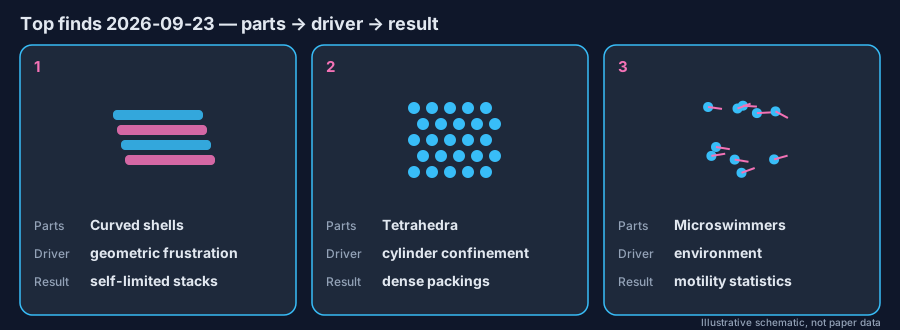
Diagram: original illustration of this digest’s key idea (not from the papers).
Highlights
1. Self-limited stacking of non-Euclidean colloidal shells: From saddles to caps
- Authors: Kyle T. Sullivan, Mark J. Stevens, Gregory M. Grason
- Submitted: 2026-09-21
- Link: https://arxiv.org/abs/2609.25399
- Why newsworthy: Geometric frustration in curved colloidal “curvamers” extended from cylinders to spherical caps and saddles. Stretching vs bending (FvK-like thickness measure) sets how fast elastic energy grows with stack height; typical self-limiting sizes largest for cylinders, smallest for caps, intermediate for saddles — with thin saddles giving especially robust size selection.
- Beginner hook: Curved pieces that won’t tile flat space can still assemble towers that stop at a designed height — curvature as a built-in ruler.
- Caveat: Continuum + coarse-grained simulation; not a classroom chemistry kit.
2. Dense packing of tetrahedra in cylinders
- Authors: Gabrielle N. Jones, Adil Mughal, Philipp W. A. Schönhöfer, Sharon C. Glotzer
- Submitted: 2026-09-22
- Link: https://arxiv.org/abs/2609.26627
- Why newsworthy: First systematic densest-packings map of regular tetrahedra in a circular cylinder: chiral Tetra Helices vs achiral Dimer Chains. Boerdijk–Coxeter helix emerges naturally under confinement; at a critical diameter the two families coexist at identical packing fraction.
- Beginner hook: Tube diameter alone can choose spiral vs paired stacks of the same sharp pieces — packing as programmable geometry.
- Caveat: Simulation + analytic packing theory.
3. Statistical signatures of microorganism motility under environmental stress
- Authors: Luiza Treichel Mossi, Nicole Mazzitelli Narvaz, Larissa da Silva Bento, Roger Modena, Bernardo Boatini, Amalia Garcez, Leonardo Gregory Brunnet, Alexandre Arenzon, Carolina Brito
- Submitted: 2026-09-21
- Link: https://arxiv.org/abs/2609.25403
- Why newsworthy: Video microscopy of Paramecium and Artemia under baseline vs stress; trajectory metrics + data-fit run-and-tumble-style models. Path statistics proposed as physiological-stress indicators — an accessible active-matter experiment.
- Beginner hook: Living microscopic swimmers are active matter you can track — change the environment carefully and the path statistics change.
- Caveat: Experimental organisms; any classroom live-culture work needs adult supervision and ethical handling (no hazardous chemistry).
4. Mesoscale heterogeneity in protein hydrogels from dynamic unfolding
- Authors: Victoria Byelova, Lorna Dougan, David Head
- Submitted: 2026-09-22
- Link: https://arxiv.org/abs/2609.26681
- Why newsworthy: Coarse-grained chemically crosslinked protein gels with one-step unfolding produce crowded high-density clusters linked by low-density stranded corridors; post-gelation relaxation shifts fractal metrics more than unfolding-barrier height.
- Beginner hook: Soft gels are not uniform Jell-O — after they set, dense clumps remain linked by stringy bridges.
- Caveat: Simulation only.
5. Linear and nonlinear active microrheology via fluid particle dynamics
- Authors: Muhammed Muhsin Abdul Azeez, Henning Reinken, Andreas M. Menzel
- Submitted: 2026-09-22
- Link: https://arxiv.org/abs/2609.26431
- Why newsworthy: Microrheology method extended to viscoelastic/elastic media and nonlinear drive. Large forcing yields distorted stress–strain loops and net probe drift (near walls or between two probes) that vanishes in purely viscous or purely elastic limits — tweezers/magnetic-drive analogue.
- Beginner hook: Continues yesterday’s jammed-soft-matter theme — push a tiny bead hard enough and viscoelastic gels drift in ways linear rheology misses.
- Caveat: Simulation.
Stretch
- Endocytosis Onsager / cytoskeletal viscoelasticity (2026-09-22): https://arxiv.org/abs/2609.26734
- Brownian gyrator probing scale (2026-09-21): https://arxiv.org/abs/2609.24748
- Stratified-medium extended optical tweezers (2026-09-20): https://arxiv.org/abs/2609.23757
- Modular robot calibration composition (2026-09-20): https://arxiv.org/abs/2609.23731
- Equivariant Stokes resistance NN for microparticles (2026-09-19): https://arxiv.org/abs/2609.23105
Safe classroom / discussion follow-ons
- Curved-shell paper models: Cut paper saddles vs spherical-cap segments; stack identical pieces and ask which geometry “wants” to stop sooner as elastic cost grows (inspired by arXiv:2609.25399). Paper/scissors only; no chemistry.
- Tetra-helix tube packing: Foam/wooden (or paper) tetrahedra in a clear tube of varying diameter — look for spiral vs paired arrangements (echo of arXiv:2609.26627). Supervise small parts; no chemistry.
Corpus mirror: /workspace/self-assembly-corpus/digests/2026-09-23.md.
Last updated on