Digest — 2026-09-16
Curated America/New_York (ET). Prefer arXiv / open sources. Verified via arXiv API.
Focus: roughly last 1–2 weeks. Items from the 2026-09-15 digest are not re-listed as “new today.”
Frame these as frontier progress, not finished technology. Applications remain mostly lab-scale.
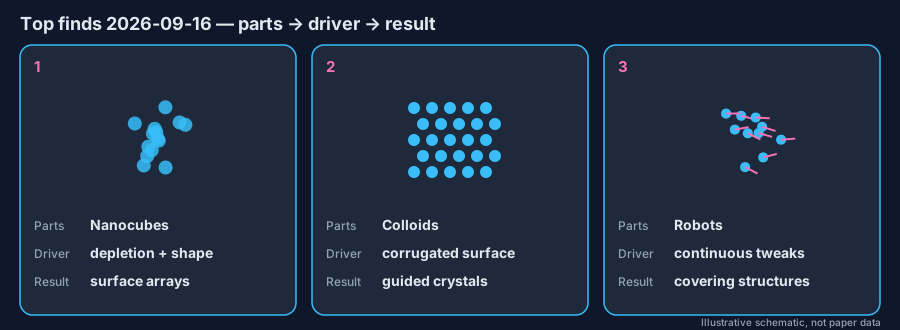
Highlights
1. Morphology and depletion force-based large-scale self-assembly of nanocubes on surface (MIDAS)
- Authors: Yeonhee Lee, Seungsang Cha, Yuna Kwak, Nicholas Juntunen, Grant M. Rotskoff, Jwa-Min Nam
- Submitted: 2026-09-09
- Link: https://arxiv.org/abs/2609.09761
- Why newsworthy: MIDAS uses morphology-sensitive depletion forces plus substrate roughness to build large-scale 2D monolayers or 3D multilayers of gold nanocubes without complex ligand recipes; lattice-gas and kinetic Monte Carlo modeling back the story.
- Beginner hook: Surface roughness and particle shape can organize nanoparticles as much as fancy coatings.
- Caveat: Research-lab nanoparticle work — not a classroom wet lab.
2. Designing corrugated surfaces to guide colloidal self-assembly
- Authors: Dinesh Kumar Sahu, Jude Ann Vishnu, Lisa Shafroth, Martin Lenz, Olivia du Roure, Julien Heuvingh
- Submitted: 2026-09-03
- Link: https://arxiv.org/abs/2609.04001
- Why newsworthy: Two-photon-printed side topography on polygonal colloids programs selective depletion assembly into dimers, chains, zigzags, or honeycombs; salt/depletant/topography scale flip selective ↔ non-selective regimes.
- Beginner hook: “Program the edges, get the structure” — LEGO-stud intuition for soft matter.
- Open problems: Tuning interaction specificity vs aggregate size in a reversible, scalable way.
3. Learning to build covering structures with continuous adjustments
- Authors: Gabriel Vallat, Maryam Kamgarpour, Stefana Parascho
- Submitted: 2026-09-08 · Accepted IROS 2026
- Link: https://arxiv.org/abs/2609.08669
- Why newsworthy: Hybrid RL (HSAC) adapts multi-robot block construction under fabrication noise instead of brittle fixed plans; physical two-robot spanning-arch demo with 3D-printed blocks.
- Beginner hook: Self-assembly-adjacent robotics — plans that tolerate mess, not only perfect CAD.
4. Machine learned designs of functional colloidal foldamers
- Authors: Ryan van Mastrigt, Zorana Zeravcic
- Submitted: 2026-08-28
- Link: https://arxiv.org/abs/2608.28554
- Why newsworthy: Reinforcement learning designs pathways (downhill vs detour) for DNA-coated droplet-chain folding; function can emerge from the process, including reconfiguration between structures.
- Beginner hook: Design the recipe over time — closer to protein folding than snapping bricks.
5. Mechanistic Framework for Multicomponent Nanoparticle Assembly (FormLNP)
- Authors: Turash Haque Pial, Tine Curk
- Submitted: 2026-09-03
- Link: https://arxiv.org/abs/2609.04029
- Why newsworthy: Process-aware kinetic Monte Carlo predicts single-particle heterogeneity for mRNA lipid nanoparticles and PEI–DNA complexes; open-source FormLNP tooling claimed in the abstract.
- Beginner hook: Vaccine and gene-delivery particles are self-assembled — process history shapes what each particle contains.
6. Towards AI-Driven Nanomedicine Discovery (NSA-Bench / NSA-Net)
- Authors: Quan Hao, Mengyue Fan, Zifan Dong, et al.
- Submitted: 2026-09-03
- Link: https://arxiv.org/abs/2609.04278
- Why newsworthy: Public NSA-Bench benchmark plus multimodal NSA-Net for predicting whether molecular pairs will self-assemble into nanomedicine candidates.
- Beginner hook: ML meets “will these molecules assemble?” — useful for data-curious students, with wet-lab caveats.
Stretch (robotics, ~4 weeks)
- Reconfiguration-Complete Motion Primitives for Deformable Planar Modular Robots — Gu et al., submitted 2026-08-18 — https://arxiv.org/abs/2608.17324 — constructive completeness results for pivot/shear primitives on deformable rhombus modules.
Safe classroom / discussion follow-ons
- Corrugated-edge paper craft: Identical cardboard hexagons; roughen only selected edges. Ask which patterns favor dimers vs chains vs loops (weak tape/magnets only — no chemicals). Inspired by arXiv:2609.04001.
- Pathway vs target journaling: Reach the same square graph two ways — only add edges, or allow one undo — and discuss when undoing is necessary (echo of foldamer pathways, arXiv:2608.28554).
Teaching note
Pair this digest with 2026-09-15, landmark classics on the Papers page, and the Learn path. Newest ≠ most important for beginners.
Last updated on