Digest — 2026-10-02
Curated America/New_York (ET). Prefer arXiv / open sources. Verified via arXiv Atom API and cond-mat.soft / active-matter / self-assembly keyword listings.
Focus: roughly since the 2026-10-01 digest (Thu→Fri). Prior items are not re-listed as “new today.”
Frame these as frontier progress, not finished technology. Applications remain mostly lab-scale.
At a glance
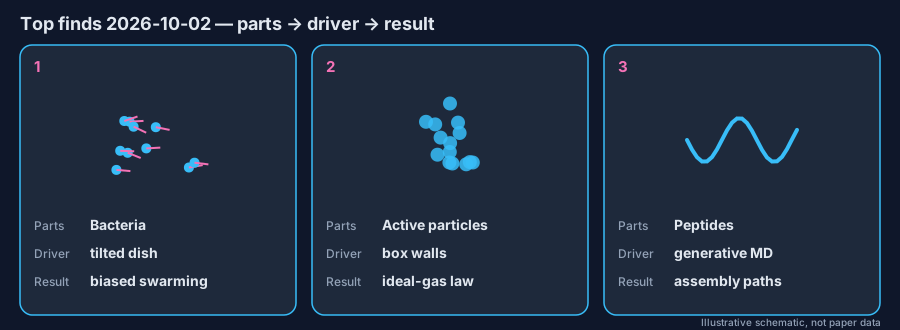
Diagram: original illustration of this digest’s key idea (not from the papers).
Highlights
1. Inclined surfaces bias bacterial swarming expansion and edge organization
- Authors: Pengxi Gu, Zixiang Lin, Hui Ren, Jin Zhu, Anqi Li, Omar Said, Weijie Chen, Zijie Qu
- Submitted: 2026-10-01
- Link: https://arxiv.org/abs/2610.01281
- Why newsworthy: Gravity/inclination non-monotonically tunes Enterobacter swarm expansion and downhill-biased morphology; up-facing vs down-facing agar sides differ at the same tilt magnitude (thin-film model separates tangential redistribution from normal pressure effects).
- Beginner hook: Tipping the Petri dish changes how far — and in what shape — a living swarm frontier grows.
- Caveat: Agar-surface bacterial experiment + thin-film model (not a classroom wet demo).
2. Ideal gas of active particles in a box
- Authors: Siran Li, Ralf Eichhorn, Lennart Dabelow
- Submitted: 2026-10-01
- Link: https://arxiv.org/abs/2610.01287
- Why newsworthy: Ideal active gas law for noninteracting particles in a finite box — exact for 1D RTPs, analytic for AOUPs, numeric for ABPs/higher-D RTPs — enabling macroscopic thermo without tracking every propulsion kick.
- Beginner hook: Self-propelled “gases” get their own ideal-gas-style rule for pressure and volume.
- Caveat: Theory + numerics.
3. SupraTITO: generative MD for peptide self-assembly
- Authors: Weilong Chen, Nuno Costa, Julija Zavadlav
- Submitted: 2026-10-01
- Link: https://arxiv.org/abs/2610.01381
- Why newsworthy: Transferable GenMD with sequence/topology/geometry-conditioned transfer operators; generalizes across held-out dipeptides and concentrations while resolving assembly structures and dynamics.
- Beginner hook: A learned fast-forward explores how peptide sequences assemble without waiting for every atom wiggle.
- Caveat: Computational GenMD — not a wet lab protocol.
4. Microscopic origin of the chiral pressure in a two-dimensional fluid
- Authors: Francisco Vega Reyes
- Submitted: 2026-10-01
- Link: https://arxiv.org/abs/2610.02003
- Why newsworthy: Antisymmetric chiral pressure from a parity-breaking pseudo-scalar / rotational viscosity, present even in a homogeneous Quiescent Chiral State.
- Beginner hook: A quiet, uniform chiral soup can still carry a sideways twist pressure.
- Caveat: Kinetic theory / micropolar hydrodynamics (PRE Letter submission).
5. Scalar field theory for (chiral) active Brownian particles — bottom-up derivation
- Authors: Yuta Kuroda, Thomas Speck
- Submitted: 2026-10-01
- Link: https://arxiv.org/abs/2610.01672
- Why newsworthy: RG / pressure-expansion bridge from interacting ABPs to fourth-order scalar field theories; chiral ABPs add two odd continuum terms.
- Beginner hook: Particle-level chirality shows up as odd terms in the big-picture continuum equations.
- Caveat: Long-form continuum derivation.
Stretch
- Active-Matter Battery (2026-09-30): https://arxiv.org/abs/2610.00428
- Enhanced LW fluctuations in active crystals (2026-09-30): https://arxiv.org/abs/2610.00634
- Spherical crystal / quasicrystal nucleation (2026-10-01): https://arxiv.org/abs/2610.00931
- Bio-inspired rigid-soft finger Jacobian (2026-10-01): https://arxiv.org/abs/2610.01668
Safe classroom / discussion follow-ons
- Tilted-swarm storyboard: Sketch a circular colony on flat agar, then the same swarm on a gentle downhill tilt with a stretched tip; annotate where edge motion might slow (inspired by arXiv:2610.01281). Pencil/paper only — no bacterial culture.
- Active ideal-gas cartoon: Draw self-propelled arrows in a box vs Brownian dots; discuss why wall pressure may need a different rule than PV = nRT (inspired by arXiv:2610.01287). Paper/pencil only.
Corpus mirror: /workspace/self-assembly-corpus/digests/2026-10-02.md.
Last updated on