Digest — 2026-09-17
Curated America/New_York (ET). Prefer arXiv / open sources. Verified via arXiv abs pages, Nature metadata, and EurekAlert.
Focus: roughly last 1–2 weeks. Items from the 2026-09-16 digest are not re-listed as “new today.”
Frame these as frontier progress, not finished technology. Applications remain mostly lab-scale.
Highlights
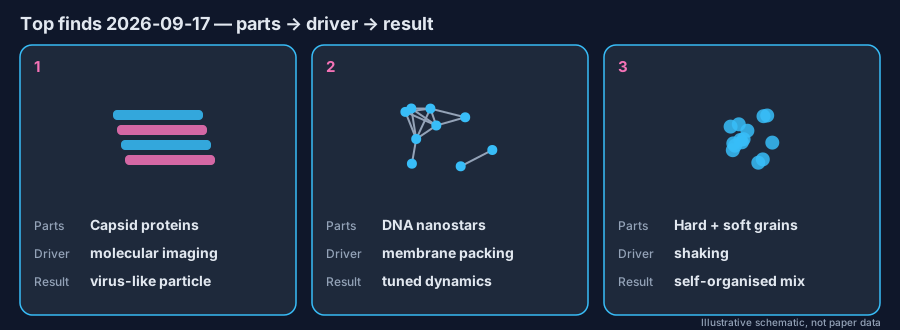
1. Molecular-level observation of the self-assembly of a virus-like particle
- Authors: Roi Asor, Dan Loewenthal, Diana Melnyk, Tiong Kit Tan, Philipp Kukura, et al.
- Published: 2026-09-16 (Nature)
- Links: https://www.nature.com/articles/s41586-026-10948-z · https://doi.org/10.1038/s41586-026-10948-z · EurekAlert summary · bioRxiv
- Why newsworthy: Mass photometry plus single-molecule trapping watches individual virus-like particles assemble in real time; weak reversible contacts plus a few topologically closed intermediates (including an early closed pentameric ring) channel assembly through a nucleation-and-growth pathway despite thousands of theoretical intermediates.
- Beginner hook: Trial-and-error weak bonds + a few closed shapes that lock — how nature builds hard structures without a blueprint.
- Caveat: Research instrumentation / engineered VLP; not a classroom wet lab.
2. Interfacial Packing of DNA Nanostars Regulates Dynamics on Synthetic Cell Membranes
- Authors: Kazutoshi Masuda, Takahiro Yokoyama, Miho Yanagisawa, Arash Nikoubashman
- Submitted: 2026-09-11
- Link: https://arxiv.org/abs/2609.12555
- Why newsworthy: Rigid vs soft DNA nanostars on cationic lipid-coated droplets show packing-controlled mobility, jamming-like arrest for rigid stars, and distinct crowded configurations (deformed soft vs gear-like rigid) with knock-on effects for lipid diffusion.
- Beginner hook: Programmable DNA “stars” as furniture on a synthetic cell membrane — stiffness and crowding change how things move.
- Caveat: Lab DNA nanostructures; not beginner wet work.
3. Self-organisation in hard-soft granular mixtures
- Authors: Haoran Jiang, Dominik Krengel, Takashi Matsushima, Raphael Blumenfeld
- Submitted: 2026-09-10
- Link: https://arxiv.org/abs/2609.12294
- Why newsworthy: Simulations of hard+soft granular mixtures under compaction; contact-network “cells” and packing statistics shift with friction and soft-particle fraction.
- Beginner hook: Self-organisation is not only nano — squishy + hard grains rearrange differently than all-rigid sand.
4. Configurational-space separation and structure selection in three hard squares
- Authors: Yuheng Yang, Meng Xiao, Duanduan Wan
- Submitted: 2026-09-09
- Link: https://arxiv.org/abs/2609.09936
- Why newsworthy: Even three hard squares in a 2D box develop disconnected configuration regions above packing fraction 3/5 — excluded volume alone creates structure-selection barriers.
- Beginner hook: Tiny model of “getting stuck” with no chemistry — geometry can wall off whole arrangement families.
Stretch (modular robotics, ~3.5 weeks)
- Collective assembly and shape formation of modular cubes under uniform global magnetic control — Anuruddha Bhattacharjee, Min Jun Kim, npj Robotics (published 2026-08-24) — https://doi.org/10.1038/s44182-026-00111-1 — 2 mm magnetically encoded cubes assemble/stack/locomote under a single global field.
Safe classroom / discussion follow-ons
- Closed-shape checkpoint (mechanical only): Paper clips or interlocking toy links — compare a closed pentagon vs an open chain. Why might more contacts make a closed loop “stickier”? Echo of VLP closed intermediates.
- Soft vs hard packing tray: Mix foam packing peanuts with rigid beads; gently compact and compare contact patterns to all-rigid fill (inspired by arXiv:2609.12294). No chemicals.
Teaching note
Pair with 2026-09-16, 2026-09-15, the Papers page, and Learn. Newest ≠ most important for beginners.
Last updated on