Digest — 2026-09-18
Curated America/New_York (ET). Prefer arXiv / open sources. Verified via arXiv Atom API and bioRxiv.
Focus: roughly last 1–2 weeks. Items from the 2026-09-17 digest are not re-listed as “new today.”
Frame these as frontier progress, not finished technology. Applications remain mostly lab-scale.
Highlights
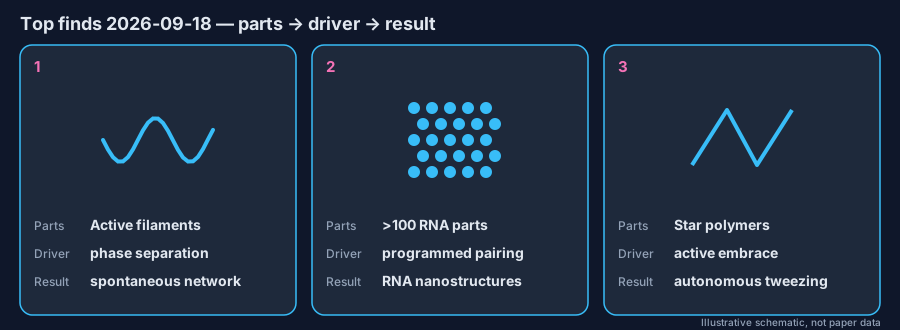
1. Spontaneous filament formation and network self-assembly via active phase separation
- Authors: Elena Lucas, Varun Venkatesh, Amin Doostmohammadi
- Submitted: 2026-09-17
- Link: https://arxiv.org/abs/2609.19800
- Why newsworthy: Active Model H⁻ (overdamped active phase separation) forms filamentous networks with arrested coarsening. Isolated filaments bend, curve-driven self-propulsion makes them collide, and they assemble into a percolating web that breaks and reforms under noise while still obeying Lewis’s law at large scales.
- Beginner hook: Activity alone — no sticky chemistry recipe — can build a living filament network that keeps remodeling.
- Caveat: Continuum theory / simulation; not a classroom wet lab.
2. Programmable Self-Assembly of RNA Nanostructures with >100 Unique Components
- Authors: Liangxiao Chen, Zhishang Li, Jun Yan, Swarup Dey, Cong Li, et al. (incl. Hao Yan, Peng Yin, Di Liu)
- Posted: 2026-09-03 (bioRxiv)
- Links: https://www.biorxiv.org/content/10.64898/2026.09.02.748990v1 · https://doi.org/10.64898/2026.09.02.748990 · dsRNA-brick GitHub
- Why newsworthy: dsRNA bricks — many distinct RNA components encoded in one precursor transcript, released enzymatically, stabilized as double-stranded pieces, and joined by branched kissing loops into complex 2D/3D architectures with >100 unique components (DNA-brick-scale ambition for RNA).
- Beginner hook: RNA LEGO at scale: cut many addressable bricks from one long transcript so cost and ssRNA fragility hurt less.
- Caveat: Research wet lab; not beginner chemistry.
3. Active embracement enables autonomous tweezing in active star polymers
- Authors: Marco Musacchio, Davide Breoni, Iman Abdoli, Luca Tubiana, Hartmut Löwen, Lorenzo Caprini
- Submitted: 2026-08-30
- Link: https://arxiv.org/abs/2608.29728
- Why newsworthy: Active star polymers (core + self-propelled arms) collapse into “hugging” states, mutually intertwine, and capture passive particles — vibrobot experiments plus simulations show activity overrides passive steric repulsion.
- Beginner hook: Vibrating robot stars that hug and tweeze cargo — activity as a design knob, not just glue.
- Caveat: Macroscopic robot demo / soft-matter sim; supervise toy motors.
4. Flexible-body modeling of overconstrained spatial linkages
- Authors: Daniel Huczala, Michael Pieber, Johannes Gerstmayr, Andreas Mair, Frederik Schulte, et al.
- Submitted: 2026-09-15
- Link: https://arxiv.org/abs/2609.17627
- Why newsworthy: Flexible multibody models of Bennett-style overconstrained linkages; PLA prototypes with intentional axis misalignment still assemble because compliance drives parts toward ideal geometry. Cardboard-tube and bamboo-stick demos show low-cost materials work with limited accuracy.
- Beginner hook: Soft joints forgive manufacturing error — flex can help a “too constrained” machine snap into a working loop.
Stretch (media / older journal date)
- #-CAD crisscross DNA megastructures — Aquilina, Katzmeier, Shih et al., Nature Communications (2026-07-17); phys.org feature 2026-09-16 — https://doi.org/10.1038/s41467-026-75175-6 · https://phys.org/news/2026-09-big-dna-software.html · https://github.com/mattaq31/Hash-CAD
Safe classroom / discussion follow-ons
- Compliance helps assembly: Cardboard tubes or rolled paper with soft tape/elastic joints — build a slightly “wrong” skewed four-bar and ask whether flex still lets it move as one loop (inspired by arXiv:2609.17627). Scissors/tape only.
- Active hug mini-demo or discussion: If vibrobots/bristlebots exist, loosely tether 3–4 to a hub and compare motors on vs off; otherwise discuss why pushing arms could collapse a star when passive arms stay open (arXiv:2608.29728). Supervise batteries; no hazardous chemistry.
Teaching note
Pair with 2026-09-17, 2026-09-16, 2026-09-15, the Papers page, and Learn. Newest ≠ most important for beginners.
Last updated on