Chapter 2 — Local rules, energy, and order from disorder
Order does not require a boss. It can come from many weak, local interactions plus an environment that lets parts explore.
The three knobs engineers turn
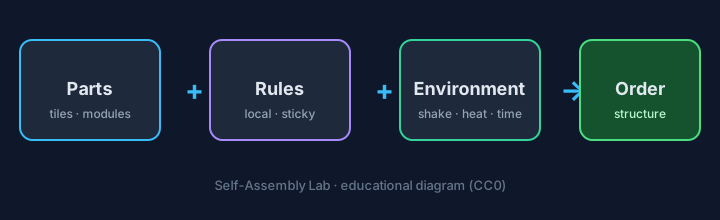
- Parts — shapes, patches, magnet faces, DNA sticky ends, robot bodies.
- Rules — who sticks to whom; which messages neighbors exchange.
- Environment — temperature schedule, shaking, liquid surface, power, time.
Change any knob and the final pattern can change.
Local rules beat global blueprints (usually)
In many self-assembling systems:
- Each part only “knows” its neighbors.
- Nobody draws a full map from the outside every second.
- Global shape is an emergent result of local behavior.
That is why Kilobots can form a star with only short-range IR communication — and why DNA tiles grow crystals from sticky-end matching.
Glossary — local rule. A behavior or binding preference that depends only on nearby information (a neighbor robot, a complementary DNA sequence), not on a complete global map.
Energy: why shaking helps (sometimes)
Parts need a way to try arrangements:
| Energy / motion source | Example | Role |
|---|---|---|
| Thermal jiggling | Molecules in warm water | Explore bindings; anneal DNA origami |
| Gentle agitation | Shaking a tray of magnetic tiles | Break wrong contacts; find better ones |
| Active robots | Vibration motors on Kilobots | Move until a local rule says “stop” |
| Continuous power | Living cells, some soft-matter systems | Dynamic / dissipative order |
Too little motion → stuck in junk piles (kinetic traps).
Too much motion → nothing stays stuck.
Glossary — kinetic trap. The system gets stuck in a wrong or incomplete structure because pathways and timing matter — not only the “best” final energy.
Order from disorder — concrete pictures
Crystals. Randomly moving molecules settle into a lattice when cooling allows stable bonds.
Capillary floatiles. Random floating pieces drift into clusters because deformed liquid surfaces create attraction (Cheerios effect). Classroom kits: UCSD MRSEC , FloaTiles .
Algorithmic tiles. DNA tiles can encode local matching rules that grow patterned crystals (theory + AFM demos). See Doty’s survey PDF: algorithmic tiles .
Watch: robots that only push/pull locally
Particle robots show collective motion from loosely coupled units — another “local physics → global behavior” story.
Source: Columbia Engineering — Particle Robotics (companion to Nature 2019 particle robotics work).
Try this (paperclip “sticky ends”)
- Color-code paperclips or craft magnets as “A / A′ / B / B′”.
- Rule: A only sticks to A′; B only to B′.
- Mix on a tray; shake gently 30 seconds.
- Count correct vs wrong attachments.
This is the intuition behind DNA sticky ends — without a wet lab.
Honesty checkpoint
Local rules scale beautifully in demos and fail messily in products when defects, energy cost, or manufacturing yield get in the way. That is why we keep the frontier framing on every page.