Chapter 4 — Robot swarms & modular robots you can see
If DNA is hard to see, robots make self-assembly visible. Same big idea: local rules + many units → global shape or motion.
Two families
| Family | What it is | Famous example |
|---|---|---|
| Swarm robots | Many simple mobile robots | Kilobots (~1,024 forming shapes) |
| Modular / reconfigurable robots | Dockable modules that change shape | M-Blocks, SMORES, Claytronics vision |
Programmable matter sits in the vision column: ensembles of tiny modules that reshape on demand. Hardware today is still research-scale.
Kilobots — swarm self-assembly you can watch
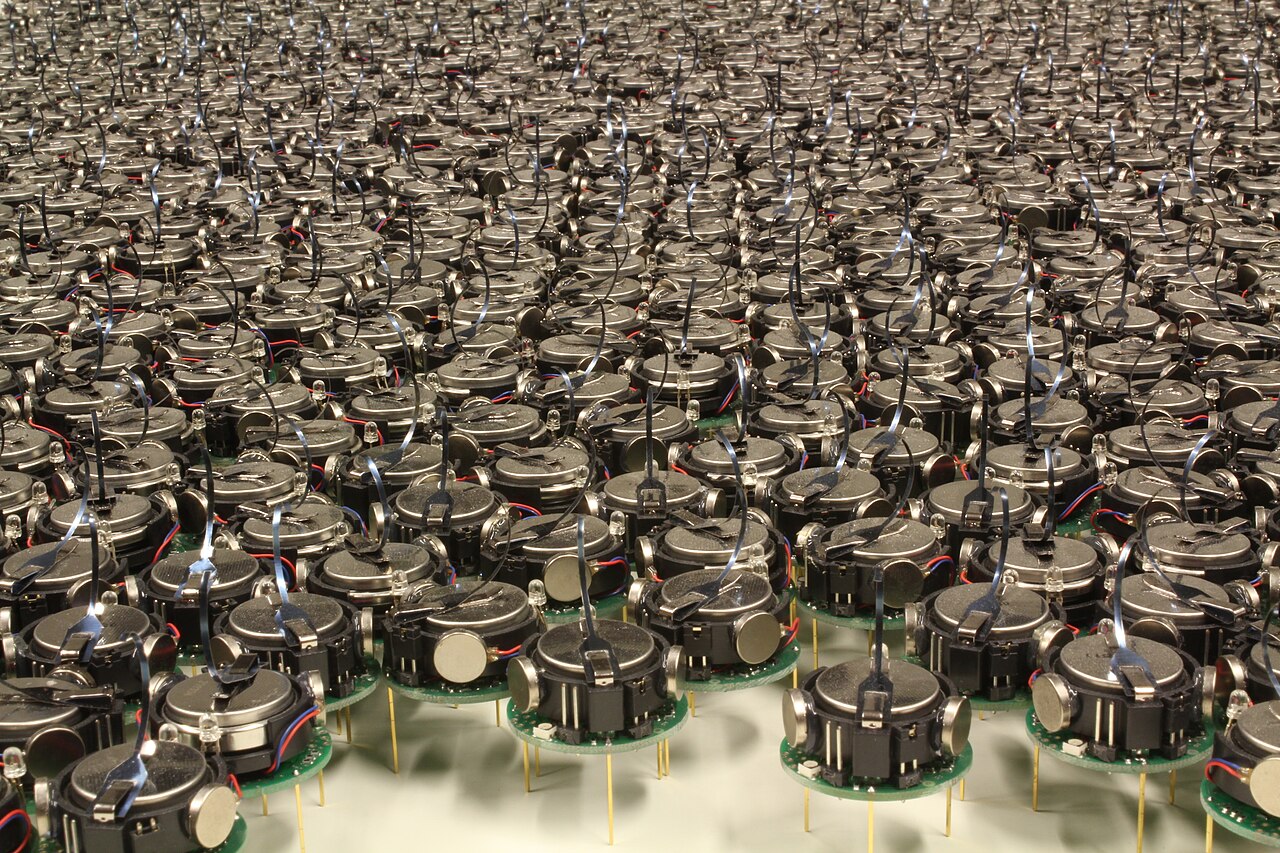
Each Kilobot is deliberately simple: vibration locomotion, local IR sensing/communication, cheap parts. The science is in the collective algorithm.
Source: Introduction to Kilobot .
Then watch the thousand-robot demo again with new eyes — seeds, edge-following, local distance:
Plain-language writeup: Harvard SEAS news . Lab context: ssr.seas.harvard.edu/kilobots .
Glossary — seed. A starting robot (or molecular seed structure) that defines an origin or kickstarts growth. In the Kilobot shape demo, a few robots mark the coordinate origin.
Modular cubes that climb each other
MIT CSAIL M-Blocks use an internal flywheel + magnets — no external arms — to pivot and climb.
Source: MIT — Small cubes that self-assemble . Background: MIT News 2019 .
Other lineages to skim (open project pages, not product stores):
- SMORES-EP (UPenn ModLab) — electro-permanent magnet connectors
- CMU Claytronics — classic programmable-matter vision + papers
- Survey: Seo, Paik & Yim 2019 modular reconfigurable robotics (DOI )
What beginners can actually build
You probably will not fab a thousand Kilobots this month. Realistic starter paths:
- Simulate swarms (NetLogo, Python) — Experiment 5 on Experiments.
- Few-unit modular toys — 3D-printed blocks + magnets (see Manufacturing).
- Open educational platforms — look for university swarm courses, K-Team/Kilobot academic kits when available, or DIY vibration-robot tutorials at makerspaces.
- Microcontrollers — Arduino / ESP32 for neighbor messaging prototypes (UART/IR/radio).
Try this (human swarm)
- Give 6 friends one rule: “Stay an arm’s length from the nearest two people; slowly form a circle.”
- No leader talking.
- Time how long it takes; then change the rule to “form a line.”
- Discuss: which failures look like robot defects?
Honesty checkpoint
Swarm demos are thrilling. Scaling to useful outdoor work, strong structures, or consumer products still hits energy, reliability, and manufacturing walls. Treat viral videos as existence proofs, not shipping dates.