Digest — 2026-09-29
Curated America/New_York (ET). Prefer arXiv / open sources. Verified via arXiv Atom API and cond-mat.soft / active-matter keyword listings.
Focus: roughly since the 2026-09-28 digest (Mon→Tue). Prior items are not re-listed as “new today.”
Frame these as frontier progress, not finished technology. Applications remain mostly lab-scale.
At a glance
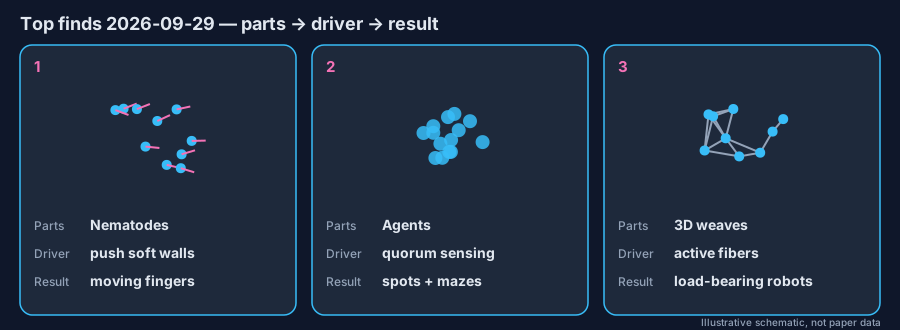
Diagram: original illustration of this digest’s key idea (not from the papers).
Highlights
1. Active matter within flexible boundaries: T. aceti nematodes
- Authors: Christina M. Ceballos, Matthew S. Mizuhara, Mykhailo Potomkin, Anton Peshkov
- Submitted: 2026-09-26
- Link: https://arxiv.org/abs/2609.32945
- Why newsworthy: Synchronized vinegar-eel nematodes push a pliable liquid–liquid–gas border into periodic deformations and a new multi-protrusion state (oscillate, rotate, merge, split). Model + analytics for active matter at flexible interfaces.
- Beginner hook: Crowds of tiny wigglers can push a soft wall into moving “fingers.”
- Caveat: Soft-matter / biophysics experiment (not a classroom culture).
2. Quorum sensing with density-enhanced motility and size regulation
- Authors: Itay Azizi
- Submitted: 2026-09-28
- Link: https://arxiv.org/abs/2609.35085
- Why newsworthy: Agents that enlarge and speed up when local density exceeds global density form spots, holes, bands, and labyrinths; pattern length scale set mainly by the sensing radius.
- Beginner hook: Get bigger and faster when crowded, and the crowd can draw spots and mazes.
- Caveat: Simulation / theory.
3. Active 3D weaves for load-bearing and damage-resilient locomotion
- Authors: Guowei Wayne Tu, Evgueni T. Filipov
- Submitted: 2026-09-26
- Link: https://arxiv.org/abs/2609.32099
- Why newsworthy: Modular 3D woven shells combine axial load-bearing stiffness, bending compliance for actuation, and crush resilience. Five robots; carry ~70× self-weight and keep working after extreme compression.
- Beginner hook: Basket-weave logic can make a robot shell bendy for walking and stiff for hauling.
- Caveat: Soft-robotics / materials experiment (lab-scale).
4. Cell division sets a universal flow geometry in cell layers
- Authors: Tianxiang Ma, Lasse Bonn, Valeriia Grudtsyna, Nigar Abbasova, Martin Cramer Pedersen, Nuno A. M. Araujo, Amin Doostmohammadi
- Submitted: 2026-09-28
- Link: https://arxiv.org/abs/2609.34631
- Why newsworthy: Epithelial vortical-interface flow geometry (percolation / conformal hallmarks) is controlled by cell division via geometric and mechanical flexibility of the cell–cell network.
- Beginner hook: Who divides can decide whether a living sheet keeps its special swirl geometry.
- Caveat: Soft-matter / biophysics experiment.
5. Domain growth in lipid membranes and the budding instability
- Authors: Jean Wolff, Fabrice Thalmann, Carlos Marques, David Andelman, Haim Diamant, Shigeyuki Komura
- Submitted: 2026-09-26
- Link: https://arxiv.org/abs/2609.32951
- Why newsworthy: Conserved TDGL domain growth crosses (D\sim t^0.3333333333333333) to (D\sim t^0.5) before finite-size saturation; time-dependent line tension and budding criteria analyzed.
- Beginner hook: A lipid patch grows with clock-like rules and may want to pinch into a bud.
- Caveat: Theory / numerics.
6. Odd stochastic density functional theory
- Authors: Yael Avni, Michel Fruchart, David Martin, Tali Khain, Vincenzo Vitelli
- Submitted: 2026-09-25
- Link: https://arxiv.org/abs/2609.32080
- Why newsworthy: Extends SDFT to a chiral overdamped limit relevant to magnetized electrolytes and chiral active matter (“odd SDFT”). Late Fri submission missed by the Mon digest.
- Beginner hook: A density-field language for active fluids with a built-in twist.
- Caveat: Theory.
Stretch
- Charge-regulated nanoparticle interactions (2026-09-27): https://arxiv.org/abs/2609.33793
- Mechanical cell clustering via ECM (2026-09-25): https://arxiv.org/abs/2609.31860
- Harmonic Theory of Behavior / Couzin (2026-09-27): https://arxiv.org/abs/2609.33896
- Fish-school positional choice (biohybrid) (2026-09-28): https://arxiv.org/abs/2609.35554
- LdG anchoring-induced tilt modes (2026-09-28): https://arxiv.org/abs/2609.35127
Safe classroom / discussion follow-ons
- Soft-wall crowd sketch: Draw a flexible dashed boundary around self-propelled arrows and annotate where synchronized pushing might make the wall bulge into fingers that merge/split (inspired by arXiv:2609.32945). Pencil/paper only — no live animals.
- Paper-strip “woven corner” model: Interlace stiff paper/cardstock strips into a small 3D corner and compare top-loading vs sideways bending (inspired by arXiv:2609.32099). Dry craft only — no motors or heat.
Corpus mirror: /workspace/self-assembly-corpus/digests/2026-09-29.md.
Last updated on