Chapter 3 — Molecular toys: DNA origami intuition (no wet lab)
DNA can be more than “the code of life.” Engineers also use it as a building material with programmable sticky patches.
The toy model (read this first)
Imagine:
- One long scaffold strand (like a long piece of string).
- Many short staple strands (like color-coded clips).
- Each staple binds two places on the scaffold and pulls the long strand into a designed shape.
That is the core idea of DNA origami (Rothemund, 2006). You do not need a lab to understand the idea.
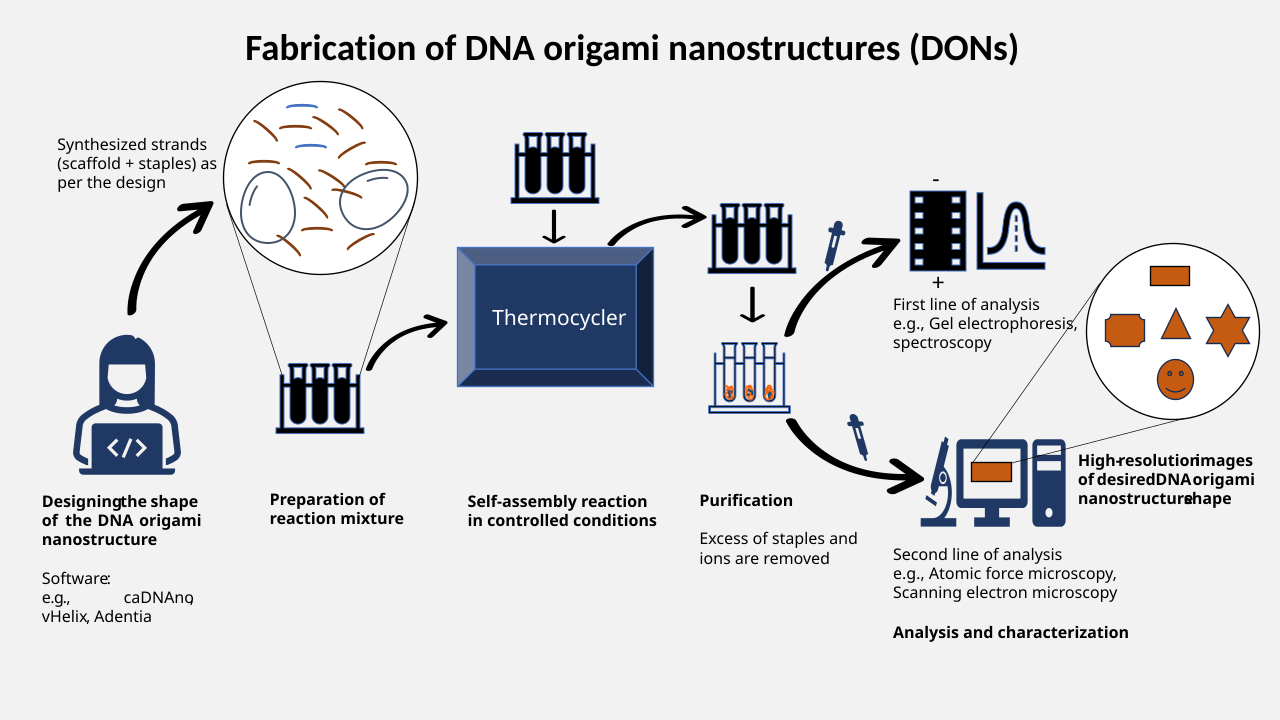
Glossary — DNA origami. A long single-stranded DNA scaffold is folded into a designed 2D/3D shape by many short complementary staple strands. Classic paper: Rothemund 2006 (author PDF ).
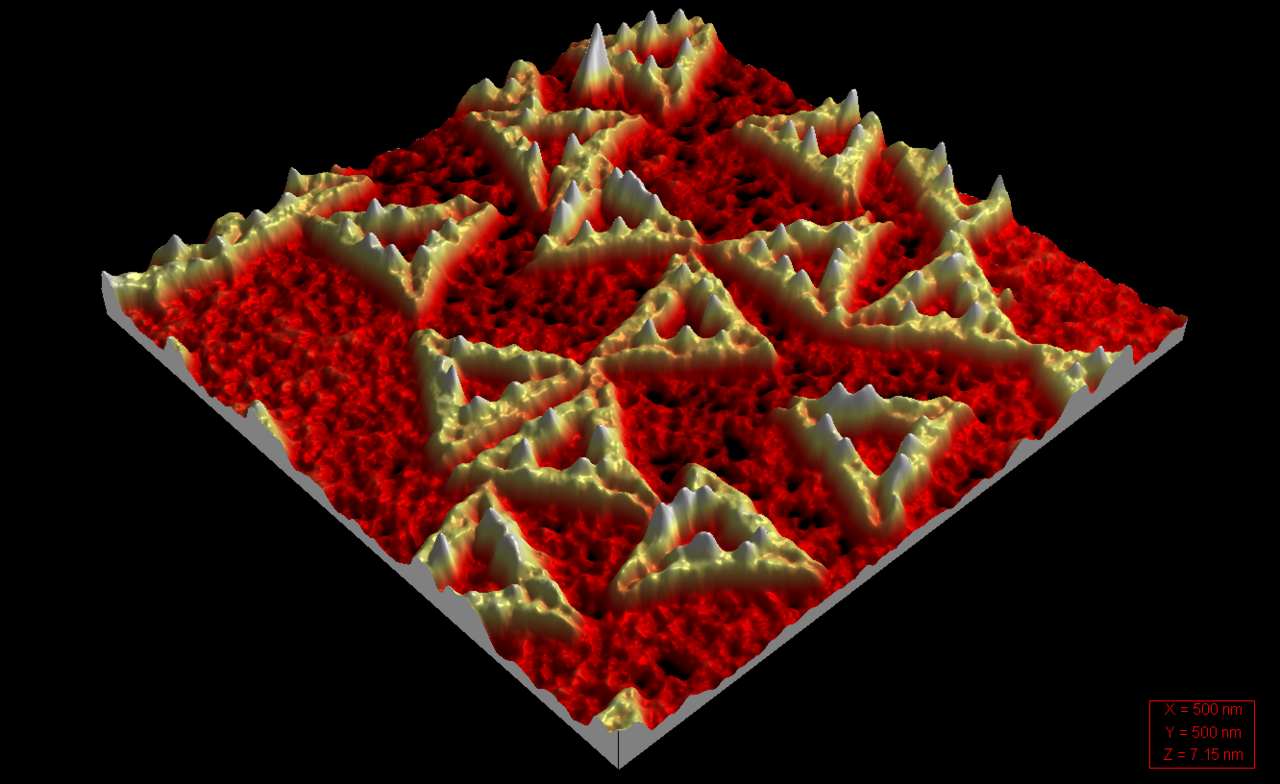
What AFM pictures look like
After folding (in a real lab), researchers image shapes with atomic force microscopy. Triangles, smileys, and snowflake-like designs are common teaching images.
Watch: a clear scientific lecture
William Shih (Harvard / Wyss) explains scaffolded origami for students and researchers. Free via iBiology.
Source: iBiology / Science Communication Lab — Shih Part 1 · hub: ibiology.org nanofabrication .
Optional deeper cut (DNA “bricks” instead of one scaffold): Shih Part 2 (noWkRxKYBhU).
Sticky ends = programmable glue
Short overhanging sequences bind complementary partners. That is how tiles and origami sheets connect into larger assemblies.
| Idea | DNA version | Everyday analogy |
|---|---|---|
| Complementary glue | A–T, C–G base pairing | Color-matched Velcro |
| Temperature control | Annealing (cool slowly) | Glue that sets as it cools |
| Errors | Misfolds, aggregates | Wrong Lego connections |
Design-only path (safe for beginners)
You can learn the workflow without ordering DNA:
- Sketch a 2D shape on graph paper.
- Pretend one long path is the scaffold.
- Mark staple routes that hold folds.
- Or explore educational tools such as cadnano (when available) or paper “origami” analogs from Experiments (design-only DNA origami task).
Real synthesis is usually bought as a service (e.g. oligo vendors like IDT) — covered in Manufacturing and Supply chain. Beginners should treat wet lab DNA work as supervised university/core-facility territory.
Try this (tabletop)
- Cut a long strip of paper (scaffold).
- Cut short colored strips (staples).
- Tape staples so the long strip folds into a triangle or smiley.
- Journal: Which staple failed? Why?
Honesty checkpoint
DNA origami is a spectacular lab capability. It is not a home DIY chemistry project. Yield, purification, imaging, and cost still limit everyday products.