Lesson 27 — AI/ML platform: GPU supply chain — weight registries, checkpoint lifecycle & cold-start hydrate economics
2026-10-05
What interviewers are really probing
Lesson 13 made weights trustworthy (signing, bucket IAM, encryption). Lesson 21 made KV cache the capacity wallet. Lesson 24 routed traffic across cells only where digests were warm. Lesson 26 priced restart waste on spot. This lesson is the logistics layer underneath all of them: how does a 140 GB–1 TB artifact get from a training run to 2,000 GPUs — fast, cheaply, and without a single unsigned byte landing in HBM?
Interviewers at AI platform shops (fuel: wafer-ai/gpu-perf-engineering-resources (opens in a new tab)) want evidence you've actually lived through a scale-up storm — not that you know docker pull exists:
- Weight registries — OCI artifacts (ORAS / modctl / CNCF ModelPack) vs bucket prefixes vs Hugging Face mirrors; Harbor/ECR/Artifact Registry with immutable tags, retention, replication to cells
- Delivery planes — Kubernetes ImageVolume (KEP-4639: beta 1.33, on by default 1.35), KServe Modelcars /
LocalModelCache, CSI (Mountpoint for S3, GCS FUSE, Hyperdisk ML ROX, FSx/Lustre), local NVMe caches - Fan-out — P2P (Dragonfly, Spegel, Kraken), preheat-before-scale, lazy loading (SOCI, eStargz, Nydus, GKE image streaming) and why lazy loading doesn't help inference weights much
- Load path into HBM — safetensors mmap vs Run:ai Model Streamer (
--load-format runai_streamer), TP-pre-sharded weights,torch.compile/CUDA-graph caches; the cold-start waterfall - Checkpoint lifecycle — sharded/async checkpoints (PyTorch DCP), commit markers, tiering NVMe → object store, retention ladders, promotion: train ckpt → consolidated serving weights → quantize → eval → sign → registry
- Economics — cold-start seconds × GPU $/s × scale events vs warm-pool idle cost; registry egress; double disk footprint; checkpoint storage that grows forever
- Security floor — digest pins, signatures verified at hydrate time, kubelet cached-image credential gap, P2P peers that verify digests,
weights_onlydeserialization, prefix-scoped write identity, Object Lock on released weights
Interview sentence: “I treat weights like images with a different physics: package them as signed OCI artifacts, replicate them to every cell's registry, preheat them P2P onto the node pool before the autoscaler needs them, mount them read-only via ImageVolume or a model cache, and stream them into HBM with a parallel loader — and I measure cold start as a waterfall so I know whether to buy bandwidth, warm pools, or nothing.”
Core diagram: Train → Checkpoint tiers → Promote → Registry → Cell replicas → Fan-out → Node cache → HBM
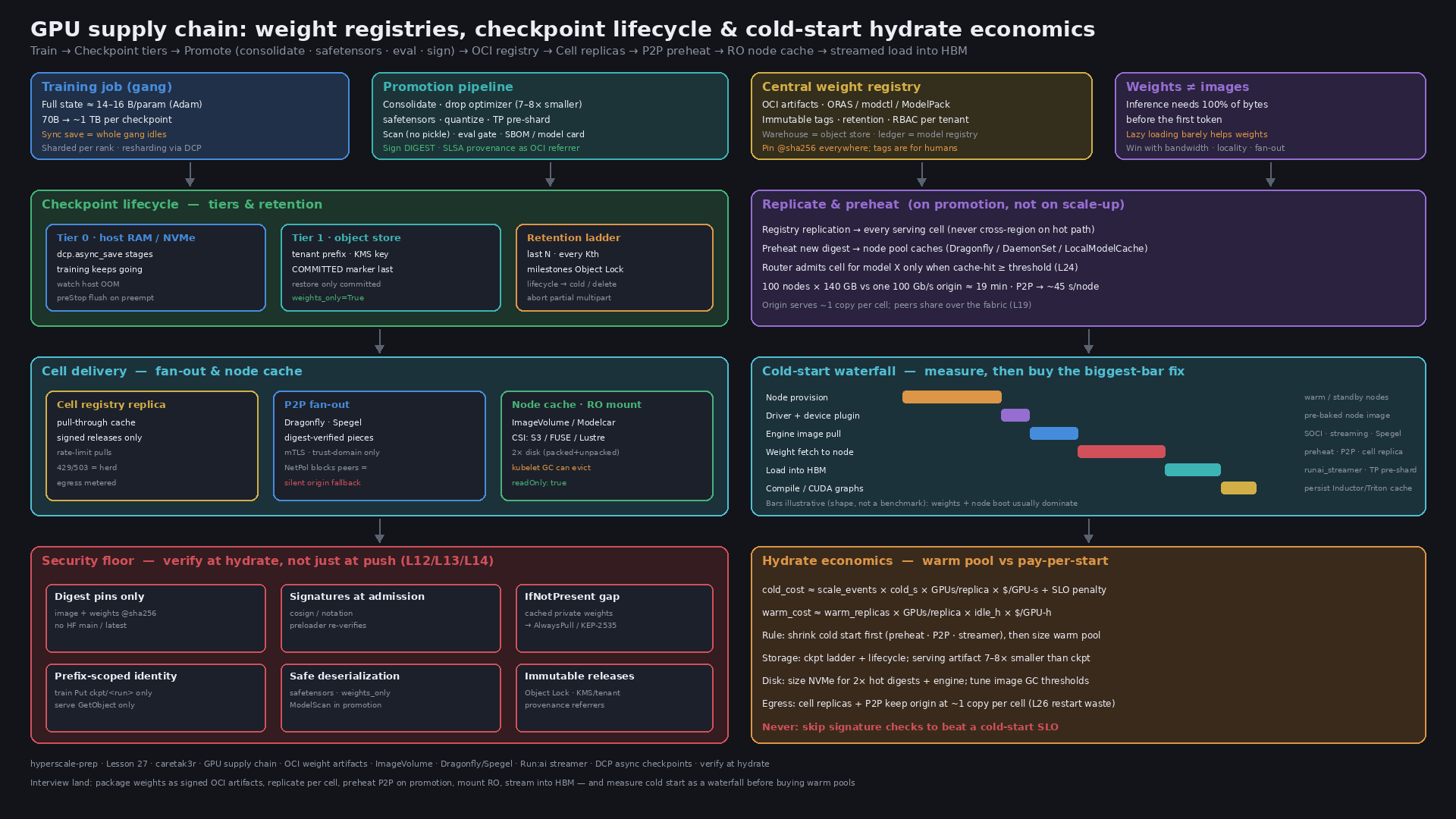
Read it top-down, then the dotted lines: a training gang writes async, sharded checkpoints to a fast tier and drains them to object storage with a commit marker; a retention ladder keeps cost bounded. A promotion pipeline turns one checkpoint into a serving artifact — optimizer state dropped, safetensors, maybe quantized and TP-pre-sharded — gated by eval and scanning, then signed and pushed as an immutable OCI artifact. The central registry replicates to each cell (L24); P2P preheats node caches before the autoscaler fires; pods mount weights read-only and stream into HBM. Security is enforced at hydrate time, not just at push time; economics decides how much of this pipeline you keep warm.
Idiosyncrasies / operator depth
1. Weights are not images (the physics are different)
| Property | Container image | Model weights |
|---|---|---|
| Size | 2–15 GB (CUDA base layers dominate) | 15 GB (8B FP16) → 140 GB (70B FP16) → 700 GB+ (400B+/MoE) |
| Access pattern | Lazy: a few % of files touched at start | All bytes, once, sequentially into HBM before first token |
| Change rate | Every deploy | Every model release / fine-tune (rarer, bigger) |
| Dedup | Shared base layers | Little cross-model dedup; LoRA adapters are the exception |
| Lazy loading wins? | Yes (SOCI / eStargz / Nydus / image streaming) | Mostly no for inference — you need 100% before serving; helps training data and adapter catalogs |
Interview rule: Lazy loading shortens time-to-container-start, not time-to-first-token. For inference weights you win with bandwidth (parallel streams), locality (preheat), and fan-out (P2P).
2. Registry choices — where the canonical bytes live
| Plane | Strengths | Traps |
|---|---|---|
| OCI registry (Harbor, ECR, Artifact Registry, ACR) via ORAS / modctl / ModelPack | Digests, immutable tags, RBAC, replication, retention, cosign/notation, P2P ecosystem, ImageVolume native | Per-layer size limits on some registries; push of 500 GB needs chunked uploads; GC is a stop-the-world chore on some backends |
| Object store prefix (S3 / GCS) | Cheapest at rest, highest aggregate throughput, Run:ai streamer/Mountpoint native | No digest semantics unless you add a manifest; "latest/" prefixes get overwritten; IAM sprawl |
| Hugging Face Hub / mirror | Ecosystem, model cards | Public egress, rate limits, mutable main revision — pin commit SHA; tokens become crown jewels (L14) |
| Model registry metadata (MLflow, W&B, Vertex Model Registry) | Lineage, stages, eval results | It's a catalog, not a CDN — never the hot path for 2,000 pods |
Common hyperscale pattern: object store is the warehouse, OCI registry is the shipping manifest, model registry is the ledger. Pin by digest everywhere; tags are for humans.
3. Delivery into the pod — five patterns
| Pattern | How | Good for | Gotcha |
|---|---|---|---|
| Baked into image | COPY model/ in Dockerfile | Tiny models, air-gapped edge | Every engine CVE patch re-ships 140 GB; double disk |
| Init container download | aws s3 cp / huggingface-cli download to emptyDir | Simple, universal | Serial, per-pod, no sharing across pods on the node; burns ephemeral storage |
| ImageVolume / Modelcar | volumes[].image.reference (K8s ≥1.33 beta; on by default 1.35) or KServe oci:// sidecar | Model and engine versioned separately; shared per node; registry tooling | Runtime support (CRI-O ≥1.31, containerd 2.1+); kubelet image GC can evict it; IfNotPresent credential gap (see Security) |
| CSI mount of object store / parallel FS | Mountpoint for S3, GCS FUSE (file cache + parallel download), Hyperdisk ML (ROX, many attachers), FSx/Lustre | Huge models, many replicas, no per-node copy | Default stripe count 1 on Lustre = one OST bottleneck; FUSE page-cache thrash; mmap random reads over network |
| Node-local model cache | KServe LocalModelCache, DaemonSet preloader, Dragonfly preheat to NVMe | Predictable cold start, scale-to-one | Cache coherence = digest naming; disk sizing; who evicts? |
4. The cold-start waterfall (measure it, or you'll buy the wrong fix)
| Stage | Typical range (order-of-magnitude) | Fix lever |
|---|---|---|
| Node provision (cloud VM + boot) | 2–10 min for GPU SKUs | Warm/standby nodes, capacity reservations (L26) |
| Driver / device plugin / DCGM ready | 30–120 s | Pre-baked node images with driver; GPU Operator readiness gates (L18) |
| Engine image pull (8–15 GB) | 30 s – several min | SOCI parallel pull, image streaming, Spegel, pre-pulled on AMI |
| Weight fetch to node | bytes ÷ effective bandwidth | P2P, preheat, cell-local replica, CSI parallel reads |
| Load into HBM | seconds → minutes | Run:ai streamer concurrency, TP-pre-sharded files, safetensors (not pickle) |
| Compile / CUDA graphs / warmup | 10–60 s+ | Persist torch.compile/Inductor + Triton caches; warmup requests before Ready |
Bandwidth arithmetic interviewers love (plain math, not a benchmark):
- 70B FP16 ≈ 140 GB. At 25 Gb/s effective per node ≈ 3.1 GB/s → ~45 s best case for one node.
- 100 nodes scale at once against one registry/bucket front with 100 Gb/s egress (12.5 GB/s): 14 TB ÷ 12.5 GB/s ≈ ~19 minutes — the origin is the bottleneck.
- With P2P, origin serves ≈ one copy per cell; nodes serve each other over the 200–400 Gb/s fabric → back toward the single-node number.
5. Cold-start economics — warm pool vs pay-per-start
cold_start_cost ≈ scale_events × cold_start_seconds × GPUs_per_replica × gpu_$_per_second + SLO_penalty(queue during cold start)
warm_pool_cost ≈ warm_replicas × GPUs_per_replica × idle_hours × gpu_$_per_hour
Illustrative example only (made-up round numbers): at a notional $4/GPU-h, an 8-GPU replica with a 10-minute cold start burns ≈ $5.33 per scale-up in GPUs that are allocated but not serving. Ten scale-ups a day ≈ $53/day — cheaper than one idle warm replica (8 × 24 × $4 ≈ $768/day). But if those 10 minutes blow your TTFT SLO for a paying tenant (L21), the penalty term dominates and one warm replica (or a hot node cache + standby node) wins. The point: shrink the cold start first (cheap: preheat, P2P, streamer), then decide the warm-pool size.
6. Checkpoint lifecycle — the forgotten storage bill
| Fact | Why it matters |
|---|---|
| Full training state ≈ 14–16 bytes/param with mixed-precision Adam (bf16 weights + fp32 master + 2 moments) | 70B → ~1 TB per checkpoint; checkpoint every 30 min × weeks = petabytes |
| Serving weights ≈ 2 bytes/param (bf16), 1 or less quantized | Promotion should drop optimizer state — 7–8× smaller artifact |
| Sync save stalls the gang | Every GPU idles during write → use async save (PyTorch DCP async_save) staged to host RAM/NVMe |
| Sharded (one file per rank) | Parallel write, but restore to a different world size needs resharding (DCP handles; hand-rolled formats don't) |
| Commit marker | Readers must only trust checkpoints with a completed metadata/COMMITTED object — partial checkpoints after preemption are the #1 corrupt-restore cause |
| Retention ladder | Keep last N (restart), every Kth (rollback), milestones (Object Lock); lifecycle the rest to cold storage or delete |
7. Cell replication & preheat (ties L24)
- Replicate released artifacts to every serving cell's registry (Harbor replication / ECR cross-region replication / Artifact Registry remote repos). Never cross-region pull on the hot path.
- Preheat on promotion, not on scale-up: when a new digest is promoted, push it to the target node pool's caches (Dragonfly preheat, DaemonSet pre-puller,
LocalModelCache). Then flip traffic. - Router admits a cell for model X only when cache-hit ratio for digest X ≥ threshold (L24).
8. Classic gotchas (say these out loud)
latest/ HFmainas a reference → half the fleet on one weight set, half on another, mismatched tokenizer.- containerd stores compressed and unpacked layers; a 140 GB model image can cost ~280 GB of disk →
DiskPressureevictions. - Kubelet image GC (
imageGCHighThresholdPercent) silently evicts the model image on a busy node → next pod pays full cold start. - Lustre default stripe count 1 → a 500 GB load serialized through one storage target.
torch.compilecache in/tmpof the pod → paid again on every restart.- Preemption mid-save → no commit marker → restore from the previous good checkpoint, not the partial one.
- P2P daemon enabled but peers can't reach each other (NetworkPolicy / security groups) → every node falls back to origin, silently.
Concrete commands & config
Package & push weights as a signed OCI artifact
# ORAS: weights as an OCI artifact (no runnable config)
oras push registry.internal/models/llama-70b-instruct:2026-10-05 \
  --artifact-type application/vnd.cncf.model.manifest.v1+json \
  model-00001-of-00030.safetensors model-00002-of-00030.safetensors \
  config.json tokenizer.json

# modctl (CNCF ModelPack tooling) — Modelfile like a Dockerfile (sketch)
modctl modelfile generate .
modctl build -t registry.internal/models/llama-70b-instruct:2026-10-05 -f Modelfile .
modctl push registry.internal/models/llama-70b-instruct:2026-10-05

# Resolve the digest and sign the DIGEST, never the tag
DIGEST=$(oras resolve registry.internal/models/llama-70b-instruct:2026-10-05)
cosign sign --key kms://projects/p/locations/l/keyRings/r/cryptoKeys/model-signer \
  registry.internal/models/llama-70b-instruct@${DIGEST}
cosign verify --key kms://... registry.internal/models/llama-70b-instruct@${DIGEST}
ImageVolume — engine image and weights as separate artifacts
apiVersion: v1
kind: Pod
metadata:
  name: vllm-llama70b
  labels: { tenant: t1, model: llama-70b, purchase-option: reserved }
spec:
  runtimeClassName: nvidia
  containers:
  - name: vllm
    image: registry.internal/engines/vllm@sha256:ENGINE_DIGEST
    args: ["--model", "/models", "--tensor-parallel-size", "8"]
    volumeMounts:
    - name: weights
      mountPath: /models
      readOnly: true
    resources:
      limits: { nvidia.com/gpu: 8 }
  volumes:
  - name: weights
    image:
      reference: registry.internal/models/llama-70b-instruct@sha256:WEIGHT_DIGEST
      pullPolicy: IfNotPresent   # see Security: pair with credential verification
KServe — Modelcar (oci://) and node-local cache
apiVersion: serving.kserve.io/v1beta1
kind: InferenceService
metadata:
  name: llama-70b
spec:
  predictor:
    model:
      modelFormat: { name: huggingface }
      storageUri: oci://registry.internal/models/llama-70b-instruct@sha256:WEIGHT_DIGEST
---
apiVersion: serving.kserve.io/v1alpha1
kind: LocalModelCache          # preload onto node-group NVMe before scale-up
metadata:
  name: llama-70b-cache
spec:
  sourceModelUri: s3://models-released/llama-70b-instruct/WEIGHT_DIGEST/
  modelSize: 150Gi
  nodeGroups: ["h100-serving-cell-a"]
Streamed load into HBM (vLLM + Run:ai Model Streamer)
vllm serve s3://models-released/llama-70b-instruct/WEIGHT_DIGEST/ \
  --load-format runai_streamer \
  --tensor-parallel-size 8
# env tuning — raise until storage saturates, back off on host-RAM pressure
export RUNAI_STREAMER_CONCURRENCY=16
# persist compile caches on a node-local volume so restarts skip recompile
export TORCHINDUCTOR_CACHE_DIR=/var/cache/inductor
export TRITON_CACHE_DIR=/var/cache/triton
Fan-out — Spegel (local OCI mirror) and Dragonfly preheat
# Spegel: every node serves its containerd content store to peers
helm upgrade --install spegel oci://ghcr.io/spegel-org/helm-charts/spegel \
  -n spegel --create-namespace

# Dragonfly preheat on promotion (sketch — via manager API or Harbor P2P provider)
curl -s -X POST https://dragonfly-manager.internal/api/v1/jobs \
  -H 'Content-Type: application/json' \
  -d '{"type":"preheat","args":{"type":"image","url":"https://registry.internal/v2/models/llama-70b-instruct/manifests/sha256:WEIGHT_DIGEST","scope":"all_peers"}}'
Parallel filesystem layout (Lustre) — born wide
lfs setstripe -c -1 -S 4M /lustre/models/llama-70b-instruct   # before download
lfs getstripe /lustre/models/llama-70b-instruct/model-00001-of-00030.safetensors
lfs migrate -c -1 -S 4M /lustre/models/old-model/*.safetensors  # restripe in place
Kubelet — keep model images from being GC'd mid-day
# KubeletConfiguration (node pool for serving)
imageGCHighThresholdPercent: 90
imageGCLowThresholdPercent: 80
imageMinimumGCAge: 24h
# size NVMe for: engine image x2 (compressed + unpacked) + hottest N model digests x2 + headroom
Async, sharded checkpoints with a commit marker (PyTorch DCP)
import torch.distributed.checkpoint as dcp

state = {"model": model.state_dict(), "optim": optimizer.state_dict(), "step": step}
ckpt_dir = f"s3://ckpt-t1/run-{run_id}/step-{step:08d}"   # tenant-scoped prefix
fut = dcp.async_save(state, checkpoint_id=ckpt_dir)       # stage to host, write in background
# ... training continues ...
fut.result()                                             # before the next save / before exit
if rank == 0:
    write_marker(f"{ckpt_dir}/COMMITTED")                # restore logic trusts ONLY committed dirs
Retention ladder as lifecycle policy (S3 sketch)
{
  "Rules": [
    { "ID": "expire-intermediate-ckpts", "Status": "Enabled",
      "Filter": { "Tag": { "Key": "ckpt-class", "Value": "intermediate" } },
      "Expiration": { "Days": 7 } },
    { "ID": "rollback-ckpts-to-cold", "Status": "Enabled",
      "Filter": { "Tag": { "Key": "ckpt-class", "Value": "rollback" } },
      "Transitions": [ { "Days": 14, "StorageClass": "GLACIER_IR" } ] },
    { "ID": "abort-partial-uploads", "Status": "Enabled",
      "Filter": {}, "AbortIncompleteMultipartUpload": { "DaysAfterInitiation": 2 } }
  ]
}
Measure the waterfall
# where did the time go for one pod?
kubectl get events -n serve --field-selector involvedObject.name=vllm-llama70b-abc12 \
  --sort-by=.lastTimestamp
kubectl describe node gpu-a-017 | grep -A5 -i 'conditions\|diskpressure'
crictl images | grep models/       # is the weight artifact already on this node?
crictl imagefsinfo                 # disk headroom
# Pod created -> Ready, per model, p95 — custom recording rule built from pod status timestamps
# (kube-state-metrics kube_pod_created + kube_pod_status_ready_time), exported as a histogram
histogram_quantile(0.95, sum by (le, model) (rate(serve:pod_cold_start_seconds_bucket{namespace="serve"}[1h])))
# Weight cache hit ratio per cell (custom exporter from preloader / Dragonfly)
sum by (cell) (rate(model_cache_hits_total[15m])) / sum by (cell) (rate(model_cache_requests_total[15m]))
# Origin egress during scale-up (registry / bucket front)
sum(rate(registry_http_response_size_bytes_sum{repo=~"models/.*"}[5m]))Failures & fixes
| Symptom | Likely cause | Fix / mitigation |
|---|---|---|
| Scale-up takes 20+ min, registry returns 429/503 | Thundering herd on origin; no P2P | P2P fan-out (Dragonfly/Spegel); cell-local replica; preheat on promotion; rate-limit concurrent pulls |
Node DiskPressure → evictions after new model rollout | Compressed + unpacked double-store; old digests never GC'd | Size NVMe for 2× hot set; registry + node retention; dedicated imagefs |
| Random pods cold-start slowly on "warm" nodes | Kubelet image GC evicted the model artifact | Tune GC thresholds; pin via preloader; cache-hit metric per node |
| Weight load 10× slower than storage spec | Single-stream loader; Lustre stripe count 1; FUSE without parallel download | runai_streamer + concurrency; lfs setstripe -c -1; GCS FUSE parallel download / file cache |
| Every restart pays +50 s before Ready | torch.compile / Triton cache in pod /tmp | Persist caches on node-local volume keyed by engine+model digest |
| Half the fleet answers differently | Mutable tag / HF main revision | Digest pin in manifests; admission rejects tag-only references |
| P2P installed, origin egress unchanged | Peers blocked by NetworkPolicy / SGs; daemon not in mirror config | Allow peer ports node-to-node; verify containerd hosts.toml; alert on P2P hit ratio |
| Restore crashes / NaNs after preemption | Partial checkpoint with no commit marker | Restore only COMMITTED dirs; async save + wait before exit; preStop hook to flush |
| Training throughput drops 15–30% around saves | Synchronous checkpointing stalls gang | dcp.async_save; stage to host RAM/NVMe; stagger ranks |
| Host OOM during async save | Staging full state to RAM on a node already tight | Stage to NVMe; reduce save frequency; pin memory budget |
| Checkpoint bucket bill doubles monthly | No retention ladder; incomplete multipart uploads | Lifecycle rules by ckpt-class; abort incomplete MPU; promote-then-delete |
| Can't restore on a different GPU count | Hand-rolled per-rank format | DCP resharding; or consolidate on promotion |
ImageVolume pod stuck ContainerCreating | Feature gate off / runtime too old / artifact media type unsupported | K8s ≥1.33 with gate (default on 1.35); CRI-O ≥1.31 or containerd 2.1+; check runtime logs |
| New cell routed traffic but TTFT terrible for 10 min | Router admitted cell before weights were warm | Gate cell admission on digest cache-hit ratio (L24) |
Security & hardening
The supply chain is the attack surface. Every hop in the diagram — checkpoint bucket, promotion pipeline, registry, replica, P2P peer, node cache, loader — is a place where someone can swap bytes, read bytes they shouldn't, or skip a check "just this once" to beat a cold-start SLO. L12 and L13 defined the controls; this lesson enforces them at every hop, especially at hydrate time.
| Control | Why | Practice |
|---|---|---|
| Digest-pinned references only | Tags and HF main are mutable | Admission (VAP/Kyverno) rejects image.reference / storageUri without @sha256:; HF pulls pinned to commit SHA |
| Verify signatures at hydrate, not just at push | Replicas, caches, and P2P peers are new trust boundaries | Cosign/notation verify in admission (policy-controller / Kyverno verifyImages covers ImageVolume refs too); preloader re-verifies digest before marking cache ready |
| Kubelet cached-image credential gap | With IfNotPresent, a pod without pull credentials can use a private weight artifact another tenant's pod already pulled to that node | Dedicated node pools per trust domain (L25); AlwaysPullImages admission for shared pools; kubelet KubeletEnsureSecretPulledImages (KEP-2535) where available |
| P2P peers verify content | A compromised node could serve poisoned pieces | Content-addressed transfer with digest check on assembly; mTLS between Dragonfly peers; P2P only inside a trust domain; NetPol limits peer ports to the node CIDR |
| Read-only mounts, no shared writable cache | Writable /models = persistence + tamper | readOnly: true; ImageVolume is RO by design; preloader writes, pods only read |
| Safe deserialization | Pickle checkpoints execute code on load | safetensors for serving; torch.load(weights_only=True) for training restore; scan with ModelScan/picklescan in promotion |
| Prefix-scoped identities | Train SAs with broad PutObject can overwrite released weights | Train WI: Put only ckpt-<tenant>/run-*; promotion SA: Put only models-staging/; release bucket write = signer pipeline only; serving WI: GetObject only on released digests |
| Immutable released artifacts | Rollback must be trustworthy; ransomware/delete | Registry immutable tags; S3 Object Lock / GCS bucket lock on models-released; versioning + MFA delete on checkpoint milestones |
| Encryption with key separation | Checkpoints = full IP incl. optimizer state | SSE-KMS/CMEK per tenant; decrypt grant only to that tenant's train/serve identities |
| Provenance links | "Which data and code produced this?" during an incident | SLSA provenance: run ID, code commit, data snapshot digest, base model digest → attached as OCI referrer |
| Registry hygiene | Retention without signing = deleted evidence; replication without RBAC = leak | Harbor project RBAC per tenant; retention keeps signed releases; replication only for released repos |
| Preheat jobs are privileged paths | Preheat credentials can read every model | Separate preheat identity per tenant scope; audit preheat requests |
AI/ML weight, model & deployment hardening across the supply chain (required)
| Stage | Weight / model / deploy controls |
|---|---|
| Checkpoint write | Tenant-prefixed bucket; KMS per tenant; train SA Put only to its run prefix; commit marker written last; no public ACLs |
| Checkpoint restore | Only COMMITTED dirs; weights_only=True; verify manifest hashes before resume |
| Promotion | Drop optimizer state; convert to safetensors; scan; eval gate; SBOM/model card; sign digest with KMS-backed key; attach provenance |
| Registry | Immutable tags; per-tenant project RBAC; replication only of signed releases; Object Lock/immutability on released |
| Fan-out & cache | P2P inside trust domain with digest verification; node pools per trust domain; preloader re-verifies; RO mounts |
| Pod admission | @sha256: required for engine and weights; signature verified; RuntimeClass; PSS restricted; NetPol default-deny (egress only to registry/bucket endpoints) (L14) |
| Incident: suspected tampered weights | Freeze promotion; revoke serving WI on that digest; purge node caches by digest; re-hydrate from Object-Locked release; rotate signing key if signer compromised |
# Kyverno sketch: weights must be digest-pinned and signed, mounts RO
apiVersion: kyverno.io/v1
kind: ClusterPolicy
metadata:
  name: model-weights-supply-chain
spec:
  validationFailureAction: Enforce
  rules:
  - name: imagevolume-digest-pinned
    match:
      any:
      - resources: { kinds: [Pod], namespaceSelector: { matchLabels: { trust-domain: gpu-tenant } } }
    validate:
      message: "Weight ImageVolumes must be digest-pinned (@sha256:)."
      foreach:
      - list: "request.object.spec.volumes[?image]"
        deny:
          conditions:
            any:
            - key: "{{ element.image.reference }}"
              operator: NotEquals
              value: "*@sha256:*"
  - name: verify-weight-signatures
    match:
      any:
      - resources: { kinds: [Pod] }
    verifyImages:
    - imageReferences: ["registry.internal/models/*"]
      attestors:
      - entries:
        - keys:
            kms: "awskms:///arn:aws:kms:us-east-1:111122223333:alias/model-signer"
Punchline: fast hydrate and strong provenance are not in tension — content addressing gives you both. If every hop moves bytes by digest and verifies on arrival, you can P2P, cache, and preheat aggressively without ever trusting the pipe.
Interview soundbites
- "Weights aren't images: inference needs 100% of the bytes before the first token, so lazy loading barely helps — bandwidth, locality, and fan-out do."
- "Object store is the warehouse, OCI registry is the manifest, model registry is the ledger — pin by digest everywhere."
- "Preheat on promotion, not on scale-up."
- "100 nodes × 140 GB against one origin is a 19-minute outage; P2P turns it back into a 45-second load."
- "Measure cold start as a waterfall — node, driver, image, weights, HBM, compile — then buy the fix for the biggest bar."
- "Shrink the cold start first, then size the warm pool from SLO penalty vs idle GPU-hours."
- "A training checkpoint is 7–8× bigger than the serving artifact — promotion drops optimizer state, then signs."
- "Async, sharded saves with a commit marker; restore only what committed."
- "IfNotPresent plus a shared node means a tenant can mount weights it never had credentials for."
- "Verify at hydrate, not just at push — every cache and peer is a new trust boundary."
- "Next: inference autoscaling & scale-to-zero — token-metric HPA/KEDA, warm pools, and GPU node provisioning latency."
How this maps to the JD
Hyperscale + AI/ML platform JDs that say "model deployment at scale," "artifact management," "fast rollout across clusters," or "supply-chain security" are asking whether you can move very large, very valuable artifacts across 100+ clusters without melting the origin or trusting the pipe. This lesson ties L12/L13 (provenance) to L19 (fabric bandwidth), L21 (TTFT SLOs), L24 (cell readiness), and L26 (restart waste economics). Fuel: wafer-ai/gpu-perf-engineering-resources (opens in a new tab). Next up — Lesson 28: inference autoscaling & scale-to-zero — token-metric HPA/KEDA, warm pools, and GPU node provisioning latency.
Watch (talks & demos)
Real talks — watch after Failures & fixes.
Scaling up Without Slowing Down: Accelerating Pod Start Time
A KubeCon framework talk comparing on-demand image loading, P2P, pre-warming nodes, and checkpoint/restore — and explicitly calling out that inference (needs the whole model) and training (gradual access) want different fixes. Operator takeaway: this is the decision matrix behind the cold-start waterfall; the Q&A on Spegel and containerd's double-store is gold for the disk-pressure gotcha.
Open on YouTube (opens in a new tab)
Dragonfly V2.4.0 — Intro, Updates, Data Distribution in AI Infrastructure
Wenbo Qi & Chenyu Zhang (Ant Group), KubeCon EU 2026. Demo: package a Hugging Face model with modctl, push to Harbor (RBAC, retention, signing), preheat via Dragonfly, then mount it as an OCI volume next to a vLLM container. Operator takeaway: the end-to-end "model as a separate, signed, preheated artifact" pipeline in one live demo.
Open on YouTube (opens in a new tab)
Streamlined Efficiency: Unshackling Kubernetes Image Volumes for Rapid AI Model and Dataset Loading
Esteban Rey (Microsoft) & Yifan Yuan (Alibaba Cloud), KubeCon EU 2025. How to use ImageVolume with streaming so huge models and datasets mount without a full pull or re-packaging existing object-store blobs. Operator takeaway: the tradeoffs between converting to OCI artifacts vs streaming from what you already have — and the disk-space math.
Open on YouTube (opens in a new tab)
References
- KEP-4639: OCI VolumeSource (opens in a new tab) · Kubernetes 1.31 Image Volume blog (opens in a new tab) · Image volumes docs (opens in a new tab)
- KServe Modelcars (OCI storage) (opens in a new tab) · KServe LocalModelCache (opens in a new tab)
- ORAS (opens in a new tab) · CNCF ModelPack / modctl (opens in a new tab) · Harbor (opens in a new tab) · Sigstore cosign (opens in a new tab)
- Dragonfly (opens in a new tab) · Spegel (opens in a new tab) · SOCI snapshotter (opens in a new tab)
- Run:ai Model Streamer (opens in a new tab) · vLLM Run:ai streamer loading (opens in a new tab) · AWS: Fast model loading for AI inference on EKS (opens in a new tab) · NVIDIA Dynamo: Fast model weight loading (opens in a new tab)
- PyTorch Distributed Checkpoint (DCP) (opens in a new tab) · safetensors (opens in a new tab) · Mountpoint for Amazon S3 CSI (opens in a new tab) · Cloud Storage FUSE CSI (opens in a new tab)
- KEP-2535: Ensure secret pulled images (opens in a new tab) · Kyverno verifyImages (opens in a new tab)
- wafer-ai/gpu-perf-engineering-resources (opens in a new tab) — fleet / inference arithmetic fuel
- Prior: 26 — GPU cost attribution / reclaim / spot · 25 — Multi-tenant GPU isolation / quota · 24 — Multi-cluster inference routing / capacity · 21 — Inference serving SLOs · 19 — GPU topology · 18 — GPU node pools / MIG · 14 — ML deploy hardening · 13 — ML weights · 12 — Supply chain
- Next: Lesson 28 — AI/ML platform: inference autoscaling & scale-to-zero — token-metric HPA/KEDA, warm pools, and GPU node provisioning latency
Quick self-check
Out loud, in under two minutes:
- Why does lazy loading (SOCI/eStargz) help engine images but barely help inference weights? What does help?
- Do the arithmetic: 100 nodes pull a 140 GB model from a 100 Gb/s origin. How long, and how do P2P and preheat-on-promotion change it?
- Walk the cold-start waterfall from node provision to first token, and name one fix per stage.
- How big is a 70B training checkpoint vs its serving artifact, and what does promotion drop, convert, verify, and sign?
- Explain the
IfNotPresentcached-image credential gap and two ways to close it — plus three other controls that must hold at hydrate time.