Lesson 24 — AI/ML platform: multi-cluster inference routing & capacity planning across cells
2026-10-02
What interviewers are really probing
Lesson 18 gave you SKU pools. Lesson 19 made NVLink / RDMA / NCCL schedulable. Lesson 20 admitted gangs. Lesson 21 made KV cache the capacity wallet and taught TTFT / TPOT / goodput. Lesson 22 split prefill vs decode. Lesson 23 gave you eyes — DCGM, NCCL canaries, roofline. This lesson is the fleet layer: how do you route inference traffic and plan capacity across many independent clusters/cells without turning “multi-cluster mesh” into a single blast-radius fantasy — and without shipping unsigned weights or a train SA onto the routers?
Interviewers at hyperscale AI platforms (fuel: wafer-ai/gpu-perf-engineering-resources (opens in a new tab)) want evidence you have operated multi-cell inference under partial failure, not only “we put Envoy in front of one cluster”:
- Cell / region / AZ topology — independent control planes; blast-radius cells; why “one mesh for 100 clusters” is usually wrong (L1)
- Edge → cell routing — Anycast / GLB (L7); Gateway API / Envoy / optional Istio multi-cluster (L10); sticky vs free routing for KV affinity vs PD disagg (L21/L22)
- Capacity across cells — KV seats, prefill vs decode pools, roofline inputs (L23); headroom & admission ceilings
- Health-aware routing — TTFT/TPOT SLO burn; DCGM/XID cell quarantine; NCCL fabric health gates
- Model rollout / canary — digest-pinned weights across cells; weighted traffic shift; never “latest” tags
- Failover — cell drain, brownout, retry budgets; why you usually don’t ship decode KV cross-cell
- Discovery / east-west — MCS / Gateway composite backends / DNS / mesh optional — pick deliberately
- Observability — per-cell goodput, route-decision metrics, capacity dashboards
- Security floor — signed weights, private registries, RO mounts, GetObject-only WI, digests, NetPol across cell boundaries, admission/RBAC, no train SA on routers, mTLS between cells
Interview sentence: “I treat each inference cell as an independent blast-radius control plane; edge GLB + regional Gateway API/Envoy routes by capacity and SLO burn (KV seats, prefill/decode headroom, DCGM/NCCL health), keep decode affinity inside a cell and avoid cross-cell KV by default, canary digest-pinned weights with weighted traffic shift, and never put train SAs or writable weight mounts on the routing control plane.”
Core diagram: Edge → Gateway → Cells (PD + KV) → capacity/health CP (+ security floor)
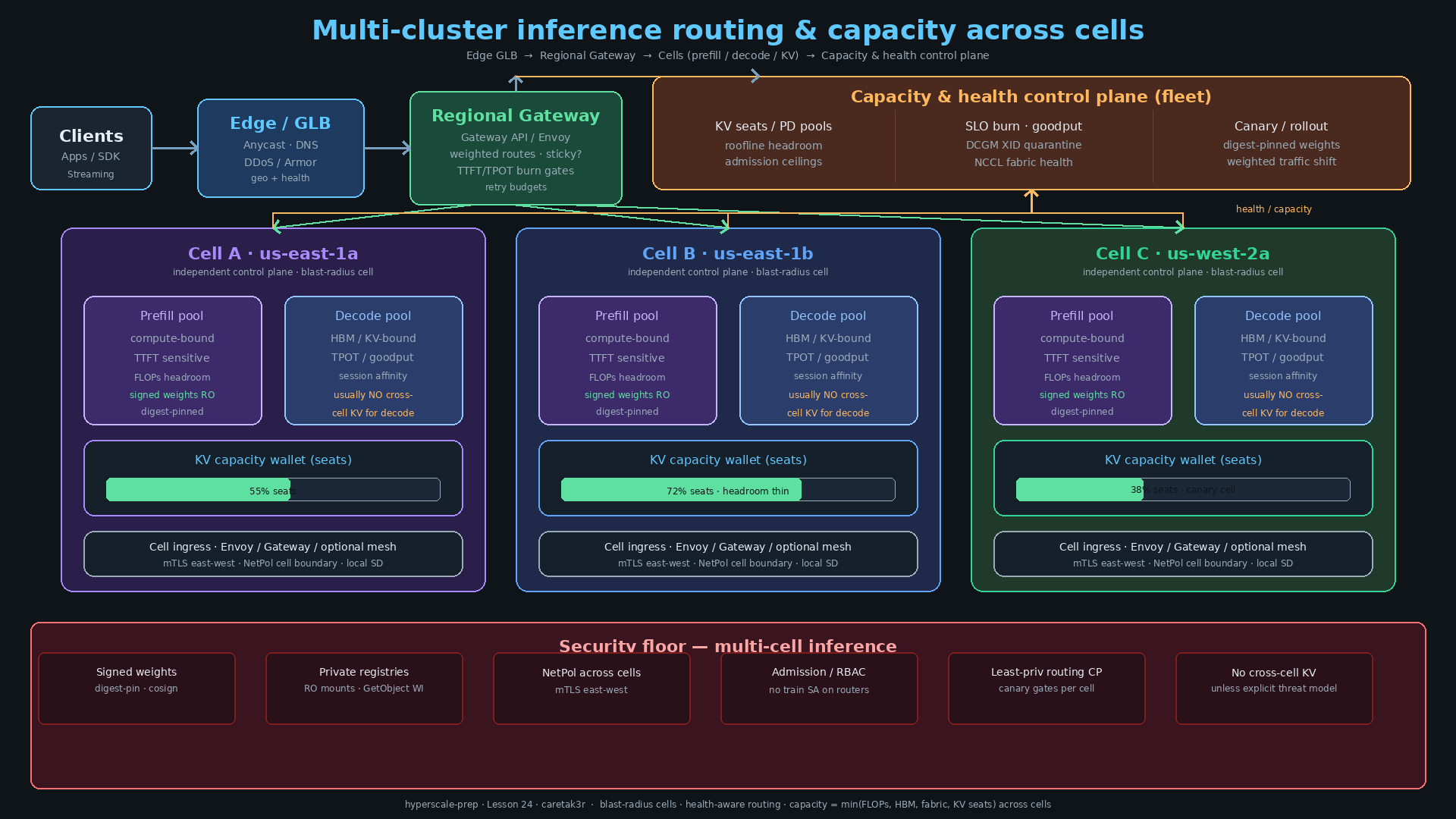
Read it top-down, then the feedback loop: Clients hit an edge GLB (Anycast / geo / DDoS — L7). A regional Gateway (Gateway API / Envoy; mesh optional — L10) picks a cell using weights plus capacity and health signals. Each cell owns prefill, decode, and a local KV wallet (L21/L22). A fleet capacity & health control plane aggregates KV seats, roofline headroom (L23), SLO burn, DCGM/XID quarantine, and NCCL fabric health — then feeds route decisions and canary traffic shifts. Everything sits on a security floor: signed digest-pinned weights, NetPol across cell boundaries, mTLS east-west, no train SA on routers.
Idiosyncrasies / operator depth
1. Cell vs region vs AZ — blast radius first
| Unit | What it owns | Operator rule |
|---|---|---|
| Cell | Independent K8s control plane + inference stacks | Fail / upgrade / drain one cell without taking the product offline |
| Region | Shared edge GLB, compliance boundary, latency budget | Route preference + failover peer; not a single etcd |
| AZ / zone | Power / network fault domain inside a cell or across sibling cells | Prefer cells that already span AZs or multiple mono-AZ cells — don’t pretend AZ = cell |
| Pool (prefill / decode / train) | Schedulable GPU inventory inside a cell (L18) | Capacity math is per pool per cell, then rolled up |
Gotcha: “Multi-cluster service mesh with one trust root and automatic failover everywhere” sounds elegant in a diagram and becomes a correlated outage when a control-plane bug or CA mishap hits. Hyperscale mental model (L1): many small control planes, deliberate cross-cell contracts.
2. Edge → cell routing patterns (pick deliberately)
| Pattern | Where it lives | When it fits |
|---|---|---|
| Anycast / GLB + DNS | Edge (L7) | Geo + DDoS + coarse health; not KV-aware |
| Gateway API HTTPRoute / GRPCRoute | Regional / cell ingress | Portable L7 weights, headers, canaries; Inference Extension for endpoint picking |
| Envoy (standalone or gateway) | Same | Custom filters: SLO burn, capacity headers, retry budgets |
| Istio / Linkerd multi-cluster | Optional east-west + mTLS (L10) | When you need identity + policy across cells — not mandatory for routing |
| MCS / ServiceImport | Cluster networking | L4-ish export; often insufficient alone for KV-aware inference |
| Composite / multi-cluster backends | Emerging Gateway API | Aggregate backends across clusters without pretending one ClusterIP |
Interview trap: Equating “we have Istio” with “we have multi-cell inference routing.” Mesh gives identity and policy; capacity-aware routing still needs a decision plane fed by KV seats, SLO burn, and silicon health.
3. Sticky vs free routing — KV, sessions, PD disagg
| Traffic class | Affinity need | Cross-cell? |
|---|---|---|
| Stateless classify / embeddings | Free / least-loaded | Yes — easy failover |
| Prefill (disagg) | Often free across prefill pool inside cell; sticky rarely required | Prefer same cell as target decode; cross-cell prefill→decode KV transfer is expensive and security-sensitive |
| Decode with warm KV | Sticky to replica / shard that holds the KV (L21) | Usually NO — rematerializing KV elsewhere burns TTFT and couples cells |
| MoE EP collectives | Topology-local (L19/L22) | Never cross-cell for the collective fabric |
| Canary model digest | Sticky to canary pool for measurement | Yes for fractional traffic — but canary cell or canary pool, not “random sticky forever” |
Default posture: Free at the edge for cell selection (capacity + health), sticky inside the cell for decode. If you must move a live decode session, treat it as brownout / drain with reconnect, not silent KV teleport.
4. Capacity planning across cells (the wallet that interviews care about)
| Input | Source | Roll-up |
|---|---|---|
| KV seats free | Serve metrics (L21) | Per cell → admit ceiling |
| Prefill FLOPs headroom | Roofline + DCGM SM/power (L23) | Prefill pool size × util |
| Decode HBM / mem-BW headroom | Roofline + HBM util | Decode pool size × util |
| Fabric health | NCCL canary BusBw vs baseline (L19/L23) | Gate cell from receiving new traffic if red |
| SLO burn | TTFT / TPOT / goodput error budget | Weight → 0 before hard fail |
| Headroom policy | Platform SLO (e.g. keep 20–30% KV + 15% FLOPs) | Don’t route into “full but not yet paging” cells |
Cell capacity (operator formula):
cell_admit = min(kv_seats_free, prefill_flops_headroom, decode_hbm_headroom, fabric_ok, slo_budget_ok)
Fleet planner routes proportional to cell_admit (or ranked tiers: green / yellow / red), never pure RPS round-robin.
5. Health-aware routing — what actually moves weight to zero
| Signal | Action on cell weight |
|---|---|
| TTFT burn (error budget) | Shed new sessions; prefer other cells; optionally brownout long prompts |
| TPOT / goodput burn | Stop admitting decode-heavy traffic; scale decode pool or drain |
| DCGM XID / ECC / throttle storm | Quarantine node → if pool degraded past threshold, cell yellow/red (L23) |
| NCCL canary fail / BusBw regress | Block MoE / multi-node admits; may still serve single-node decode depending on SKU |
| Control-plane / etcd pressure | Cell is sick even if GPUs are green — weight → 0 |
| Weight hydrate / digest mismatch | Canary or rollback; never dual-digest chaos on same sticky key |
6. Model rollout / canary across cells
| Step | Practice |
|---|---|
| Pin digest | Image + weight artifact digests; cosign verify (L12/L13) |
| Hydrate offline | Pull to cell local cache / RO volume before traffic |
| Canary cell or canary pool | 1–5% sticky traffic; compare TTFT/TPOT/goodput + DCGM |
| Weighted shift | 5 → 25 → 50 → 100% via Gateway weights; pause on burn |
| Rollback | Weight → previous digest; don’t “hotfix latest” |
| Mixed digests | Allowed across cells during shift; dangerous inside one sticky decode pool |
7. Failover, drain, brownout, retries
| Mode | Meaning | Gotcha |
|---|---|---|
| Cell drain | Weight → 0; finish in-flight; reject new sticky | Decode sticky clients need reconnect UX |
| Brownout | Shed expensive prefill / long context first | Better than hard 503 for everyone |
| Retry budget | Edge retries idempotent classify; careful with non-idempotent tool calls | Unlimited retries amplify a dying cell |
| Cross-cell KV | Copy or remote-read KV for decode | Latency + consistency + data exfil surface — default don’t |
| Cold restart elsewhere | Re-prefill on healthy cell | TTFT spike accepted; product must tolerate |
8. Multi-cluster discovery without one mandatory mesh
| Approach | Pros | Cons |
|---|---|---|
| DNS / GLB only | Simple blast radius | Coarse; no KV awareness |
| Per-cell Gateway + regional controller | Clear contracts; portable HTTPRoute | Need a capacity signal bus |
| MCS + Gateway | Standard export | L4 sameness ≠ inference picker |
| Istio multi-primary / primary-remote | mTLS + AuthZ | Operational blast radius; still need capacity inputs |
| Inference Gateway / endpoint picker | Designed for model backends | Young APIs — pin versions; don’t bet the fleet on one alpha CRD without a fallback |
Operator stance: mTLS and NetPol are mandatory between cells that speak; full mesh is optional. Many fleets run Gateway + SPIFFE/mTLS ferrymen only on the cross-cell paths that exist.
9. Observability — route decisions you can defend in an incident
| Metric / view | Why |
|---|---|
| Per-cell goodput / TTFT / TPOT | Product truth (L21) |
route_cell_weight / selected cell | Did the planner do what you think? |
cell_admit_* components | Which min() term is binding? |
| Canary digest × SLO | Rollout health |
| Cross-cell retry / failovers /s | Amplification detector |
| DCGM + NCCL cell health rollup | Silicon/fabric gates (L23) |
| Security: deny NetPol hits on cell boundary | Lateral movement attempts |
Gotcha: Logging full prompts or tenant IDs into route-decision metrics recreates the L23 cardinality / privacy footgun. Keep cell + pool + digest_short + reason_code.
10. Interview trap — “just fail over the KV”
If decode affinity dies with a cell, re-prefill or reconnect. Shipping KV across cells “for availability” couples failure domains, adds a high-bandwidth trust boundary, and often loses the TTFT you were trying to save under load. Say that out loud.
Concrete commands & config
Fleet inventory — cells, pools, weights
# Cell registry (platform CRD / ConfigMap — shape only)
kubectl --context fleet-admin get inferencecells -A \
  -o custom-columns=NAME:.metadata.name,REGION:.spec.region,WEIGHT:.status.routeWeight,ADMIT:.status.admitCeiling,HEALTH:.status.health

# Per-cell pool snapshot
for CTX in cell-a cell-b cell-c; do
  echo "=== $CTX ==="
  kubectl --context "$CTX" -n inference get deploy,svc -l app.kubernetes.io/component in prefill,decode
  kubectl --context "$CTX" -n inference get cm cell-capacity -o yaml
done
Capacity snapshot → admit ceiling (runbook sketch)
# Pull binding constraints (replace with your Prom / API)
# kv_free, prefill_flops_headroom, decode_hbm_headroom, fabric_ok (0/1), slo_ok (0/1)
python3 - <<'PY'
kv, flops, hbm, fabric, slo = 1200, 0.35, 0.22, 1, 1
# headroom floors: keep 20% KV, 15% compute/mem as policy
admit = min(kv * 0.8, flops, hbm) * fabric * slo
print(f"cell_admit_score={admit:.3f}")
PY
Gateway API — weighted cell backends + canary digest header
apiVersion: gateway.networking.k8s.io/v1
kind: HTTPRoute
metadata:
  name: llm-inference
  namespace: edge-gw
spec:
  parentRefs:
    - name: regional-gw
  hostnames: ["infer.example.com"]
  rules:
    - matches:
        - path:
            type: PathPrefix
            value: /v1/
      backendRefs:
        - name: cell-a-infer
          port: 443
          weight: 40
        - name: cell-b-infer
          port: 443
          weight: 45
        - name: cell-c-infer
          port: 443
          weight: 15   # canary cell / digest
      filters:
        - type: RequestHeaderModifier
          requestHeaderModifier:
            add:
              - name: x-model-digest
                value: "sha256:REPLACE_CANARY_OR_PROD"
              - name: x-routing-policy
                value: "capacity-v1"
---
# Optional: sticky for decode resume paths (cookie / header hash) — cell-local preference
apiVersion: gateway.networking.k8s.io/v1
kind: HTTPRoute
metadata:
  name: llm-decode-sticky
  namespace: edge-gw
spec:
  parentRefs:
    - name: regional-gw
  hostnames: ["infer.example.com"]
  rules:
    - matches:
        - path:
            type: PathPrefix
            value: /v1/sessions/
      backendRefs:
        - name: cell-a-infer
          port: 443
          weight: 1
      # Real sticky often lives in Envoy consistent-hash or Inference Extension picker;
      # document which layer owns affinity — don’t double-stick edge + mesh.
Envoy cluster sketch — outlier detection + retry budget
# Fragment — wire via Gateway / Helm values; pin Envoy image digest
clusters:
  - name: cell_a
    connect_timeout: 1s
    type: STRICT_DNS
    lb_policy: LEAST_REQUEST
    load_assignment:
      cluster_name: cell_a
      endpoints:
        - lb_endpoints:
            - endpoint:
                address:
                  socket_address: { address: cell-a.infer.svc, port_value: 443 }
    outlier_detection:
      consecutive_5xx: 5
      interval: 10s
      base_ejection_time: 30s
      max_ejection_percent: 100
    # Circuit breakers / retry budgets belong at edge — prevent retry storms into a red cell
Helm values — regional router (shape)
# Shape only — digests, not tags, in prod
regionalRouter:
  image: registry.example.com/infer-router@sha256:REPLACE
  serviceAccount: infer-router   # NOT train-sa
  env:
    CAPACITY_API: https://capacity.fleet.example.com
    DEFAULT_POLICY: min_kv_flops_hbm_fabric_slo
    CROSS_CELL_KV: "false"
  resources:
    requests: { cpu: "2", memory: 4Gi }
  affinity:
    podAntiAffinity:
      requiredDuringSchedulingIgnoredDuringExecution:
        - labelSelector:
            matchLabels: { app: infer-router }
          topologyKey: topology.kubernetes.io/zone
Cell drain / brownout / weight shift
CELL=cell-b

# 1) Mark yellow in capacity API / CR
kubectl --context fleet-admin patch inferencecell "$CELL" --type merge \
  -p '{"status":{"health":"yellow","routeWeight":5}}'

# 2) Stop new sticky admits; allow in-flight drain window
kubectl --context "$CELL" -n inference annotate deploy/decode \
  drain.platform/mode=brownout-prefill-first --overwrite

# 3) Hard drain when in-flight < threshold
kubectl --context fleet-admin patch inferencecell "$CELL" --type merge \
  -p '{"status":{"health":"red","routeWeight":0}}'

# 4) After fix: NCCL canary + DCGM green + digest verify before weight restore ([L23])
Per-cell goodput / route metrics (PromQL sketches)
# Goodput by cell
sum by (cell) (rate(inference_goodput_requests_total[5m]))

# Binding admit term (custom exporter)
min by (cell) (
  cell_admit_kv_seats_ratio,
  cell_admit_prefill_flops_ratio,
  cell_admit_decode_hbm_ratio,
  cell_admit_fabric_ok,
  cell_admit_slo_budget_ratio
)

# Edge selected cell vs planned weight
sum by (cell) (rate(router_selected_cell_total[5m]))
  /
sum by (cell) (router_desired_weight)
Kyverno / VAP — no train SA on routers (sketch)
apiVersion: admissionregistration.k8s.io/v1
kind: ValidatingAdmissionPolicy
metadata:
  name: router-privilege-floor
spec:
  failurePolicy: Fail
  matchConstraints:
    resourceRules:
      - apiGroups: ["apps"]
        apiVersions: ["v1"]
        operations: ["CREATE", "UPDATE"]
        resources: ["deployments"]
  validations:
    - expression: >
        !has(object.metadata.labels) ||
        object.metadata.labels["trust-domain"] != "infer-router" ||
        (
          object.spec.template.spec.serviceAccountName in
            ["infer-router", "edge-gw", "capacity-reader"] &&
          !object.spec.template.spec.serviceAccountName.startsWith("train")
        )
      message: "infer-router trust-domain must use router SAs — never train SA"
Failures & fixes
| Symptom | Likely cause | Fix / mitigation |
|---|---|---|
| One cell dies; all regions 5xx | Edge retries with no budget / no other healthy weights | Outlier eject + retry budget; keep ≥2 green cells in weights |
| TTFT fine at edge, TPOT burns after failover | Sticky decode lost; re-prefill storm | Accept reconnect; brownout; don’t invent cross-cell KV under fire |
| “Balanced” RPS but one cell SLO-red | Round-robin ignoring KV seats / roofline | Route on cell_admit = min(...); expose binding term |
| Canary looks green; prod digests diverge mid-shift | Mixed digests inside one sticky pool | Canary cell or pool; pin x-model-digest; block mixed sticky keys |
| Mesh mTLS outage takes every cell | Shared root / control plane coupled | Separate trust domains per cell; ferry only needed paths (L10) |
| Cross-AZ “cell” flaps on single switch | Cell ≠ fault domain | Revisit topology; sibling cells per AZ (L1/L5) |
| Weight hydrate races traffic | Traffic before RO mount ready | Offline hydrate + readiness on digest; Gateway weight 0 until ready |
| DCGM XID on 20% of decode; router still full weight | Health not wired to capacity CP | Roll up XID/throttle into cell health (L23) |
| NCCL red; MoE still admitted | Fabric gate missing | fabric_ok in min(); block EP admits |
Router SA can PutObject on weight buckets | Train WI reused | GetObject-only / no weight creds on router (L13) |
| East-west open between cells | Missing NetPol / overly broad mesh | Default-deny; allow only gateway ferry CIDRs (L9) |
| Retry storm doubles load on dying cell | Unlimited 502 retries | Budget + hedged cancel; eject first |
| Capacity dashboard shows SM util only | Vanity metrics | Show KV seats + HBM + FLOPs + fabric + burn (L23) |
| GLB health = TCP:443 green while serve is brownout | Shallow health check | Health on SLO/capacity endpoint, not just TLS accept (L7) |
Security & hardening
The routing plane sits in front of every model you serve. A router with train credentials, a flat NetPol across cells, or unsigned “latest” weights turns multi-cluster routing into a fleet-wide exfil and supply-chain fan-out. Same spirit as L11–L14, applied to edge + regional + cell ingress.
| Control | Why | Practice |
|---|---|---|
| Signed weights + digest pins | Every cell must serve the same verified artifact | Cosign verify; pin image + weight digests; no :latest (L12/L13) |
| Private registries | Public pulls = inventory + tamper surface | Private mirror; admission deny external registries for serve/router |
| RO mounts | Writable /models on serve or router is a backdoor | readOnly mounts; emptyDir for scratch only |
| GetObject-only WI | Routers and serve hydrate paths must not write checkpoints | Workload Identity / IRSA with s3:GetObject (or GCS equivalent) only; no PutObject on weight buckets |
| No train SA on routers | Train WI is a privilege trampoline | infer-router / edge-gw / capacity-reader only; VAP deny train* |
| NetPol across cell boundaries | Lateral movement via “just routing” | Default-deny; allow only ferry / gateway ports; no pod-pod mesh flatness (L9) |
| mTLS between cells | Spoofed cell backends | SPIFFE / mesh / gateway mTLS on cross-cell hops (L10) |
| Admission / RBAC | Anyone who can edit HTTPRoute weights can shift prod | Break-glass + audit; least-priv route editors; separate canary editors |
| Least-priv routing control plane | Capacity API is a load-shedding oracle | Read metrics; write weights via narrowly scoped SA; no exec into serve |
| No cross-cell KV by default | KV is tenant conversation state | Explicit threat model + encryption + ACL if ever enabled |
| Route metric label hygiene | PII / prompts in router logs | cell + pool + digest_short + reason_code only (L23) |
| Canary gates | Bad digest → all cells | Per-cell verify; weighted shift with auto-pause on burn |
AI/ML weight, model & deployment hardening on the multi-cell path (required)
Multi-cell routing does not relax L13/L14. Each cell hydrates signed, digest-pinned weights onto RO volumes with GetObject-only identity. Regional routers never mount /models, never reuse train SAs, and never hold PutObject on checkpoint buckets. Cross-cell NetPol + mTLS protect the ferry. Deployment admission still requires RuntimeClass, digest pins, and pool nodeSelectors on every cell — including the “temporary” canary cell.
| Scenario | Weight / model / deploy controls |
|---|---|
| New cell join | Cosign + digest hydrate before weight > 0; NCCL/DCGM green (L23) |
| Canary digest shift | Header/InferencePool pin; RO mounts; compare SLO; auto-pause |
| Router deploy | Signed router image; no weight PVC; router SA only |
| East-west ferry | mTLS; NetPol allowlist; no raw weight sync protocol on that path |
| Incident: suspected weight tamper | Freeze weights → 0; revoke registry pulls; re-verify digests cell-by-cell |
| Train job in same org | Hard SA / WI / NetPol separation from router and serve (L14) |
# Sketch: multi-cell inference routing security floor (platform CR shape)
apiVersion: policy.platform/v1
kind: MultiCellInferGate
metadata:
  name: infer-routing-floor
spec:
  match:
    labels:
      trust-domain: infer-router
  require:
    imageDigestPin: true
    weightDigestPin: true
    cosignVerify: true
    privateRegistryOnly: true
    weightMountOnRouter: false
    weightMountOnServe: "readOnly"
    serveWorkloadIdentity:
      objectGetOnly: true
      putObject: false
    allowedServiceAccounts: ["infer-router", "edge-gw", "capacity-reader"]
    trainSaOnRouters: false
    crossCellKv: false
    networkPolicy:
      defaultDeny: true
      allowEastWest:
        - from: "namespace:edge-gw"
          to: "cell-ingress:443"
          mtls: required
    admission:
      runtimeClass: nvidia
      auditRouteWeightChanges: true
    canary:
      autoPauseOnSloBurn: true
      maxMixedDigestInStickyPool: 0
Punchline: Multi-cell routing is a security-critical control plane. Digest-pinned signed weights, GetObject-only hydrate, no train SA on routers, NetPol + mTLS across cell boundaries, and no casual cross-cell KV are what keep “smart capacity routing” from becoming a fleet-wide compromise path.
Interview soundbites
- “Cells are blast-radius units — independent control planes, deliberate cross-cell contracts.”
- “Edge GLB for geo/DDoS; Gateway/Envoy for weighted capacity routes — mesh is optional identity, not magic routing.”
- “Free at the edge for cell pick; sticky inside the cell for decode KV.”
- “cell_admit = min(KV seats, prefill FLOPs, decode HBM, fabric, SLO budget) — the minimum wins.”
- “XID / NCCL / TTFT burn all move weight — GPUs green ≠ cell green.”
- “Canary digest-pinned weights with weighted shift; never :latest across cells.”
- “Don’t teleport decode KV cross-cell by default — reconnect/re-prefill beats coupled failure domains.”
- “Retry budgets + outlier ejection, or one red cell becomes a retry amplifier.”
- “No train SA on routers; RO weights; GetObject-only; NetPol + mTLS between cells.”
- “Next: multi-tenant GPU isolation and quota economics across cells.”
How this maps to the JD
Hyperscale + AI/ML platform JDs that mention 100+ clusters, inference serving, and GPU fleets are asking whether you can route and plan capacity across cells under partial failure — not run a single-cluster Envoy demo. This lesson lifts L18–L23 into the fleet layer with L1/L5–L7/L9/L10/L13–L14 controls. Fuel: wafer-ai/gpu-perf-engineering-resources (opens in a new tab). Next up — Lesson 25: multi-tenant GPU isolation & quota economics across cells.
Watch (talks & demos)
Real talks — watch after Failures & fixes.
Building the Next Generation of Multi-Cluster with Gateway API
KubeCon talk (Mike Morris & Alan Grosskurth) on ClusterIP Gateways, endpoint selectors, and composite backends for aggregating backends across clusters. Operator takeaway: multi-cluster inference needs an explicit backend aggregation story in Gateway API terms — not “one Service DNS name forever.” Pair with capacity signals from this lesson; APIs alone don’t know your KV seats.
Open on YouTube (opens in a new tab)
NVIDIA Dynamo — LLM Inference in Multi-Node Distributed Environments
Hands-on / overview of Dynamo’s distributed serving stack (multi-node inference, routing adjacent to PD pools). Operator takeaway: treat KV-aware / disagg routers as cell-local brains feeding a fleet weight plane — don’t confuse engine-level KV routing with cross-cell GLB decisions (L21/L22).
Open on YouTube (opens in a new tab)
Tutorial: Configuring Your Service Mesh with Gateway API
Gateway API + mesh (Linkerd/Istio) workshop for routing, resilience, and progressive delivery. Operator takeaway: use Gateway for portable canary weights; use mesh selectively for mTLS/identity between cells — don’t merge them into one mandatory monolith (L10).
Open on YouTube (opens in a new tab)
References
- Gateway API (opens in a new tab) · Gateway API Inference Extension (opens in a new tab) · kubernetes-sigs/gateway-api-inference-extension (opens in a new tab)
- Multi-Cluster Services (MCS) (opens in a new tab) · Istio multi-cluster (opens in a new tab) · Envoy outlier detection (opens in a new tab)
- NVIDIA Dynamo docs — KV routing (opens in a new tab) · Routing concepts (opens in a new tab)
- wafer-ai/gpu-perf-engineering-resources (opens in a new tab) — fleet / inference arithmetic fuel
- Prior: 23 — GPU observability · 22 — Prefill/decode disagg / MoE · 21 — Inference serving SLOs · 18 — GPU node pools · 14 — ML deploy hardening · 13 — ML weights · 10 — Service mesh · 09 — NetworkPolicy · 07 — Edge LB / DDoS · 05 — Cloud networking · 01 — Hyperscale mental model
- Next: Lesson 25 — AI/ML platform: multi-tenant GPU isolation & quota economics across cells
Quick self-check
Out loud, in under two minutes:
- Define a cell vs a region vs a pool — and why independent control planes matter for blast radius.
- Explain free-at-edge vs sticky-in-cell for decode KV, and why cross-cell KV is usually a bad default.
- Write
cell_admit = min(...)with five inputs and say which signal moves weight to zero first in an XID storm. - Walk a digest-pinned canary: hydrate → weight shift → auto-pause on SLO burn → rollback.
- Drain a yellow cell without retry-amplifying it (outlier eject, retry budget, brownout).
- List five security controls on the routing path — signed digests, GetObject-only, no train SA on routers, NetPol + mTLS across cells, no casual cross-cell KV.