Lesson 5 — Cloud networking: VPC, peering, Shared VPC, Transit Gateway
2026-09-13
What interviewers are really probing
They are not asking you to define a VPC. They want to know if you have designed the network that 100+ clusters hang on: CIDR that will not collide in five years, which attachment model you pick when teams need private reachability, how routes actually propagate (and when they do not), and how you diagnose “pods cannot talk to the DB” when the path crosses accounts, TGW, and overlapping RFC1918.
I have watched fleets burn weeks on “just peer everything” until the mesh hit the peering limit, transitive routes never appeared, and two cells both claimed 10.0.0.0/16. The interview answer is a hub-and-spoke with explicit route ownership, not a web of peerings.
| Pattern | Topology | Transitive? | Who owns the network | Hyperscale fit |
|---|---|---|---|---|
| VPC Peering | Point-to-point | No | Each VPC | Few pairs, same CIDR plan, low churn |
| Shared VPC / Shared VNet | Host + service projects | N/A (same VPC) | Host / network team | Many clusters, one CIDR + IAM boundary |
| Transit Gateway / Cloud Router hub | Hub-and-spoke | Yes (via hub) | Hub account + attachments | Dozens–hundreds of VPCs / accounts |
| Private Link / PSC / Private Service Connect | Consumer → endpoint | N/A | Provider + consumer | SaaS / shared data plane without full VPC mesh |
Core diagram: how cells actually connect
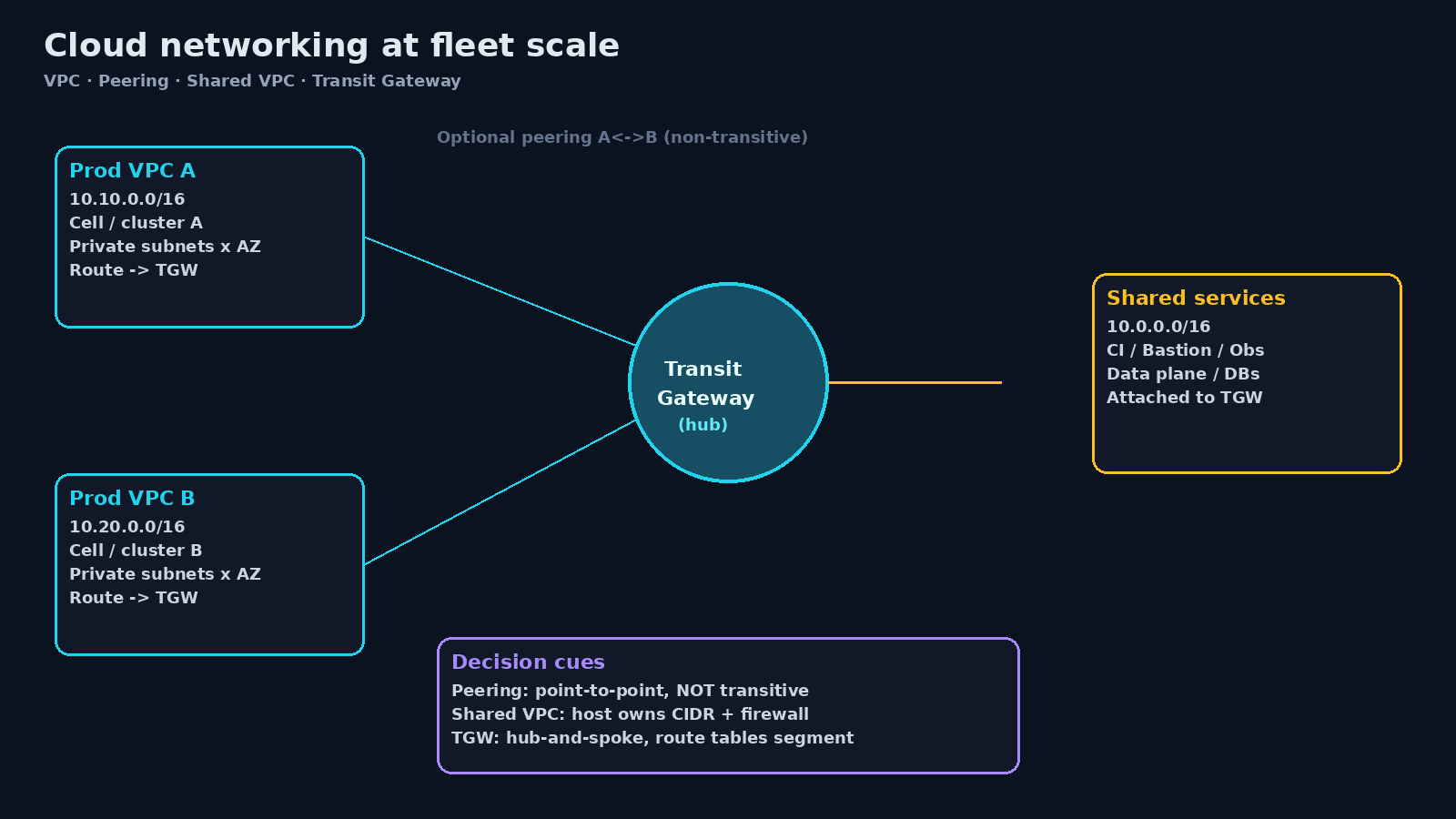
Read the hub first: at fleet scale you rarely mesh peer every pair. You attach spoke VPCs to a Transit Gateway (AWS) or equivalent hub (GCP hierarchical Firewall + Cloud Router / NCC; Azure Virtual WAN / Hub VNet), put shared services in one spoke, and control which prefixes each attachment learns. Peering remains for a few high-bandwidth pairs where you accept non-transitive routes.
CIDR & IPAM: the decision that ages badly
Before any peering or TGW attachment, own an IPAM ledger. Overlap is the silent killer: TGW will not magically NAT colliding prefixes, and peering refuses overlapping CIDRs.
# Fleet IPAM sketch (document in CMDB / Terraform)
10.0.0.0/12     reserved for company private (4096 /24s)
  10.0.0.0/16   shared-services (hub)
  10.10.0.0/16  cell-prod-us-east-1-a
  10.11.0.0/16  cell-prod-us-east-1-b
  10.20.0.0/16  cell-prod-us-west-2-a
  100.64.0.0/16 CGNAT / node pod overlays (if you carve separately)
# NEVER recycle a /16 into a peered or TGW-attached VPC without a drain plan
Idiosyncrasy: Kubernetes pod/service CIDRs are inside the cluster’s view. On AWS VPC CNI, pod IPs often come from VPC subnets — so your VPC CIDR must leave headroom for node ENIs + pods. On overlay CNIs (Calico VXLAN, Cilium VXLAN), pod CIDR can be independent, but then egress SNAT and NetworkPolicy become the path you debug. Pick one model per fleet and write it down.
# AWS: inventory VPC CIDRs before attaching anything
aws ec2 describe-vpcs --query 'Vpcs[].{Id:VpcId,Cidr:CidrBlock,Secondary:CidrBlockAssociationSet}' --output table

# GCP: list Shared VPC host + service projects
gcloud compute shared-vpc list-associated-resources HOST_PROJECT_ID
gcloud container clusters describe CLUSTER --region=REGION \
  --format='yaml(networkConfig,privateClusterConfig,ipAllocationPolicy)'
Pattern 1 — VPC peering (when it is still right)
Peering is a private pipe between two VPCs. Routes are non-transitive: A↔B and B↔C does not give A→C. Security groups / firewall rules still reference peer CIDRs (or SG IDs on AWS with peering options).
# AWS: create + accept (cross-account needs both sides)
aws ec2 create-vpc-peering-connection \
  --vpc-id vpc-aaa --peer-vpc-id vpc-bbb --peer-owner-id 222233334444
aws ec2 accept-vpc-peering-connection --vpc-peering-connection-id pcx-...

# Install routes BOTH ways (forgotten half = classic outage)
aws ec2 create-route --route-table-id rtb-aaa \
  --destination-cidr-block 10.20.0.0/16 --vpc-peering-connection-id pcx-...
aws ec2 create-route --route-table-id rtb-bbb \
  --destination-cidr-block 10.10.0.0/16 --vpc-peering-connection-id pcx-...
Use peering when: two VPCs need high PPS / low latency, stable pair count, no transitive requirement. Stop when you need N² connections or “spoke A reaches shared services and spoke B through the same path.”
Pattern 2 — Shared VPC (GCP) / shared network ownership
Shared VPC puts the network in a host project; service projects attach GKE/VMs with IAM. One CIDR, many teams — the network team owns subnets, secondary ranges for pods/services, and firewall; app teams own workloads.
# GCP: enable host, attach service project, grant networkUser
gcloud compute shared-vpc enable HOST_PROJECT
gcloud compute shared-vpc associated-projects add SERVICE_PROJECT --host-project=HOST_PROJECT
gcloud projects add-iam-policy-binding HOST_PROJECT \
  --member="serviceAccount:SERVICE_PROJECT_NUMBER@cloudservices.gserviceaccount.com" \
  --role="roles/compute.networkUser"
# GKE in a service project consuming host subnets (illustrative)
# ipAllocationPolicy secondary ranges MUST live on the Shared VPC subnet
ipAllocationPolicy:
useIpAliases: true
clusterSecondaryRangeName: pods
servicesSecondaryRangeName: services
privateClusterConfig:
enablePrivateNodes: true
enablePrivateEndpoint: false # or true + authorized networks / PSCIdiosyncrasy: secondary range exhaustion for pods is a subnet problem in the host project — app teams cannot fix it with a Helm chart. Fleet ops means watching IP address space / allocation metrics before the next cell scales.
Pattern 3 — Transit Gateway / hub (the hyperscale default)
TGW (AWS) and analogs give transitive routing through a hub. Each VPC (or VPN/DX) is an attachment; TGW route tables decide which spokes talk. This is how you connect 50 accounts without 1225 peerings.
# AWS TGW: create, attach VPC, associate + propagate routes
aws ec2 create-transit-gateway --description "fleet-hub"
aws ec2 create-transit-gateway-vpc-attachment \
  --transit-gateway-id tgw-... --vpc-id vpc-aaa \
  --subnet-ids subnet-aaa-a subnet-aaa-b subnet-aaa-c

# Critical: association vs propagation are different knobs
aws ec2 associate-transit-gateway-route-table \
  --transit-gateway-route-table-id tgw-rtb-prod \
  --transit-gateway-attachment-id tgw-attach-aaa
aws ec2 enable-transit-gateway-route-table-propagation \
  --transit-gateway-route-table-id tgw-rtb-prod \
  --transit-gateway-attachment-id tgw-attach-shared

# VPC side still needs a route to the TGW
aws ec2 create-route --route-table-id rtb-aaa \
  --destination-cidr-block 10.0.0.0/16 --transit-gateway-id tgw-...
# Terraform sketch — one module, many cells
resource "aws_ec2_transit_gateway_vpc_attachment" "cell" {
subnet_ids = module.vpc.private_subnets
transit_gateway_id = var.tgw_id
vpc_id = module.vpc.vpc_id
tags = { Cell = var.cell_name }
}
resource "aws_route" "to_shared" {
for_each = toset(module.vpc.private_route_table_ids)
route_table_id = each.value
destination_cidr_block = var.shared_services_cidr
transit_gateway_id = var.tgw_id
}Segmentation pattern that interviews love: separate TGW route tables for prod, nonprod, and shared — prod spokes associate to prod RT and only propagate/static-route to shared services, not to each other, unless you explicitly need east-west.
Decision tree (say this out loud)
Concrete commands & config (operator set)
# Path check from a node (AWS): hop to TGW? to peer?
ip route get 10.0.10.5
traceroute -n 10.0.10.5

# AWS: TGW attachment state + routes
aws ec2 describe-transit-gateway-attachments \
  --filters Name=transit-gateway-id,Values=tgw-... \
  --query 'TransitGatewayAttachments[].{Id:TransitGatewayAttachmentId,State:State,Vpc:ResourceId}'
aws ec2 search-transit-gateway-routes \
  --transit-gateway-route-table-id tgw-rtb-prod \
  --filters Name=type,Values=static,propagated

# Security groups: return path + peer/TGW CIDR must be allowed
aws ec2 describe-security-groups --group-ids sg-app \
  --query 'SecurityGroups[].IpPermissions'

# GCP: routes + firewall for Shared VPC
gcloud compute routes list --project=HOST_PROJECT --filter="network~shared"
gcloud compute firewall-rules list --project=HOST_PROJECT --filter="network~shared"
# Kubernetes: do not paper over missing routes with hostNetwork
# Prefer correct VPC/TGW routing; if you must debug:
apiVersion: v1
kind: Pod
metadata:
name: netshoot-tgw
spec:
nodeSelector:
topology.kubernetes.io/zone: us-east-1a
containers:
- name: netshoot
image: nicolaka/netshoot
command: ["sleep", "3600"]Failures & fixes
| Symptom | Likely root cause | Fix / mitigation |
|---|---|---|
curl to shared DB times out (not RST) | Missing VPC route to TGW/peer, or TGW RT association without propagation | Add VPC route; associate attachment; enable propagation / static route; verify SG/firewall allows source CIDR |
| Works from bastion in Shared VPC, fails from pods | Pod CIDR not in TGW/SG allow list; SNAT hides node IP inconsistently | Allow pod + node CIDRs; prefer VPC CNI predictability or explicit egress gateway |
| Peering create fails / stuck | Overlapping CIDRs | Renumber one VPC (painful) or use Private Link / proxied path; never “force” overlap |
| A reaches B, B reaches C, A cannot reach C | Peering non-transitive | Move to TGW hub or add A↔C peering deliberately |
| New cell cannot join shared services | Attachment on wrong TGW RT (prod vs nonprod) | Fix association; document RT matrix in Terraform |
| Intermittent cross-AZ timeouts | TGW subnet placement missing an AZ; NACL deny | Attach TGW in ≥2 AZs; open NACLs ephemeral + return |
| GKE Pending / IP exhaustion | Shared VPC secondary ranges too small | Expand secondary ranges in host project; plan /14+/15 pod space early |
| Cross-account peering works, DNS does not | Private DNS not linked | Associate Route53 private hosted zones / Cloud DNS peering both sides |
| “Connected” but asymmetric blackhole | Only one direction of routes installed | Always pair routes; test from both ends |
Security & hardening
The VPC/TGW fabric is your network trust boundary. Security groups and NACLs enforce intent; route-table segmentation keeps prod from trusting nonprod “just for debugging.”
| Control | Operator practice |
|---|---|
| Security groups / NACLs | Least-privilege ingress; ephemeral return paths; no 0.0.0.0/0 on app ports |
| Route-table segmentation | Separate TGW RTs for prod / nonprod / shared — association is policy |
| Private Link over flat mesh | Prefer PSC/PrivateLink for shared data & registries vs opening full CIDR mesh |
| No overlapping CIDR exceptions | Temporary overlaps become permanent exfiltration paths; renumber or proxy |
# Prove segmentation: cell VPC should not route to nonprod via TGW
aws ec2 search-transit-gateway-routes   --transit-gateway-route-table-id tgw-rtb-prod   --filters Name=route-search.subnet-of-match,Values=10.20.0.0/16
# SG: deny unexpected peer CIDRs; prefer prefix lists for shared services
aws ec2 describe-security-groups --group-ids sg-app   --query 'SecurityGroups[].IpPermissions'
AI/ML fleets: put model-weight object stores and private container registries on Private Link / PSC — not flat TGW reachability from every sandbox cell. GPU training VPCs get egress to artifact registries only; inference VPCs get pull-only paths. Never “temporary” overlap a training CIDR with prod serving.
Interview soundbites
- “Peering is not transitive — that is the whole joke.” If you need spoke-to-spoke via a hub, say Transit Gateway (or equivalent), not a peering mesh.
- “CIDR is a product decision.” Overlap kills peering and TGW; IPAM before the first cell.
- “Association ≠ propagation.” TGW attachments must be associated to a route table and learn/advertise the prefixes you intend.
- “Shared VPC separates network ownership from workload ownership.” Host project owns subnets/firewall; service projects consume — that is the IAM story.
- “Timeout vs connection refused tells you the layer.” Timeout → route/SG/NACL/TGW. Refused → something listening said no. Interviewers love that triage.
How this maps to the JD
Hyperscale compute roles assume you can place cells on a coherent network fabric: multi-account connectivity, shared services, and failure domains that do not require N² peerings. Next lessons go deeper on Interconnect/Direct Connect, edge LB/DDoS, then cluster networking (Cilium/eBPF) on top of this VPC layer.
Next in the arc: Cloud Interconnect / Direct Connect, Cloud NAT, BGP & route control.
Watch (talks & demos)
Real-world talks and demos that map to this lesson — watch after the Failures & fixes table.
AWS Transit Gateway reference architectures for many VPCs — re:Invent NET406
Hub-and-spoke, segmentation, DX + TGW, PrivateLink vs peering mesh — the hyperscale VPC pattern.
Open on YouTube (opens in a new tab)
Dive into the depths of routing on AWS — re:Invent 2024 NET318
BGP, TGW route tables, DX transit VIFs, and failure handling — shared with Lesson 6.
Open on YouTube (opens in a new tab)
References
- AWS Transit Gateway (opens in a new tab)
- AWS VPC peering (opens in a new tab)
- GCP Shared VPC (opens in a new tab)
- GCP VPC Network Peering (opens in a new tab)
- Azure Virtual WAN / hub-spoke (opens in a new tab)
- Amazon VPC CNI (opens in a new tab)
- GKE IP allocation / alias IPs (opens in a new tab)
- AWS PrivateLink (opens in a new tab)
Quick self-check
Out loud, in under two minutes:
- When do you choose peering vs Shared VPC vs TGW — one sentence each.
- Explain why
A↔BandB↔Cpeering does not giveA→C, and what you build instead. - Walk a failure: pods time out to a shared DB — symptom → route/TGW RT/SG triage → fix.
- Why overlapping
10.0.0.0/16across two cells is catastrophic once they share a hub.