Lesson 13 — AI/ML security: model weights & checkpoint hardening (registry, signing, bucket IAM, encryption)
2026-09-21
What interviewers are really probing
Lesson 12 closed the image half of the supply chain (digest, SBOM, cosign, admit-time verify). This lesson closes the weight / checkpoint half: the multi-gigabyte blobs that training jobs write and inference pods pull — often from object buckets or OCI artifact registries, and often with weaker controls than the container that loads them.
They want evidence you treat weights as first-class artifacts, not “files on S3”:
- Lifecycle — train → checkpoint → promote → serve, with a human/CI gate between staging and prod prefixes
- Immutability — content hashes, versioned keys / Object Lock; never a mutable
latest.safetensors - Encryption — SSE-KMS / CMEK (customer-managed keys); optional client-side for crown-jewel IP
- Bucket IAM least privilege — separate
weight-writer(training SA) vsweight-reader(inference SA) via Workload Identity / IRSA — never broad GetObject on the node instance role - Signing & provenance — cosign / OpenSSF model-signing on OCI model packages; in-toto/SLSA-style attestations tying checkpoint hash → training job identity → git commit → dataset digest
- Compose — signed serving image + unsigned weight = still broken (L12 punchline made operational here)
- Hyperscale — multi-cell mirrors of weight buckets + signature sidecars; CMEK rotation without breaking readers; audit logs for GetObject on model prefixes
Interview sentence: “I harden the serving image and the checkpoint plane — private store, CMEK, writer/reader SA split, signed digest, admit and audit the pull.”
Core diagram: train → checkpoint → encrypt/sign → private store → IAM gate → inference
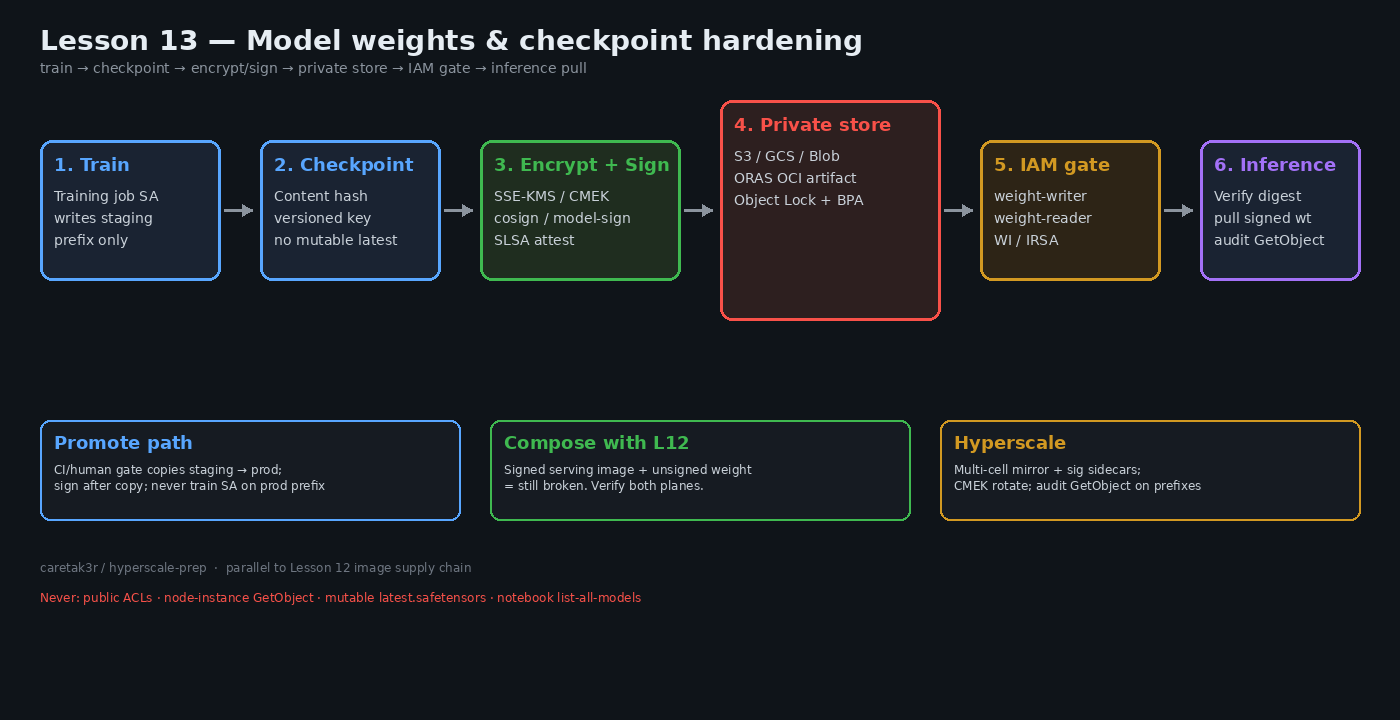
Read it top-down (left-to-right on the PNG): the training job SA may write only to a staging prefix (or staging bucket) → checkpoints land under content-addressed / versioned keys with SSE-KMS/CMEK → a promote pipeline (CI + optional human gate) copies into prod, signs (cosign on ORAS/OCI packages, or model-signing / checksum manifests for directory-shaped models), and attaches provenance → inference uses a separate weight-reader identity → admission / runtime verify matches the digest you signed → CloudTrail / Data Access logs record GetObject on model prefixes. Preview Lesson 14: securing the inference/training deployments that consume these artifacts.
Idiosyncrasies / operator depth
Weight lifecycle (parallel to image promote)
| Stage | Operator meaning | Footgun |
|---|---|---|
| Train | Job writes checkpoints to s3://models-staging/... only | Training SA also has prod PutObject |
| Checkpoint | Periodic / best / final; hash recorded in job metadata | Overwriting the same key each epoch |
| Promote | Copy + sign + attest into prod prefix/registry | “Just symlink latest” without gate |
| Serve | Inference SA GetObject / ORAS pull by digest | Node role can list the whole bucket |
Treat promote like an image release: immutable artifact ID, signature, provenance, and a record of who approved.
Storage planes: bucket vs OCI vs model hub
| Plane | When you use it | Hardening knobs |
|---|---|---|
| Object buckets (S3 / GCS / Azure Blob) | Large safetensors/gguf trees; training checkpoints | CMEK, BPA, Object Lock, prefix IAM, VPC endpoints |
| OCI registries (GAR/ECR/ACR/Harbor) via ORAS | Model packages as artifacts; same referrers/signing story as images | Private registry, cosign, admit-time verify |
| HF Hub / private hubs | Collaboration / base models | Private repos, org SSO, no world-readable; pin revision SHA; egress allow-list |
Many fleets are hybrid: base models from a controlled hub mirror into your bucket/registry; fine-tunes never leave your CMEK boundary.
Digest-like immutability for blobs
- Prefer keys like
models/llama-ft/sha256-<hex>/model.safetensorsor object versioning + Object Lock (WORM) on prod prefixes. - Record the content hash in the promote ticket / SLSA predicate — same role digest plays for images.
- Ban mutable aliases (
latest.safetensors,prod/current) in prod. Staging may use soft tags; promote resolves to hash. - For multi-file directories: hash the manifest (or use OpenSSF model-signing, which is built for directory-shaped models).
Encryption: SSE-KMS / CMEK / client-side
| Mode | Operator note |
|---|---|
| SSE-S3 / Google-managed | Better than nothing; weak separation of duties vs bucket IAM |
| SSE-KMS / CMEK | Customer-managed key; IAM and key policy must allow writer/reader; rotation drills matter |
| S3 Bucket Keys / similar | Cuts KMS request cost on huge GetObject fan-out — validate encryption-context policies first |
| Client-side | High-sensitivity IP; app holds DEK; ops complexity and key recovery risk go up |
Rotation without breaking readers: dual-encrypt window, grant both old and new key ARNs on the reader role, re-encrypt or rewrite objects on a schedule, then drop the old key grant. Hyperscale cells must share the same rotation playbook or DR pulls fail closed on KMS AccessDenied.
Bucket IAM: writer vs reader (the interview money question)
Training job SA  →  s3:PutObject on staging/*   (+ kms:GenerateDataKey)
Promote CI SA    →  staging Get + prod Put      (+ sign)
Inference SA     →  s3:GetObject on prod/*      (+ kms:Decrypt)
Nobody           →  s3:ListBucket on entire bucket from notebooks without need
Node instance role → NEVER broad models GetObject- Workload Identity / IRSA / GKE WI / AKS WI bind the K8s SA to the cloud IAM role — compose with L11.
- Block Public Access account + bucket; disable ACLs; bucket policy deny
Principal: *. - Prefer VPC endpoints / Private Google Access so training/inference nodes never need public S3/GCS IPs for weight pulls.
- Prefix-level conditions (
s3:prefix) beat “one role for all models.”
Signing & provenance for weights
| Pattern | Use when |
|---|---|
| ORAS push + cosign sign | Model packaged as OCI artifact; reuse L12 admit verifyImages / Ratify |
| OpenSSF model-signing | Directory of weight files; Sigstore or key-based; hub-friendly |
| cosign sign-blob + checksum manifest | Raw bucket objects; store .sig / Rekor entry beside the blob |
| in-toto / SLSA attestation | Bind checkpoint hash ↔ trainer identity ↔ git SHA ↔ dataset digest |
Compose with L12: admission that only checks the serving image will happily schedule a signed image that loads a poisoned weight from an over-permissioned bucket. Verify both planes — or mount only from a verified OCI artifact volume / init-container that checks the signature before the main process starts.
Training identity split & exfiltration paths
Classic leaks operators actually see:
- Notebook namespace SA with
s3:ListBucket+GetObjectonmodels/* - Debug sidecar / ephemeral pod using the node instance profile
- Unlogged egress to public HF / anonymous Git LFS
- Shared “ml-platform” role reused by train, promote, and serve
- Staging bucket with public ACL “just for the demos”
Mitigate with NetworkPolicy / egress proxies (L9 / mesh from L10), separate SAs, and Data Access audit alerts on unusual GetObject volume or principals.
Hyperscale idiosyncrasies
- Multi-cell mirrors: replicate objects and signatures (sidecar manifests, OCI referrers). A cell that has weights but not sigs fails verify; a cell with sigs but stale weights serves the wrong model.
- CMEK per region / per cell: document which key encrypts which prefix; avoid a single global key becoming a fleet SPOF without a rotation drill.
- Audit: enable object-level logging; alert on
GetObjectfrom non-inference principals on prod prefixes; retain for IR. - Admission drift: same trust roots for model OCI artifacts across cells — fleet-manage Kyverno/Ratify CRs like L12 image policy.
Concrete commands & config
# --- AWS: bucket posture (illustrative) ---
aws s3api get-public-access-block --bucket models-prod
aws s3api get-bucket-encryption --bucket models-prod
aws s3api get-object-lock-configuration --bucket models-prod 2>/dev/null || true

# Put a content-addressed checkpoint (SSE-KMS)
HASH=$(sha256sum model.safetensors | awk '{print $1}')
KEY="models/llama-ft/sha256-${HASH}/model.safetensors"
aws s3api put-object \
  --bucket models-staging \
  --key "$KEY" \
  --body model.safetensors \
  --server-side-encryption aws:kms \
  --ssekms-key-id "$KMS_KEY_ARN"

# Promote: copy staging → prod (CI role), then sign
aws s3 cp "s3://models-staging/$KEY" "s3://models-prod/$KEY"
sha256sum model.safetensors | tee "model.safetensors.sha256"
cosign sign-blob --bundle model.sigbundle model.safetensors
# store bundle next to object or in sig sidecar prefix
# --- GCP-flavored sketch ---
gcloud storage buckets describe gs://models-prod --format='yaml(iamConfiguration,encryption)'
# CMEK on bucket / object; Uniform bucket-level access ON
gsutil hash -h model.safetensors
gcloud storage cp model.safetensors \
"gs://models-staging/models/llama-ft/sha256-${HASH}/model.safetensors" \
--encryption-key=projects/P/locations/L/keyRings/R/cryptoKeys/K# --- ORAS: package weights as OCI artifact + cosign (ties to L12) ---
oras push registry.example.com/models/llama-ft:sha256-${HASH} \
./model.safetensors:application/vnd.example.safetensors \
--artifact-type application/vnd.example.model
DIGEST=$(crane digest registry.example.com/models/llama-ft:sha256-${HASH})
REF="registry.example.com/models/llama-ft@$DIGEST"
cosign sign "$REF"
cosign verify "$REF"
cosign tree "$REF" # signatures must mirror with the artifact# IRSA / WI sketch: inference SA may GetObject prod prefix only
apiVersion: v1
kind: ServiceAccount
metadata:
name: weight-reader
namespace: model-serving
annotations:
# EKS example — swap for GKE/AKS WI annotation in your cloud
eks.amazonaws.com/role-arn: arn:aws:iam::123456789012:role/weight-reader
---
# Training SA — staging write only (separate role)
apiVersion: v1
kind: ServiceAccount
metadata:
name: weight-writer
namespace: model-training
annotations:
eks.amazonaws.com/role-arn: arn:aws:iam::123456789012:role/weight-writer# IAM policy fragment — weight-reader (illustrative)
{
"Effect": "Allow",
"Action": ["s3:GetObject"],
"Resource": "arn:aws:s3:::models-prod/models/*"
},
{
"Effect": "Allow",
"Action": ["kms:Decrypt", "kms:DescribeKey"],
"Resource": "arn:aws:kms:REGION:ACCT:key/KEY-ID",
"Condition": {
"StringEquals": {
"kms:ViaService": "s3.REGION.amazonaws.com"
}
}
}# Kyverno: model-serving NS — require signed OCI model refs (compose L12)
apiVersion: kyverno.io/v1
kind: ClusterPolicy
metadata:
name: verify-model-oci-artifacts
spec:
validationFailureAction: Enforce
rules:
- name: verify-signed-model-artifacts
match:
any:
- resources:
kinds: ["Pod"]
namespaces: ["model-serving"]
verifyImages:
- imageReferences:
- "registry.example.com/models/*"
mutateDigest: true
verifyDigest: true
required: true
attestors:
- count: 1
entries:
- keys:
publicKeys: |-
-----BEGIN PUBLIC KEY-----
# fleet-managed model-signing / cosign.pub
-----END PUBLIC KEY-----# Authz / audit habits (L11 compose)
kubectl auth can-i get pods -n model-serving \
--as=system:serviceaccount:model-serving:weight-reader
# Expect: pull weights yes; list secrets no; create privileged no
kubectl get ns model-serving -o yaml | rg pod-security
# CloudTrail / GCP Data Access: alert GetObject on models-prod from non-reader rolesFailures & fixes
| Symptom | Likely root cause | Fix |
|---|---|---|
Inference AccessDenied on GetObject / KMS Decrypt | Reader role missing kms:Decrypt or wrong key ARN after rotation | Grant Decrypt on active CMEK(s); dual-key window during rotation |
| “Works in staging, fails in cell B” | Mirror copied objects but not sigs / referrers | Mirror signatures with artifacts; cosign tree in DR cell |
| Notebook lists every production model | Shared SA / node role with s3:ListBucket on models/* | Split writer/reader; prefix IAM; deny List on prod from notebook NS |
| Signed image, poisoned weights | Only L12 image verify; bucket world-readable or broad GetObject | CMEK + BPA + reader-only IAM; sign/verify weights; audit GetObject |
Promote overwrote latest.safetensors | Mutable prod key | Content-addressed keys + Object Lock; ban latest in prod policy |
| Training job wrote straight to prod | Writer role includes prod PutObject | Staging-only Put; promote CI separate; SCP / org policy guardrail |
| Mass KMS throttling on serve fan-out | Per-object GenerateDataKey without bucket keys | Enable S3 Bucket Keys / equivalent; cache; watch KMS quotas |
| Admit rejects model OCI pull | Sig not mirrored; wrong attestor; tag moved | Pin digest; fleet-sync trust roots; mirror referrers (L12) |
| Exfil to public HF from train NS | No egress policy; HF token in env | NetworkPolicy / egress proxy; external secrets; private mirror |
Security & hardening
This lesson is the weight/checkpoint hardening story. Treat the tables below as the control checklist you walk in an interview — then compose with L11 (who may create what) and L12 (signed images).
Artifact & storage controls
| Control | Operator practice |
|---|---|
| Private stores only | No public buckets/repos for checkpoints; Block Public Access; Uniform bucket-level access |
| CMEK / SSE-KMS | Customer-managed keys; key policy least privilege; documented rotation |
| Immutability | Content-hash keys, versioning, Object Lock on prod; deny mutable latest aliases |
| Writer / reader split | Training SA → staging Put; inference SA → prod Get; promote SA bridges with gate |
| No node-role GetObject | WI/IRSA on workload SAs; scrub instance profiles of model prefixes |
| VPC / private path | Gateway/interface endpoints; Private Google Access; no need for public object IPs |
| Checksum + sign | sha256 manifests; cosign sign-blob or ORAS+cosign; OpenSSF model-signing for dirs |
| Provenance | Attest trainer identity, git commit, dataset digest, framework image digest |
| Registry for packages | Private GAR/ECR/ACR/Harbor; ORAS push; admit-time verify like images |
| Audit | Object-level Data Access logs; alert anomalous GetObject / cross-principal reads |
Cluster & identity controls (compose L11 / L12)
| Control | Operator practice |
|---|---|
PSS Restricted on model-serving / model-training | No privileged debug sidecars in prod |
| RBAC | Inference SA cannot get/list Secrets broadly; cannot create Pods in other NS |
| Admission | verifyImages / verify OCI model artifacts; deny :latest for model refs |
| Network isolation | Egress allow-list; block public HF from prod train/serve unless mirrored |
| Secrets | HF/API tokens via external-secrets / CSI — never next to weights in the bucket |
| GPU pool isolation | Separate node pools / taints for train vs serve (deepen in L14) |
| Fleet policy | Same CMEK/trust-root playbook per cell; mirror weights and signatures |
AI/ML threat surfaces (operator view)
| Surface | Hardening |
|---|---|
| Model weights / checkpoints | CMEK, private prefix, signed hash, reader-only IAM, Object Lock |
| Registries | Private; ORAS+cosign; referrers mirrored; admit verify |
| Signing / provenance | Sigstore / KMS keys; SLSA-style bind to train job + dataset |
| Bucket IAM | Prefix conditions; separate roles; no public ACL |
| Encryption | SSE-KMS/CMEK default; client-side for crown jewels |
| Secrets | Short-lived WI; no long-lived keys in notebooks |
| Network | Private endpoints; deny unexpected egress |
| Admission / RBAC | L11 Restricted + L12 verify; deny break-glass sprawl |
# Punchline checks before calling a model “prod-ready”
# 1) Image signed? (L12)  2) Weight hash signed + CMEK? (L13)
# 3) Reader SA only?      4) Audit on?
cosign verify "$SERVING_IMAGE"
cosign verify "$MODEL_OCI_REF"   # or verify-blob / model-signing verify
aws s3api get-bucket-encryption --bucket models-prod
kubectl get sa weight-reader -n model-serving -o yaml | rg role-arn
Punchline: A signed serving image pulling an unsigned, over-permissioned checkpoint is still a supply-chain fail. L12 closed images; L13 closes weights. Lesson 14 hardens the inference/training deployments that consume both.
Interview soundbites
- “Weights are artifacts: content hash, CMEK, sign, promote — same discipline as images, different storage plane.”
- “Training SA writes staging only; promote CI signs into prod; inference SA is GetObject + kms:Decrypt — never the node role.”
- “Mutable
latest.safetensorsin prod is the tag-moving problem for ML.” - “Signed image + unsigned weight = still broken — verify both planes.”
- “ORAS + cosign lets model packages reuse the L12 admit path; raw buckets need sign-blob or model-signing + checksum sidecars.”
- “Block Public Access and CMEK are table stakes; the interview differentiator is writer/reader split and audit.”
- “Mirror cells must copy signatures with objects —
cosign treein DR.” - “CMEK rotation: dual-grant window, then drop the old key — or serve dies on Decrypt.”
- “Notebooks that can ListBucket prod models are an exfil path — prefix IAM and NetworkPolicy.”
- “L11 who / L12 image / L13 weight / L14 deployment — full AI/ML hardening stack.”
How this maps to the JD
Hyperscale + AI/ML platform roles own safe model artifacts across 100+ clusters: encrypted private stores, least-privilege WI/IRSA for train vs serve, signed/provenanced checkpoints, and admit-time verification that composes with image supply chain. Connect L11 → L12 → 13: authorization → image provenance → weight provenance. Fuel for GPU-fleet context: wafer-ai/gpu-perf-engineering-resources (opens in a new tab) (operator framing). Next: Lesson 14 — AI/ML security: securing inference/training deployments.
Watch (talks & demos)
Real talks that map to this lesson — watch after the Failures & fixes table.
Inside the OpenSSF Model Signing Project: Securing the ML Supply Chain
Sigstore-based signing for directory-shaped models (not only container images) — the exact “weights are huge trees” problem this lesson centers.
Open on YouTube (opens in a new tab)
Manage and Run AI/ML Models as OCI Artifacts with ORAS
Package models as OCI artifacts, push to a registry, attach signatures via referrers — the ORAS path that reuses L12 cosign/admit patterns for weights.
Open on YouTube (opens in a new tab)
AWS re:Invent 2023 — Amazon S3 security and access control best practices (STG315)
Block Public Access, encryption defaults, IAM vs bucket policies, Access Analyzer — the bucket-IAM half of weight hardening at cloud scale.
Open on YouTube (opens in a new tab)
References
- OpenSSF Model Signing (opens in a new tab) · sigstore/model-transparency (opens in a new tab) · model-signing on PyPI (opens in a new tab)
- Sigstore (opens in a new tab) · cosign other types / OCI artifacts (opens in a new tab) · SLSA (opens in a new tab) · in-toto (opens in a new tab)
- ORAS (opens in a new tab) · OCI artifacts (opens in a new tab)
- AWS SSE-KMS (opens in a new tab) · S3 Block Public Access (opens in a new tab) · S3 Object Lock (opens in a new tab)
- GCS CMEK (opens in a new tab) · Uniform bucket-level access (opens in a new tab)
- EKS IRSA (opens in a new tab) · GKE Workload Identity (opens in a new tab)
- Kyverno verifyImages (opens in a new tab) · Ratify (opens in a new tab)
- GPU/platform fuel: wafer-ai/gpu-perf-engineering-resources (opens in a new tab)
- Prior: 12 — Node/container hardening & supply chain · 11 — Cluster security / PSS / RBAC
Quick self-check
Out loud, in under two minutes:
- Why is a signed serving image still unsafe if the checkpoint bucket is world-readable or readable by the node role?
- Draw the writer / promote / reader IAM split — who may Put vs Get, and on which prefixes?
- How do content-hash keys + Object Lock beat a mutable
latest.safetensors? - When do you pick ORAS+cosign vs OpenSSF model-signing vs cosign sign-blob?
- What must multi-cell mirrors copy besides the weight bytes — and how do you verify?
- Name three exfiltration paths from training/notebook namespaces and one control each.