Lesson 7 — Edge load balancing & DDoS (Cloud Armor / AWS Shield)
2026-09-15
What interviewers are really probing
Lessons 05 and 06 built the private fabric: cells, hubs, BGP, NAT for egress. This lesson is the public front door — how users (and attackers) reach you.
They want to hear a layered story: anycast edge (CDN / Global Accelerator / global HTTPS LB) absorbs and steers traffic, Shield / provider L3–L4 scrubbing kills volumetric junk before it burns your regional capacity, and Cloud Armor / AWS WAF enforces L7 policy (rate limits, geo, bot, OWASP). Bonus if you separate CloudFront vs Global Accelerator, name health-check–based detection, and refuse to put a naked public ALB on the internet “because Shield Standard exists.”
| Layer | What it does | Typical product names | Hyperscale habit |
|---|---|---|---|
| DNS / health | Steer away from dead regions | Route 53, Cloud DNS | Health checks tied to Shield / LB |
| Global edge | Anycast entry + cache / TCP anycast | CloudFront, Cloud CDN, Global Accelerator, Global external HTTPS LB | Prefer edge before regional LB |
| L3/L4 DDoS | Absorb SYN/UDP/ICMP floods | Shield Standard (always-on), provider network scrubbing | Default; do not DIY at the VPC border |
| L7 DDoS + WAF | HTTP floods, bots, exploits | Shield Advanced + WAF; Cloud Armor (+ Adaptive Protection) | Rate rules + adaptive signatures |
| Regional LB | Path/host routing to cells | ALB / regional HTTPS LB / NLB | Private targets; no public node IPs |
Core diagram: front door before the cells
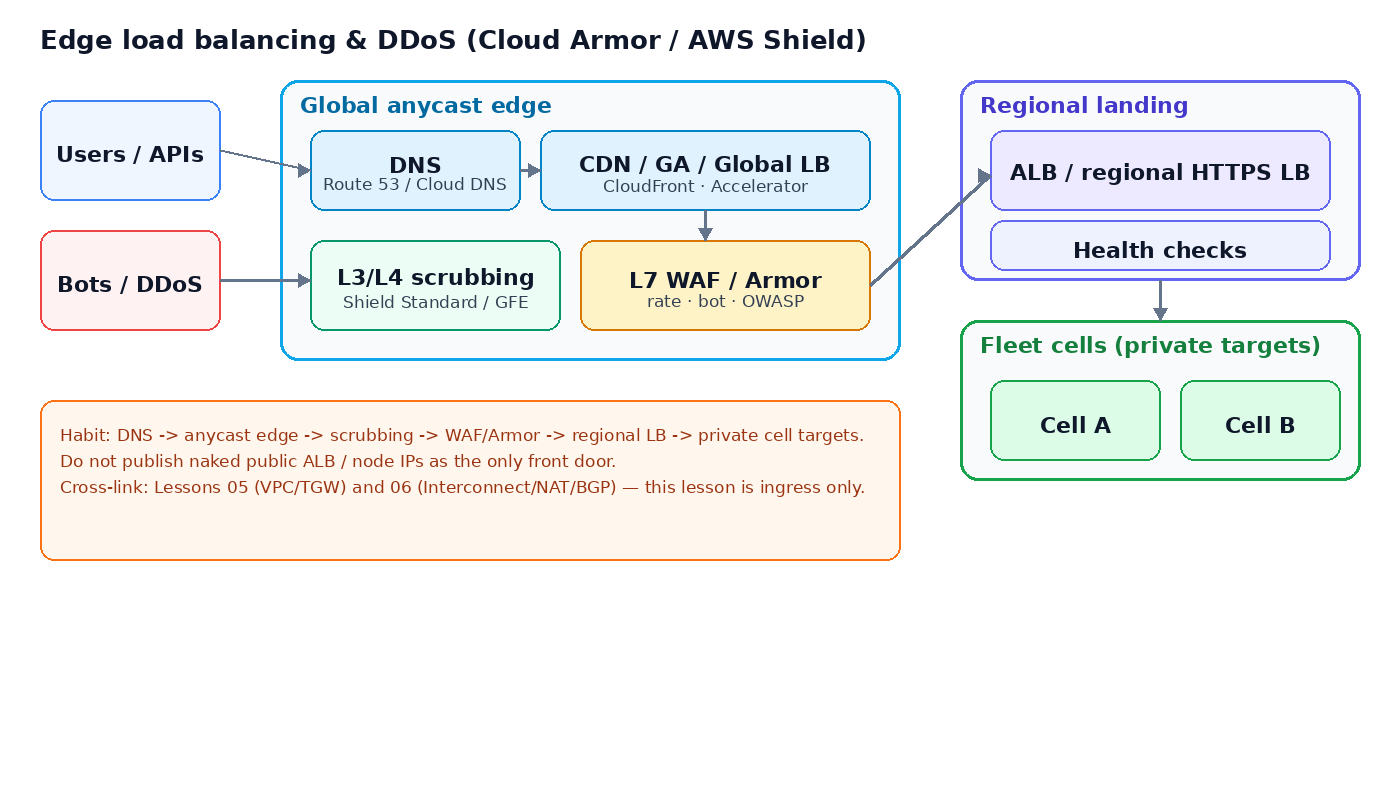
Read it top-down: DNS points at anycast edge IPs, not at a single regional ALB EIP. Volumetric junk dies at the provider perimeter (Shield Standard / Google front end). Remaining HTTP hits WAF / Cloud Armor before the regional LB fans out to cell targets. Health checks tell both DNS and Shield Advanced whether “traffic spike” equals “app is dying.”
Cross-link: Internet egress from cells still follows Lesson 6 (NAT / Private Link). This lesson is ingress only — do not conflate Cloud NAT with edge protection.
Edge load balancing — pick the right front door
Think in jobs, not logos:
- Cacheable HTTP(S) → CDN (CloudFront / Cloud CDN / Fastly / Cloudflare). Terminates TLS near users, caches GETs, origin shield optional.
- Non-cacheable HTTP(S) APIs → still often CDN or global HTTPS LB in front of regional ALB for anycast + WAF attachment points.
- TCP/UDP / static anycast IPs / multi-region failover without HTTP semantics → Global Accelerator (AWS) or equivalent L4 anycast; endpoints are ALB/NLB/EIPs across regions.
- Regional only → ALB/NLB alone. Fine for internal or tightly geo-scoped apps; weak as the sole public entry for a global fleet.
# AWS: inventory the public front door
aws elbv2 describe-load-balancers \
  --query 'LoadBalancers[].{Name:LoadBalancerName,Scheme:Scheme,Type:Type,DNS:DNSName}'
aws cloudfront list-distributions \
  --query 'DistributionList.Items[].{Id:Id,Domain:DomainName,Aliases:Aliases.Items}'
aws globalaccelerator list-accelerators
aws globalaccelerator list-listeners --accelerator-arn ARN

# GCP: global vs regional HTTP(S) LB + backends
gcloud compute forwarding-rules list --global
gcloud compute backend-services list --global
gcloud compute url-maps list
Design rule: public clients hit edge, edge forwards to regional LB, regional LB targets are private (or tightly SG-scoped). Exposing worker node public IPs “for debugging” is how you skip every scrubbing layer.
# Mental model (AWS)
Users -> Route53 -> CloudFront or Global Accelerator
                 -> (Shield Standard inline at edge)
                 -> AWS WAF web ACL
                 -> ALB (internet-facing or internal via GA)
                 -> target groups / pods in cells

# Mental model (GCP)
Users -> Cloud DNS -> Global external Application Load Balancer
                   -> Cloud Armor security policy on backend service
                   -> NEG / IG backends in cells
AWS Shield vs Google Cloud Armor — operator model
| Concern | AWS | GCP |
|---|---|---|
| Always-on L3/L4 | Shield Standard (no cost, automatic on CloudFront, Route 53, GA, ELB, EIPs) | Google Front End / network DDoS for resources behind Google LB |
| Paid / enhanced | Shield Advanced — visibility, SRT, cost protection, health-based detection, L7 auto-mitigation via WAF | Cloud Armor WAF policies; Managed Protection Plus adds Adaptive Protection, bill protection, response support |
| L7 rules | AWS WAF (often bundled value with Shield Advanced) | Cloud Armor security policy rules on backend services |
| Adaptive / ML L7 | Shield Advanced automatic application-layer DDoS mitigation (WAF rules in count/block) | Cloud Armor Adaptive Protection suggested rules |
# AWS Shield Advanced — what is protected?
aws shield list-protections
aws shield describe-attack --attack-id ATTACK_ID   # during / after an event
aws shield describe-subscription

# Associate Route 53 health check with Shield protection (health-based detection)
# Console/API: protection + HealthCheckId — alerts when attack coincides with unhealthy

# AWS WAF on CloudFront (scope CLOUDFRONT) or regional (ALB/API GW)
aws wafv2 list-web-acls --scope CLOUDFRONT --region us-east-1
aws wafv2 get-web-acl --scope CLOUDFRONT --id ID --name NAME --region us-east-1

# GCP Cloud Armor
gcloud compute security-policies list
gcloud compute security-policies describe POLICY
gcloud compute backend-services describe BACKEND --global \
  --format='yaml(securityPolicy)'
# Cloud Armor — illustrative rate-limit + deny rule sketch
# Attach securityPolicy to the backend service, not "the VM"
rules:
- action: rate_based_ban
description: "per-IP flood tripwire"
match:
versionedExpr: SRC_IPS_V1
config:
srcIpRanges: ["*"]
rateLimitOptions:
conformAction: allow
exceedAction: deny(429)
enforceOnKey: IP
rateLimitThreshold:
count: 100
intervalSec: 60
priority: 1000
- action: allow
priority: 2147483647
match:
versionedExpr: SRC_IPS_V1
config:
srcIpRanges: ["*"]# AWS WAF — rate-based rule sketch (attach to CloudFront web ACL)
{
"Name": "per-ip-http-flood",
"Priority": 10,
"Action": { "Block": {} },
"Statement": {
"RateBasedStatement": {
"Limit": 2000,
"AggregateKeyType": "IP"
}
},
"VisibilityConfig": {
"SampledRequestsEnabled": true,
"CloudWatchMetricsEnabled": true,
"MetricName": "PerIpHttpFlood"
}
}Interview nuance: Shield Standard is not a substitute for architecture. Putting an ALB in a single AZ with no CDN still concentrates blast radius. Shield Advanced’s cost protection matters at hyperscale — DDoS-driven autoscaling and data-transfer spikes can dwarf the subscription if you are unprotected.
Decision tree: where should this packet die?
Concrete commands & config (operator set)
# Prove clients are not hitting cell public IPs
dig +short api.example.com
# Expect: CloudFront / GA / global LB anycast — not ALB regional DNS alone for global apps

# AWS: is this ALB internet-facing? who is allowed?
aws elbv2 describe-load-balancers --names prod-api \
  --query 'LoadBalancers[0].{Scheme:Scheme,Vpc:VpcId,AZs:AvailabilityZones}'
aws ec2 describe-security-groups --group-ids sg-xxx \
  --query 'SecurityGroups[0].IpPermissions'

# CloudFront origin must be reachable only from edge (OAC/OAI or SG/prefix lists)
aws cloudfront get-distribution-config --id E123

# GCP: backend policy attached?
gcloud compute backend-services describe api-backend --global \
  --format='value(securityPolicy,loadBalancingScheme,protocol)'

# During an event: separate "bytes in" from "5xx / latency"
# AWS: Shield Advanced event metrics + WAF sampled requests + ALB 5xx
# GCP: Cloud Armor preview / adaptive protection findings + LB backend metrics
# Terraform sketch — edge before regional (illustrative)
# aws_cloudfront_distribution + aws_wafv2_web_acl (CLOUDFRONT)
# aws_shield_protection on the CloudFront ARN / GA ARN / ALB ARN
# google_compute_security_policy + google_compute_backend_service.security_policyFailures & fixes
| Symptom | Likely root cause | Fix / mitigation |
|---|---|---|
| Regional ALB CPU / connection tables melt; CloudFront quiet | DNS/clients bypass edge (direct ALB DNS, old EIP, mobile app hardcode) | Force anycast entry; rotate secrets/endpoints; block direct origin |
| Legitimate users get 403 after “tuning WAF” | Rule too broad; geo/IP block; bot control false positive | Ship rules in count first; sampled requests; staged rollouts |
| Shield Advanced silent while app dies | No health check association; detection is volume-only | Attach Route 53 health checks; alert on unhealthy + traffic delta |
| L7 flood passes WAF | No rate-based rules; only static OWASP; no adaptive/auto mitigation | Rate limits per IP/session; enable Shield L7 auto-mitigation / Adaptive Protection |
| Cost spike mid-attack without “breach” | Autoscaling + egress absorbing junk at origin | Keep junk at edge; Shield Advanced cost protection; cache/static where possible |
| Global Accelerator healthy but users in one country fail | Endpoint weight / traffic dial; regional outage; blocked ports | Check GA endpoint groups; dual-region active; health check path realism |
| Cloud Armor policy “attached” but not enforcing | Attached to wrong backend service / not on the live URL map path | Trace URL map → backend service → security policy |
| NLB/EIP under UDP flood | Expectation that Shield Standard = infinite; app protocol amplifies | GA + Shield Advanced; protocol hardening; avoid open amplifiers |
Security & hardening
Edge is where hostile traffic dies and where you refuse to expose model APIs naked. Origin lock-down + WAF discipline is the difference between Shield theater and real defense.
| Control | Operator practice |
|---|---|
| Origin lock-down | ALB/NEG only from edge (OAC/OAI, SG prefix lists, private LB) — no public shortcut |
| WAF count-then-block | New rules in count/observe; then block; rate limits on inference paths |
| TLS everywhere | Edge terminates TLS; re-encrypt to origin when policy requires |
| Authn at edge for models | No anonymous public inference endpoints; API keys / JWT / mTLS before the cell |
| Rate-limit inference APIs | Per-IP / per-token quotas — GPU burn is both cost and abuse vector |
# Origin must not accept the world
aws ec2 describe-security-groups --group-ids sg-origin   --query 'SecurityGroups[0].IpPermissions'
# Cloud Armor / WAF: rate-based rule on /v1/completions (count first)
gcloud compute security-policies rules list POLICY
AI/ML fleets: model weights and inference endpoints are high-value targets — do not put a public ALB on a GPU serving Deployment “because Shield Standard exists.” Require authn at the edge, rate-limit tokens, and keep origins private so scrapers cannot exfiltrate models via unauthenticated inference or steal capacity.
Interview soundbites
- “Shield Standard is the floor, not the architecture.” Anycast edge + private origins is the design; Standard rides along.
- “CloudFront caches; Global Accelerator anycasts TCP/UDP.” Do not say they are the same product with different stickers.
- “WAF without rate limits is a signature museum.” HTTP floods need thresholds and adaptive controls, not only SQLi rules.
- “Count mode is how you avoid paging yourself.” New deny rules ship observe-first at fleet scale.
- “Health checks turn DDoS telemetry into availability telemetry.” Volume alone is not impact.
- “Origin must not be a public shortcut.” If attackers can skip the edge, you paid for theater.
How this maps to the JD
Hyperscale roles own availability under hostile traffic, not just “we have a load balancer.” You are expected to place scrubbing and policy at the edge, keep cells private, and reason about L3/L4 vs L7 failure modes the same way you reason about BGP and NAT. Next networking deep-dive: cluster networking — CNI, Cilium, eBPF — what happens east-west after the packet is inside the cell.
Next in the arc: Cluster networking: CNI, Cilium, eBPF fundamentals.
Watch (talks & demos)
Real-world talks and demos that map to this lesson — watch after the Failures & fixes table.
AWS re:Invent 2021 — AWS Shield: Automated layer 7 DDoS mitigation
How Shield Advanced proposes and applies WAF rules for L7 floods — count vs block, and why auto-mitigation sits on top of Standard L3/L4.
Open on YouTube (opens in a new tab)
Getting started with Cloud Armor Adaptive Protection — Google Cloud Tech
ML-assisted L7 detection on Cloud Armor Managed Protection Plus: findings, suggested rules, and operator workflow.
Open on YouTube (opens in a new tab)
AWS re:Invent 2023 — Enhance your app’s security & availability with Elastic Load Balancing (NET318)
ALB/NLB/GWLB scaling and security-relevant patterns — how the regional hop behaves once edge and WAF have done their job.
Open on YouTube (opens in a new tab)
References
- AWS Shield (opens in a new tab)
- AWS Shield Advanced (opens in a new tab)
- AWS WAF (opens in a new tab)
- Amazon CloudFront (opens in a new tab)
- AWS Global Accelerator (opens in a new tab)
- Elastic Load Balancing (opens in a new tab)
- Google Cloud Armor (opens in a new tab)
- Cloud Armor Adaptive Protection (opens in a new tab)
- GCP External Application Load Balancer (opens in a new tab)
- Prior lessons: 05 — VPC / TGW, 06 — Interconnect / NAT / BGP
Quick self-check
Out loud, in under two minutes:
- Why put CloudFront or a global HTTPS LB in front of a regional ALB instead of publishing the ALB as the only public DNS name?
- What does Shield Standard buy you that architecture alone does not — and what does it not fix?
- Walk a failure: CloudFront metrics look fine, ALB is drowning — where do you look first?
- When do you use Global Accelerator instead of CloudFront, and how does WAF/Armor attachment differ?