Lesson 16 — Workflow orchestration: Temporal & Argo Workflows
2026-09-24
What interviewers are really probing
Lesson 15 gated who may change the substrate. This lesson is about what runs after the change — multi-hour cell upgrades, drain waves, ML checkpoint → validate → promote, inference canaries that wait on humans or metrics. Interviewers are not asking “can you write a CronJob.” They want evidence you pick the right orchestration plane and keep it from becoming a blast-radius machine:
- Temporal vs Argo — when durable code workflows win vs when K8s-native DAG pods win (and how they compose)
- Determinism & history — Temporal workflow code that survives replay; Continue-As-New before history melts
- Task queues / workers — multi-cluster workers, sticky execution, starvation vs retry storms
- Argo CR surface — Workflow / CronWorkflow / WorkflowTemplate, DAG vs steps, artifacts, pod GC
- Fleet ops — upgrade orchestration, drain waves, canary across cells (echoes L3 / L4)
- ML pipelines — GPU train jobs as Argo steps; Temporal signals for promote/rollback; weights & signed images (L12–L14)
- Security — Temporal mTLS + payload encryption; Argo SA least privilege; private artifact buckets; no world-readable checkpoints
Interview sentence: “Atlantis applies the cell change; Temporal owns the durable multi-step saga (drain waves, canary signals, rollback); Argo runs the K8s-native GPU/batch DAGs with signed images and scoped weight IAM — workers and workflow SAs are never cluster-admin, and artifacts are never world-readable.”
Core diagram: Temporal + Argo composing for fleet / ML
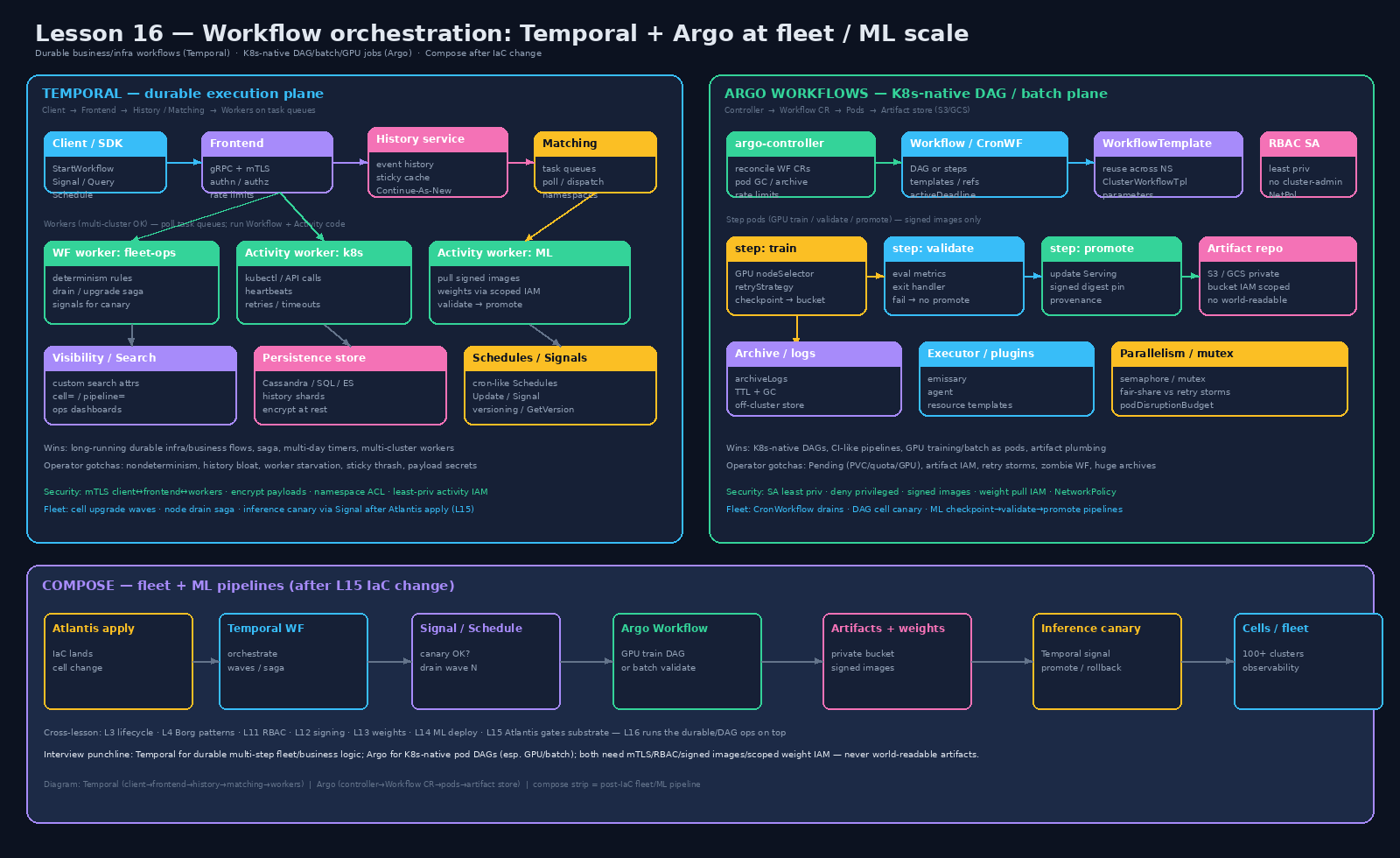
Read it top-down: An Atlantis apply (L15) lands a cell or ML-platform change → a Temporal client starts (or signals) a durable workflow through the Frontend (mTLS) → History persists every event; Matching dispatches work on task queues to workers that may live in many clusters → for K8s-native GPU/batch steps the Temporal activity (or a Schedule) submits an Argo Workflow CR → the workflow-controller spawns step pods that pull signed images, write artifacts to a private bucket, and optionally pull weights with scoped IAM (L13) → Temporal signals gate canary promote/rollback across fleet cells. The PNG compose strip is the interview story: IaC → durable saga → DAG pods → artifacts → canary.
Idiosyncrasies / operator depth
When Temporal wins vs when Argo wins
| Plane | Wins when | Footgun if forced |
|---|---|---|
| Temporal | Long-running durable business/infra logic: retries, timers (hours–days), signals, saga/compensation, multi-cluster workers, human-in-the-loop | Modeling every YAML DAG as Temporal activities that just kubectl apply — you reinvent Argo poorly |
| Argo Workflows | K8s-native DAGs, CI-like pipelines, GPU training/batch as pods, artifact plumbing (S3/GCS), CronWorkflow fan-out | Encoding multi-day business saga with signals/compensation purely as Workflow CRs — history of CRs and stuck Pending become the product |
| Compose | Temporal orchestrates when/whether; Argo executes pod DAGs | Two uncoordinated control planes racing the same Deployment |
At hyperscale: Temporal = durable control brain; Argo = K8s execution muscle. Same instinct as L4 (scheduler vs executor separation).
Temporal: workflow vs activity determinism
- Workflow code must be deterministic — given the same history, replay produces the same commands. No random, no local clock (
workflow.Now), no direct I/O, no unordered map iteration surprises in some languages. - Activities do the real world: HTTP, cloud APIs,
kubectl, GPU job submit, bucket GetObject. Retries, timeouts, heartbeats live here. - Nondeterminism error after a deploy = you changed workflow code without versioning (
GetVersion/ worker versioning) while open executions still replay old history. - Sticky execution caches the workflow worker to avoid full replay every task — great until the sticky worker dies and everyone pays replay cost at once.
Task queues, workers, namespaces
| Knob | Operator meaning |
|---|---|
| Task queue | Routing key: fleet-ops, ml-train-gpu, cell-us-east-1-a — workers poll what they can run |
| Worker identity | Horizontal scale by adding pollers; starvation = not enough workers or activities stuck without heartbeat |
| Namespace | Blast-radius + tenancy boundary (team/env); separate retention, search attributes, auth |
| Visibility / search attributes | cell_id, pipeline, change_ticket — how oncall finds “all drains for cell-a” |
| Schedule | Cron-like durable schedules (prefer over homemade CronJobs that fire StartWorkflow without visibility) |
History size, Continue-As-New, versioning
- Event history is the source of truth. Unbounded loops (poll forever, append forever) → history bloat → latency and
Workflow history size exceeds limit. - Continue-As-New checkpoints into a fresh run with carry-over state — mandatory for long-lived fleet controllers and chatty ML promotion loops.
- Worker versioning / GetVersion — ship new workflow logic without breaking open executions. Treat workflow code like a schema.
Argo: Workflow / CronWorkflow / WorkflowTemplate
| Kind | Use |
|---|---|
| Workflow | One-shot DAG or steps run |
| CronWorkflow | Scheduled (drains, nightly eval, drift-adjacent batch) — still a Workflow under the hood |
| WorkflowTemplate / ClusterWorkflowTemplate | Reuse; pin versions like modules in L15 |
DAG vs steps: DAG expresses dependencies explicitly (depends); steps are sequential lists with fan-out via withItems. For ML “train → validate → promote”, DAG with explicit fail paths + exit handlers beats a fragile linear steps list.
Parallelism, retries, deadlines, artifacts
parallelism, semaphore/mutex — cap concurrent GPU pods or external API calls; without them CronWorkflow +retryStrategy= retry storm.retryStrategy+activeDeadlineSeconds— retries without a deadline are how zombie GPU jobs burn quota overnight.- Artifacts (S3/GCS) — outputs between steps; misconfigured IAM → Pending forever or world-readable checkpoints (security incident, not a “storage glitch”).
archiveLogs/ pod GC — keep enough for forensics; TTL aggressively or etcd/API and disks drown.- Resource templates / executor plugins — call K8s resources or plugins; still subject to admission (L11 / L14).
Fleet ops patterns (the JD meat)
| Pattern | Temporal role | Argo role |
|---|---|---|
| Cluster upgrade waves | Saga: cordon → drain → wait healthy → next cell; signal pause on SLO burn | Optional per-node DaemonSet/job steps |
| Node drain waves | Durable progress across hours; compensation if drain stuck | Pod-disruption-aware jobs; PDB-respecting batch |
| Canary across cells | Signal canary_ok / rollback from metrics or human | Rollout jobs / eval Workflows per cell |
| ML train → validate → promote | Outer workflow: gate promote on metrics + signed digest | Inner DAG: GPU train, eval pod, artifact publish |
| Post-Atlantis hook | Start workflow from apply comment / webhook with change ticket search attr | Materialize Jobs that Atlantis should not run inline |
Concrete commands & config
Temporal CLI — namespaces, workflows, visibility
# namespaces (blast radius)
temporal operator namespace list
temporal operator namespace describe --namespace fleet-ops

# start a durable cell-upgrade workflow
temporal workflow start \
  --namespace fleet-ops \
  --task-queue fleet-ops \
  --type CellUpgradeWorkflow \
  --workflow-id "upgrade-cell-a-2026-09-24" \
  --input '{"cell":"us-east-1-a","wave_size":5,"change_ticket":"ATL-1842"}'

# signal canary gate (inference promote)
temporal workflow signal \
  --namespace fleet-ops \
  --workflow-id "upgrade-cell-a-2026-09-24" \
  --name CanaryDecision \
  --input '{"promote":true,"digest":"sha256:abc…"}'

# describe + show history size pressure
temporal workflow describe --namespace fleet-ops --workflow-id "upgrade-cell-a-2026-09-24"
temporal workflow show --namespace fleet-ops --workflow-id "upgrade-cell-a-2026-09-24"

# visibility: find drains for a cell
temporal workflow list --namespace fleet-ops \
  --query "cell_id = 'us-east-1-a' AND ExecutionStatus = 'Running'"
Temporal worker sketch (determinism boundary)
// Workflow: deterministic orchestration only
func CellUpgradeWorkflow(ctx workflow.Context, in CellUpgradeInput) error {
    ao := workflow.ActivityOptions{
        StartToCloseTimeout: 30 * time.Minute,
        HeartbeatTimeout:    2 * time.Minute,
        RetryPolicy:         &temporal.RetryPolicy{MaximumAttempts: 5},
    }
    ctx = workflow.WithActivityOptions(ctx, ao)

    var drained int
    for wave := 0; wave*in.WaveSize < in.NodeCount; wave++ {
        if err := workflow.ExecuteActivity(ctx, DrainWaveActivity, in, wave).Get(ctx, &drained); err != nil {
            return err // or run compensation activity
        }
        // wait for human/metrics signal before next wave
        var decision CanaryDecision
        sigCtx, _ := workflow.WithCancel(ctx)
        workflow.GetSignalChannel(sigCtx, "CanaryDecision").Receive(sigCtx, &decision)
        if !decision.Promote {
            return workflow.ExecuteActivity(ctx, RollbackWaveActivity, in, wave).Get(ctx, nil)
        }
        // long-running controller: Continue-As-New periodically
        if workflow.GetInfo(ctx).GetContinueAsNewSuggested() {
            return workflow.NewContinueAsNewError(ctx, CellUpgradeWorkflow, in.AfterWave(wave))
        }
    }
    return nil
}

// Activity: real I/O, heartbeats, retries — NOT in workflow code
func DrainWaveActivity(ctx context.Context, in CellUpgradeInput, wave int) (int, error) {
    // kubectl / cloud API / internal fleet API — heartbeat while waiting
    return drainWave(ctx, in, wave)
}
Temporal mTLS / client config (sketch)
# workers and clients share the trust domain — no plaintext frontend in prod
temporal:
  hostPort: temporal-frontend.temporal.svc:7233
  namespace: fleet-ops
  tls:
    clientCertPath: /var/run/certs/client.pem
    clientKeyPath: /var/run/certs/client.key
    caPath: /var/run/certs/ca.pem
    serverName: temporal-frontend.temporal.svc
  # payload codec / encryption keys via env from Secret (not plaintext in ConfigMap)
Argo Workflow — ML checkpoint → validate → promote
apiVersion: argoproj.io/v1alpha1
kind: Workflow
metadata:
  generateName: ml-promote-
  namespace: ml-pipelines
  labels:
    pipeline: weights-promote
    cell: us-east-1-a
spec:
  serviceAccountName: argo-ml-pipeline   # least privilege — not default
  entrypoint: train-validate-promote
  activeDeadlineSeconds: 14400          # hard cap — no infinite GPU burn
  parallelism: 4
  podGC:
    strategy: OnWorkflowSuccess
    deleteDelayDuration: 1h
  artifactRepositoryRef:
    configMap: artifact-repositories
    key: default
  templates:
    - name: train-validate-promote
      dag:
        tasks:
          - name: train
            template: gpu-train
          - name: validate
            depends: train.Succeeded
            template: eval-metrics
          - name: promote
            depends: validate.Succeeded
            template: promote-serving
      # on any failure: notify Temporal / page — do not leave half-promoted weights
      onExit: exit-handler

    - name: gpu-train
      retryStrategy:
        limit: "2"
        retryPolicy: Always
        backoff:
          duration: "2m"
          factor: 2
      nodeSelector:
        nvidia.com/gpu.product: NVIDIA-H100
      container:
        image: registry.example.com/ml/train@sha256:…   # digest-pinned, signed (L12)
        imagePullSecrets: [{name: regcred}]
        resources:
          limits:
            nvidia.com/gpu: 8
        envFrom:
          - secretRef: {name: weights-reader}           # scoped GetObject only (L13)
        command: ["python", "-m", "train"]
      outputs:
        artifacts:
          - name: checkpoint
            path: /out/checkpoint
            s3:
              key: "checkpoints/{{workflow.name}}/ckpt"

    - name: eval-metrics
      container:
        image: registry.example.com/ml/eval@sha256:…
        command: ["python", "-m", "eval", "--fail-under", "0.92"]
      inputs:
        artifacts:
          - name: checkpoint
            path: /in/checkpoint

    - name: promote-serving
      resource:
        action: apply
        manifest: |
          apiVersion: apps/v1
          kind: Deployment
          metadata:
            name: inference-canary
          spec:
            template:
              spec:
                containers:
                  - name: serve
                    image: registry.example.com/ml/serve@sha256:…
      # Prefer signaling Temporal to flip serving weight vs mutating prod directly from Argo

    - name: exit-handler
      steps:
        - - name: notify
            template: notify-temporal
            when: "{{workflow.status}} != Succeeded"
Argo CronWorkflow + RBAC scraps
apiVersion: argoproj.io/v1alpha1
kind: CronWorkflow
metadata:
  name: nightly-cell-drain-canary
  namespace: fleet-ops
spec:
  schedule: "0 3 * * *"
  concurrencyPolicy: Forbid          # never overlap drain waves
  successfulJobsHistoryLimit: 3
  failedJobsHistoryLimit: 3
  workflowSpec:
    serviceAccountName: argo-drain
    activeDeadlineSeconds: 7200
    entrypoint: drain-canary
    templates:
      - name: drain-canary
        steps:
          - - name: drain
              templateRef:
                name: drain-wave-template
                template: drain
# --- RBAC: Workflow SA may create pods in its NS; may NOT patch cluster-scoped RBAC ---
apiVersion: v1
kind: ServiceAccount
metadata:
  name: argo-ml-pipeline
  namespace: ml-pipelines
---
apiVersion: rbac.authorization.k8s.io/v1
kind: Role
metadata:
  name: argo-ml-pipeline
  namespace: ml-pipelines
rules:
  - apiGroups: [""]
    resources: [pods, pods/log, configmaps, secrets]
    verbs: [get, list, watch, create, patch, delete]
  - apiGroups: ["argoproj.io"]
    resources: [workflows, workflowtaskresults]
    verbs: [get, list, watch, patch]
# Bind Role — never ClusterRole/cluster-admin for pipeline SAs
Submit / debug Argo
argo submit -n ml-pipelines --watch ml-promote.yaml
argo list -n ml-pipelines
argo get -n ml-pipelines ml-promote-xxxxx
argo logs -n ml-pipelines ml-promote-xxxxx
argo stop  -n ml-pipelines ml-promote-xxxxx    # graceful
argo terminate -n ml-pipelines ml-promote-xxxxx

# Pending forever? classic causes
kubectl -n ml-pipelines describe pod | grep -A20 "Events:"
kubectl -n ml-pipelines get resourcequota,limitrange
kubectl describe nodes | grep -A5 "nvidia.com/gpu"
Failures & fixes
| Symptom | Likely root cause | Fix |
|---|---|---|
Temporal Nondeterminism after deploy | Workflow code changed; replay diverges | GetVersion / worker versioning; never silently edit branching of open WFs; pin worker builds |
| Workflow latency spikes / history limit | Unbounded loop; chatty activities; missing Continue-As-New | Continue-As-New on suggest; shrink payloads; move bulk data to object store + pass refs |
| Activities timing out / worker “idle” but backlog grows | Not enough pollers; wrong task queue; sticky thrash; no heartbeat on long activity | Scale workers; fix queue names; heartbeat; raise HeartbeatTimeout appropriately |
| Schedule fires twice / missed | Multiple Schedule writers; clock skew assumptions; namespace confusion | Single owner per Schedule ID; use Temporal Schedule not homemade Cron+Start |
| Argo Workflow stuck Pending | PVC unbound; ResourceQuota; GPU shortage; imagePullBackoff; affinity | Describe pod/events; fix storage class; request GPU nodes; digest-pinned pulls with pull secret |
| Artifact step fails with AccessDenied | Bucket IAM / wrong key prefix / missing KMS decrypt | Scoped IAM for WF SA / IRSA; CMEK grant; never make bucket public to “unblock” |
| Retry storm burns GPU quota | retryStrategy without activeDeadlineSeconds / Forbid concurrency | Hard deadlines; concurrencyPolicy: Forbid; semaphore on GPU templates |
| Zombie Workflow Running forever | Missing deadline; exit handler never fires; controller overload | activeDeadlineSeconds; controller HA + rate limits; terminate + alert on age |
| Half-promoted model in serving | Promote step ran after failed validate; no outer gate | DAG depends: validate.Succeeded; Temporal signal gate; atomic serving pointer update |
| Secret in Temporal payload plaintext | Activity args logged/visibility | Payload encryption/codec; pass secret refs/handles not values; scrub visibility |
Security & hardening
This is the execution plane sitting on everything L11–L15 hardened. A perfect PSS profile still loses if an Argo SA is cluster-admin, Temporal payloads carry weight URLs with standing keys, or artifact buckets are world-readable.
Temporal controls
| Control | Operator practice |
|---|---|
| mTLS everywhere | Clients, workers, frontend — private CA; rotate; no plaintext 7233 on a shared VPC “because internal” |
| Authn / authz per namespace | JIT access for break-glass; operators ≠ application writers |
| Encrypt payloads | Codec / encryption so history store & visibility do not become a secret lake |
| Least-priv activity IAM | Activity workers assume scoped cloud roles (cell drain API, weight reader, never s3:*) |
| NetworkPolicy | Workers egress only to frontend + required APIs; frontend not world-reachable |
| Audit | Workflow ID = change ticket; search attributes carry change_ticket, actor |
Argo controls
| Control | Operator practice |
|---|---|
| Workflow SA least privilege | Role in namespace only; no cluster-admin; separate SA for ML vs fleet drain |
| Deny privileged / hostPath | PSS restricted + admission (L11 / L14); workflows invent pods — treat them as untrusted compute |
| Signed, digest-pinned images | Cosign verify / admission; no :latest in templates (L12) |
| Private registries | imagePullSecrets or node identity; block Docker Hub surprise pulls in prod NS |
| Artifact bucket IAM | Private bucket; CMEK; deny public ACLs; prefix-scoped read/write per pipeline |
| Secrets | K8s Secrets / external secrets → env; never bake long-lived cloud keys into templates; prefer WI/IRSA |
| NetworkPolicy | Pipeline pods talk to registry, artifact bucket endpoint, model store — not the flat cluster network |
| Controller hardening | Argo server SSO/RBAC; disable --auth-mode=server anonymous; audit who can argo submit |
AI/ML angle (required)
Workflows that pull model weights/checkpoints, train, or promote serving inherit L12–L14:
| Risk | Hardening |
|---|---|
| Weight exfil via artifact repo | Private bucket; no allUsers; separate writer (train) vs reader (serve); CMEK (L13) |
| Unsigned train/serve image | Digest pin + cosign verify in admission before Workflow pods schedule (L12) |
| Standing weight credentials in WF spec | Short-lived WI/IRSA on the step SA; Secret store refs; Temporal passes handles, not keys |
| GPU pod escape / lateral move | PSS restricted; no privileged; NetPol; GPU pool isolation (L14) |
| Provenance gap | Record image digest + checkpoint hash + Workflow UID in Temporal search attrs / artifact metadata (SLSA mindset) |
| World-readable eval artifacts | Same bucket controls as weights; TTL delete; no anonymous HTTPS listing |
# Sketch NetworkPolicy for ml-pipelines Workflow pods
apiVersion: networking.k8s.io/v1
kind: NetworkPolicy
metadata:
  name: ml-pipeline-egress
  namespace: ml-pipelines
spec:
  podSelector:
    matchLabels:
      workflows.argoproj.io/workflow: ""  # tighten with your labels
  policyTypes: [Egress]
  egress:
    - to:
        - namespaceSelector:
            matchLabels: {kubernetes.io/metadata.name: kube-system}
      # DNS — prefer explicit CoreDNS selectors in real clusters
    - to:
        - podSelector: {}  # replace with registry / artifact gateway selectors
      ports:
        - {protocol: TCP, port: 443}
Punchline: Temporal durability without mTLS/encrypted payloads is a durable secret leak. Argo convenience without SA/image/bucket discipline is a GPU-powered exfil path. L15 decides who may change the substrate; L16 decides who may run code that touches weights and cells.
Interview soundbites
- “Temporal for durable multi-day fleet sagas with signals; Argo for K8s-native GPU/batch DAGs — compose, don’t collapse.”
- “Workflow code is deterministic; activities do I/O — nondeterminism after deploy is a versioning bug, not bad luck.”
- “History bloat means you needed Continue-As-New yesterday.”
- “Task queues are blast-radius and capacity boundaries — starve or storm starts with queue design.”
- “CronWorkflow without Forbid concurrency and activeDeadlineSeconds is how you DDoS your own GPU pool.”
- “Artifacts are data planes: private buckets, scoped IAM, CMEK — never world-readable checkpoints.”
- “Workflow SAs are least privilege; PSS restricted; digest-pinned signed images only.”
- “Promote is a Temporal signal gated on validate — not an Argo step that always runs.”
- “Atlantis applies; Temporal orchestrates; Argo executes pods — three planes, one change ticket.”
- “mTLS to Temporal frontend; payload encryption; NetPol on workers — durable ≠ trusted.”
- “Search attributes carry cell_id and change_ticket — oncall finds the wave without SSH folklore.”
- “Zombie Running workflows get deadlines, GC, and alerts — hope is not an SRE strategy.”
How this maps to the JD
Hyperscale platforms do not “SSH and drain.” They run durable orchestration across 100+ clusters: upgrades, drains, canaries, and ML promote paths that survive process death and human sleep. Temporal maps to the Borg-like control instincts from L4 with modern durable execution; Argo maps to K8s-native batch/DAG execution on the cells L3 provisioned and L15 changed safely. Security posture composes L11–L14: RBAC, signed images, weight IAM, admission — now applied to workflow runners themselves. Next curriculum beat: systems design tradeoffs for rapidly evolving platforms, then the deeper AI/ML GPU track.
Watch (talks & demos)
Real talks that map to this lesson — watch after the Failures & fixes table.
Declarative and Imperative Kubernetes Operations with Temporal and M3 (KubeCon NA 2021)
Chronosphere + Temporal: why operators detect drift declaratively while Temporal runs imperative mitigation (upgrades, quorum-safe rolls) — the exact compose model for fleet ops.
Open on YouTube (opens in a new tab)
Large Scale Batch Processing with Argo Workflows and Events (Intuit / KubeCon)
~40k pipelines, multi-cluster Argo, HA controller, PDBs, rate limits, semaphores — operator depth for Argo at fleet/batch scale (including ML-adjacent data pipelines).
Open on YouTube (opens in a new tab)
Getting to know Temporal (Maxim Fateev)
Founder-level walkthrough of durable execution, workflow vs activity, retries, and why this replaces homemade saga/queue folklore — grounding for the Temporal half of the lesson.
Open on YouTube (opens in a new tab)
References
- Temporal docs (opens in a new tab) · Workflows (opens in a new tab) · Activities (opens in a new tab) · Task Queues (opens in a new tab) · Continue-As-New (opens in a new tab) · Versioning (opens in a new tab) · Security (opens in a new tab)
- Argo Workflows docs (opens in a new tab) · Workflow concept (opens in a new tab) · DAG (opens in a new tab) · Artifacts (opens in a new tab) · CronWorkflow (opens in a new tab) · Security / RBAC (opens in a new tab)
- CNCF Argo (opens in a new tab) · Temporal (open source) (opens in a new tab)
- Prior: 15 — Terraform / Atlantis · 14 — ML inference/training deploy hardening · 13 — ML weights / checkpoint hardening · 12 — Node/container hardening / supply chain · 11 — Cluster security / PSS / RBAC · 04 — Borg/Mesos orchestration · 03 — Cluster provisioning
Quick self-check
Out loud, in under two minutes:
- When do you choose Temporal over Argo Workflows — and when do you compose both?
- Why must Temporal workflow code be deterministic, and what breaks if you change it under open executions?
- What does Continue-As-New buy you operationally at fleet scale?
- Name three reasons an Argo Workflow stays Pending and how you diagnose each.
- How do you harden an ML promote pipeline (images, weight IAM, SA, artifacts, promote gate)?
- How does L16 sit on top of L15 (Atlantis) and L12–L14 (signing / weights / deploy hardening)?