Lesson 4 — Borg/Mesos-like orchestration patterns
2026-09-12
What interviewers are really probing
They are not asking you to recite the Borg paper. They want to know whether you can reason about schedulers as product decisions: who owns placement, how priority and preemption actually work under contention, why gang scheduling exists, and how Kubernetes both inherits and breaks with Borg/Mesos ideas when you run 100+ cells.
I have seen teams treat kube-scheduler like a black box until a batch wave starved online serving — then discover PriorityClass was never wired, TopologySpread conflicted with the Cluster Autoscaler, and nobody owned the “offer vs request” model for spot capacity. The Borg/Mesos vocabulary is how you talk about that without hand-waving.
| System | Scheduling model | Unit of work | Isolation boundary |
|---|---|---|---|
| Borg | Centralized Borgmaster + Borglets | Job → Alloc → Task | Cell (shared machines, hard priority) |
| Mesos | Two-level: master offers → framework decides | Framework Task / Executor | Framework + role / quota |
| Kubernetes | Centralized kube-scheduler (+ plugins) | Pod (sometimes Job/CRD) | Cluster / namespace / PriorityClass / ResourceQuota |
Core diagram: three schedulers, one problem
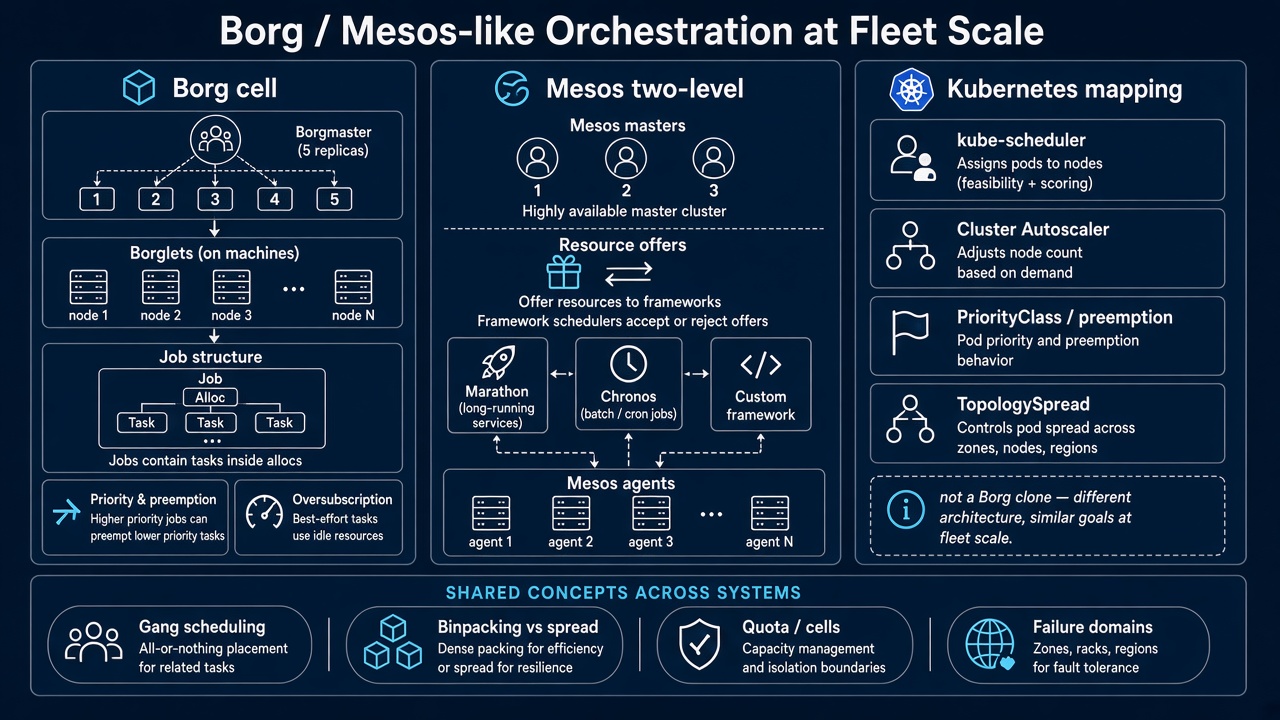
Read left to right: Borg is a single opinionated scheduler for a cell. Mesos offers resources and lets frameworks decide. Kubernetes looks Borg-like (one scheduler), but at fleet scale you reintroduce Mesos-style specialization with custom schedulers, Kueue, Volcano, and per-team queues — two-level thinking without calling it Mesos.
The concepts that actually show up in production
1. Allocs / resource shapes vs “just request CPU”
Borg allocs reserved a resource envelope that tasks shared. In K8s, the closest operators are:
- Pod
requests/limits(and Guaranteed / Burstable / BestEffort QoS) - PriorityClass + preemption
- Node-level oversubscription (kubelet reserved CPU/memory, eviction thresholds)
- Vertical Pod Autoscaler / in-place resize (where enabled)
# Serving: Guaranteed QoS — requests == limits
apiVersion: v1
kind: Pod
metadata:
  name: checkout-api
  labels:
    tier: serving
spec:
  priorityClassName: prod-serving-p1
  containers:
    - name: app
      image: registry.example.com/checkout:1.2.3
      resources:
        requests: { cpu: "2", memory: "4Gi" }
        limits:   { cpu: "2", memory: "4Gi" }
---
# Batch: Burstable + lower priority — preemptible under pressure
apiVersion: scheduling.k8s.io/v1
kind: PriorityClass
metadata:
  name: batch-best-effort
value: 1000
preemptionPolicy: PreemptLowerPriority
globalDefault: false
description: "Batch / ML training — yield to serving"
Idiosyncrasy: if batch pods are BestEffort (no requests), they look “cheap” until memory pressure eviction thrashes the node and serving pods flap. Prefer explicit low PriorityClass + modest requests over BestEffort for anything that shares nodes with prod.
2. Two-level scheduling (Mesos) — why fleets reinvent it
Mesos masters advertise offers (CPU/mem/ports on agents). Frameworks accept or reject. That pattern returns when:
- One cluster hosts serving + Spark/Flink + ML training
- You need fair share / queueing beyond PriorityClass
- You want gang scheduling (all-or-nothing for N workers)
Interview trap: “Kubernetes has no two-level scheduling” is half-true. Core kube-scheduler is one level; production ML platforms add a second level (Kueue, Volcano, Yunikorn, custom) because PriorityClass alone cannot express queues, fair share, and gang constraints.
3. Gang scheduling
Training jobs and distributed systems often need all N pods placed before any start. Without gangs:
- 7/8 workers schedule
- The 8th waits on capacity
- The 7 idle-hold GPUs for hours
- Autoscaler oscillates
# Volcano / PodGroup sketch — API names vary; pattern is the point
apiVersion: scheduling.volcano.sh/v1beta1
kind: PodGroup
metadata:
  name: train-resnet-pg
spec:
  minMember: 8
  queue: ml-training
  minResources:
    cpu: "64"
    memory: 256Gi
    nvidia.com/gpu: "8"
# Diagnose a stuck gang / Job
kubectl get pods -l job-name=train-resnet -o wide
kubectl describe pods -l job-name=train-resnet | rg -n "FailedScheduling|Insufficient|didn't find"
kubectl get events -n ml --field-selector reason=FailedScheduling --sort-by=.lastTimestamp | tail -30
# Who is hogging the SKU?
kubectl describe nodes -l node.kubernetes.io/instance-type=p4d.24xlarge \
| rg -n "Allocated resources|nvidia.com/gpu|Name:"4. Binpacking vs spread
| Goal | Prefer | Mechanism |
|---|---|---|
| Cost / density | Binpack | MostAllocated scoring, consolidation CA, fewer nodes |
| Blast-radius / HA | Spread | TopologySpreadConstraints, pod anti-affinity |
| Mixed | Tiered | Pack batch; spread serving replicas across zones |
apiVersion: apps/v1
kind: Deployment
metadata:
  name: edge-api
spec:
  replicas: 12
  template:
    spec:
      topologySpreadConstraints:
        - maxSkew: 1
          topologyKey: topology.kubernetes.io/zone
          whenUnsatisfiable: DoNotSchedule
          labelSelector:
            matchLabels: { app: edge-api }
        - maxSkew: 1
          topologyKey: kubernetes.io/hostname
          whenUnsatisfiable: ScheduleAnyway
          labelSelector:
            matchLabels: { app: edge-api }
Idiosyncrasy: aggressive spread + undersized node groups = permanent Pending. Pair spread with PDBs, minAvailable, and CA expander strategy (least-waste vs priority) or you will fight yourself in every incident review.
5. Priority, preemption, and oversubscription
Borg ran production + batch on the same machines with hard priority. K8s can too — if you wire it deliberately:
# Inventory priority landscape
kubectl get priorityclass
kubectl get pods -A -o custom-columns=\
NAME:.metadata.name,NS:.metadata.namespace,\
PC:.spec.priorityClassName,QOS:.status.qosClass,NODE:.spec.nodeName

# Simulate contention: what would preempt whom?
kubectl get pods -A -o json \
  | jq -r '.items[] | select(.spec.priority!=null)
    | [.spec.priority, .metadata.namespace, .metadata.name] | @tsv' \
  | sort -n
# kubelet eviction — the quiet sibling of preemption
# (node config / kubelet configmap — illustrative)
evictionHard:
memory.available: "500Mi"
nodefs.available: "10%"
evictionSoft:
memory.available: "1Gi"
evictionSoftGracePeriod:
memory.available: 1mIdiosyncrasy: scheduler preemption and kubelet eviction are different control loops. Preemption frees capacity for a higher-priority Pending pod; eviction reacts to node pressure. Blaming “the scheduler” for OOMKills is a classic interview fail.
Concrete commands & config (operator set)
# Scheduler decisions (enable SchedulerExpand in audit / use events)
kubectl get events -A --field-selector reason=Scheduled --sort-by=.lastTimestamp | tail -20
kubectl get events -A --field-selector reason=FailedScheduling --sort-by=.lastTimestamp | tail -40

# Plugin / profile awareness (scheduler config — control plane)
# Look for profiles, plugins, extenders, percentageOfNodesToScore
kubectl -n kube-system get cm kube-scheduler-config -o yaml 2>/dev/null || true

# Cluster Autoscaler signals
kubectl -n kube-system logs deploy/cluster-autoscaler --tail=200 \
  | rg -n "ScaleUp|ScaleDown|Unremovable|max cluster|expander"

# Spot / interruptible: label and taint from bootstrap (Lesson 3)
kubectl get nodes -l lifecycle=spot -o wide
kubectl taint nodes -l lifecycle=spot spot=true:NoSchedule --dry-run=client -o yaml | head
# Example: dedicated batch queue via taints + tolerations (Mesos-role vibe)
apiVersion: v1
kind: Pod
metadata:
name: spark-executor
spec:
tolerations:
- key: spot
operator: Equal
value: "true"
effect: NoSchedule
- key: workload
operator: Equal
value: batch
effect: NoSchedule
nodeSelector:
workload: batch
priorityClassName: batch-best-effort
containers:
- name: executor
image: spark:3.5
resources:
requests: { cpu: "4", memory: "16Gi" }
limits: { memory: "16Gi" } # CPU burstable OK for batchFailures & fixes
| Symptom | Likely root cause | Fix / mitigation |
|---|---|---|
Pods Pending forever; events say Insufficient cpu | Binpack + no CA headroom; or requests oversized vs node allocatable | Right-size requests; raise CA max; check kube-reserved; split SKUs |
| 7/8 workers Running, 1 Pending for hours | No gang scheduling; partial placement holds GPUs | PodGroup / Kueue / Volcano; or all-or-nothing Job controller |
| Serving latency spike during batch wave | Missing / wrong PriorityClass; BestEffort batch | Pin serving to high PriorityClass + Guaranteed QoS; lower batch |
| CA scales up then immediately scales down | TopologySpread / PDB prevents drain; “unremovable” nodes | Soften whenUnsatisfiable; tune PDB; CA ignore annotations carefully |
| Preemption thrash (pods bouncing) | Priority values too close; retry storms | Widen priority bands; backoff; separate node pools for hostile workloads |
| OOMKill on Guaranteed pods | Limits too tight or node memory accounting / hugepages / kernel | Raise limits; check cgroup v2; don’t confuse eviction with app leak |
| Custom scheduler pods never bind | Multi-scheduler: schedulerName mismatch | Align spec.schedulerName with non-default scheduler Deployment |
| Namespace “has quota” but still starves | ResourceQuota vs Priority; fair-share missing | Add queueing layer; per-team ResourceQuota + PriorityClass matrix |
Security & hardening
Scheduling policy is multi-tenant security. Priority, quota, and taints decide whether a hostile batch Job can starve secured serving or land on sensitive SKUs.
| Control | Operator practice |
|---|---|
| PriorityClass abuse | Bound who can create high PriorityClass; protect system / serving bands |
| ResourceQuota fence | Soft multi-tenant fence per namespace/team — CPU/GPU/memory caps |
| Taints for sensitive SKUs | GPU inference / HSM-adjacent / regulated pools: taint + explicit tolerations only |
| Batch vs serving policy | Don’t let BestEffort batch preempt or co-reside with secured serving without policy |
# Sensitive GPU pool — require explicit toleration + PriorityClass
apiVersion: scheduling.k8s.io/v1
kind: PriorityClass
metadata:
  name: prod-inference-p1
value: 100000
globalDefault: false
description: "Prod inference only; RBAC-gated"
---
# Node: taint gpu-sku=inference:NoSchedule
# Pod: tolerations + priorityClassName: prod-inference-p1 + ResourceQuota on nvidia.com/gpu
AI/ML fleets: isolate training vs inference node pools; gate who can schedule onto GPU SKUs that hold loaded weights in memory. ResourceQuota + queueing (Kueue) prevents one team’s training wave from exhausting capacity used by authenticated inference — treat GPU time as a secured resource, not a free-for-all.
Interview soundbites
- “Kubernetes is Borg-inspired, not Borg.” Shared ideas: cells≈clusters, Borglet≈kubelet, jobs/tasks≈Pods, priority/preemption. Missing Borg allocs and first-class cell oversubscription — you reconstruct them with QoS, PriorityClass, and node pools.
- “Mesos two-level is still the right mental model for mixed fleets.” When serving and training share metal, you need an admitter/queue above kube-scheduler — that is the framework layer.
- “Gang scheduling is an efficiency feature, not a nicety.” Partial placement burns accelerators. Say “all-or-nothing” and name Kueue/Volcano.
- “Preemption ≠ eviction.” Scheduler frees space for a higher-priority Pending pod; kubelet reacts to pressure. Own both in the design.
- “Spread vs pack is a product choice per tier.” Serving spreads across zones; batch packs for $/GPU. One TopologySpread for everything is a smell.
How this maps to the JD
Hyperscale compute jobs expect you to operate the scheduler as infrastructure: contention between online and batch, accelerator packing, fair share across teams, and failure modes when autoscaling and topology policy fight. Borg/Mesos language is how you show you have thought about 100+ clusters as many cells with local schedulers — not one magical control plane.
Next in the arc: cloud networking (VPC, peering, Shared VPC, Transit Gateway) — the fabric those cells hang on.
Watch (talks & demos)
Real-world talks and demos that map to this lesson — watch after the Failures & fixes table.
Cluster Management at Google with Borg — John Wilkes (GOTO 2016)
Priority, packing, and cell-level scheduling — the Borg side of the Lesson 4 comparison.
Open on YouTube (opens in a new tab)
Large-scale cluster management at Google with Borg (paper talk)
Utilization, admission control, and isolation themes that map to PriorityClass / QoS / node pools.
Open on YouTube (opens in a new tab)
References
- Large-scale cluster management at Google with Borg (PDF) (opens in a new tab)
- Omega: flexible, scalable schedulers for large compute clusters (opens in a new tab)
- Apache Mesos architecture (opens in a new tab)
- Kubernetes scheduler (opens in a new tab)
- Pod priority and preemption (opens in a new tab)
- Pod topology spread constraints (opens in a new tab)
- Cluster Autoscaler (opens in a new tab)
- Kueue (opens in a new tab)
- Volcano (opens in a new tab)
Quick self-check
Out loud, in under two minutes:
- Contrast Borg’s centralized scheduler with Mesos’ offer model — and name where Kubernetes sits.
- Give one production reason you would add a queue/gang layer above kube-scheduler.
- Walk a failure: batch wave causes serving latency — symptom → root cause → fix involving PriorityClass and QoS.
- Explain why TopologySpread + undersized node groups produces permanent Pending — and what you change first.