Lesson 14 — AI/ML security: securing inference/training deployments (admission, network policy, secrets, GPU isolation)
2026-09-22
What interviewers are really probing
Lesson 13 closed the weight / checkpoint plane (CMEK, writer/reader SA, signed digests). This lesson hardens the deployments that consume those artifacts — the training Jobs and inference Deployments that land on GPU nodes with cloud identity, network egress, and secrets.
They want evidence you treat train and serve as hostile neighbors that share a fleet but not trust:
- Namespace + identity split —
model-trainingvsmodel-serving; no shared ServiceAccount; separate WI/IRSA roles - Admission as the last gate — signed images (L12), signed/digest-pinned model refs (L13), deny privileged / hostPath / hostNetwork /
:latest, require non-root + GPU RuntimeClass, PSS Restricted - NetworkPolicy default-deny — weight-store VPC endpoints + private registry only; block public HF/internet from prod; train cannot talk to serve (and vice versa except intentional metrics)
- Secrets hygiene — External Secrets / CSI; short-lived WI/IRSA; never bake HF tokens or API keys into images or weight buckets; no long-lived tokens in env
- GPU pool isolation — dedicated node pools; taints + pool labels train vs serve; MIG when multi-tenant; no time-slicing across trust boundaries
- Front door — private LB / mesh mTLS (L10); no naked public LoadBalancer without Armor/WAF (L7)
- Compose — signed image + signed weight + hardened deploy = the full AI/ML stack (L11 → L12 → L13 → L14)
Interview sentence: “I separate train and serve namespaces and SAs, admit only signed images and digest-pinned weights, default-deny egress to private stores, keep secrets out of env and buckets, and isolate GPU pools with taints — so a compromised trainer cannot exfil or pivot into serving.”
Core diagram: train/serve NS → admission → NetPol → secrets → private stores
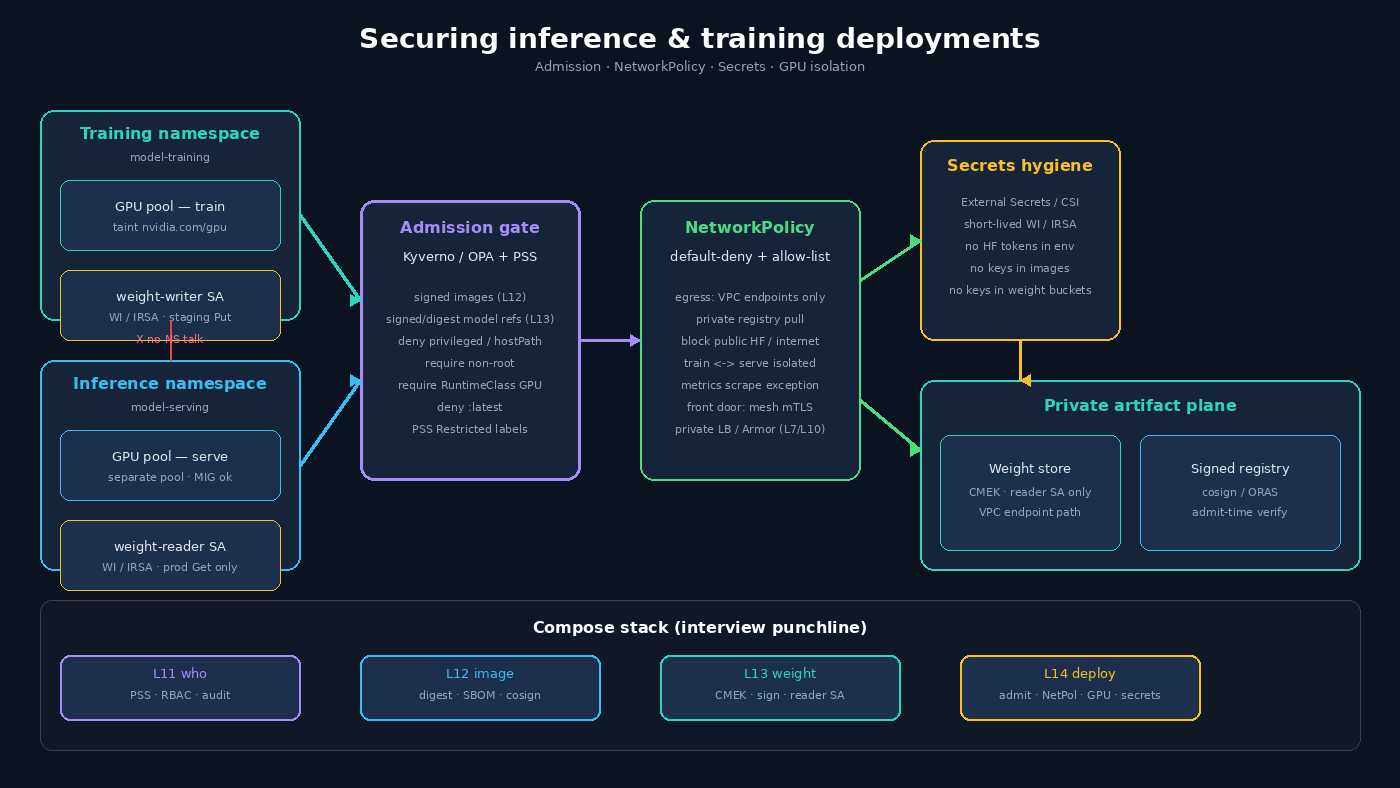
Read it top-down (left-to-right on the PNG): Training and Inference namespaces each own a GPU pool and a distinct SA (writer vs reader) → every Pod create hits an admission gate (Kyverno/OPA + PSS Restricted: signed image, signed/digest model ref, no privileged/hostPath, RuntimeClass for GPU) → NetworkPolicy default-deny allows only weight-store VPC endpoints and the private registry; train and serve cannot talk to each other → secrets arrive via External Secrets / CSI bound to short-lived WI/IRSA — never HF tokens in env or beside weights → pulls land on the private weight store + signed registry from L13 / L12. Compose strip on the PNG: L11 who → L12 image → L13 weight → L14 deploy.
Idiosyncrasies / operator depth
Namespace and SA split (the cheap control that interviews skip)
| Boundary | Operator practice | Footgun |
|---|---|---|
| Namespaces | model-training and model-serving (plus staging/canary if needed) | One ml namespace for notebooks, train, and serve |
| ServiceAccounts | weight-writer (train) vs weight-reader (serve); never shared | ClusterRoleBinding that lets either SA create Pods cluster-wide |
| Cloud identity | Separate WI/IRSA roles; staging Put vs prod Get (L13) | Node instance role still has s3:* on models |
| RBAC | Inference SA cannot get/list Secrets broadly; cannot create in train NS | edit on both NS for the same CI bot |
Namespace alone is not isolation — pair with NetPol, RBAC, and admission or you only renamed folders.
Admission: what must fail closed before a GPU ever wakes
Compose L11 + L12 + L13 into one admit path for model-* namespaces:
| Rule | Why |
|---|---|
| verifyImages (cosign / Ratify) | Unsigned serving/training image = supply-chain fail |
| Digest-pin model refs | Tag-moving weights are the ML version of :latest |
| Deny privileged / CAP_SYS_ADMIN | GPU debug habits become escape hatches |
| Deny hostPath / hostNetwork / hostPID | Weight theft and node pivots |
Require runAsNonRoot + drop ALL | PSS Restricted baseline |
| Require RuntimeClass for GPU pods | Stops accidental default runtime without device plugin/isolation |
Deny :latest on images and model OCI tags | Force immutable refs |
| Require pool labels / tolerations | Train Job cannot land on serve pool (and reverse) |
OPA Gatekeeper ConstraintTemplates or Kyverno ClusterPolicies — pick one fleet-wide; do not run conflicting enforce modes on the same resource.
NetworkPolicy: default-deny is the product, allow-list is the exception
From L9:
- Ingress: only mesh sidecar / front-door / Prometheus scrape (labeled). No pod-to-pod from other NS.
- Egress: VPC endpoint CIDRs (or FQDN policies via Cilium) for S3/GCS/ECR/GAR; DNS; maybe control-plane. Deny
0.0.0.0/0and public HF from prod. - Cross-NS: train ↛ serve and serve ↛ train. Metrics may flow to a central monitoring NS only.
- NCCL / RDMA (train): if multi-NIC training needs wide east-west, scope it inside train NS + RDMA VLAN — never open that to serve. Wafer-style SKU/topology isolation belongs in the upcoming GPU platform arc; here the security point is trust-boundary, not CUDA.
Secrets: HF tokens are crown jewels, not env vars
| Bad | Better |
|---|---|
HF_TOKEN in Deployment env / ConfigMap | ExternalSecret → CSI mount, or short-lived WI to private mirror |
| Token baked into image layers | Rebuild from private base; scan history |
| Token object next to weights in the bucket | Separate secrets plane; bucket has weights only |
| Long-lived static IAM keys in notebooks | WI/IRSA; disable key creation via SCP where possible |
Inference that needs a vendor API key uses CSI / ESO with rotation; training that needs hub access should prefer a private mirror already promoted under L13 controls.
GPU isolation: pools, taints, MIG vs time-slicing
Platform fuel (wafer-ai/gpu-perf-engineering-resources (opens in a new tab)) talks SKU pools — security borrows the same cut:
| Control | Operator meaning |
|---|---|
| Dedicated node pools | pool=train vs pool=serve labels; different ASGs / MIGs / machine families if needed |
| Taints | nvidia.com/gpu=true:NoSchedule plus workload=train:NoSchedule / workload=serve:NoSchedule |
| Tolerations + nodeAffinity | Workloads must opt in; accidental CPU Deployments do not steal GPU nodes |
| MIG | Hardware memory/fault isolation for multi-tenant same trust tier |
| Time-slicing | Not a security boundary — no memory isolation; never across train/serve or hostile tenants |
| Device plugin + RuntimeClass | Admission requires the RuntimeClass your GPU Operator ships; blocks “just privileged” GPU hacks |
Inference front door
- Prefer ClusterIP + mesh gateway with mTLS (L10) over
type: LoadBalancerpublic IPs. - If public: Cloud Armor / Shield / WAF (L7), authn at the edge, rate limits — model endpoints are scraping and prompt-abuse magnets.
- Admin/debug ports (tokenizer dump,
/metricswith internals) stay private.
Audit that catches the real incidents
- kube-apiserver audit: create/update Pod in
model-*(who admitted what image/digest). - Cloud audit / Data Access: GetObject on prod weight prefixes (compose L13).
- Alert: new principal, surge GetObject, Pod with privileged or hostPath that somehow bypassed (policy drift).
Hyperscale idiosyncrasies
- Per-cell policy packs: same Kyverno/Gatekeeper CRs + NetPol templates fleet-managed; drift = one cell becomes the soft underbelly.
- Break-glass: time-boxed break-glass SA with dual-control; never standing
cluster-adminfor ML platform oncall. - Canary serve NS: promote weights (L13) and Deployment digests together; NetPol identical to prod so canary is not an egress loophole.
Concrete commands & config
# --- Namespaces + PSS Restricted labels (L11 compose) ---
kubectl create ns model-training
kubectl create ns model-serving
for ns in model-training model-serving; do
  kubectl label ns "$ns" \
    pod-security.kubernetes.io/enforce=restricted \
    pod-security.kubernetes.io/audit=restricted \
    pod-security.kubernetes.io/warn=restricted \
    --overwrite
done
# ServiceAccounts — separate WI/IRSA (EKS-flavored; swap annotation for GKE/AKS WI)
apiVersion: v1
kind: ServiceAccount
metadata:
name: weight-writer
namespace: model-training
annotations:
eks.amazonaws.com/role-arn: arn:aws:iam::123456789012:role/weight-writer
---
apiVersion: v1
kind: ServiceAccount
metadata:
name: weight-reader
namespace: model-serving
annotations:
eks.amazonaws.com/role-arn: arn:aws:iam::123456789012:role/weight-reader# Kyverno ClusterPolicy — model-* admit gates (illustrative Enforce pack)
apiVersion: kyverno.io/v1
kind: ClusterPolicy
metadata:
name: harden-model-workloads
spec:
validationFailureAction: Enforce
background: true
rules:
- name: deny-latest-tag
match:
any:
- resources:
kinds: ["Pod"]
namespaces: ["model-training", "model-serving"]
validate:
message: "mutable :latest tags are forbidden for model workloads"
pattern:
spec:
containers:
- image: "!*:latest"
- name: require-nonroot-drop-caps
match:
any:
- resources:
kinds: ["Pod"]
namespaces: ["model-training", "model-serving"]
validate:
message: "PSS Restricted: runAsNonRoot + drop ALL"
pattern:
spec:
securityContext:
runAsNonRoot: true
containers:
- securityContext:
allowPrivilegeEscalation: false
capabilities:
drop: ["ALL"]
readOnlyRootFilesystem: true
- name: deny-host-namespaces-and-path
match:
any:
- resources:
kinds: ["Pod"]
namespaces: ["model-training", "model-serving"]
validate:
message: "hostPath / hostNetwork / privileged forbidden"
deny:
conditions:
any:
- key: "{{ request.object.spec.hostNetwork || false }}"
operator: Equals
value: true
- key: "{{ request.object.spec.volumes[].hostPath || '' }}"
operator: NotEquals
value: ""
- name: require-gpu-runtimeclass
match:
any:
- resources:
kinds: ["Pod"]
namespaces: ["model-training", "model-serving"]
selector:
matchLabels:
gpu: "true"
validate:
message: "GPU pods must set runtimeClassName"
pattern:
spec:
runtimeClassName: "nvidia"
- name: verify-signed-serving-images
match:
any:
- resources:
kinds: ["Pod"]
namespaces: ["model-serving"]
verifyImages:
- imageReferences:
- "registry.example.com/serving/*"
mutateDigest: true
verifyDigest: true
required: true
attestors:
- count: 1
entries:
- keys:
publicKeys: |-
-----BEGIN PUBLIC KEY-----
# fleet cosign.pub (L12)
-----END PUBLIC KEY-----# NetworkPolicy — model-serving default-deny + private egress allow-list
apiVersion: networking.k8s.io/v1
kind: NetworkPolicy
metadata:
name: serving-default-deny
namespace: model-serving
spec:
podSelector: {}
policyTypes: ["Ingress", "Egress"]
---
apiVersion: networking.k8s.io/v1
kind: NetworkPolicy
metadata:
name: serving-allow-private-stores
namespace: model-serving
spec:
podSelector:
matchLabels:
app: inference
policyTypes: ["Egress", "Ingress"]
ingress:
- from:
- namespaceSelector:
matchLabels:
name: istio-gateways # or linkerd / ingress NS
- namespaceSelector:
matchLabels:
name: monitoring
ports:
- protocol: TCP
port: 8080
- protocol: TCP
port: 15090
egress:
# DNS
- to:
- namespaceSelector: {}
ports:
- protocol: UDP
port: 53
# VPC endpoint / prefix lists for weight store + private registry (CIDRs illustrative)
- to:
- ipBlock:
cidr: 10.10.0.0/24 # S3/GCS VPC interface endpoints
- ipBlock:
cidr: 10.20.0.0/24 # private registry
ports:
- protocol: TCP
port: 443
# Intentionally NO egress to model-training and NO 0.0.0.0/0# GPU pool isolation — taints on nodes; affinity+tolerations on workloads
# Node (train pool): kubectl taint nodes $N nvidia.com/gpu=true:NoSchedule workload=train:NoSchedule
# kubectl label nodes $N pool=train gpu=true
apiVersion: apps/v1
kind: Deployment
metadata:
name: inference
namespace: model-serving
spec:
selector:
matchLabels:
app: inference
template:
metadata:
labels:
app: inference
gpu: "true"
spec:
serviceAccountName: weight-reader
runtimeClassName: nvidia
securityContext:
runAsNonRoot: true
seccompProfile:
type: RuntimeDefault
tolerations:
- key: nvidia.com/gpu
operator: Equal
value: "true"
effect: NoSchedule
- key: workload
operator: Equal
value: serve
effect: NoSchedule
affinity:
nodeAffinity:
requiredDuringSchedulingIgnoredDuringExecution:
nodeSelectorTerms:
- matchExpressions:
- key: pool
operator: In
values: ["serve"]
containers:
- name: server
image: registry.example.com/serving/llama@sha256:beef...
securityContext:
allowPrivilegeEscalation: false
readOnlyRootFilesystem: true
capabilities:
drop: ["ALL"]
resources:
limits:
nvidia.com/gpu: "1"
volumeMounts:
- name: api-creds
mountPath: /var/run/secrets/api
readOnly: true
volumes:
- name: api-creds
csi:
driver: secrets-store.csi.k8s.io
readOnly: true
volumeAttributes:
secretProviderClass: inference-api-creds# External Secrets — no HF token in Pod env
apiVersion: external-secrets.io/v1beta1
kind: ExternalSecret
metadata:
name: inference-api-creds
namespace: model-serving
spec:
refreshInterval: 1h
secretStoreRef:
name: cluster-secret-store
kind: ClusterSecretStore
target:
name: inference-api-creds
creationPolicy: Owner
data:
- secretKey: token
remoteRef:
key: prod/inference/api-token# Authz / audit habits
kubectl auth can-i create pods -n model-serving \
--as=system:serviceaccount:model-training:weight-writer
# Expect: no
kubectl auth can-i get secrets -n model-serving \
--as=system:serviceaccount:model-serving:weight-reader
# Expect: no (CSI/ESO controller holds that power, not the workload SA)
kubectl get netpol -n model-serving
kubectl get clusterpolicy harden-model-workloads -o yaml | rg -n "validationFailureAction|verifyImages"
# Dry-run a bad Pod (privileged + :latest) — should deny
kubectl apply --dry-run=server -f bad-pod.yamlFailures & fixes
| Symptom | Likely root cause | Fix |
|---|---|---|
| Train Job schedules on serve GPU nodes | Missing pool taint/affinity; shared pool label | Separate pools; workload=serve:NoSchedule + required affinity |
| Inference pulls public HF at runtime | No egress NetPol; HF token in env; no private mirror | Default-deny + VPC endpoints; ESO/CSI; L13 promote to private store |
| Kyverno Allow but PSS warns Restricted | Namespace labels only warn/audit, not enforce | enforce=restricted on model-*; admit pack aligned |
AccessDenied GetObject from serve | Wrong SA / IRSA annotation; role missing prod Get | Fix WI binding; never fall back to node role |
| Signed image, unsigned model ref admitted | verifyImages only on serving image, not model OCI / digest pin | Extend policy for model refs (L13); init-container verify |
| Cross-NS pivot train → serve | Missing NetPol; shared CNI allow-all | Default-deny both NS; deny cross-NS selectors |
| GPU OOM / data leak across tenants | Time-slicing across trust tiers | MIG or dedicated GPU; ban time-slice for hostile multi-tenant |
| Public LB scraped / abused | type: LoadBalancer without Armor/auth | Mesh gateway + mTLS; Armor/WAF (L7/L10) |
| HF token in image history / bucket | Built into Dockerfile or uploaded with weights | Rotate; rebuild; separate secrets plane; bucket policy deny non-weight suffixes |
| Admit bypass via CronJob/Job template | Policy matches Pod only, not higher controllers inconsistently | Match Pod controllers + validate pod template; tests in CI (kyverno apply) |
| NCCL hang after NetPol | Train east-west blocked too hard | Allow within train NS / RDMA fabric only — do not open to serve |
Security & hardening
This lesson is the deployment hardening story. Walk this checklist in an interview after L12/L13 — the punchline is compose, not a new silo.
Admission gates (must-enforce on model-*)
| Control | Operator practice |
|---|---|
| Signed images | Kyverno/Ratify verifyImages; fleet cosign trust root (L12) |
| Signed / digest-pinned weights | Model OCI verify or init-container checksum; ban mutable tags (L13) |
| Deny privileged / hostPath / hostNetwork | Enforce + PSS Restricted labels |
| Non-root, drop ALL, readOnlyRootFilesystem | Where writable scratch needed, emptyDir only |
| RuntimeClass for GPU | Required label/selector; blocks unmanaged GPU paths |
Deny :latest | Images and model artifact tags |
| Pool placement | Require tolerations + affinity matching train/serve |
NetworkPolicy / egress
| Control | Operator practice |
|---|---|
| Default-deny | Ingress + egress on both NS |
| Private path only | Weight-store VPC endpoints; private registry; no public HF from prod |
| NS isolation | Train ↛ serve; serve ↛ train; metrics exception labeled |
| Front door | Mesh mTLS / private LB; Armor if public (L7, L10) |
| Exfil resistance | No 0.0.0.0/0; alert on NetPol edits in model-* |
Secrets hygiene
| Control | Operator practice |
|---|---|
| External Secrets / CSI | Mount files; prefer not env for long-lived tokens |
| Short-lived WI/IRSA | Workload SA → cloud role; no static keys |
| No HF tokens in images or weight buckets | Separate secrets plane; rotate on leak |
| RBAC | Workload SA cannot list Secrets; ESO controller least-priv |
GPU pool isolation
| Control | Operator practice |
|---|---|
| Separate train vs serve pools | Labels + taints + affinity |
nvidia.com/gpu=true:NoSchedule | Plus workload-specific taints |
| MIG for same-trust multi-tenant | Hardware isolation |
| No time-slicing across trust boundaries | Time-slice ≠ security |
| Device plugin + RuntimeClass | Admit-time required |
Compose with L11 / L12 / L13
L11  who may create what     →  PSS Restricted, RBAC, WI binding, audit
L12  what image runs         →  digest, SBOM, cosign, admit verify
L13  what weight is loaded   →  CMEK, writer/reader SA, signed hash, private store
L14  how the deploy is shaped →  NS split, NetPol, secrets, GPU pools, front door
Weight pull path still gated: reader SA only; VPC endpoint; admit verifies digest/sig; cloud audit on GetObject. Registry/signing reminder: serving image and (when OCI) model package both signed. Bucket IAM: inference = GetObject (+ KMS Decrypt) on prod prefix only — never node role.
# Punchline checks — "prod-ready" inference
cosign verify "$SERVING_IMAGE"                 # L12
cosign verify "$MODEL_OCI_REF"                 # L13 (or verify-blob / model-signing)
kubectl get ns model-serving -o yaml | rg enforce=restricted
kubectl get netpol -n model-serving
kubectl get sa weight-reader -n model-serving -o yaml | rg role-arn
kubectl auth can-i create pods -n model-serving \
  --as=system:serviceaccount:model-training:weight-writer  # expect no
Punchline: Signed image + signed weight still fail open if the Deployment is privileged, shares an SA with training, can egress to the public internet, or runs on a time-sliced GPU next to a hostile tenant. L14 closes the deploy plane.
Interview soundbites
- “Train and serve are different namespaces, different SAs, different GPU pools — sharing any one of those is how exfil happens.”
- “Admission is the last gate: signed image, digest-pinned weight, non-root, no hostPath, RuntimeClass for GPU.”
- “NetworkPolicy default-deny; allow VPC endpoints and private registry only — prod does not speak HTTP to public HF.”
- “HF tokens never live in env, images, or weight buckets — External Secrets / CSI + short-lived WI.”
- “Time-slicing is a density trick, not a trust boundary; MIG or dedicated GPUs between trust tiers.”
- “Taints without affinity are theater — require pool labels on the Pod template.”
- “Public LoadBalancer on an LLM endpoint without Armor/mTLS is an abuse magnet.”
- “L11 who / L12 image / L13 weight / L14 deploy — say the compose stack out loud.”
- “If training can create Pods in serving, your RBAC is the vulnerability, not the model.”
- “Audit Pod creates in model- and GetObject on prod prefixes — those two streams catch most ML incidents.”*
How this maps to the JD
Hyperscale + AI/ML platform roles own safe GPU serving and training across many cells: least-privilege identities, admit-time supply-chain checks, egress that cannot exfil weights, secrets that are not ambient, and GPU pools that respect trust tiers. This is the operator half of wafer-ai/gpu-perf-engineering-resources (opens in a new tab) (SKU/pool isolation) joined to L11–L13. Next curriculum items shift toward IaC (Terraform + Atlantis) and the deeper GPU platform arc (topology, gang/Kueue, inference SLOs).
Watch (talks & demos)
Real talks that map to this lesson — watch after the Failures & fixes table.
Kyverno Introduction and Deep Dive
Policy-as-code for Kubernetes: validation, mutation, and verifyImages with cosign — the admit-time half of L12/L14 for model namespaces.
Open on YouTube (opens in a new tab)
Confidential Containers for GPU Compute (KubeCon EU 2024)
NVIDIA / Kata path for stronger GPU workload isolation — useful contrast when MIG and namespace NetPol are not enough for hostile multi-tenant AI.
Open on YouTube (opens in a new tab)
Introduction to External Secrets
External Secrets Operator syncing vault/cloud secrets into Kubernetes — the secrets-hygiene pattern (no HF tokens in env) this lesson requires.
Open on YouTube (opens in a new tab)
References
- Kyverno verifyImages (opens in a new tab) · Kyverno policies (opens in a new tab) · OPA Gatekeeper (opens in a new tab) · Ratify (opens in a new tab)
- Pod Security Standards (opens in a new tab) · NetworkPolicy (opens in a new tab) · RuntimeClass (opens in a new tab)
- External Secrets Operator (opens in a new tab) · Secrets Store CSI Driver (opens in a new tab)
- EKS IRSA (opens in a new tab) · GKE Workload Identity (opens in a new tab)
- NVIDIA GPU Operator — MIG (opens in a new tab) · Time-slicing (not a security boundary) (opens in a new tab)
- Cilium FQDN / egress policies (opens in a new tab) (when CIDR-only NetPol is too blunt)
- GPU/platform fuel: wafer-ai/gpu-perf-engineering-resources (opens in a new tab)
- Prior: 13 — ML weights / checkpoint hardening · 12 — Node/container hardening / supply chain · 11 — Cluster security / PSS / RBAC · 10 — Service mesh / mTLS · 09 — NetworkPolicy / multi-NIC / sFlow · 07 — Edge LB / DDoS / Armor
Quick self-check
Out loud, in under two minutes:
- Why is a shared
mlServiceAccount across train and serve an exfil path even with signed images? - List five admit-time rules you enforce on
model-servingbefore a GPU Pod starts. - What egress is allowed from prod inference — and what is explicitly denied?
- Where do HF / API tokens live, and where must they never live?
- When is MIG appropriate vs when is time-slicing a security smell?
- Say the compose stack: L11 / L12 / L13 / L14 — one sentence each.