Lesson 22 — AI/ML platform: prefill/decode disaggregation & MoE serving topology on the fleet
2026-09-30
What interviewers are really probing
Lesson 18 gave you SKU pools. Lesson 19 made NVLink / RDMA schedulable. Lesson 20 admitted train gangs without half-placing them — and told you not to share those gangs with latency inference. Lesson 21 made KV cache the capacity wallet and taught TTFT / TPOT / goodput under continuous batching. This lesson is the architecture half of that serving contract: when co-located prefill+decode fights for HBM and SMs, how do you disaggregate the pools, hand off KV over RDMA, and place MoE experts without melting the fabric — while keeping a security floor on every path?
Interviewers at hyperscale AI platforms (fuel: wafer-ai/gpu-perf-engineering-resources (opens in a new tab)) want evidence you have run PD-disaggregated and MoE serving under contention, not only “we deploy vLLM”:
- Why co-location hurts — prefill is compute-bound; decode is memory-bandwidth-bound; they fight for HBM/SM; TTFT vs TPOT tension from L21
- Prefill/decode disaggregation — separate pools/pods; KV transfer (RDMA / NVLink / offload); routing gateway; independent capacity sizing
- KV handoff / locality — Mooncake / DistServe-class patterns: transfer latency, replication, pin vs recompute
- MoE serving topology — expert parallelism (EP), expert placement across nodes/NICs, dispatch/combine all-to-all; capacity = active experts × (KV + weights); EP + DP + TP with L19 topology
- Scheduling isolation — prefill pools vs decode pools vs train gangs (L20); flavors/taints; don’t mix bursty prefill with latency decode on the same HBM
- Observability — prefill queue / TTFT, decode TPOT, KV transfer latency, expert imbalance, RDMA errors
- Security floor on every role — separate SAs for prefill vs decode vs experts; RO weight mounts; signed images; NetPol on KV/EP fabric; admission/RBAC (L11–L14, L9, L7)
Interview sentence: “I split prefill and decode into independent pools so TTFT and TPOT stop fighting for the same HBM, hand off KV over RDMA with locality-aware placement, size MoE EP capacity as active experts × seats, isolate those pools from train gangs, and every serve SA is read-only on signed weights with NetPol locking the KV and expert fabric.”
Core diagram: Client/Gateway → Prefill → KV (RDMA) → Decode (+ MoE EP, security floor)
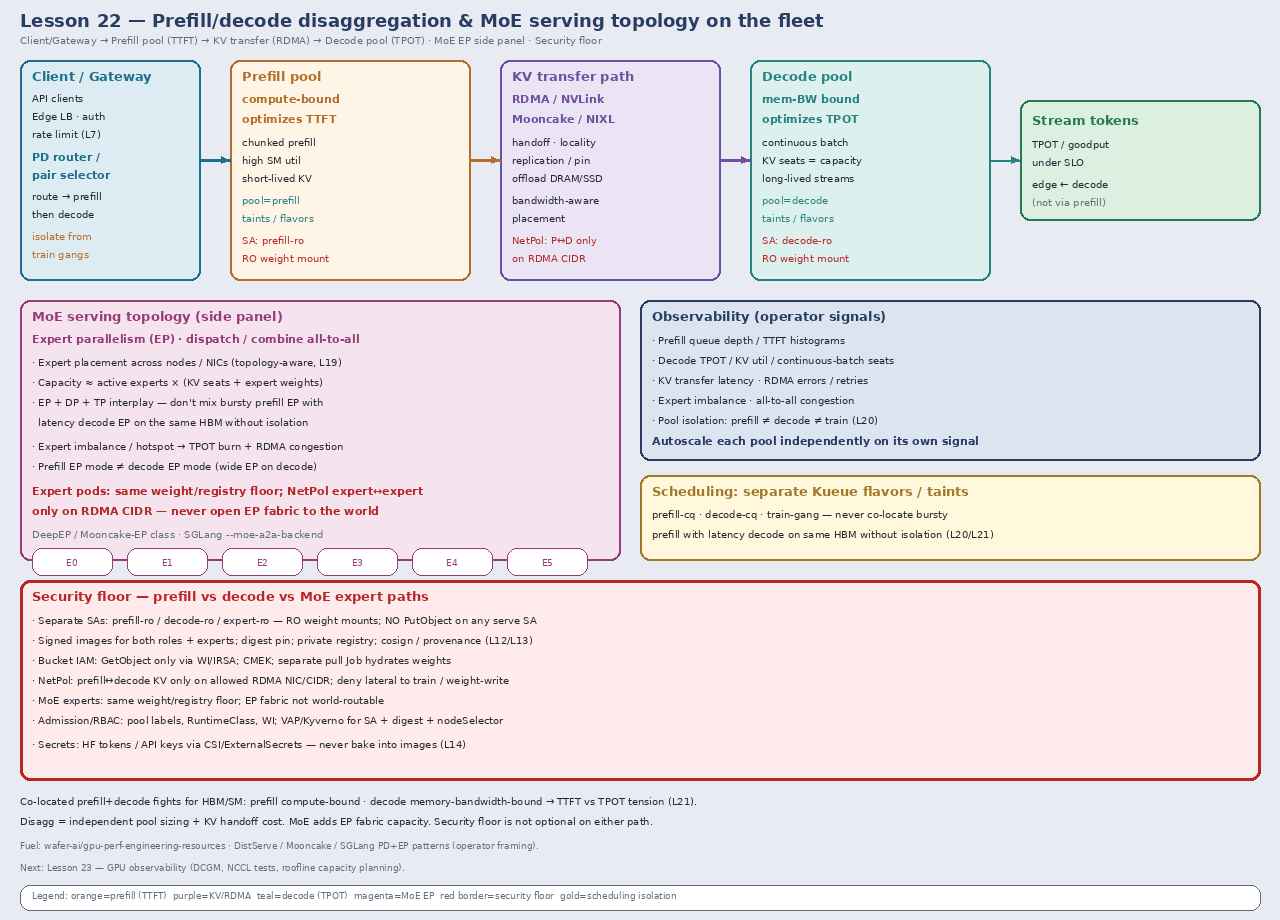
Read it left-to-right: Clients hit an edge gateway (auth, abuse rate limits from L7). A PD router picks a prefill↔decode pair (or MoE expert set) and admits work. Prefill workers burn SM cycles on long prompts and emit KV. That KV crosses a dedicated transfer path (RDMA / NVLink / Mooncake-class engine — not random East-West HTTP). Decode workers own the long-lived KV seats and stream tokens under TPOT. A MoE side panel adds expert parallelism: tokens dispatch/combine across experts on the RDMA fabric with topology constraints from L19. Everything sits on a security floor: separate read-only SAs, signed digests, NetPol locking P↔D and expert fabrics, admission on pool labels.
Idiosyncrasies / operator depth
1. Why co-located prefill + decode fights for HBM / SM
| Phase | Bound | What it wants | How it hurts the other |
|---|---|---|---|
| Prefill | Compute (SM) | Fat batch of prompt tokens; high FLOPs | Steals SM/HBM bandwidth → TPOT spikes for in-flight decode |
| Decode | Memory bandwidth | Many concurrent sequences × KV seats | Keeps HBM full → prefill TTFT queues / truncates |
| Co-located engine | Coupled | One max_num_seqs / one HBM wallet | You trade TTFT vs TPOT every time traffic mix shifts (L21) |
2. Prefill/decode disaggregation — operator shape
| Piece | Operator meaning |
|---|---|
| Prefill pool | Nodes/pods optimized for TTFT; may use different TP/DP/EP than decode |
| Decode pool | Nodes/pods optimized for TPOT + KV seats; long-lived streams |
| KV transfer | RDMA / NVLink / GPUDirect path; transfer latency is now part of TTFT |
| Router / gateway | Selects PD pair; retries; sticky decode for streaming; health on both sides |
| Independent sizing | Scale prefill on queue/TTFT; scale decode on KV util/TPOT — different HPAs |
| Placement | Bandwidth-aware: prefer same rail / NVLink domain for P↔D pairs (L19) |
3. KV cache handoff / replication / locality (Mooncake / DistServe-class)
| Pattern | Operator use | Gotcha |
|---|---|---|
| Direct P→D RDMA | Lowest latency handoff after prefill | Needs healthy NICs, pinned memory, topology affinity |
| Disaggregated KV store | Mooncake-style DRAM/SSD pool; reuse prefixes across requests | Another failure domain; still RO from serve SAs |
| Replicate / pin hot KV | Decode locality; crash recovery of streams | Memory tax; eviction policy becomes SLO |
| Recompute vs transfer | Sometimes cheaper to re-prefill than cross a congested fabric | Measure transfer p99 vs recompute cost |
| Chunked / pipelined transfer | Overlap remaining prefill with early decode | Complexity in router + engine versions |
4. MoE serving topology — EP, placement, capacity
| Concept | Operator meaning |
|---|---|
| Expert parallelism (EP) | Experts sharded across ranks/nodes; tokens dispatch then combine |
| All-to-all fabric | Dispatch/combine rides RDMA (DeepEP / Mooncake-EP class) — congestion = TPOT |
| Active experts × KV | Capacity ≠ “GPU count”; it’s routed experts in play × seats + expert weight footprint |
| EP + DP + TP | Prefill often narrower EP; decode often wider EP for GroupGEMM density (L19) |
| Expert imbalance | Hot experts starve TPOT; need EPLB / rebalance / admission |
| Isolation | Don’t run bursty prefill EP and latency decode EP on the same HBM island |
5. Scheduling: isolate prefill vs decode vs train (L20)
| Workload | Pool / queue | Why |
|---|---|---|
| Prefill | pool=prefill taints + Kueue flavor; TTFT PriorityClass | Bursty SM; must not steal decode HBM |
| Decode | pool=decode taints + flavor; latency PriorityClass | TPOT SLOs; long-lived KV |
| MoE experts | Same role pools or dedicated EP fabric nodes | Fabric congestion isolation |
| Train gangs | Exclusive gang CQ | Must not borrow inference HBM “for one more replica” |
6. Observability that interviewers expect
| Signal | Shape |
|---|---|
| Prefill queue / TTFT | Histograms + waiting depth on prefill pool |
| Decode TPOT / KV util | Histograms + free blocks on decode pool (L21) |
| KV transfer latency | p50/p99 handoff; timeout / retry counters |
| RDMA errors | Link flaps, QP errors, GPUDirect failures |
| Expert imbalance | Tokens/expert skew; hot-expert queue |
| All-to-all congestion | NIC util, PFC/pause, NCCL/EP collective time |
| Per-pool goodput | Tokens under both TTFT and TPOT after disagg |
7. When not to disaggregate
| Situation | Prefer |
|---|---|
| Tiny models / short contexts / soft SLOs | Co-located continuous batching (L21) |
| No RDMA / unreliable multi-NIC | Fix topology first (L19) |
| Transfer p99 > TTFT budget | Co-locate or same-rail placement; or recompute |
| Ops maturity missing (no dual HPA, no NetPol) | Don’t add failure domains you can’t page |
Concrete commands & config
Inspect prefill / decode / expert pools
# Pool nodes
kubectl get nodes -l pool=prefill -o wide
kubectl get nodes -l pool=decode -o wide
kubectl get nodes -l pool=moe-ep -o wide

# Workloads
kubectl get deploy,pods -n model-inference \
  -l 'role in (prefill,decode,moe-expert)' -o wide

# Pending under pressure (wrong taints / flavors)
kubectl get pods -n model-inference --field-selector=status.phase=Pending
kubectl describe pod -n model-inference -l role=prefill | sed -n '/Node-Selectors:/,/Events:/p'
SGLang / vLLM-class PD disaggregation flags (shape)
# Prefill instance (shape — flag names drift by engine/version)
python -m sglang.launch_server \
  --model-path /models/deepseek-v3 \
  --disaggregation-mode prefill \
  --host 0.0.0.0 --port 30000 \
  --tp-size 8 \
  --trust-remote-code \
  --disaggregation-ib-device mlx5_bond_0 \
  --mem-fraction-static 0.85

# Decode instance
python -m sglang.launch_server \
  --model-path /models/deepseek-v3 \
  --disaggregation-mode decode \
  --host 0.0.0.0 --port 30000 \
  --tp-size 8 \
  --trust-remote-code \
  --disaggregation-ib-device mlx5_bond_0 \
  --mem-fraction-static 0.90

# MoE + EP (decode often wider EP) — interview vocabulary
#   --enable-dp-attention
#   --dp-size 8
#   --ep-size 64
#   --moe-a2a-backend deepep   # or mooncake-class backend
# Transfer backend talking points: Mooncake Transfer Engine, NIXL, NVLink path
Deployment sketches: prefill + decode (RO weights, separate SAs)
apiVersion: apps/v1
kind: Deployment
metadata:
  name: sglang-prefill
  namespace: model-inference
  labels:
    role: prefill
    trust-domain: inference-prod
spec:
  replicas: 4
  selector:
    matchLabels:
      role: prefill
  template:
    metadata:
      labels:
        role: prefill
        trust-domain: inference-prod
        pool: prefill
    spec:
      serviceAccountName: prefill-readonly
      runtimeClassName: nvidia
      nodeSelector:
        sku: h100
        pool: prefill
      tolerations:
        - key: pool
          value: prefill
          effect: NoSchedule
      containers:
        - name: sglang
          image: registry.example.com/ml/sglang@sha256:REPLACE_PREFILL
          args:
            - "--model-path=/models/deepseek-v3"
            - "--disaggregation-mode=prefill"
            - "--tp-size=8"
            - "--disaggregation-ib-device=mlx5_bond_0"
          resources:
            limits:
              nvidia.com/gpu: "8"
              memory: 512Gi
            requests:
              nvidia.com/gpu: "8"
              cpu: "32"
              memory: 512Gi
          volumeMounts:
            - name: weights
              mountPath: /models
              readOnly: true
          securityContext:
            allowPrivilegeEscalation: false
            readOnlyRootFilesystem: true
            capabilities:
              drop: ["ALL"]
      volumes:
        - name: weights
          persistentVolumeClaim:
            claimName: deepseek-v3-weights-ro
---
apiVersion: apps/v1
kind: Deployment
metadata:
  name: sglang-decode
  namespace: model-inference
  labels:
    role: decode
    trust-domain: inference-prod
spec:
  replicas: 8
  selector:
    matchLabels:
      role: decode
  template:
    metadata:
      labels:
        role: decode
        trust-domain: inference-prod
        pool: decode
    spec:
      serviceAccountName: decode-readonly
      runtimeClassName: nvidia
      nodeSelector:
        sku: h100
        pool: decode
      tolerations:
        - key: pool
          value: decode
          effect: NoSchedule
      containers:
        - name: sglang
          image: registry.example.com/ml/sglang@sha256:REPLACE_DECODE
          args:
            - "--model-path=/models/deepseek-v3"
            - "--disaggregation-mode=decode"
            - "--tp-size=8"
            - "--disaggregation-ib-device=mlx5_bond_0"
          resources:
            limits:
              nvidia.com/gpu: "8"
              memory: 512Gi
            requests:
              nvidia.com/gpu: "8"
              cpu: "32"
              memory: 512Gi
          volumeMounts:
            - name: weights
              mountPath: /models
              readOnly: true
          securityContext:
            allowPrivilegeEscalation: false
            readOnlyRootFilesystem: true
            capabilities:
              drop: ["ALL"]
      volumes:
        - name: weights
          persistentVolumeClaim:
            claimName: deepseek-v3-weights-ro
Kueue flavors: prefill vs decode (isolation from train)
apiVersion: kueue.x-k8s.io/v1beta1
kind: ResourceFlavor
metadata:
  name: gpu-prefill-h100
spec:
  nodeLabels:
    pool: prefill
    sku: h100
---
apiVersion: kueue.x-k8s.io/v1beta1
kind: ResourceFlavor
metadata:
  name: gpu-decode-h100
spec:
  nodeLabels:
    pool: decode
    sku: h100
---
# ClusterQueues (sketch): prefill-cq and decode-cq each bind their flavor.
# Train gang CQ must NOT borrow these flavors ([L20]).
NetworkPolicy: prefill ↔ decode KV path only
apiVersion: networking.k8s.io/v1
kind: NetworkPolicy
metadata:
  name: pd-default-deny
  namespace: model-inference
spec:
  podSelector: {}
  policyTypes: ["Ingress", "Egress"]
---
apiVersion: networking.k8s.io/v1
kind: NetworkPolicy
metadata:
  name: prefill-to-decode-kv
  namespace: model-inference
spec:
  podSelector:
    matchLabels:
      role: prefill
  policyTypes: ["Egress"]
  egress:
    - to:
        - podSelector:
            matchLabels:
              role: decode
      # App control plane + transfer ports — pin real ports in-cluster
      ports:
        - protocol: TCP
          port: 30000
    - to:
        # RDMA / RoCE data plane CIDR for KV transfer only ([L9])
        - ipBlock:
            cidr: 10.50.0.0/16
    - to:
        - namespaceSelector:
            matchLabels:
              role: dns
---
apiVersion: networking.k8s.io/v1
kind: NetworkPolicy
metadata:
  name: decode-from-prefill-kv
  namespace: model-inference
spec:
  podSelector:
    matchLabels:
      role: decode
  policyTypes: ["Ingress", "Egress"]
  ingress:
    - from:
        - podSelector:
            matchLabels:
              role: prefill
        - namespaceSelector:
            matchLabels:
              role: edge-gateway
  egress:
    - to:
        - podSelector:
            matchLabels:
              role: moe-expert
      ports:
        - protocol: TCP
          port: 30000
    - to:
        - ipBlock:
            cidr: 10.50.0.0/16   # RDMA fabric
    - to:
        - namespaceSelector:
            matchLabels:
              role: dns
# Explicitly NO path to train namespaces or weight-write Jobs
Dual HPA: prefill on TTFT queue; decode on KV util
apiVersion: autoscaling/v2
kind: HorizontalPodAutoscaler
metadata:
  name: sglang-prefill
  namespace: model-inference
spec:
  scaleTargetRef:
    apiVersion: apps/v1
    kind: Deployment
    name: sglang-prefill
  minReplicas: 4
  maxReplicas: 24
  metrics:
    - type: Pods
      pods:
        metric:
          name: prefill_waiting_requests
        target:
          type: AverageValue
          averageValue: "4"
    - type: Pods
      pods:
        metric:
          name: ttft_slo_burn_ratio
        target:
          type: AverageValue
          averageValue: "800m"
---
apiVersion: autoscaling/v2
kind: HorizontalPodAutoscaler
metadata:
  name: sglang-decode
  namespace: model-inference
spec:
  scaleTargetRef:
    apiVersion: apps/v1
    kind: Deployment
    name: sglang-decode
  minReplicas: 8
  maxReplicas: 48
  metrics:
    - type: Pods
      pods:
        metric:
          name: kv_cache_usage_ratio
        target:
          type: AverageValue
          averageValue: "750m"
    - type: Pods
      pods:
        metric:
          name: tpot_slo_burn_ratio
        target:
          type: AverageValue
          averageValue: "800m"
Admission floor: role SA + pool + digest
apiVersion: admissionregistration.k8s.io/v1
kind: ValidatingAdmissionPolicy
metadata:
  name: pd-serve-floor
spec:
  failurePolicy: Fail
  matchConstraints:
    resourceRules:
      - apiGroups: ["apps"]
        apiVersions: ["v1"]
        operations: ["CREATE", "UPDATE"]
        resources: ["deployments"]
  validations:
    - expression: >
        !has(object.metadata.labels) ||
        object.metadata.labels["trust-domain"] != "inference-prod" ||
        (
          object.metadata.labels["role"] == "prefill" &&
          object.spec.template.spec.serviceAccountName == "prefill-readonly"
        ) ||
        (
          object.metadata.labels["role"] == "decode" &&
          object.spec.template.spec.serviceAccountName == "decode-readonly"
        ) ||
        (
          object.metadata.labels["role"] == "moe-expert" &&
          object.spec.template.spec.serviceAccountName == "expert-readonly"
        )
      message: "inference-prod PD/MoE roles require matching *-readonly SA"
Failures & fixes
| Symptom | Likely cause | Fix / mitigation |
|---|---|---|
| TTFT fine co-located; TPOT dies under load | Prefill steals SM/HBM from decode | Disaggregate; isolate pools; dual HPA |
| Decode starved / empty batches after split | Prefill under-provisioned or router imbalance | Scale prefill on queue/TTFT; sticky PD pairs |
| KV transfer stalls; streams hang | RDMA flap / wrong NIC / no GPUDirect | Pin IB device; topology affinity (L19); timeout→recompute/failover |
| TTFT regresses after disagg | Transfer p99 ate the budget | Same-rail placement; Mooncake locality; measure handoff histogram |
| Expert hotspot; TPOT skew | Imbalanced routing / cold experts | EPLB; admit on hot-expert queue; wider EP carefully |
| MoE all-to-all congestion | EP fabric shared with train / wrong NIC | Dedicated RDMA CIDR; NetPol; isolate train gangs (L20) |
| Prefill+decode co-scheduled on same node | Missing taints / shared flavor | Separate ResourceFlavors + taints; admit checks |
| Wrong SA on prefill pull path | Copied train or shared inference SA | prefill-readonly / decode-readonly; no PutObject (L13) |
| Weight pull fails on one role only | Role SA missing GetObject / wrong WI | Per-role WI; audit; pull Job hydrates RO PVC |
| Unsigned decode image scaled out | Supply-chain gap on one role | Cosign both roles; digest pin; admission (L12) |
| Lateral move prefill → train | NetPol too open | Default-deny; allow only P↔D RDMA CIDR + edge (L9, L14) |
| Edge open, both pools burning | No gateway rate limit | Armor/WAF per-tenant QPS (L7) before PD admit |
Security & hardening
Disaggregation multiplies trust boundaries. Prefill, decode, and MoE expert pods each hydrate weights, speak on an RDMA fabric, and sit next to customer traffic. A single shared inference SA with s3:PutObject, an unsigned decode image, or a world-routable expert fabric turns “better TTFT” into a multi-tenant weight and lateral-move story.
| Control | Why | Practice |
|---|---|---|
| Separate SAs per role | Prefill / decode / experts may hydrate differently; blast radius | prefill-readonly, decode-readonly, expert-readonly; never train SA on serve pods (L14) |
| RO weight mounts | Serve must not mutate prod weights | PVC/CSI readOnly: true; WI GetObject only; no PutObject on any serve SA (L13) |
| Signed images + digest pin | Both roles + experts are high-value | Private registry; cosign verify; @sha256: in Deployments; SBOM (L12) |
| Bucket IAM for pulls | Steady-state dependency | Per-SA WI/IRSA; CMEK; deny public ACLs; separate pull Job for hydration |
| Registries + provenance | Weights and engine images for every role | Provenance attestations; block :latest; same floor for MoE expert images |
| NetPol on KV path | P↔D transfer is a privileged fabric | Allow prefill↔decode only on RDMA NIC/CIDR; deny train / weight-write (L9) |
| MoE expert fabric | All-to-all must not be world-open | Expert↔expert + decode only on fabric CIDR; same weight/registry floor |
| Admission / RBAC / PSS | Labels ≠ security | PSS restricted; VAP/Kyverno for role SA, RuntimeClass, digest, pool nodeSelector (L11) |
| Secrets | HF tokens, router keys, tool creds | External Secrets / CSI; short-lived OIDC; never bake into images |
| Edge rate limits | Protect both pools’ goodput | Gateway auth + per-tenant QPS (L7) before PD admission |
| GPU / pool isolation | MIG / exclusive / taints | Match L18 / L20; don’t silently share with train |
AI/ML weight & registry hardening on PD / MoE paths (required)
| Scenario | Weight / registry controls |
|---|---|
| Prefill cold start | Digested prefill image + signed weights → RO volume via prefill-readonly WI |
| Decode scale-out | Digested decode image; same RO weights; no write IAM even if KV store attaches |
| MoE expert add | Expert image signed; same registry/bucket floor; EP NetPol before traffic |
| KV store / Mooncake DRAM | Treat as another serve dependency — RO from serve SAs; encrypt at rest; no public bind |
| Model swap / canary | New digests on both roles; router traffic split; rollback = prior digests |
| Incident: suspected exfil | Revoke role WI; fabric NetPol already default-deny; rotate API keys; audit GetObject |
# Sketch: PD / MoE serving-path weight & image floor
apiVersion: policy.platform/v1
kind: MlServeGate
metadata:
  name: pd-moe-weight-floor
spec:
  match:
    labels:
      trust-domain: inference-prod
  require:
    imageDigestPin: true
    cosignVerify: true
    runtimeClass: nvidia
    roleServiceAccounts:
      prefill: prefill-readonly
      decode: decode-readonly
      moe-expert: expert-readonly
    workloadIdentity: true
    weightMountReadOnly: true
    weightBucketPublicAccess: false
    cmek: true
    serveSaPutObject: false
    trainSaOnServePods: false
    networkPolicy:
      defaultDeny: true
      allowKvPathCidr: "10.50.0.0/16"
      denyTrainNamespace: true
    edgeRateLimit: true
    apiKeyInImage: false
Punchline: Prefill/decode disaggregation and MoE EP are capacity and topology features. Separate read-only SAs, signed digests on every role, CMEK GetObject-only WI, NetPol locking KV and expert fabrics, and admission on pool labels are what stop a PD scale-out from becoming a fleet-wide weight breach.
Interview soundbites
- “Co-located prefill and decode share one HBM wallet — TTFT and TPOT will fight.”
- “Disagg = two pools + a KV transfer budget; size each on its own signal.”
- “KV handoff latency is part of TTFT — RDMA flaps are SLO pages.”
- “MoE capacity is active experts × seats, not GPU count vanity.”
- “Prefill EP and decode EP are different shapes — don’t mix them on one island.”
- “Train gangs, prefill, decode: three flavors, three NetPol stories.”
- “Separate SAs for prefill and decode; neither gets PutObject.”
- “Sign both role images; digest-pin the expert pods too.”
- “NetPol the RDMA CIDR — expert all-to-all is not the public internet.”
- “If the fabric can’t carry KV, don’t disaggregate for the résumé.”
- “Next: DCGM / NCCL observability and roofline capacity planning.”
How this maps to the JD
Hyperscale + AI/ML platform JDs that mention inference serving, GPU fleets, MoE, and latency SLOs are asking whether you can operate disaggregated serving under fabric and capacity contention: prefill vs decode pools, KV handoff over RDMA, MoE EP topology, isolation from train gangs, dual autoscaling, and a security floor on every role’s weight/image path. This lesson extends L21 (TTFT/TPOT/KV capacity) with L19 (RDMA/NVLink placement), L20 (pool isolation), L9 / L7 (fabric + edge), and L11–L14 (admission, supply chain, weights, deploy isolation). Fuel: wafer-ai/gpu-perf-engineering-resources (opens in a new tab). Next up — Lesson 23: GPU observability — DCGM, NCCL tests, roofline capacity planning.
Watch (talks & demos)
Real talks — watch after Failures & fixes.
DistServe — Disaggregating Prefill and Decoding (OSDI ’24)
The canonical academic/systems talk for PD disaggregation: why co-located prefill/decode interfere, how separate instances unlock independent TTFT vs TPOT optimization, and why KV-transfer bandwidth and placement become first-class. Operator takeaway: two pools + transfer budget, not one coupled Deployment.
Open on YouTube (opens in a new tab)
Mooncake — KVCache-centric disaggregated architecture (FAST ’25)
Production-scale KV-centric disagg (Kimi / Moonshot): prefill/decode clusters plus a distributed KVCache pool over RDMA/DRAM/SSD. Operator takeaway: locality, transfer engine, and “trade storage for compute” when long-context TTFT burns.
Open on YouTube (opens in a new tab)
SGLang — PD disaggregation & large-scale expert parallelism
Liangsheng Yin (PyTorch): PD disaggregation, DeepSeek-class large-scale EP, DP attention, and transfer backends (Mooncake / NIXL) as shipped in an open serving stack. Operator takeaway: --disaggregation-mode, EP/DP/TP interplay, and why prefill vs decode use different dispatch shapes.
Open on YouTube (opens in a new tab)
References
- DistServe (OSDI ’24) · arXiv:2401.09670 (opens in a new tab) · USENIX talk (opens in a new tab) · LLMServe/DistServe (opens in a new tab)
- Mooncake (FAST ’25) (opens in a new tab) · kvcache-ai/Mooncake (opens in a new tab) · Mooncake docs (opens in a new tab)
- SGLang PD disaggregation (opens in a new tab) · LMSYS: DeepSeek PD + large-scale EP on 96×H100 (opens in a new tab)
- vLLM (opens in a new tab) · Splitwise (related PD work) (opens in a new tab)
- wafer-ai/gpu-perf-engineering-resources (opens in a new tab) — GPU fleets / serving / topology fuel
- Prior: 21 — Inference serving SLOs · 20 — Training/inference scheduling · 19 — GPU topology · 18 — GPU node pools · 14 — ML deploy hardening · 13 — ML weights · 12 — Node/container hardening · 11 — Cluster security · 09 — NetworkPolicy · 07 — Edge LB / DDoS
- Next: Lesson 23 — GPU observability — DCGM, NCCL tests, roofline capacity planning
Quick self-check
Out loud, in under two minutes:
- Why do co-located prefill and decode fight — and how does that create TTFT vs TPOT tension?
- What are the moving parts of PD disaggregation (pools, KV transfer, router) and how do you size each?
- Name three KV handoff patterns and when you’d recompute instead of transfer.
- How do you express MoE capacity (active experts × seats) and EP + DP + TP interplay with topology?
- How do you isolate prefill vs decode vs train in Kueue/taints — and which dual HPA signals?
- List four security controls specific to PD/MoE paths — including separate SAs, NetPol on RDMA CIDR, and why serve SAs never PutObject.