Lesson 25 — AI/ML platform: multi-tenant GPU isolation & quota economics across cells
2026-10-03
What interviewers are really probing
Lesson 18 gave you SKU pools and when MIG / time-slice / exclusive fit. Lesson 19 made NVLink / RDMA / NCCL schedulable — and fragile if you shatter domains for “fairness.” Lesson 20 admitted gangs with Kueue / Volcano fair-share. Lesson 21 made KV cache the capacity wallet. Lesson 22 split prefill vs decode. Lesson 23 gave you eyes. Lesson 24 routed across cells. This lesson is the tenant layer: how do you isolate orgs/teams on a shared GPU fleet, encode reserved vs burst economics, and charge back without silent sharing, cross-tenant weight leaks, or breaking topology — and without a train SA that can lateral-move into every tenant’s model bucket?
Interviewers at hyperscale AI platforms (fuel: wafer-ai/gpu-perf-engineering-resources (opens in a new tab)) want evidence you have operated multi-tenant GPU quotas under contention, not only “we gave each team a namespace”:
- Soft vs hard multi-tenancy — when MIG / exclusive / time-slice / MPS fit (L18); what “isolation” actually means on silicon
- Tenant = org/team/product — ResourceQuota + LimitRange + PriorityClass + Kueue ClusterQueue / LocalQueue + cohort fair-share (L20)
- Isolation stack — namespaces, NetworkPolicy, RuntimeClass, device plugin / DRA, node taints/labels; SPOG vs per-cell quotas
- Cross-cell quota economics — reserved vs burst, oversubscribe, reclaim, chargeback/showback (GPU-hours, HBM-GB-hours, KV-seat-hours); idle waste vs fragmentation
- Capacity markets across cells — per-tenant admit ceilings; starved tenant vs wasted cell (L24)
- Topology constraints — don’t break NVLink / NCCL domains for fairness (L19)
- Inference multi-tenant — model-per-tenant vs shared model + request auth / rate limits; KV / cache isolation risks (L21)
- Training — gang + fair-share + preemption economics (L20)
- Gotchas — silent GPU sharing; quota that ignores MIG slices; ResourceQuota vs extended resources; cross-tenant weight bucket ACL leaks; train SA lateral movement
- Security floor — per-tenant signed weight digests, private registries, RO mounts, GetObject-only WI scoped per tenant prefix, no shared writable model cache, admission deny cross-tenant PVC/Secret, VAP for RuntimeClass + digests, NetPol default-deny, no flat RDMA trust, audit chargeback labels without PII/prompts (L13/L14)
Interview sentence: “I model each tenant as an org with ResourceQuota + Kueue ClusterQueue nominal quota and cohort fair-share; pick MIG / exclusive / time-slice by trust and SLO class; enforce NetPol + RuntimeClass + per-tenant signed digests and GetObject-only WI on weight prefixes; roll admit ceilings across cells without shattering NVLink domains; and charge back GPU-hours / HBM-GB-hours / KV-seat-hours with reserved-vs-borrowed split — never a flat shared writable model cache or a train SA that can reach every tenant’s bucket.”
Core diagram: Tenants → Quota CP → Cells (MIG / exclusive) → Isolation floor → Chargeback
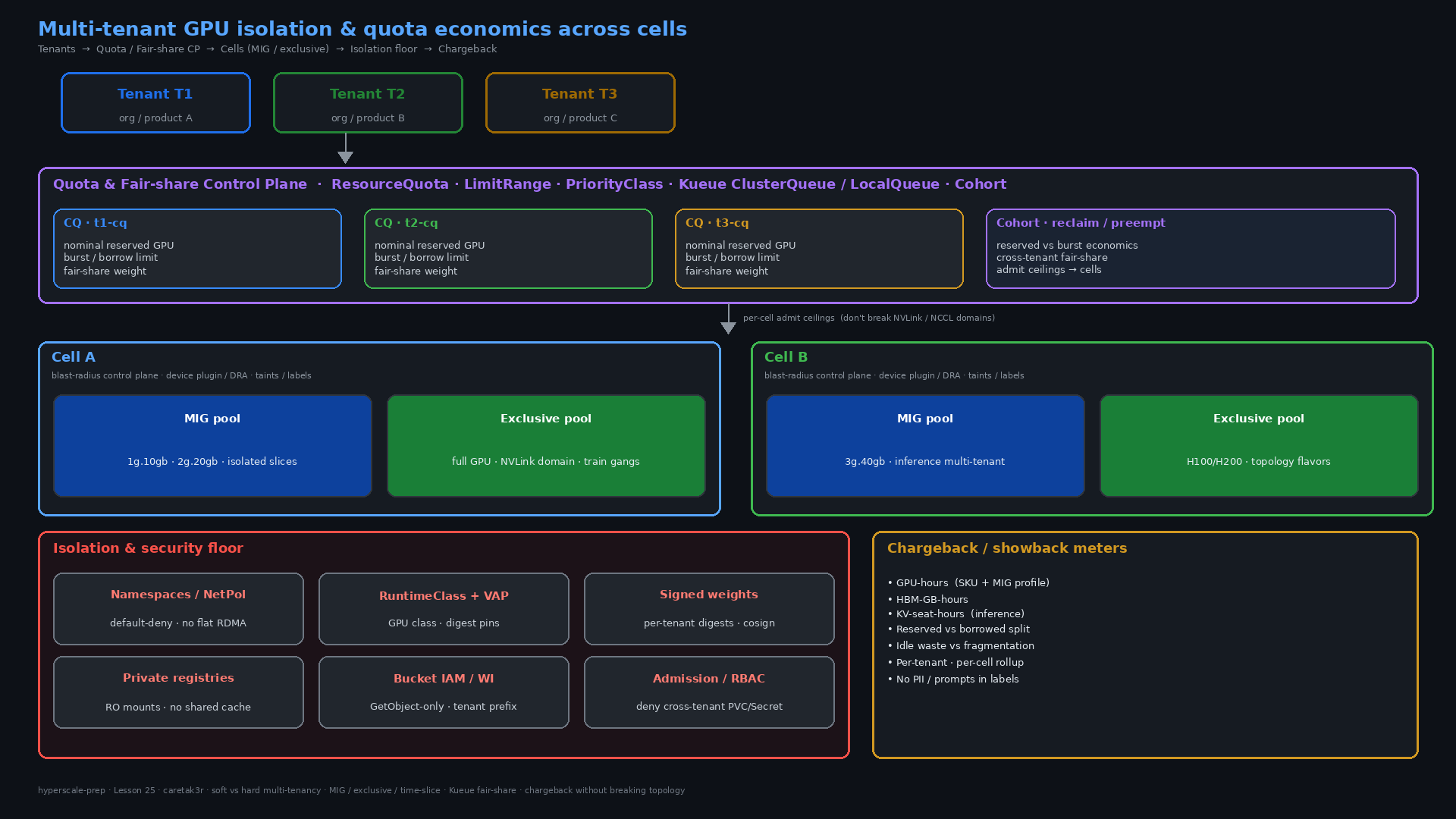
Read it top-down, then the meters: Each tenant (org / team / product) hits a fleet quota & fair-share control plane — ResourceQuota / LimitRange / PriorityClass plus Kueue ClusterQueue / LocalQueue in a cohort that encodes reserved vs burst and reclaim (L20). That plane issues per-cell admit ceilings into independent cells, each with MIG and exclusive pools (L18) that must respect topology (L19). Everything sits on an isolation & security floor (NetPol, RuntimeClass, signed per-tenant weights, scoped IAM). Chargeback meters close the loop so finance and capacity planning see GPU-hours, HBM-GB-hours, and KV-seat-hours — not vanity SM util alone (L23/L24).
Idiosyncrasies / operator depth
1. Soft vs hard multi-tenancy on GPUs (pick by trust + SLO)
| Mode | Isolation strength | Fits | Breaks when |
|---|---|---|---|
| Exclusive GPU | Hard on device (one tenant / pod class) | Train gangs, MoE EP, strict SLO decode | Over-fragmentation; idle full GPUs |
| MIG | Hard HW partitions (HBM + SM slice) | Multi-tenant inference / notebooks on same SKU (L18) | Profile mismatch; quota counted as parent GPU |
| Time-slicing | Soft (time multiplex) | Best-effort interactive; demos | Noisy neighbor; chargeback confidence low |
| MPS | Soft-ish (context space) | Same-trust batch inference | Not a trust boundary; still shared address space class |
| vGPU / passthrough VM | Stronger tenant VM boundary | Regulated / untrusted tenants | Ops cost; NCCL / RDMA path complexity |
Gotcha: Time-slicing and MPS are utilization tools, not trust tools. Interviewers ding you if you say “we multi-tenant with MPS” when the threat model is cross-org weight theft.
2. Tenant = org/team/product — the control objects that matter
| Object | Role | Operator rule |
|---|---|---|
| Namespace | Trust + NetPol + RBAC boundary | One tenant primary ns (plus system sidecars); never flat shared ns for train+serve across orgs |
| ResourceQuota / LimitRange | Hard caps on cpu/mem/pods + extended resources | Must list nvidia.com/gpu and nvidia.com/mig-* profiles you advertise |
| PriorityClass | Preemption order inside / across queues | Separate train-prod / train-dev / infer-prod |
| Kueue ClusterQueue | Nominal quota + borrow/lend in cohort (L20) | Nominal = reserved; borrowing = burst with reclaim |
| LocalQueue | Tenant-facing submit target | Users never edit ClusterQueue; platform owns CQ |
| Cohort | Fair-share + reclaimWithinCohort | Model org hierarchy; don’t invent a second quota system beside Kueue |
Interview trap: Equating “ResourceQuota of 8 GPUs” with “we have multi-tenant fairness.” Without cohort fair-share + preemption, the loudest submitter owns burst forever.
3. Isolation stack — layers you actually enforce
| Layer | What it blocks | Failure if missing |
|---|---|---|
| Namespace + RBAC | Cross-tenant API reads / exec | Train SA lists every Secret |
| NetworkPolicy default-deny | Pod ↔ pod lateral (L9) | Flat east-west exfil |
| RuntimeClass (nvidia / kata) | Wrong runtime / shared host path | Accidental privileged GPU path (L14) |
| Device plugin / DRA | Wrong SKU / MIG profile | Silent full-GPU assign under “mig” label |
| Node taints / labels | Pool bleed (train on infer MIG pool) | Topology and SLO chaos (L18) |
| SPOG vs per-cell quotas | Global oversubscribe fantasy | SPOG admits 200% of every cell; per-cell alone starves global fairness |
Operator stance: Per-cell hard ceilings + fleet fair-share policy that proposes ceilings. One global ResourceQuota across 100 cells without cell binding is a spreadsheet, not a control plane.
4. Cross-cell quota economics — reserved, burst, reclaim, waste
| Concept | Meaning | Meter |
|---|---|---|
| Reserved (nominal) | Guaranteed GPU (or MIG profile) count per tenant per flavor | Bill as reserved even if idle (capacity reservation) |
| Burst (borrow) | Use unused nominal of peers in cohort | Bill borrowed at burst rate; preemptible |
| Oversubscribe policy | How much burst vs reserved ratio allowed | Cap per CQ lendingLimit / fair-share weight |
| Reclaim | Owner returns; preempt borrowers | Gang-aware reclaim (L20) |
| Idle waste | Reserved but unused | Showback to tenant; reclaim campaign |
| Fragmentation | Free MIG slices wrong shape / free GPUs wrong topology | Not the same as idle — fix profiles / binpack |
| KV-seat-hours | Inference capacity wallet hours (L21) | Often better product meter than raw SM% |
Formula interviewers like:
tenant_effective = min(cq_nominal + borrow_allowed, sum_over_cells(cell_admit_tenant), topology_fit)
If topology_fit is zero because you scattered a gang across NVLink domains for “fairness,” you manufactured waste (L19).
5. Capacity markets across cells (tie L24)
| Signal | Platform action |
|---|---|
| Starved tenant, wasted cell | Raise that tenant’s admit ceiling on the green cell; don’t only page the tenant |
| Tenant over reserve on cell A, idle on B | Rebalance nominal or route inference (L24) — train gangs usually stay cell-sticky |
| Borrow storm on one cell | Fair-share preemption + cell yellow weight for new burst admits |
| MIG fragmentation high | Defrag window / profile rebalance; charge fragmentation separately from idle |
Default posture: Inference can follow capacity across cells (with digest pins). Multi-node train stays topology-local; quota must encode flavors (zone / rail / NVLink island), not raw GPU integers.
6. Topology — fairness that breaks NCCL is not fairness
| Anti-pattern | Symptom | Fix |
|---|---|---|
| Spread gang “evenly” across tenants’ free GPUs on different rails | BusBw collapse; train hangs | Topology-aware flavors in Kueue / scheduler (L19/L20) |
| MIG-slice a GPU mid NVLink domain for “more tenants” | Collective jobs can’t place | Separate MIG inference pools from exclusive train islands |
| Flat RDMA trust across tenant namespaces | Cross-tenant RDMA read fantasy | NetPol + VF / namespace ownership; no shared GID pools (L9) |
7. Inference multi-tenant — model-per-tenant vs shared model
| Pattern | Isolation | Quota / rate | Risk |
|---|---|---|---|
| Model-per-tenant deploy | Strong (separate pods / optionally MIG) | GPU or MIG seats per tenant | Cost; weight hydrate fan-out |
| Shared model multi-tenant | Request auth + per-tenant rate / KV budgets | KV-seat-hours + RPS tokens | Prompt/KV cross-talk if cache keys leak; harder blast radius |
| LoRA / adapter per tenant on shared base | Medium — base shared, adapters isolated | Adapter memory + base GPU | Base weight compromise hits all; pin base digest hard (L13) |
KV / cache isolation: Never key KV only by session_id without tenant_id. Shared prefix caches across trust domains are a data-exfil footgun. Prefer per-tenant cache partitions or separate replicas for high-trust tenants (L21).
8. Training — gang + fair-share + preemption economics
| Policy | When | Cost |
|---|---|---|
| WithinCQ LowerPriority | Dev jobs yield to prod inside tenant | Checkpoint-friendly workloads only |
| reclaimWithinCohort | Owner returns from borrowers | Burst tenants must tolerate preempt |
| Fair-share weights | Equalize borrow under contention | Prevents one tenant owning all burst (L20) |
| No partial gang preempt | Avoid stranded ranks | Preempt whole Workload |
Gotcha: Preempting without checkpoint discipline “improves utilization” on slides and burns GPU-hours on restarts — chargeback should show useful GPU-hours vs restart waste.
9. Classic gotchas (say these out loud)
| Gotcha | Why it bites |
|---|---|
| Silent GPU sharing | Device plugin time-slice replicas look like N GPUs; tenants think they have hard isolation |
| Quota ignores MIG slices | ResourceQuota on nvidia.com/gpu: 2 while pods request nvidia.com/mig-1g.10gb → unbounded MIG consume |
| ResourceQuota vs extended resources | Forgetting to include extended resources; or counting parent GPU and MIG double |
| Cross-tenant weight bucket ACL | Shared s3://models/ with team-level IAM; GetObject across prefixes |
| Train SA lateral movement | One train-sa bound in every tenant ns with broad WI |
| Chargeback on SM% only | Idle reserved and fragmented capacity invisible (L23) |
Concrete commands & config
Inventory — tenants, queues, GPU / MIG allocatable
# Tenant namespaces + quotas
kubectl get ns -l tenant.platform/org --show-labels
kubectl get resourcequota -A -l tenant.platform/org

# Extended resources on GPU nodes (parent + MIG)
kubectl get nodes -l nvidia.com/gpu.present=true \
  -o custom-columns=NAME:.metadata.name,GPU:.status.allocatable.nvidia\.com/gpu,MIG1G:.status.allocatable.nvidia\.com/mig-1g\.10gb,MIG2G:.status.allocatable.nvidia\.com/mig-2g\.20gb

# Kueue queues
kubectl get clusterqueue,localqueue,resourceflavor -A
kubectl get clusterqueue -o custom-columns=NAME:.metadata.name,COHORT:.spec.cohort,PEND:.status.pendingWorkloads,ADM:.status.admittedWorkloads
ResourceQuota + LimitRange that include MIG
apiVersion: v1
kind: ResourceQuota
metadata:
  name: t1-gpu-quota
  namespace: tenant-t1
spec:
  hard:
    requests.nvidia.com/gpu: "8"
    requests.nvidia.com/mig-1g.10gb: "16"
    requests.nvidia.com/mig-2g.20gb: "8"
    requests.cpu: "200"
    requests.memory: 2Ti
    pods: "400"
---
apiVersion: v1
kind: LimitRange
metadata:
  name: t1-gpu-limits
  namespace: tenant-t1
spec:
  limits:
    - type: Container
      max:
        nvidia.com/gpu: "8"
        nvidia.com/mig-1g.10gb: "4"
      defaultRequest:
        cpu: "1"
        memory: 4Gi
Kueue ClusterQueues in a cohort (reserved + burst)
apiVersion: kueue.x-k8s.io/v1beta1
kind: ResourceFlavor
metadata:
  name: h100-exclusive-rail-a
spec:
  nodeLabels:
    pool: train-exclusive
    topology.platform/rail: "a"
---
apiVersion: kueue.x-k8s.io/v1beta1
kind: ClusterQueue
metadata:
  name: t1-cq
spec:
  cohort: ml-org
  resourceGroups:
    - coveredResources: ["nvidia.com/gpu", "cpu", "memory"]
      flavors:
        - name: h100-exclusive-rail-a
          resources:
            - name: nvidia.com/gpu
              nominalQuota: 64
              borrowingLimit: 64   # burst cap from cohort
            - name: cpu
              nominalQuota: 2048
            - name: memory
              nominalQuota: 16Ti
  preemption:
    withinClusterQueue: LowerPriority
    reclaimWithinCohort: Any
  fairSharing:
    weight: 1
---
apiVersion: kueue.x-k8s.io/v1beta1
kind: LocalQueue
metadata:
  name: t1-train
  namespace: tenant-t1
spec:
  clusterQueue: t1-cq
MIG pool vs exclusive — node labels / taints (shape)
# Exclusive train island
kubectl taint nodes -l pool=train-exclusive train-exclusive=true:NoSchedule
kubectl label nodes -l pool=train-exclusive \
  nvidia.com/gpu.product=H100 \
  topology.platform/rail=a \
  tenant.platform/trust=hard

# MIG inference pool (profiles via GPU Operator / MIG manager — [L18])
kubectl label nodes -l pool=infer-mig \
  nvidia.com/mig.config=all-1g.10gb \
  tenant.platform/trust=mig
Per-tenant admit ceiling across cells (sketch)
# Fleet CR / ConfigMap shape — ceilings feed L24 routers + Kueue flavors
kubectl --context fleet-admin get tenantquota t1 -o yaml
# status.cells:
#   cell-a: { reservedGpu: 32, burstGpu: 16, mig1g: 64, admit: green }
#   cell-b: { reservedGpu: 16, burstGpu: 8,  mig1g: 32, admit: yellow }

python3 - <<'PY'
# Binding admit for tenant on a cell
reserved, burst_used, cell_free, topology_ok = 32, 10, 40, 1
tenant_ceil = min(reserved + max(0, 16 - burst_used), cell_free) * topology_ok
print(f"tenant_cell_admit={tenant_ceil}")
PY
Chargeback / showback PromQL sketches
# Allocated GPU-hours by tenant (allocation truth — prefer over SM%)
sum by (tenant) (
  kube_pod_resource_request{resource="nvidia_com_gpu"}
  * on(namespace) group_left(tenant)
    kube_namespace_labels{label_tenant_platform_org!=""}
)

# Kueue queue join (allowlist kueue labels on kube-state-metrics)
sum by (label_kueue_x_k8s_io_cluster_queue_name) (
  rate(container_cpu_usage_seconds_total{container!=""}[5m])
  * on(namespace,pod) group_left(label_kueue_x_k8s_io_cluster_queue_name)
    kube_pod_labels{label_kueue_x_k8s_io_cluster_queue_name!=""}
)

# MIG profile-hours (exporter label mig_profile)
sum by (tenant, mig_profile) (rate(gpu_allocated_seconds_total[1h]))

# KV-seat-hours by tenant (inference)
sum by (tenant) (inference_kv_seats_inuse) * 1  # integrate over time in recording rule
NetPol default-deny between tenant namespaces
apiVersion: networking.k8s.io/v1
kind: NetworkPolicy
metadata:
  name: default-deny-ingress
  namespace: tenant-t1
spec:
  podSelector: {}
  policyTypes: ["Ingress", "Egress"]
---
# Allow only tenant-local + approved platform scrape / weight hydrate
apiVersion: networking.k8s.io/v1
kind: NetworkPolicy
metadata:
  name: allow-platform-and-same-tenant
  namespace: tenant-t1
spec:
  podSelector: {}
  ingress:
    - from:
        - namespaceSelector:
            matchLabels: { tenant.platform/org: t1 }
        - namespaceSelector:
            matchLabels: { role: platform-metrics }
  egress:
    - to:
        - namespaceSelector:
            matchLabels: { tenant.platform/org: t1 }
    - to:
        - namespaceSelector:
            matchLabels: { role: weight-hydrate }
      ports:
        - protocol: TCP
          port: 443
VAP — RuntimeClass + digest pins + no cross-tenant mounts (sketch)
apiVersion: admissionregistration.k8s.io/v1
kind: ValidatingAdmissionPolicy
metadata:
  name: tenant-gpu-floor
spec:
  failurePolicy: Fail
  matchConstraints:
    resourceRules:
      - apiGroups: ["apps"]
        apiVersions: ["v1"]
        operations: ["CREATE", "UPDATE"]
        resources: ["deployments", "jobs"]
  validations:
    - expression: >
        object.spec.template.spec.runtimeClassName in ["nvidia", "nvidia-mig", "kata-nvidia"]
      message: "GPU workloads require approved RuntimeClass"
    - expression: >
        !has(object.spec.template.metadata.annotations) ||
        object.spec.template.metadata.annotations["platform.weight/digest"].startsWith("sha256:")
      message: "weight digest pin required (sha256:...)"
Failures & fixes
| Symptom | Likely cause | Fix / mitigation |
|---|---|---|
| Tenant “quota full” but nodes show free GPUs | Quota on wrong resource name / wrong cell | Align ResourceQuota + CQ flavors with advertised extended resources; check per-cell ceilings |
| MIG pods schedule unbounded | Quota only on nvidia.com/gpu | Add hard limits for each nvidia.com/mig-* profile |
| Two tenants on same GPU; SLO chaos | Time-slice / MPS mistaken for isolation | Move untrusted tenants to MIG or exclusive (L18) |
| Train BusBw collapses after “fair” placement | Gang packed across rails for balance | Topology flavors; refuse cross-rail gangs (L19) |
| One tenant owns all burst for days | No fair-share / no reclaim | Cohort fairSharing weights + reclaimWithinCohort (L20) |
| Owner can’t reclaim reserved | Preemption disabled / non-preemptible PriorityClass | Fix preemption policy; make burst workloads preemptible |
| Chargeback shows high util; finance angry at idle bill | Billing SM% not allocation; reserved idle invisible | Bill allocation + reserved; show idle waste separately |
| Fragmentation high; free capacity unusable | Wrong MIG profile mix | Defrag window; separate profile pools; track fragmentation metric |
| Starved tenant; green cell empty | SPOG quota not mapped to cell admit | Per-cell ceilings + L24 capacity routing for inference |
| Cross-tenant weight read | Shared bucket ACL / prefix | Per-tenant prefix + GetObject-only WI (L13) |
| Train SA mounts other tenant PVC | Admission gap | VAP deny cross-tenant PVC/Secret; ns-scoped RBAC |
Shared writable /models cache poisoned | One cache for all tenants | RO per-tenant caches; no shared writable (L14) |
| KV leak across tenants on shared model | Cache key missing tenant_id | Partition KV; authZ on request path (L21) |
| RDMA noisy / cross-ns | Flat GID / missing NetPol | Default-deny; own VFs per trust domain (L9) |
| Silent time-slice “8 GPUs” on 1 GPU | Device plugin replicas | Label pool trust=soft; don’t sell as hard multi-tenant |
| Restart waste after preempt storm | No checkpoint discipline | Require checkpoint for burst queue; meter restart GPU-hours |
Security & hardening
Multi-tenant GPU fleets concentrate every tenant’s weights, prompts, and train credentials on shared silicon. Soft sharing without a security floor turns “fair-share utilization” into cross-tenant exfil. Same spirit as L11–L14, applied to tenant quotas + cell pools.
| Control | Why | Practice |
|---|---|---|
| Per-tenant signed weight digests | Prevent mix-and-match / tamper across orgs | Cosign verify; pin image + weight digests per tenant deploy (L12/L13) |
| Private registries | Public pulls = inventory + supply-chain | Private mirror; admission deny external regs for train/serve |
| RO mounts | Writable model dirs are backdoors | readOnly: true on /models; scratch emptyDir only |
| GetObject-only WI per tenant prefix | Stop PutObject / cross-prefix Get | Workload Identity / IRSA scoped to s3://models/t1/* (or GCS equiv.); no shared wildcard |
| No shared writable model cache | Poison / exfil across trust domains | Per-tenant cache volume or content-addressed RO blob store |
| Admission deny cross-tenant PVC/Secret | Lateral data access | VAP / Kyverno; ns ownership labels |
| VAP: RuntimeClass + digest pins | Enforce GPU path + supply-chain | Approved RuntimeClass list; platform.weight/digest required |
| NetPol default-deny | Block east-west between tenant ns | Allow only same-tenant + platform scrape / hydrate (L9) |
| No flat RDMA trust | RDMA bypasses NetPol fantasies | Per-tenant VF / GID ownership; don’t share HCAs casually |
| RBAC / SA hygiene | Train SA trampoline | Per-tenant SA; never bind one WI into all tenant ns (L14) |
| Audit chargeback labels | Privacy + cardinality | tenant + queue + sku + cell — no prompts / user PII (L23) |
| Separate train vs infer trust | Infer front-door ≠ train checkpoint writer | Different SAs, NetPol, bucket prefixes even inside one org |
AI/ML weight, model & deployment hardening for multi-tenant GPUs (required)
Multi-tenant quotas do not relax L13/L14. Each tenant hydrates signed, digest-pinned weights onto RO volumes with GetObject-only identity scoped to that tenant’s prefix. No shared writable cache across trust domains. Admission blocks cross-tenant PVC/Secret mounts and requires RuntimeClass + digests. NetPol default-deny between tenant namespaces; RDMA is not a free-for-all. Chargeback metrics carry tenant/queue/SKU — never prompts.
| Scenario | Weight / model / deploy controls |
|---|---|
| New tenant onboard | Ns + RQ + CQ + NetPol + WI prefix + registry pull SA — GitOps template |
| Tenant train job | Signed base image; RO weights; checkpoint PutObject only to tenant prefix |
| Shared-model inference | Request authZ; per-tenant rate + KV partition; base digest pin |
| MIG co-residency | Still separate ns/NetPol; MIG ≠ “skip RBAC” |
| Incident: cross-tenant read | Freeze WI; revoke prefix policy; audit GetObject; rotate digests if tamper suspected |
| Cell join for tenant | Hydrate digests before admit ceiling > 0 on that cell (L24) |
# Sketch: multi-tenant GPU security floor (platform CR shape)
apiVersion: policy.platform/v1
kind: MultiTenantGpuGate
metadata:
  name: gpu-tenant-floor
spec:
  match:
    labels:
      trust-domain: gpu-tenant
  require:
    imageDigestPin: true
    weightDigestPin: true
    cosignVerify: true
    privateRegistryOnly: true
    weightMount: "readOnly"
    sharedWritableModelCache: false
    workloadIdentity:
      objectGetOnly: true
      putObjectPrefixes: ["checkpoints/${tenant}/*"]
      getObjectPrefixes: ["models/${tenant}/*", "models/shared-base/*"]
      crossTenantPrefixAccess: false
    networkPolicy:
      defaultDeny: true
      allowSameTenantOnly: true
      flatRdmaTrust: false
    admission:
      runtimeClasses: ["nvidia", "nvidia-mig", "kata-nvidia"]
      denyCrossTenantPvc: true
      denyCrossTenantSecret: true
    quota:
      mustIncludeMigResources: true
      chargebackLabels: ["tenant", "queue", "sku", "cell"]
      forbidLabelKeys: ["prompt", "user_email", "session_raw"]
    queues:
      requireLocalQueue: true
      trainSaInInferNs: false
Punchline: Multi-tenant GPU platforms are security-critical capacity markets. Per-tenant digests, prefix-scoped GetObject-only WI, no shared writable caches, NetPol + VAP, topology-aware quotas, and chargeback without PII are what keep “fair-share utilization” from becoming cross-org compromise.
Interview soundbites
- “Soft sharing (time-slice/MPS) is utilization; MIG/exclusive/NetPol/RBAC is tenancy.”
- “Tenant = ns + ResourceQuota + PriorityClass + Kueue CQ/LQ in a cohort — not a spreadsheet.”
- “Nominal is reserved; borrow is burst with reclaim — fair-share weights stop burst monopolies.”
- “Quota that ignores MIG profiles is a fake ceiling.”
- “Don’t shatter NVLink/NCCL domains to look fair — topology-fit is part of admit.”
- “Per-cell hard ceilings + fleet fair-share proposals; SPOG alone oversubscribes reality.”
- “Bill GPU-hours / HBM-GB-hours / KV-seat-hours; show idle vs fragmentation separately.”
- “Shared-model inference needs tenant_id in auth, rate limits, and KV keys.”
- “Per-tenant signed digests, RO mounts, GetObject-only prefix WI, no shared writable model cache.”
- “Next: GPU cost attribution, reclaim & spot/preemptible economics on the fleet.”
How this maps to the JD
Hyperscale + AI/ML platform JDs that mention shared GPU fleets, multi-tenant platforms, and chargeback are asking whether you can isolate tenants and run quota economics under contention — not create three namespaces and hope. This lesson lifts L18–L24 into the tenant/market layer with L9/L11–L14 controls. Fuel: wafer-ai/gpu-perf-engineering-resources (opens in a new tab). Next up — Lesson 26: GPU cost attribution, reclaim & spot/preemptible economics on the fleet.
Watch (talks & demos)
Real talks — watch after Failures & fixes.
Multitenancy and Fairness at Scale with Kueue: A Case Study
KubeCon / AI Day talk (Aldo Culquicondor & Rajat Phull) on Kueue nominal quotas, cohort borrowing, fair-share weights, reclaim preemption, and hierarchical cohorts for multi-team ML platforms. Operator takeaway: encode reserved vs burst in ClusterQueues, not in a side spreadsheet — and make reclaim/preemption explicit so burst tenants stay preemptible.
Open on YouTube (opens in a new tab)
Lessons learned orchestrating multi-tenant GPUs on OpenShift AI with NVIDIA KAI
Production-flavored walkthrough (Luca Berton) of bare-metal multi-tenant GPUs: GitOps tenant templates, NetPol/quotas, MIG vs time-slice vs full GPU by workload, DCGM visibility, and chargeback-oriented persona views. Operator takeaway: safety / fairness / efficiency are three different knobs — a working GPU cluster ≠ a shareable GPU platform.
Open on YouTube (opens in a new tab)
Mastering GPU Management in Kubernetes Using the Operator Pattern
NVIDIA talk (Shiva Krishna Merla & Kevin Klues) on GPU Operator lifecycle, MIG single vs mixed mode, time-slicing, and MPS configuration. Operator takeaway: admins choose sharing mode a priori today — map those modes to trust classes in your tenant model (L18); don’t sell soft replicas as hard isolation.
Open on YouTube (opens in a new tab)
References
- Kueue ClusterQueue (opens in a new tab) · Kueue Preemption / Fair Sharing (opens in a new tab) · Monitor resource usage by queue (opens in a new tab)
- NVIDIA MIG User Guide (opens in a new tab) · GPU Operator (opens in a new tab) · DRA (opens in a new tab)
- Kubernetes ResourceQuota (opens in a new tab) · NetworkPolicy (opens in a new tab) · ValidatingAdmissionPolicy (opens in a new tab)
- wafer-ai/gpu-perf-engineering-resources (opens in a new tab) — fleet / inference arithmetic fuel
- Prior: 24 — Multi-cluster inference routing / capacity · 23 — GPU observability · 21 — Inference serving SLOs · 20 — Training/inference scheduling · 19 — GPU topology · 18 — GPU node pools / MIG · 14 — ML deploy hardening · 13 — ML weights · 11 — Cluster security · 09 — NetworkPolicy
- Next: Lesson 26 — AI/ML platform: GPU cost attribution, reclaim & spot/preemptible economics on the fleet
Quick self-check
Out loud, in under two minutes:
- Soft vs hard multi-tenancy on GPUs — when MIG, exclusive, time-slice, and MPS each fit (and what they do not guarantee).
- Name the tenant control objects: ResourceQuota, LimitRange, PriorityClass, ClusterQueue, LocalQueue, cohort — and what “nominal vs borrow” means.
- Explain why a ResourceQuota that only lists
nvidia.com/gpufails on a MIG pool — and how chargeback should meter MIG profile-hours. - Walk reserved vs burst reclaim when a starved owner returns; what fair-share weights change under contention.
- List five security controls for multi-tenant weights/deploys — per-tenant digests, private registry, RO mounts, GetObject-only prefix WI, no shared writable cache, NetPol/VAP, no flat RDMA, chargeback labels without PII.