Lesson 9 — NetworkPolicy, multi-NIC, sFlow
2026-09-17
What interviewers are really probing
Lesson 08 gave you the datapath (CNI, Cilium, eBPF, Hubble). This lesson is the control story operators get wrong under pressure: how NetworkPolicy actually composes, why GPU/RDMA multi-NIC nodes punch holes in that story, and when sFlow/sampling on the fabric is the right forensic tool vs identity-aware Hubble.
They are not asking you to recite the NetworkPolicy CRD fields. They want:
- Default-allow vs default-deny with a live DNS failure mode on the tip of your tongue
- Why empty
podSelectorand AND across policies surprise teams - Why secondary interfaces (Multus / SR-IOV / RoCE) often bypass the policy you just demoed on
eth0 - A crisp compare: sFlow / NetFlow / IPFIX (sampled IP tuples at TOR) vs Hubble/eBPF (identity + drop reason)
Cross-link the fabric: VPC/TGW (05), Interconnect/NAT/BGP (06), edge scrubbing (07), then east-west CNI (08). This lesson sits inside the cell, on the policy + multi-plane NIC + sampling axis.
Core diagram: policy plane, dual-NIC, fabric samples
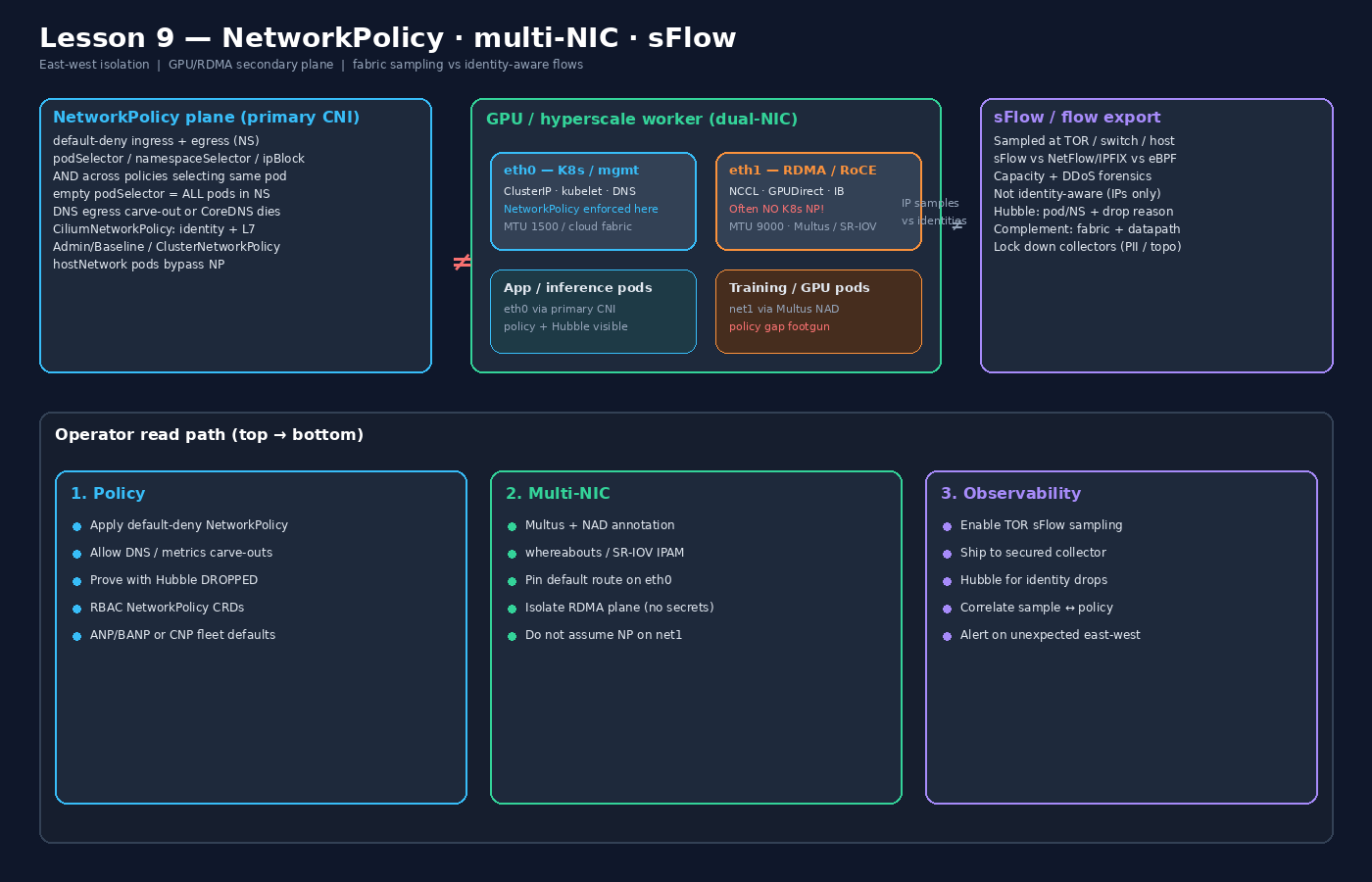
Read it top-down: Policy (vanilla NP, Cilium CNP, and admin/baseline cluster policy) binds to the primary CNI path (eth0). Multus/SR-IOV hang a secondary plane (eth1 / net1) for RDMA/NCCL that frequently never sees those NetworkPolicies. Hubble explains drops with pod identity on the K8s plane; sFlow samples IP/port at TOR or host for capacity and DDoS forensics — complementary, not interchangeable. The orange footgun in the PNG is deliberate: assume policy on net1 and you will fail the interview and the incident.
NetworkPolicy idiosyncrasies (operator depth)
Default-allow is the silent default
Kubernetes NetworkPolicy is additive allow on selected pods. If no NetworkPolicy selects a pod, that pod is unrestricted (CNI-dependent, but this is the API contract you must say out loud). “We have NetworkPolicies somewhere in the cluster” is not a security posture.
Default-deny pattern (per namespace, both directions when you mean it):
- A policy that selects all pods (
podSelector: {}) with emptyingress/egressarrays — or explicit deny-all plus separate allow policies - Set
policyTypes: [Ingress, Egress]so egress is not accidentally left open - Explicit DNS (and often metrics/API) egress carve-outs before you apply deny-all egress
| Selector / field | Gotcha |
|---|---|
podSelector: {} | Selects all pods in the namespace — not “no pods” |
Missing policyTypes with only ingress | Egress stays unrestricted for selected pods |
namespaceSelector: {} | Means all namespaces — wider than most people intend |
ipBlock + except | Easy to fat-finger; does not replace identity-aware policy |
| Multiple policies selecting same pod | Rules combine with OR within a policy direction’s allows, but selection is “any policy that selects you applies” — treat as union of allows once selected; still need default-deny base |
Interview line: “Empty podSelector equals the whole namespace. Empty namespaceSelector equals the whole cluster. I always pair deny-all with an explicit CoreDNS allow.”
The DNS footgun (every fleet hits this once)
Apply egress default-deny without allowing UDP/TCP 53 to kube-dns / CoreDNS and you break:
- Service discovery by name
- Many readiness probes that resolve names
- Operators that “randomly” fail only after policy rollout
# Minimal DNS egress carve-out (illustrative — label your DNS pods correctly)
apiVersion: networking.k8s.io/v1
kind: NetworkPolicy
metadata:
  name: allow-dns-egress
  namespace: tenant-a
spec:
  podSelector: {}
  policyTypes: ["Egress"]
  egress:
    - to:
        - namespaceSelector:
            matchLabels:
              kubernetes.io/metadata.name: kube-system
          podSelector:
            matchLabels:
              k8s-app: kube-dns
      ports:
        - protocol: UDP
          port: 53
        - protocol: TCP
          port: 53
hostNetwork, kubelet, control-plane carve-outs
hostNetwork: truepods typically bypass NetworkPolicy (they are on the host netns). DaemonSets for CNI, CSI, node agents — treat as trusted computing base, not “covered by NP.”- Kubelet health / node probes and some cloud LB health checks talk to the host or NodePort path — policy on pod netns will not save a broken NodePort story (08).
- Control-plane / system namespaces: do not casually default-deny
kube-systemwithout a written allow matrix (API server → webhook, metrics, DNS, CNI agents).
CiliumNetworkPolicy vs vanilla NP (pointer, not a rehash of 08)
Vanilla NetworkPolicy is L3/L4 + selectors. CiliumNetworkPolicy adds security identities, optional L7/DNS/FQDN, and clusterwide defaults (CCNP). In interviews: “I use K8s NP for portable baseline; Cilium CNP when I need identity stability across IP churn and Hubble drop reasons” — then stop repeating Lesson 8’s maps lecture.
AdminNetworkPolicy / Baseline / ClusterNetworkPolicy
Cluster admins needed guardrails tenants cannot override. Direction of travel:
- AdminNetworkPolicy (ANP) + BaselineAdminNetworkPolicy (BANP) (
policy.networking.k8s.io/v1alpha1) — admin tier first (Allow/Deny/Pass), then namespaced NetworkPolicy, then baseline default - ClusterNetworkPolicy (
v1alpha2) consolidates admin/baseline into one API with atierfield (Admin vs Baseline)
Say in the interview: “Namespaced NetworkPolicy is the app contract; Admin/Baseline (or ClusterNetworkPolicy tiers) are the platform guardrails — Pass is how we delegate back to tenant policy.”
Multi-NIC idiosyncrasies (GPU / RDMA hyperscale)
Why the node has more than one NIC
Hyperscale and GPU nodes routinely split planes:
| Plane | Typical NIC | Traffic | Policy expectation |
|---|---|---|---|
| Management / K8s primary | eth0 (cloud ENI / bond) | kubelet, ClusterIP, DNS, control | NetworkPolicy / Cilium CNP |
| RDMA / RoCE / InfiniBand | eth1 / ib0 / SR-IOV VFs | NCCL, GPUDirect, storage RDMA | Often fabric ACL / VF isolation only |
| Optional | storage / backup NIC | snapshots, checkpoint pulls | Separate subnet + IAM |
Upcoming AI/ML topology lessons go deep on NVLink/NCCL; here you only need the operator networking punchline: east-west training traffic may never touch the CNI you policy.
Multus / whereabouts / SR-IOV patterns
- Multus: meta-plugin; primary CNI stays default; secondary nets via NetworkAttachmentDefinition (NAD) + pod annotation
k8s.v1.cni.cncf.io/networks - whereabouts (or host-local / DHCP / cloud IPAM): IPAM for secondary interfaces without colliding across nodes
- SR-IOV CNI + device plugin: allocate VFs; pods get near-line-rate NICs; pairs with RDMA device plugins on GPU fleets
apiVersion: v1
kind: Pod
metadata:
  name: gpu-train
  annotations:
    k8s.v1.cni.cncf.io/networks: rdma-net@eth1
spec:
  containers:
    - name: trainer
      image: registry.example/train:1
      resources:
        limits:
          nvidia.com/gpu: 8
          # plus sriov / rdma resource names as your device plugin exposes
Routing asymmetry, default route, MTU
- Pod may have two default routes if the secondary CNI is sloppy — management traffic blackholes or hairpins via the RDMA fabric
- Pin default route on eth0; use explicit routes/on-link for the RDMA subnet only
- MTU: K8s plane often 1500 (or cloud overlay less); RDMA/RoCE often 9000 — do not “unify MTU” blindly across NICs
- Source-based routing / policy routing shows up when both NICs can reach overlapping CIDRs
Policy enforcement gap (the huge security footgun)
Most NetworkPolicy implementations attach to the primary CNI datapath. Secondary interfaces from Multus/SR-IOV frequently do not enforce the same NetworkPolicy. Attack story: compromised tenant pod cannot hit model ClusterIP on eth0 (policy works) but can still speak raw RDMA/TCP on net1 to a neighbor GPU pod if fabric ACLs are loose.
Interview must-say: “NetworkPolicy on the K8s NIC is not isolation for the RDMA NIC. I design the RDMA plane as a separate trust boundary — VLAN/VRF, VF ACLs, no secrets/metadata listeners bound there.”
sFlow & related observability
| Mechanism | What you get | Strength | Weakness |
|---|---|---|---|
| sFlow | Packet samples + counters from switch/host | Cheap at TOR scale; capacity & DDoS trends | Not every flow; IP-centric; no K8s identity |
| NetFlow / IPFIX | Flow records (often sampled/aggregated) | Familiar NetOps tooling | Export volume; still identity-blind |
| eBPF / Hubble | Per-flow events with pod/NS identity, verdict, drop reason | Ties to NetworkPolicy/CNP | Node/agent scope; not a replace-all for fabric sampling |
When operators enable sFlow: TOR/spine capacity planning, elephant-flow detection, DDoS forensics correlating edge (07) with east-west blowups, proving “was this hit at the fabric?” when Hubble is quiet (e.g. traffic never entered the pod netns).
Hubble replaces vs complements: Hubble replaces “guess which NetworkPolicy dropped me.” Fabric sFlow complements when you need underlay visibility, multi-tenant TOR contention, or traffic that bypassed the CNI (RDMA plane, hostNetwork, mis-routed secondary NIC). Best incident rooms use both: sample says which TOR pair lit up; Hubble says which identity was denied on eth0.
Privacy / security of exports: flow records leak who talks to whom, service topology, sometimes payload-derived ports that fingerprint apps. Treat collectors as sensitive: mTLS, ACLs, retention limits, no world-readable S3, RBAC on who can query. Same discipline as audit logs.
Concrete commands & config
# What policies exist? Who do they select?
kubectl get networkpolicy -A
kubectl describe networkpolicy -n tenant-a
kubectl get cnp,ccnp -A 2>/dev/null
kubectl get anp,banp -A 2>/dev/null
kubectl get clusternetworkpolicy -A 2>/dev/null

# Prove enforcement (Cilium)
kubectl -n kube-system exec ds/cilium -- hubble observe --since 10m \
  --verdict DROPPED --namespace tenant-a
kubectl -n kube-system exec ds/cilium -- cilium endpoint list | rg tenant-a

# Multi-NIC / Multus on a node or debug pod
kubectl get net-attach-def -A
ip -d link show
ip route show table all | head
cat /etc/cni/net.d/*.conflist 2>/dev/null | head -100

# Inside a dual-homed pod
kubectl exec -it gpu-train -- ip addr
kubectl exec -it gpu-train -- ip route
kubectl exec -it gpu-train -- cat /etc/cni/net.d/ 2>/dev/null
# Default-deny + allow frontend→backend on 8080 (vanilla NP)
apiVersion: networking.k8s.io/v1
kind: NetworkPolicy
metadata:
name: default-deny-all
namespace: tenant-a
spec:
podSelector: {}
policyTypes: ["Ingress", "Egress"]
---
apiVersion: networking.k8s.io/v1
kind: NetworkPolicy
metadata:
name: allow-frontend-to-backend
namespace: tenant-a
spec:
podSelector:
matchLabels:
app: backend
policyTypes: ["Ingress"]
ingress:
- from:
- podSelector:
matchLabels:
app: frontend
ports:
- protocol: TCP
port: 8080# Multus NetworkAttachmentDefinition sketch (secondary RDMA net)
apiVersion: k8s.cni.cncf.io/v1
kind: NetworkAttachmentDefinition
metadata:
name: rdma-net
namespace: gpu-jobs
spec:
config: |
{
"cniVersion": "0.3.1",
"type": "sriov",
"ipam": {
"type": "whereabouts",
"range": "192.168.100.0/24"
}
}# sFlow / sampling — switch side is vendor CLI; host-side agents vary.
# Operator checklist (illustrative):
# 1) sampling rate set on TOR (e.g. 1:1000) toward collector VIP
# 2) collector only accepts from TOR mgmt VRF
# 3) correlate timestamps with Hubble / metrics during incidentFailures & fixes
| Symptom | Likely root cause | Fix / mitigation |
|---|---|---|
| After NP rollout, all DNS / Service names fail | Egress deny without DNS carve-out | Allow kube-dns:53 UDP/TCP; retest nslookup |
| Policy YAML applied; traffic still flows | No default-deny; wrong namespace; pod not selected; CNI not enforcing NP | kubectl describe np; confirm CNI supports NP; add deny-all; Hubble FORWARDED |
| “Empty selector” locked the wrong NS | podSelector: {} or namespaceSelector: {} broader than intended | Tighten labels; use ANP Pass carefully |
| GPU job hangs on NCCL, K8s HTTP fine | Secondary NIC down / wrong VF / MTU / IPAM collision | Check Multus annotation, NAD, ip addr in pod, whereabouts allocations |
| App reaches peer on RDMA IP despite NP deny on ClusterIP | Policy only on primary CNI | Fabric ACL / separate VRF; do not bind sensitive listeners on RDMA plane |
| Asymmetric timeouts / return path fails | Dual default routes; wrong source IP | Policy routing; pin default via eth0 |
| sFlow collector flooded / missing | Sampling rate too hot/cold; ACL blocks exporters | Tune sample rate; VRF-limit exporters; watch collector CPU |
| Hubble quiet during TOR meltdown | Traffic never hit pod netns (underlay / secondary NIC) | Use fabric sFlow/IPFIX; check Multus path |
| hostNetwork DaemonSet ignores NP | Expected bypass | Isolate via node firewall / PSS; limit privileged DS |
| Tenant overrides platform deny | Only namespaced NP; no Admin/Baseline tier | Introduce ANP/BANP or ClusterNetworkPolicy Admin tier |
Security & hardening
This lesson’s security story is segmentation that survives multi-NIC and observability that does not become a leak.
| Control | Operator practice |
|---|---|
| NetworkPolicy default-deny | Per sensitive NS: deny ingress+egress, explicit allows, DNS carve-out, prove with Hubble DROPPED |
| Multi-NIC isolation | Treat RDMA/RoCE as separate trust zone: VF ACLs, VLAN/VRF, no cluster credentials or IMDS listeners on that plane |
| Inference / model pod isolation | Default-deny east-west to model NS on eth0; allow only ingress gateway / ranked clients; also block casual access to RDMA endpoints between tenants |
| Admission / RBAC for policy CRDs | Restrict create/update/delete on networkpolicies, ciliumnetworkpolicies, ciliumclusterwidenetworkpolicies, adminnetworkpolicies, baselineadminnetworkpolicies, clusternetworkpolicies to platform break-glass roles |
| sFlow / sampling data sensitivity | Collectors behind mTLS + network ACL; short retention; no public buckets; treat flow logs like audit (topology + PII risk) |
| Secrets not on RDMA plane | No Secret mounts needed solely for NCCL; no sidecar that scrapes API on net1; metadata/IMDS only via mgmt NIC if at all |
| hostNetwork / privileged CNI | Already TCB from 08 — NP will not save you; PSS + RBAC + pinned versions |
# Who can edit policy objects?
kubectl auth can-i create networkpolicies -n tenant-a --as=system:serviceaccount:ci:deployer
kubectl auth can-i create adminnetworkpolicies --as=system:serviceaccount:ci:deployer

# Model NS: unexpected FORWARDED is a finding
kubectl -n kube-system exec ds/cilium -- hubble observe --since 30m \
  --to-namespace model-serving --verdict FORWARDED
AI/ML angle: a stolen training pod with Multus net1 is an east-west GPU backplane attacker. Harden eth0 with NetworkPolicy and assume the RDMA fabric needs non-K8s controls — or you will “pass” a NetworkPolicy audit while NCCL still cross-talks tenants.
Interview soundbites
- “Default-allow until a policy selects you — empty podSelector selects the whole namespace.”
- “Egress deny without DNS is a self-inflicted outage, not a security win.”
- “Policies that select the same pod union their allows; start from deny-all.”
- “hostNetwork bypasses NetworkPolicy — DaemonSets are TCB.”
- “Multus secondary NICs often skip NetworkPolicy — RDMA is a separate trust boundary.”
- “Pin default route on eth0; jumbo MTU only on the RDMA plane.”
- “sFlow samples IPs at the fabric; Hubble explains identity and drop reason — use both.”
- “Flow collectors are sensitive systems — ACL and retention like audit logs.”
- “Admin/Baseline (or ClusterNetworkPolicy tiers) are platform guardrails tenants should not override.”
How this maps to the JD
Hyperscale roles own cell security under multi-plane networking: NetworkPolicy that does not strand DNS, GPU nodes with mgmt vs RDMA NICs, and observability that spans fabric samples and datapath identity. You should connect Lessons 05–08 into one story: cloud fabric → edge → CNI/eBPF → policy + multi-NIC + sampling.
Next in the arc: Service mesh (Istio/Envoy/Linkerd & mTLS) — where L7 identity meets what NetworkPolicy started at L3/L4.
Watch (talks & demos)
Real talks that map to this lesson — watch after the Failures & fixes table.
Adopting Network Policies in Highly Secure Environments — Raymond de Jong, Isovalent (CNCF)
Coarse-to-fine NetworkPolicy / Cilium policy adoption, DNS/FQDN restrictions, and Hubble for proving allows/denies — the operator rollout narrative behind default-deny.
Open on YouTube (opens in a new tab)
Build Your Own Private 5G Network on Kubernetes — Frank Zdarsky & Raymond Knopp (CNCF)
Multus, SR-IOV CNI, device plugins, and multi-homed pods under real latency/bandwidth pressure — the same multi-NIC patterns GPU/RDMA fleets reuse (even if the workload is 5G CNFs).
Open on YouTube (opens in a new tab)
High Performance Networking with KubeVirt — Doug Smith & Abdul Halim (CNCF)
SR-IOV device plugin, VF scheduling, and high-performance secondary interfaces in Kubernetes — grounding for why secondary NICs exist and why they sit outside “one NetworkPolicy to rule them all.”
Open on YouTube (opens in a new tab)
References
- Kubernetes Network Policies (opens in a new tab)
- Network Policy API (Admin / Baseline / ClusterNetworkPolicy) (opens in a new tab)
- Cilium Network Policy (opens in a new tab)
- Hubble observability (opens in a new tab)
- Multus CNI (opens in a new tab)
- SR-IOV CNI (opens in a new tab)
- whereabouts IPAM (opens in a new tab)
- sFlow.org (opens in a new tab)
- Prior lessons: 05 — VPC / TGW, 06 — Interconnect / NAT / BGP, 07 — Edge LB / DDoS, 08 — CNI / Cilium / eBPF
Quick self-check
Out loud, in under two minutes:
- What does an empty
podSelectormean, and what breaks if you default-deny egress without DNS? - How do multiple NetworkPolicies that select the same pod compose, and why is default-deny the required base?
- Why can a GPU pod still talk to a neighbor over RDMA after NetworkPolicy denies ClusterIP on eth0 — and what do you do about it?
- When do you reach for sFlow at the TOR vs Hubble drop reason — and why are flow collectors a security boundary?