Lesson 20 — AI/ML platform: training/inference scheduling — gang, Kueue/Volcano, fair-share queues
2026-09-28
What interviewers are really probing
Lesson 18 gave you SKU pools. Lesson 19 made NVLink domains and RDMA rails schedulable. This lesson asks the operator question that kills GPU utilization in interviews and in production: can you admit multi-pod training without half-placing a gang — and share the fleet fairly without starving inference SLOs?
Interviewers at hyperscale AI platforms (fuel: wafer-ai/gpu-perf-engineering-resources (opens in a new tab)) want evidence you have run batch queues under contention, not only “we use the default scheduler”:
- Vanilla kube-scheduler + Job parallelism fails for training — partial place → idle GPUs holding ranks → NCCL hang / watchdog abort (L1, L4)
- Gang scheduling semantics — all-or-nothing /
minAvailable; topology from L19 is a packing constraint, not a hope - Kueue — ClusterQueue, LocalQueue, ResourceFlavor, Cohort, borrowing/lending, fair-sharing, preemption, Workload CR; Job / JobSet / Kubeflow MPIJob / PyTorchJob admission
- Volcano — Queue, PodGroup, gang plugins, queue priority — when it shows up vs Kueue in interviews
- Fair-share / hierarchical queues — team quotas vs capacity planning; reclaim loaned capacity
- Training vs inference — exclusive gang train ≠ latency-SLO inference; don’t share without isolation (L14)
- Topology-aware + queue — flavors for NVLink/RDMA SKUs; don’t admit a gang that can’t pack into one fabric island
- Orchestration vs batch queue — Temporal/Argo (L16) own workflow DAG / retries; Kueue/Volcano own when GPU capacity is reserved
- Security floor on queues — queue admins ≠ weight writers; admission on CQ/LQ; signed controller images; preemption must not leave weight-writable sidecars (L11–L14)
Interview sentence: “I admit training as a gang through Kueue (or Volcano PodGroup) against topology-aware flavors, fair-share cohorts reclaim loaned GPUs, train and inference never share without isolation, and queue RBAC never implies weight-bucket IAM.”
Core diagram: Jobs → LocalQueue → ClusterQueue/Cohort → Flavors → schedule → nodes (+ Volcano path, security floor)
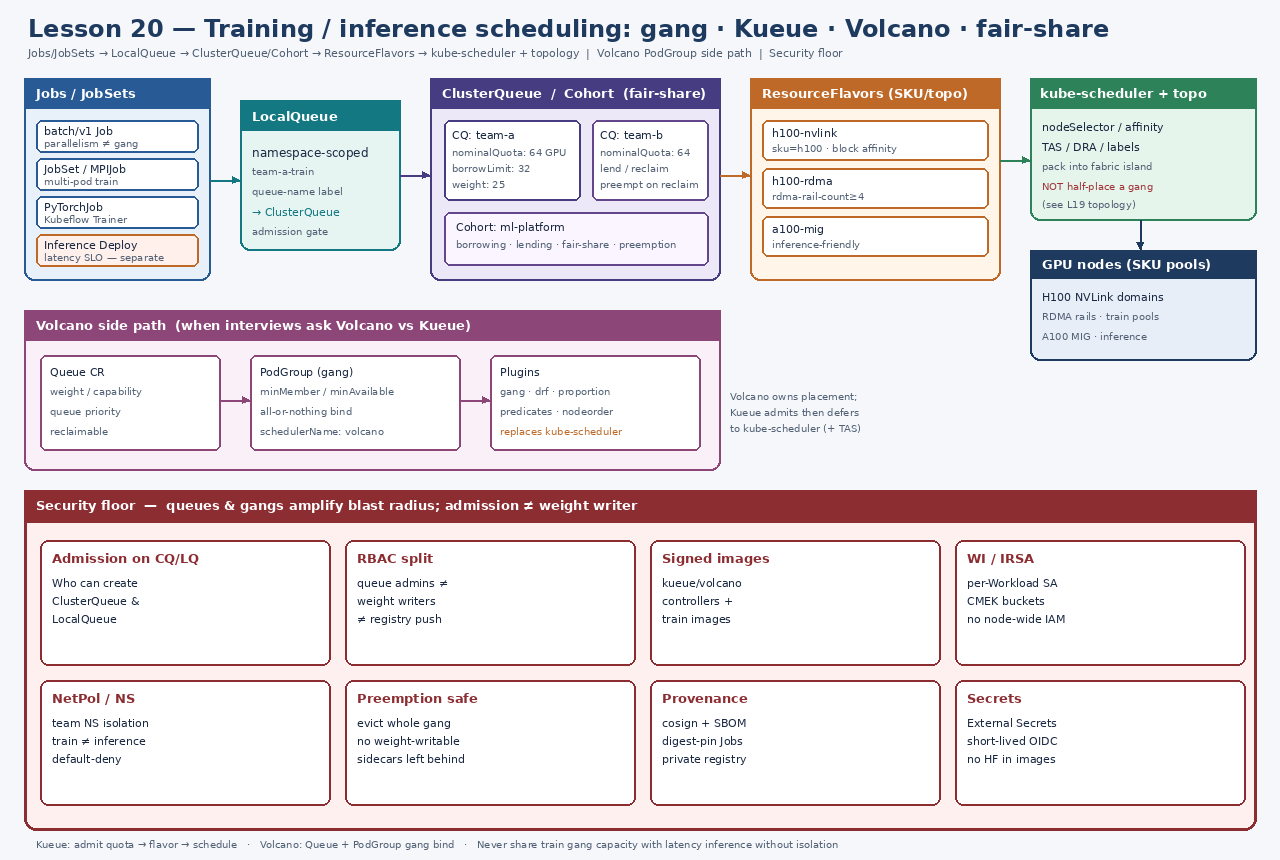
Read it left-to-right: A training Job / JobSet / MPIJob / PyTorchJob lands on a namespace LocalQueue (label kueue.x-k8s.io/queue-name). That queue points at a cluster-scoped ClusterQueue inside a Cohort that fair-shares and can borrow/lend with preemption on reclaim. Admission picks a ResourceFlavor (SKU + topology labels). Only then does kube-scheduler (optionally with Kueue TAS) place pods — ideally into one fabric island from L19. Volcano is the alternate path: its Queue + PodGroup gang-binds via plugins and replaces default scheduling for those pods. Inference is a different product: latency SLOs, not exclusive gangs — isolate pools/queues. Everything sits on a security floor: who can mutate queues, who can write weights, signed controller + train images, WI/IRSA, NetPol, and preemption that tears down the whole gang cleanly.
Idiosyncrasies / operator depth
1. Why vanilla kube-scheduler + Job parallelism fails for multi-pod training
| What you did | What happens | Why it hurts |
|---|---|---|
Job.spec.parallelism: 8 | Scheduler places pods independently | 5 pods Running, 3 Pending forever → 5×8 GPUs idle in NCCL wait |
| “Enough” free GPUs cluster-wide | Fragmented across racks/blocks | Partial place + bad topology (L19) |
Rely on completions / restart | Hang looks like framework bug | Watchdog / NCCL timeout; ticket says “PyTorch” — root cause is admission |
| No timeout on partial place | Head-of-line waste | Other gangs blocked behind stuck partials |
Interview sentence: “Job parallelism is not gang scheduling — without all-or-nothing admission you donate GPUs to a hang.”
2. Gang scheduling semantics (all-or-nothing / minAvailable)
| Concept | Operator meaning |
|---|---|
| All-or-nothing | Either the gang’s minimum members bind (or are ready), or none keep capacity |
minAvailable / minMember | Threshold for “enough ranks to start” (often = world size; sometimes loosely for elastic) |
| Admission vs bind | Kueue: reserve quota (+ TAS domains) then schedule; waitForPodsReady requeues on timeout. Volcano: PodGroup gang plugin holds until minMember can schedule together |
| Topology interaction | Gang that cannot pack into one NVLink/RDMA island should not admit — don’t hope affinity fixes it later (L19) |
| Preemption | Evict whole lower-priority gangs (or reclaim borrowers); never leave orphan ranks |
Interview sentence: “Gang is a capacity contract: admit only when the full ring fits — including topology, not just GPU count.”
3. Kueue building blocks
| Object | Scope | Role |
|---|---|---|
| LocalQueue | Namespace | User-facing queue; Job label kueue.x-k8s.io/queue-name |
| ClusterQueue | Cluster | Quota, flavors, preemption policy, cohort membership |
| ResourceFlavor | Cluster | Node labels / taints mapping (SKU, spot vs on-demand, topology) |
| Cohort | Logical group of CQs | Borrowing / lending unused nominal quota |
| Fair-sharing | Cohort | Weights + share values decide who gets burst; reclaim via preemption |
| Workload | Created by kueue | Internal CR tracking admission / eviction for a Job/JobSet/… |
| Admission | Controllers | Suspend Job until Admitted; inject flavor node selectors |
Integrations interviewers name-drop: plain batch/v1 Job, JobSet, Kubeflow MPIJob / PyTorchJob, RayJob, LeaderWorkerSet — kueue admits them as Workloads when the framework controller is wired.
Interview sentence: “LocalQueue is the team UX; ClusterQueue is the quota contract; ResourceFlavor is how SKU and topology become admit-time constraints.”
4. Volcano vs Kueue — when each shows up
| Axis | Kueue | Volcano |
|---|---|---|
| Model | Admission + queueing in front of kube-scheduler | Replacement scheduler (schedulerName: volcano) |
| Gang | All-or-nothing via TAS + waitForPodsReady (timeout requeue) | PodGroup minMember / gang plugin — classic interview “gang” word |
| Fair-share | Cohort + fair sharing / borrowing | Queue weight, DRF / proportion plugins |
| API surface | ClusterQueue, LocalQueue, ResourceFlavor, Workload | Queue, PodGroup, volcano Job, plugins |
| Interview tell | Multi-tenant ML platform on stock kube-scheduler + autoscaler | Batch/HPC lineage, “we run Volcano for gang” |
Interview sentence: “Kueue is quota admission that keeps kube-scheduler; Volcano is a batch scheduler with PodGroup gang — I pick based on whether we own scheduling or only admission.”
5. Fair-share, hierarchical queues, team quotas vs capacity planning
| Practice | Operator truth |
|---|---|
| Nominal quota | Guaranteed GPUs per team CQ — capacity plan # |
| Borrow / lend | Burst into unused cohort capacity; must reclaim when owner needs it |
| Fair-share weights | Burst allocation by share value, not first-come forever |
| Hard limits only | Leaves idle GPUs on the table; constant quota thrash |
| Hierarchical org queues | Platform → org → team CQs; don’t flatten politics into one FIFO |
| Capacity planning | Nominal sums ≤ real SKU pools (L18); oversubscribe deliberately with preemption policy |
Interview sentence: “Quotas without reclaim are lies; fair-share without preemption is a suggestion.”
6. Training vs inference scheduling (don’t share blindly)
| Workload | Scheduling shape | Isolation |
|---|---|---|
| Distributed train | Exclusive gang; long-lived; topology-sensitive | Train CQ + train flavors + train NetPol/NAD |
| Batch fine-tune | Gang or single-node; preemptible often OK | Same train cohort with lower priority |
| Online inference | Deployment / LWS; latency SLO (TTFT/TPOT → Lesson 21) | Separate CQ/pool; never borrow train NVLink islands for “just one more replica” without policy |
| Offline batch infer | Job-like; can share train cohort carefully | PriorityClass + flavor that excludes train-only rails |
Interview sentence: “Training buys atomic GPU sets; inference buys tail latency — one ClusterQueue for both is how you get both angry.”
7. Topology-aware flavors — admit only what packs
| Flavor pattern | Labels / constraints | Footgun |
|---|---|---|
h100-nvlink | sku=h100, nvlink-domain, block/rack | Admitting 16-GPU gang across two blocks |
h100-rdma | rdma-rail-count≥4, train pool taint | Flavor matches A100 MIG nodes “with a GPU” |
| TAS (Kueue) | Topology domains at admit time | Quota free but domains fragmented → should stay Pending at queue, not half-run |
| Spot flavor | lifecycle=spot | Train checkpoints + spot without reclaim story (L13) |
Interview sentence: “ResourceFlavor is where L18 SKUs and L19 topology become admission predicates — if the island can’t fit the gang, don’t Admit.”
8. Orchestration vs batch queue (L16)
| Layer | Owns | Does not own |
|---|---|---|
| Temporal / Argo | DAG, retries, artifacts, human steps | GPU quota fairness across teams |
| Kueue / Volcano | When capacity is reserved / preempted | Business workflow semantics |
| Together | Argo step submits Job labeled for LocalQueue; Temporal activity waits on Workload Admitted | Don’t invent a second GPU scheduler inside the workflow engine |
Interview sentence: “Argo starts the Job; Kueue decides if the fleet can afford the gang today.”
Concrete commands & config
Inspect Kueue objects & Workload state
# Queues & flavors
kubectl get clusterqueues.kueue.x-k8s.io -o wide
kubectl get localqueues.kueue.x-k8s.io -A
kubectl get resourceflavors.kueue.x-k8s.io
kubectl describe clusterqueue team-a-cq

# Workloads: Admitted / Evicted / Finished
kubectl get workloads.kueue.x-k8s.io -A \
  -o custom-columns=NS:.metadata.namespace,NAME:.metadata.name,CQ:.status.admission.clusterQueue,STATE:.status.conditions[-1:].type

kubectl describe workload -n model-training JOB_NAME
kubectl get events -n model-training --field-selector reason=Admitted,reason=Evicted,reason=QuotaReserved

# Optional CLI (if installed)
kueuectl list workload -n model-training
kueuectl list clusterqueue
Volcano inspect
kubectl get queues.scheduling.volcano.sh
kubectl get podgroups.scheduling.volcano.sh -A
kubectl describe podgroup -n model-training train-gang
# volcano-cli where available:
# vcctl queue list && vcctl job list -n model-training
kubectl get pods -n model-training -o wide --field-selector=status.phase=Pending
kubectl describe pods -n model-training -l volcano.sh/job-name=train-gang | sed -n '/Events:/,$p'
YAML: ResourceFlavor + ClusterQueue + LocalQueue + Job
apiVersion: kueue.x-k8s.io/v1beta1
kind: ResourceFlavor
metadata:
  name: h100-nvlink
spec:
  nodeLabels:
    sku: h100
    pool: train-exclusive
    # Topology island — tighten to your inventory ([L19])
    block: cell-a-block-3
  # optional: nodeTaints + tolerations to match train taints
---
apiVersion: kueue.x-k8s.io/v1beta1
kind: ClusterQueue
metadata:
  name: team-a-cq
spec:
  cohort: ml-platform
  queueingStrategy: BestEffortFIFO   # or StrictFIFO — know HOL blocking
  namespaceSelector: {}               # restrict in prod
  resourceGroups:
    - coveredResources: ["nvidia.com/gpu", "cpu", "memory"]
      flavors:
        - name: h100-nvlink
          resources:
            - name: nvidia.com/gpu
              nominalQuota: 64
              borrowingLimit: 32
            - name: cpu
              nominalQuota: "512"
            - name: memory
              nominalQuota: 4Ti
  preemption:
    withinClusterQueue: LowerPriority
    reclaimWithinCohort: Any
  # fairSharing:
  #   weight: 25
---
apiVersion: kueue.x-k8s.io/v1beta1
kind: LocalQueue
metadata:
  name: team-a-train
  namespace: model-training
spec:
  clusterQueue: team-a-cq
---
apiVersion: batch/v1
kind: Job
metadata:
  name: train-gang-demo
  namespace: model-training
  labels:
    kueue.x-k8s.io/queue-name: team-a-train
  annotations:
    # Framework-specific: JobSet / MPIJob similarly labeled
spec:
  parallelism: 4
  completions: 4
  # kueue suspends until Admitted when managed
  template:
    metadata:
      labels:
        app: train-gang
        trust-domain: train-prod
      annotations:
        k8s.v1.cni.cncf.io/networks: rdma-train-rail
    spec:
      runtimeClassName: nvidia
      serviceAccountName: weight-writer
      restartPolicy: OnFailure
      # Flavor injects selectors; still pin topology intent
      nodeSelector:
        sku: h100
        pool: train-exclusive
      containers:
        - name: trainer
          image: registry.example.com/ml/trainer@sha256:REPLACE
          resources:
            limits:
              nvidia.com/gpu: "8"
          securityContext:
            allowPrivilegeEscalation: false
            capabilities:
              add: ["IPC_LOCK"]
              drop: ["ALL"]
YAML: Volcano PodGroup sketch
apiVersion: scheduling.volcano.sh/v1beta1
kind: Queue
metadata:
  name: ml-training
spec:
  weight: 1
  reclaimable: true
  capability:
    nvidia.com/gpu: 128
---
apiVersion: scheduling.volcano.sh/v1beta1
kind: PodGroup
metadata:
  name: train-gang
  namespace: model-training
spec:
  minMember: 4
  minResources:
    nvidia.com/gpu: "32"
  queue: ml-training
  priorityClassName: train-high
---
# Pods / volcano Job set schedulerName: volcano and
# annotation scheduling.k8s.io/group-name: train-gang (pattern varies by version)
Admission sketch: queue mutation ≠ weight IAM
apiVersion: rbac.authorization.k8s.io/v1
kind: ClusterRole
metadata:
  name: kueue-queue-admin
rules:
  - apiGroups: ["kueue.x-k8s.io"]
    resources: ["clusterqueues", "resourceflavors", "localqueues"]
    verbs: ["get", "list", "watch", "create", "update", "patch"]
  # Explicitly NOT: secrets, IAM bindings, bucket policies
---
apiVersion: admissionregistration.k8s.io/v1
kind: ValidatingAdmissionPolicy
metadata:
  name: kueue-job-floor
spec:
  failurePolicy: Fail
  matchConstraints:
    resourceRules:
      - apiGroups: ["batch"]
        apiVersions: ["v1"]
        operations: ["CREATE", "UPDATE"]
        resources: ["jobs"]
  validations:
    - expression: >
        !has(object.metadata.labels) ||
        !has(object.metadata.labels["kueue.x-k8s.io/queue-name"]) ||
        (has(object.spec.template.spec.serviceAccountName) &&
         object.spec.template.spec.serviceAccountName != "default" &&
         has(object.spec.template.spec.runtimeClassName) &&
         object.spec.template.spec.runtimeClassName == "nvidia")
      message: "Kueue train Jobs require non-default SA + nvidia RuntimeClass"
Failures & fixes
| Symptom | Likely cause | Fix / mitigation |
|---|---|---|
| 5/8 train pods Running, rest Pending; NCCL hang | No gang / no waitForPodsReady; vanilla Job parallelism | Kueue all-or-nothing + TAS; or Volcano PodGroup minMember; don’t start ranks until Admitted |
| Workload Pending forever; GPUs “free” | Flavor mismatch (A100 job → H100-only CQ); wrong LocalQueue | Align ResourceFlavor labels; kubectl describe workload / CQ status |
| Team B idle while Team A stuck | Head-of-line StrictFIFO; huge gang ahead | BestEffortFIFO / priority; split interactive vs train queues |
| Borrowed GPUs never return | No reclaimWithinCohort / preemption disabled | Enable reclaim; PriorityClass; alert on CQ borrowing age |
| Preemption storm | Aggressive reclaim + short jobs thrashing | Dampen; borrowingLimit; separate inference CQ |
| Inference p99 explodes during train burst | Shared CQ/pool; train borrowed inference GPUs | Separate flavors/pools; NetPol + taints (L14, L18) |
| Admitted then Evicted on timeout | Nodes slow / image pull / RDMA device plugin | waitForPodsReady backoff; mirror registry; pin digests (L12) |
| Gang packs but 10× slow | Topology ignored at admit | Flavors + TAS for block/rack; required affinity (L19) |
| Loaned capacity “returned” but ranks linger | Partial preemption left sidecars | Preempt whole Workload/PodGroup; forbid weight-writable sidecars on preemptible templates |
Security finding: queue admin can s3:* | Conflated platform Role | Split RBAC; WI only on weight-writer SA (L13) |
| Unsigned kueue controller image | Supply-chain gap on admit path | Cosign verify controllers + webhooks (L12) |
Security & hardening
Queues and gangs concentrate power. Whoever admits a 64-GPU Workload can also become a weight exfil path if SA, images, and NetPol are sloppy. Preemption without a clean gang teardown leaves orphans that still mount checkpoints.
| Control | Why | Practice |
|---|---|---|
| Admission on ClusterQueue / LocalQueue | Creating a CQ is creating money + blast radius | Restrict CQ/Flavor mutate to platform; teams only create LocalQueue in their NS (L11) |
| Queue admins ≠ weight writers | Queue RBAC must not imply object-store admin | Separate ClusterRoles; weight-writer SA via WI/IRSA only on Jobs that need checkpoints (L13) |
| Bucket IAM / CMEK | Admitted gangs pull/push checkpoints hard | Per-Workload WI; CMEK; no public buckets; no node-wide s3:* / gs://* because “train nodes need storage” |
| Registries + signing / provenance | Compromised train image × gang = fleet-wide | Private registry; cosign verify; digest-pin Job images; also sign kueue/volcano controller + webhook images (L12) |
| Secrets | HF tokens / registry creds in preempted pods | External Secrets / CSI; short-lived OIDC; never bake tokens into images |
| Network isolation | Train gangs on RDMA + weight endpoints | Default-deny NetPol; allow DNS, private registry, weight VPC endpoints, train NAD; isolate inference NS (L9, L14) |
| Namespace isolation for teams | LocalQueue is per-NS for a reason | One team NS ↔ one (or few) LocalQueues; no cross-NS Job create |
| Preemption safety | Eviction mid-checkpoint | Evict whole Workload/PodGroup; drain sidecars; forbid privileged / hostPath / weight-writable sidecars on preemptible templates; checkpoint to CMEK with fsync story (L13) |
| Admission on Workloads / Jobs | Label alone is not a security boundary | VAP/Kyverno: require non-default SA, RuntimeClass, digest, queue-name allowlist |
| Controller least privilege | kueue/volcano SAs are high value | Narrow ClusterRoles; PSS on system NS; audit webhook configs |
AI/ML weight & registry hardening on queued gangs (required)
| Scenario | Weight / registry controls |
|---|---|
| Admitted train gang | Digested trainer image; WI to CMEK checkpoint prefix; no shared “train-node” IAM |
| Preempted / Evicted Workload | Tear down all ranks; revoke short-lived creds; don’t leave PVC with world-readable weights |
| Borrowed cohort capacity | Same IAM as nominal — borrowing GPUs ≠ borrowing another team’s bucket |
| Queue admin break-glass | Still cannot push to prod weight registry without separate provenance gate |
| Inference vs train | Inference SA read-only weights; train SA write checkpoints; never one SA for both (L14) |
# Sketch: queue + weight floor (policy-as-code shape)
apiVersion: policy.platform/v1
kind: MlQueueGate
metadata:
  name: kueue-weight-floor
spec:
  match:
    labels:
      kueue.x-k8s.io/queue-name: "*"
  require:
    imageDigestPin: true
    cosignVerify: true
    runtimeClass: nvidia
    serviceAccountNotDefault: true
    workloadIdentity: true
    weightBucketPublicAccess: false
    cmek: true
    forbidNodeWideObjectIAM: true
    networkPolicy: deny-by-default
    preemptibleSidecarWeightWrite: false
    kueueControllerImageSigned: true
    volcanoControllerImageSigned: true
    queueAdminImpliesWeightIAM: false
Punchline: Fair-share and gang admission are capacity features. RBAC splits, signed images (including controllers), WI/IRSA, NetPol, and whole-gang preemption are what stop a Cohort from becoming a multi-tenant weight breach.
Interview soundbites
- “Job parallelism is not a gang — partial place is how you waste a rack.”
- “Kueue admits quota; kube-scheduler places; Volcano does both for its pods.”
- “LocalQueue is UX; ClusterQueue is the contract; ResourceFlavor is SKU + topology.”
- “Borrow without reclaim is theft with good intentions.”
- “Fair-share needs preemption or it’s a story you tell finance.”
- “Don’t admit a gang that can’t pack into one fabric island.”
- “Train gangs and inference SLOs don’t share a ClusterQueue without isolation.”
- “Argo orchestrates steps; Kueue orchestrates GPU scarcity.”
- “Queue admin ≠ weight writer ≠ registry pusher.”
- “Preempt the whole Workload — orphan ranks still hold checkpoints.”
- “Sign kueue controllers like you sign trainers.”
- “Next: inference SLOs — TTFT/TPOT, goodput, KV-cache as capacity.”
How this maps to the JD
Hyperscale + AI/ML platform JDs that mention GPU fleets, multi-tenant training, and fair capacity are asking whether you can operate admission under contention: gang semantics, Kueue/Volcano, fair-share cohorts, topology-aware flavors, and the train vs inference split — with the same security bar as any other cell. This lesson extends L18/L19 (pools + topology) with L4/L1 (fleet packing / Borg instincts), L16 (orchestration ≠ batch queue), and L11–L14 (admission, supply chain, weights, deploy isolation). Fuel: wafer-ai/gpu-perf-engineering-resources (opens in a new tab). Next up — Lesson 21: inference serving SLOs — TTFT/TPOT/goodput, continuous batching, KV-cache as capacity.
Watch (talks & demos)
Real talks — watch after Failures & fixes.
Multitenancy and Fairness at Scale with Kueue: A Case Study (Aldo Culquicondor & Rajat Phull)
Cohorts, borrowing, fair-share weights, and reclaim-via-preemption in production ML platforms — the interview core for “how do teams share GPUs without lying about quotas.”
Open on YouTube (opens in a new tab)
Building a Batch System for the Cloud with Kueue (Aldo Culquicondor & Kante Yin)
ClusterQueue / LocalQueue / ResourceFlavor, flavor injection, and preemption when reclaiming loaned capacity — how kueue sits in front of kube-scheduler without replacing it.
Open on YouTube (opens in a new tab)
Lightning Talk: Optimizing AI Workload Scheduling at Scale with Kueue (P. Matam)
Practical cluster-queue / local-queue / flavor / cohort vocabulary for AI training admission — tight interview flashcard after the two deeper talks.
Open on YouTube (opens in a new tab)
Volcano — Advanced Batch Scheduling for Kubernetes (CNCF Incubation series)
Gang scheduling, multi-queue fair-share, and topology-aware batch placement — the Volcano side of “Kueue vs Volcano” interview contrasts.
Open on YouTube (opens in a new tab)
References
- Kueue (opens in a new tab) · All-or-nothing scheduling (opens in a new tab) · Concepts: ClusterQueue / LocalQueue / ResourceFlavor (opens in a new tab)
- JobSet (opens in a new tab) · Kubeflow Trainer (opens in a new tab)
- Volcano (opens in a new tab) · PodGroup / gang (opens in a new tab) · CNCF Volcano (opens in a new tab)
- Kubernetes scheduling / DRA (opens in a new tab) · PriorityClass / preemption (opens in a new tab)
- wafer-ai/gpu-perf-engineering-resources (opens in a new tab) — GPU fleets / schedulers / serving fuel
- Prior: 19 — GPU topology · 18 — GPU node pools · 16 — Temporal / Argo · 14 — ML deploy hardening · 13 — ML weights · 12 — Node/container hardening · 11 — Cluster security · 09 — NetworkPolicy / multi-NIC · 04 — Borg/Mesos · 01 — Hyperscale mental model
- Next: Lesson 21 — inference serving SLOs (TTFT/TPOT/goodput, continuous batching, KV-cache as capacity)
Quick self-check
Out loud, in under two minutes:
- Why does
Jobparallelism without gang semantics waste GPUs on multi-pod training? - Name Kueue’s LocalQueue, ClusterQueue, ResourceFlavor, Cohort — and what each decides.
- How does Volcano’s PodGroup
minMemberdiffer from Kueue’s admit +waitForPodsReady? - What breaks if a team borrows cohort GPUs forever with no reclaim/preemption?
- Why must train gangs and latency inference not share a ClusterQueue without isolation?
- List four security controls that must hold when an admitted gang pulls model weights — including why queue admins must not be weight writers.