Lesson 15 — IaC: Terraform + Atlantis at fleet scale
2026-09-23
What interviewers are really probing
Lesson 3 covered how cells get born. This lesson is about who may change them after birth — and how you keep that change system from nuking 100+ clusters (or an ML weight bucket) with one bad apply.
They are not asking “can you run terraform apply.” They want evidence you run PR-gated infrastructure change at fleet scale:
- PR-gated plan/apply — Atlantis (or equivalent) posts plans on the PR; apply is comment-driven and often merge-gated
- State backends that survive — remote state (S3/GCS) + lock table (DynamoDB/Firestore); encryption; IAM that is not world-readable
- Workspace / cell blast radius — one state per cell/env, never one mega-state for the fleet
- Plan-only vs apply permissions — different IAM identities; reviewers can see plans without holding destroy rights
- Drift — scheduled detection vs continuous plan spam that burns provider quotas
- Lock contention across many projects / parallel PRs on shared modules
- Module versioning — pin git tags/refs; floating
mainis how Friday outages start - Policy-as-code — OPA/Conftest, Sentinel, Checkov before apply (and ideally on plan)
- Break-glass — dual-control, time-boxed, audited — not a standing
terraformadmin on a laptop
Cross-links that interviewers expect you to compose: L11 IAM least privilege, L12 signing posture for anything IaC ships into clusters, L13 / L14 for ML infra (weight buckets, CMEK, GPU pools) that Atlantis must gate harder than a staging App Deployment.
Interview sentence: “I never apply from a laptop against prod cells — Atlantis plans on the PR, policy and CODEOWNERS gate apply, each cell has its own remote state and lock, the runner authenticates with short-lived OIDC, and high-blast stacks (networking, IAM, ML weight buckets, GPU pools) have stricter apply_requirements.”
Core diagram: PR → Atlantis → state → cells
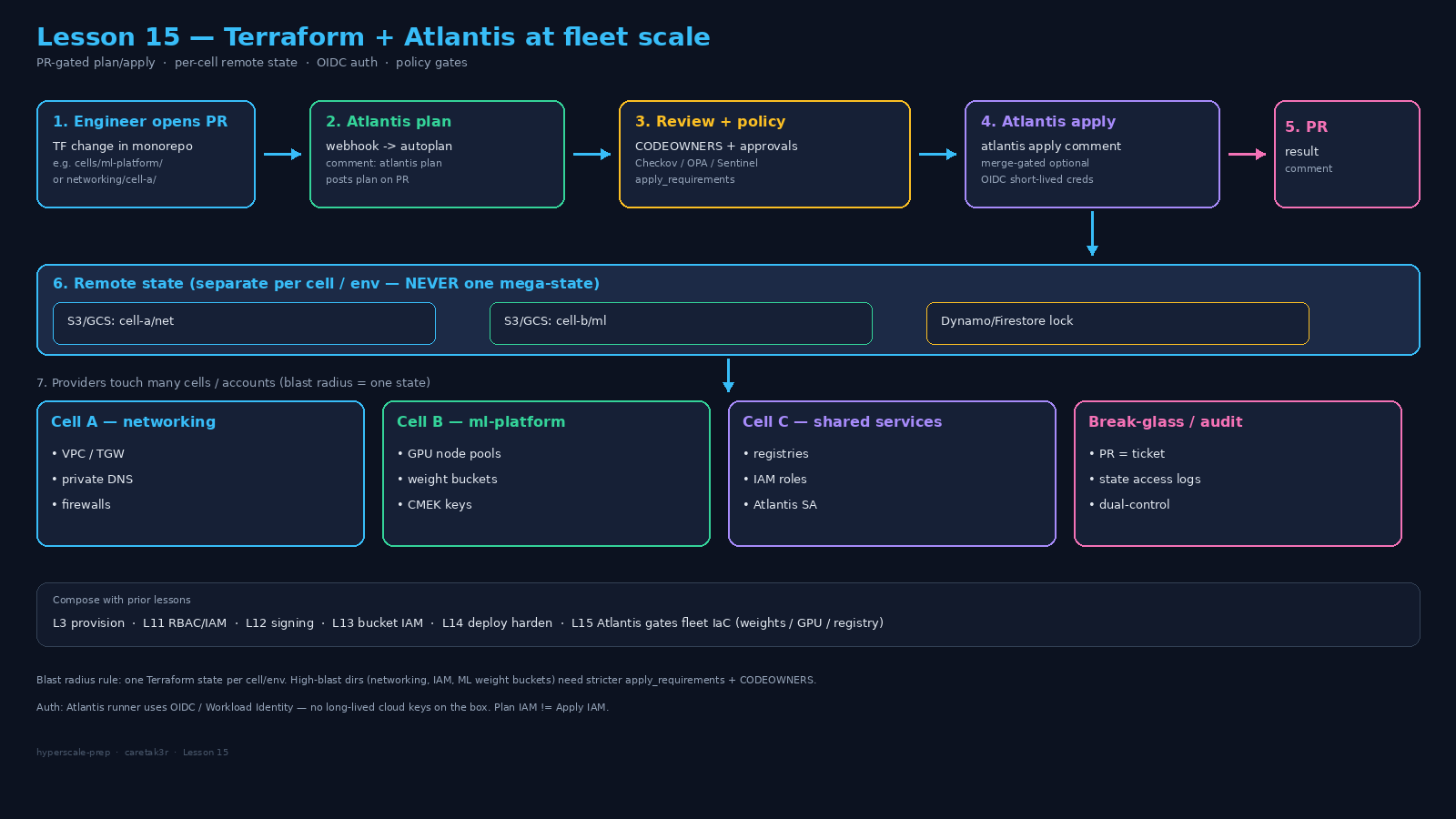
Read it top-down: An engineer opens a PR against the IaC monorepo (or a scoped multi-repo) → Atlantis receives the webhook, runs plan for when-modified projects, and posts the plan as a PR comment → human reviewers (CODEOWNERS on high-blast paths) plus policy checks (Checkov/OPA/Sentinel) must pass → authorized atlantis apply (often with apply_requirements: [approved, mergeable]) runs with short-lived OIDC credentials → Terraform writes remote state (S3/GCS, encrypted) with a lock (DynamoDB/Firestore) — one state object per cell/env, not a fleet mega-state → providers mutate only that cell’s networking or ml-platform resources → apply output returns as a PR comment (the change ticket). The PNG compose strip ties L3 → L11 → L12 → L13 → L14 → L15 gates the IaC plane.
Idiosyncrasies / operator depth
Monorepo vs multi-repo; stacks per cell
| Shape | When it wins | Footgun |
|---|---|---|
Monorepo (infra/) | Shared modules, one Atlantis, consistent policy pack | Giant blast if when-modified is too broad; noisy plans |
| Multi-repo (net / ml / platform) | Team ownership boundaries; smaller CODEOWNERS | Drift in Atlantis version, module pins, policy packs |
Directory-per-cell cells/us-east-1-a/networking | Clear blast radius; matches fleet mental model (L1/L3) | Copy-paste drift; need module version discipline |
One stack / many cells via for_each | Looks DRY | One state = one lock = one bad apply touches all cells |
At 100+ clusters, prefer stacks per cell (or per cell×env) with shared version-pinned modules. DRY belongs in modules, not in a single state file.
atlantis.yaml: projects, when-modified, autoplan, apply_requirements
| Knob | Operator meaning |
|---|---|
projects[].dir | One Atlantis project ≈ one Terraform root ≈ one state |
when_modified | Glob of paths that trigger this project’s plan (include module paths carefully) |
autoplan.enabled | Plan on open/update without a comment — great for visibility, costly if over-broad |
apply_requirements | e.g. approved, mergeable, undiverged — raise the bar for networking / IAM / ML |
workflow | Custom plan/apply steps: terraform fmt, tflint, checkov, Conftest |
High-blast directories (networking/, iam/, ml-platform/weights/) get stricter apply_requirements and CODEOWNERS — same instinct as admit-time gates in L14.
State: one per cell/env — not one mega-state
- Partial apply risk: mega-state + targeted
-targetis how you leave dangling references and “helpfully” destroy siblings. - Lock granularity: one lock per state. Shared mega-state serializes the entire fleet’s applies.
- Recovery: smaller states are restore-able; mega-state corruption is an incident class of its own.
Workspace vs directory-per-env at fleet scale
| Approach | Verdict at hyperscale |
|---|---|
Terraform workspaces (default / prod) in one dir | Fine for tiny apps; at fleet scale, easy to apply the wrong workspace; weak CODEOWNERS story |
Directory-per-env (envs/prod/, envs/staging/) | Clearer blast radius; separate backends; Atlantis project per dir |
| Directory-per-cell×env | What most 100-cluster shops converge on |
Interview answer: “Workspaces are a feature; directories + separate backends are an operational boundary.”
Module version pins
- Pin
source = "git::https://...//modules/vpc?ref=v1.4.2"(tag or commit SHA). - Floating
ref=mainmeans yesterday’s CI green is today’s silent module change. - Renovate/Dependabot PRs bump module versions through Atlantis — the bump PR is the review surface.
Provider auth: OIDC from Atlantis SA, not keys on the box
- Atlantis pod/VM assumes cloud roles via OIDC / Workload Identity (L11).
- No long-lived access keys in the Atlantis Secret.
- Prefer separate plan vs apply roles (plan: read + state read; apply: mutate scoped resources).
Parallel plans, locking, “plan file expired”
- Atlantis locks the project/dir while a PR holds a plan; competing PRs queue or unlock explicitly (
atlantis unlock— privileged). - Plan artifacts expire / diverge when
mainmoves —undivergedrequirement forces re-plan. - Parallel autoplans across 50 projects can trip provider API rate limits — tune concurrency and
when_modified.
Drift detection vs continuous plan spam
- Nightly / hourly drift plans on prod cells (read-only identity) → ticket on non-empty plan.
- Do not autoplan every commit on every cell for “drift” — you will DDoS yourself and the cloud APIs.
- Out-of-band console clicks are drift; the fix is culture + detection, not disabling Atlantis.
Concrete commands & config
Example atlantis.yaml (networking cell + ml-platform cell)
# atlantis.yaml — repo root
version: 3
parallel_plan: true
parallel_apply: false   # serialize applies; safer across shared lock tables
projects:
  - name: cell-a-networking
    dir: cells/cell-a/networking
    workspace: default
    autoplan:
      enabled: true
      when_modified:
        - "*.tf"
        - "*.tfvars"
        - "../../modules/vpc/**/*.tf"
    apply_requirements: [approved, mergeable, undiverged]
    workflow: fleet-strict

  - name: cell-a-ml-platform
    dir: cells/cell-a/ml-platform
    workspace: default
    autoplan:
      enabled: true
      when_modified:
        - "*.tf"
        - "*.tfvars"
        - "../../modules/gpu-pool/**/*.tf"
        - "../../modules/weight-bucket/**/*.tf"
    # Stricter: ML weight buckets / GPU pools / CMEK
    apply_requirements: [approved, mergeable, undiverged]
    workflow: ml-strict

workflows:
  fleet-strict:
    plan:
      steps:
        - init
        - run: terraform fmt -check -recursive
        - run: tflint --chdir=$DIR
        - run: checkov -d . --quiet --compact
        - plan
    apply:
      steps:
        - apply
  ml-strict:
    plan:
      steps:
        - init
        - run: terraform fmt -check -recursive
        - run: tflint --chdir=$DIR
        - run: checkov -d . --quiet --compact --framework terraform
        - run: conftest test plan.json -p policy/ml/   # deny public GetObject, broad IRSA
        - plan:
            extra_args: ["-out", "$PLANFILE"]
    apply:
      steps:
        - apply
Backend HCL (S3 + DynamoDB, encrypted)
# cells/cell-a/ml-platform/backend.tf
terraform {
  required_version = ">= 1.6.0"
  backend "s3" {
    bucket         = "acme-tfstate-prod"
    key            = "cells/cell-a/ml-platform/terraform.tfstate"
    region         = "us-east-1"
    encrypt        = true
    dynamodb_table = "acme-tfstate-locks"
    # Optional: KMS CMK instead of AES256
    # kms_key_id   = "arn:aws:kms:us-east-1:123:key/..."
  }
}
GCS variant sketch:
terraform {
  backend "gcs" {
    bucket = "acme-tfstate-prod"
    prefix = "cells/cell-a/ml-platform"
  }
}
# Pair with a Firestore/GCS lock strategy your org standardizes;
# encrypt with CMEK; bucket IAM deny allUsers / allAuthenticatedUsers.
Plan habits + Atlantis PR comments
# Local dry-run habits (still never apply prod from laptop)
terraform init -input=false
terraform validate
terraform plan -out=tfplan -input=false
terraform show -no-color tfplan | less
terraform show -json tfplan > plan.json
checkov -f plan.json --framework terraform_plan

# On the PR (Atlantis)
# atlantis plan
# atlantis plan -p cell-a-ml-platform
# atlantis apply -p cell-a-ml-platform
# atlantis unlock   # only after confirming no in-flight apply
CI before Atlantis apply (defense in depth)
# .github/workflows/tf-lint.yml — runs on PR; Atlantis still owns apply
- run: terraform fmt -check -recursive
- run: tflint --recursive
- run: checkov -d cells/ --framework terraform --quiet
- run: terraform validate  # after init -backend=false per root
Policy gates belong in both CI (fast fail) and Atlantis workflow (cannot skip by commenting apply only).
State list / move / import — caution footnotes
terraform state list
# terraform state mv 'module.old.aws_s3_bucket.weights' 'module.new.aws_s3_bucket.weights'
# ^^^ state mv without a reviewed plan is how you orphan CMEK policies

# Import: prefer a PR that adds the resource + import block (TF 1.5+)
# or a carefully reviewed `terraform import` runbook — never silent console create + later import surprise destroy
Rule: state surgery is a change, not a fix-up. It goes through a PR with plan output showing no unexpected destroys.
Failures & fixes
| Symptom | Likely root cause | Fix |
|---|---|---|
Error acquiring the state lock stuck for hours | Crashed apply; forgotten lock; dead PR | Confirm no apply running; atlantis unlock or DynamoDB lock item delete with dual-control; re-plan |
State looks corrupt after state mv | Partial move; wrong address; concurrent apply | Restore state from versioned bucket object; replay move in a reviewed PR; enable state versioning + MFA delete |
| Applied to wrong workspace / cell | Workspace habit; ambiguous -p; copied backend key | Directory-per-cell; require project name in apply; backend key includes cell id; CODEOWNERS |
| Soft-deleted cloud resources (GCP) / retention | Apply destroy + recreate race; API eventual consistency | Wait retention window or undelete API; plan for create-before-destroy where supported |
| Provider rate limits across 100 clusters | Parallel autoplan storm; shared account quotas | Cap Atlantis concurrency; stagger drift jobs; per-cell credentials / quotas |
| Atlantis ignores webhooks / 401 | Webhook secret mismatch; allowlist typo | Rotate ATLANTIS_GH_WEBHOOK_SECRET; fix --repo-allowlist; verify /events URL |
| Plan identity ≠ apply identity drift | Different roles; plan missed IAM denial that apply hits (or reverse) | Same trust root; document plan≤apply privileges carefully; integration-test both roles |
| Destroyed GPU node pool / weight bucket from wrong target | Mega-state; -target misuse; wrong project apply | Separate ml-platform state; ban casual -target in Atlantis; stricter apply_requirements + CODEOWNERS on ml-platform/ |
Plan file was too old / undiverged fail | main moved after plan | Re-run atlantis plan; require undiverged so stale plans cannot apply |
| Checkov green, apply opens public bucket | Policy only on HCL, not on plan JSON; exception wildcard | Conftest/OPA on plan JSON; deny public-read / allUsers bindings; alert on bucket policy diffs |
Security & hardening
This is the change-control plane for everything prior lessons hardened. A signed image and CMEK bucket still lose if IaC quietly attaches s3:* or flips a bucket to public.
Atlantis least privilege
| Control | Operator practice |
|---|---|
| Separate plan vs apply IAM | Plan role: state read, Describe/List; Apply role: scoped Create/Update/Delete on allow-listed services |
| No admin on the runner | Atlantis SA is not OrganizationAdministrator / AdministratorAccess |
| Repo allowlist + webhook secret | Mandatory; see Atlantis security (opens in a new tab) |
| Egress deny to random providers | Pin provider versions; prefer baked providers; treat external data sources as hostile |
PR branch atlantis.yaml risk | Server-side repo config can constrain workflows; do not let a PR invent arbitrary run: steps that exfil credentials |
PR approval + CODEOWNERS
# .github/CODEOWNERS
/cells/*/networking/          @platform-networking-oncall
/cells/*/iam/                 @security-iam-approvers
/cells/*/ml-platform/         @ml-platform-oncall @security-iam-approvers
/modules/weight-bucket/       @ml-platform-oncall @security-iam-approvers
/modules/gpu-pool/            @ml-platform-oncall
Pair with Atlantis apply_requirements: [approved, mergeable, undiverged] on those projects. High-blast = more humans, not fewer clicks.
Secrets & state
| Bad | Better |
|---|---|
Plaintext DB passwords in .tf / tfvars committed | Secret Manager / Vault; TF only holds references |
| Secrets in state with world-readable bucket | State encryption (SSE-KMS/CMEK); bucket IAM deny public; private to Atlantis + break-glass auditors |
sensitive = true as “encryption” | Redaction only — state still stores values |
| Long-lived keys in Atlantis K8s Secret | OIDC/WI; rotate if ever used |
OIDC / Workload Identity for cloud auth
- GitHub OIDC → AWS IAM role / GCP WIF for Atlantis (and for CI lint jobs separately).
- Condition on
sub/attribute.repository/ audience so a random fork PR cannot assume prod apply roles. - Compose with L11: same least-privilege story, different caller.
Policy gates (deny the classics)
Deny in Checkov/OPA/Sentinel/Conftest:
- Unrestricted IAM (
*.*,iam:*,AdministratorAccessattachments) - Public buckets /
allUsersobjectViewer - Open security groups
0.0.0.0/0to SSH/RDP / node ports - Unsigned /
:latestimage refs inkubernetes_manifest/ Helm releases Atlantis applies (L12) - IRSA/WI policies with
s3:*on weight prefixes (L13)
Audit trail
- PR = change ticket — plan + apply comments are the narrative; link from incident docs.
- State bucket access logs / CloudTrail data events on state objects.
- Alert: apply without approval; unlock events; policy bypass labels.
AI/ML angle (required)
Terraform that provisions model-weight buckets, CMEK keys, GPU node pools, and private registries is high-blast ML infra. It must go through Atlantis with stricter apply_requirements and dual CODEOWNERS (ML platform + security).
Tie-through:
| Lesson | What IaC must not undo |
|---|---|
| L12 | Do not let TF apply unsigned image refs into cluster manifests |
| L13 | Do not open public GetObject; keep writer/reader SA split; CMEK required |
| L14 | Do not attach overly broad IRSA/WI to train/serve node pools or workload roles |
# Sketch: weight bucket — policy tests must FAIL if public ACL / broad policy creeps in
resource "aws_s3_bucket_public_access_block" "weights" {
  bucket                  = aws_s3_bucket.weights.id
  block_public_acls       = true
  block_public_policy     = true
  ignore_public_acls      = true
  restrict_public_buckets = true
}

# IRSA for inference: GetObject + KMS Decrypt on prod prefix ONLY — never s3:*
Punchline: Admission and NetPol harden what runs. Atlantis hardens who may change the substrate those controls sit on. Skip L15 and a friendly PR can re-open the hole L13 closed.
Interview soundbites
- “I don’t apply prod from a laptop — Atlantis plans on the PR, humans and policy gate apply.”
- “One Terraform state per cell/env; a mega-state is a blast-radius bug with extra steps.”
- “Plan IAM and apply IAM are different roles; the runner is never org admin.”
- “Module sources are pinned to tags/SHAs — floating main is an unreviewed change.”
- “Workspaces are convenience; directories plus separate backends are the operational boundary.”
- “CODEOWNERS on networking, IAM, and ml-platform weight buckets — apply_requirements match the blast radius.”
- “State is secret-adjacent: encrypt it, lock it, log access, never make the bucket public.”
- “OIDC/WI for Atlantis — static cloud keys on the box are an incident waiting for a webhook.”
- “Checkov on HCL and Conftest on plan JSON — HCL-only policy misses computed public access.”
- “Drift detection is scheduled and read-only; continuous autoplan across 100 cells is self-DoS.”
- “Terraform that touches GPU pools or weight buckets inherits L12/L13/L14 — IaC must not quietly attach s3: or public GetObject.”*
- “PR comments are the audit trail; unlock and state mv are privileged actions with dual-control.”
How this maps to the JD
Hyperscale platform roles own safe change across 100+ clusters: provisioning (L3) is useless without a gated IaC path that respects cell blast radius, IAM least privilege (L11), and ML substrate controls (L13/L14). Terraform + Atlantis (or Terraform Cloud/Enterprise/Spacelift with the same PR semantics) is how you prove you can evolve networking, IAM, GPU pools, and weight stores without heroics. Next up in the curriculum: Temporal & Argo for workflow orchestration after the change lands.
Watch (talks & demos)
Real talks that map to this lesson — watch after the Failures & fixes table.
Infrastructure automation via GitHub PR for Terraform with Atlantis
End-to-end Atlantis: webhook → plan comment → apply comment against AWS — the operator loop this lesson centers on.
Open on YouTube (opens in a new tab)
Terraform Practices to Enable Infrastructure Scaling (Hila Fish)
Module boundaries, scaling practices, and the organizational habits that keep Terraform usable past a handful of stacks — pairs with per-cell state and pinned modules.
Open on YouTube (opens in a new tab)
How to Manage Terraform Secrets Safely
Why sensitive = true is not encryption, why state is secret-adjacent, and how to keep credentials out of tfvars/CI logs — required mindset for Atlantis runners and state buckets.
Open on YouTube (opens in a new tab)
References
- Atlantis docs (opens in a new tab) · Atlantis security (opens in a new tab) · Server configuration (opens in a new tab) · Repo config / atlantis.yaml (opens in a new tab)
- Terraform backends (remote state) (opens in a new tab) · S3 backend (opens in a new tab) · GCS backend (opens in a new tab)
- AWS OIDC with GitHub Actions (opens in a new tab) · GCP Workload Identity Federation (opens in a new tab)
- Checkov (opens in a new tab) · OPA / Conftest (opens in a new tab) · TFLint (opens in a new tab) · Sentinel (TFC/TFE) (opens in a new tab)
- Prior: 14 — ML inference/training deploy hardening · 13 — ML weights / checkpoint hardening · 12 — Node/container hardening / supply chain · 11 — Cluster security / PSS / RBAC · 03 — Cluster provisioning
Quick self-check
Out loud, in under two minutes:
- Why is one Terraform state for 100 clusters a blast-radius and locking problem?
- What does Atlantis
apply_requirements: [approved, mergeable, undiverged]buy you operationally? - How should Atlantis authenticate to AWS/GCP — and what must never live on the runner?
- Name three policy denials you enforce before apply on an
ml-platformstack (weights / GPU / IAM). - When is
terraform state mvacceptable, and what must the plan show afterward? - How does L15 protect the guarantees you built in L12–L14?