Lesson 12 — Node/container hardening & supply-chain provenance (images, SBOM, signing)
2026-09-20
What interviewers are really probing
Lesson 11 answered who may create what (PSS, admission, RBAC, Workload Identity). This lesson answers what is allowed to run, and how you prove the artifact is yours: hardened nodes + runtimes, digest-pinned images, SBOM/scan, cosign/Sigstore signatures, SLSA provenance, and admission that verifies before schedule.
They want evidence you have operated the full chain, not just trivy image once:
- Node / kubelet CIS posture — anonymous auth off, cert rotation, unused features disabled, seccomp/AppArmor/SELinux, no casual hostPath
- Container runtime — containerd/CRI-O, cgroup v2, RuntimeClass tiers (runc / gVisor / Kata)
- Supply chain — digests not tags, distroless/Chainguard bases, private registry, Syft SBOM + Trivy/Grype, cosign sign/verify, Fulcio/Rekor, SLSA attestations
- Cluster enforcement — Kyverno/Gatekeeper/Ratify
verifyImages, deny:latest, WI/IRSA for pulls (not long-livedimagePullSecretsas the only story) - Hyperscale — per-cell policy drift, mirror registries, airgap signing keys, webhook HA for verify (tie to L11
failurePolicy)
Interview sentence: “Admission without signed digests is theater; signatures without CIS nodes and Restricted PSS is a signed rootkit delivery path.”
Core diagram: build → sign → verify → hardened node → restricted pod
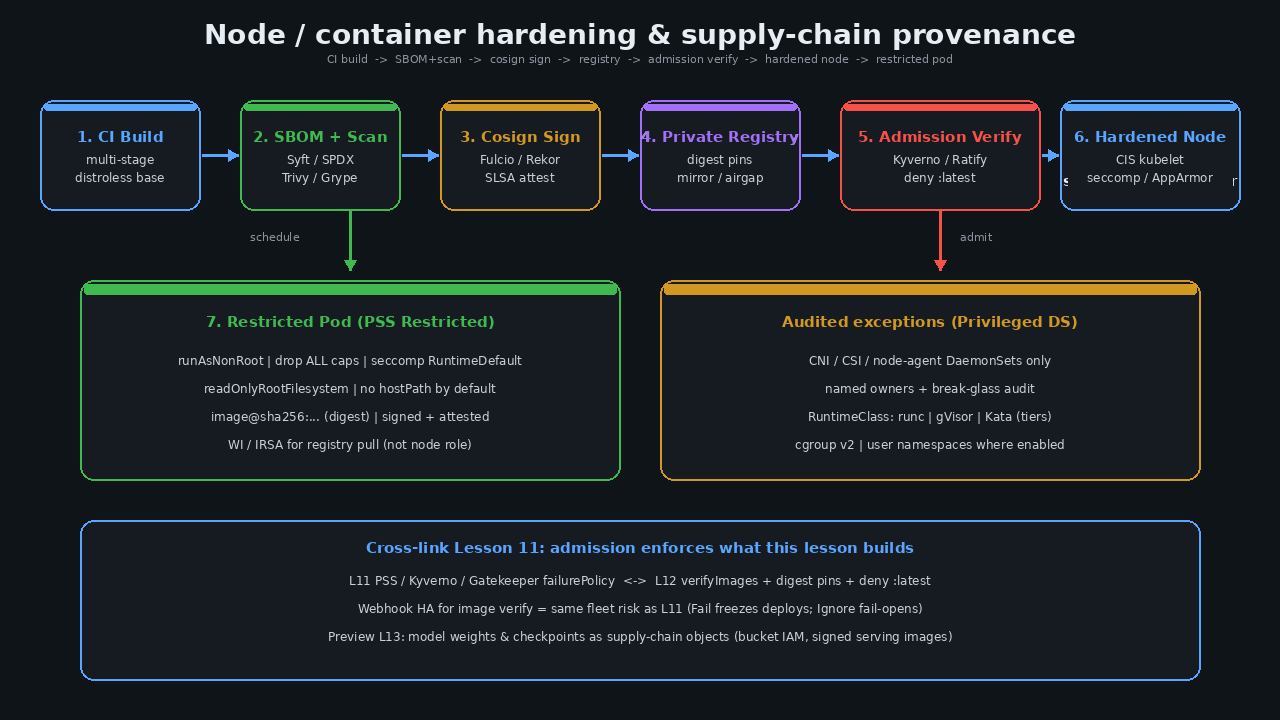
Read it top-down (left-to-right on the PNG): CI produces a multi-stage, minimal-base image → SBOM + vulnerability scan gate the promote → cosign signs the digest and optionally attaches SLSA provenance into the registry → pulls hit a private / mirrored registry by digest → admission (the L11 webhook/VAP path) verifies signature + digest and rejects :latest → the pod lands on a CIS-hardened node with RuntimeDefault seccomp → under Restricted PSS. Privileged DaemonSets exist only as named, audited exceptions. Lesson 13 will deepen the same model for model weights and checkpoints.
Idiosyncrasies / operator depth
Node hardening (CIS kubelet & OS)
Interviewers expect CIS Benchmark fluency, not a checkbox dump. Operator priorities that actually bite:
| Control | Why it matters | Footgun |
|---|---|---|
| Anonymous kubelet auth off | Unauth /pods, exec/logs pivots historically | Managed pools may reset flags on upgrade |
| Rotate kubelet / apiserver certs | Long-lived node identity = long-lived blast | Missed rotation = silent join failures |
| Disable unused kubelet features | Shrink attack surface (read-only port legacy, etc.) | Feature gates differ by distro/version |
| Privileged ports / kernel modules | Block unexpected binds; load only needed modules | CNI/CSI need documented exceptions |
| SELinux / AppArmor | MAC layer beyond namespaces | Profile drift across AMIs/images |
| Read-only rootfs where possible | Limits persistence on node agents too | Some agents still need writable scratch |
Privileged DaemonSets (CNI, CSI, node-exporters that need hostPath): treat as break-glass inventory — owners, ticket links, and audit — never “the cluster default.” Compose with L11 PSS: system NS may be Privileged; app NS stay Restricted.
Container runtime: containerd, CRI-O, isolation tiers
- containerd (most EKS/GKE/AKS paths) vs CRI-O (OpenShift-class): same CRI contract, different config knobs (
config.tomlvs CRI-O conf). Know where RuntimeClass handlers are registered. - cgroup v2 is the modern default — memory/CPU accounting and
cpu.maxbehave differently than v1; mixed nodes = mysterious OOM math. - User namespaces (where enabled): map container root ≠ host root — huge for breakout resistance; still incomplete across storage/network plugins — validate before mandating.
- RuntimeClass tiers for multi-tenant / untrusted:
runc— default, shared kernel- gVisor (
runsc) — userspace kernel syscall interception - Kata — lightweight VM per pod
- Pick tiers by trust class, not fashion: untrusted CI builders / student notebooks → gVisor/Kata; latency-sensitive inference often stays on runc + Restricted PSS + GPU isolation (later lessons).
Image supply chain (the artifact half of L11)
| Practice | Operator meaning |
|---|---|
| Digests, not tags | image@sha256:... is immutable; tags move under you |
| Multi-stage builds | Compiler toolchain never ships in the final layer |
| Distroless / Chainguard / wolfi | Fewer packages = smaller CVE surface and smaller SBOM |
| Private registry | ECR/GAR/ACR/Harbor — public Hub as cache only with policy |
| Scan | Trivy / Grype in CI and registry continuous scan |
| SBOM | Syft → SPDX/CycloneDX; store beside the image; feed policy |
| Sign | cosign sign on the digest; keyless (Fulcio OIDC) or keys/KMS |
| Transparency | Rekor entries make “who signed when” auditable |
| Provenance | SLSA attestations: builder identity, source commit, materials |
| Admit | Kyverno verifyImages / Gatekeeper/Ratify — fail closed when healthy |
Sigstore mental model: Cosign produces the signature; Fulcio issues short-lived certs from OIDC identity; Rekor logs the signature. Keyless reduces long-lived key sprawl — airgapped cells often still need offline keys / private Fulcio.
Cluster integration
- imagePullSecrets vs WI/IRSA: static pull secrets rotate poorly and end up in every NS. Prefer registry auth via node IAM + WI patterns your cloud documents; keep pull secrets for break-glass / cross-cloud only.
- Deny
:latestand require digest via admission (mutateDigest/verifyDigestin Kyverno). Signing a floating tag is how you “verify” the wrong bits tomorrow. - Cross-link L11:
failurePolicy: Failon verify webhooks freezes deploys when Kyverno/Ratify flaps — HA replicas, PDBs, SLIs, and PSS Restricted as the fail-closed backstop when custom verify is degraded.
Hyperscale idiosyncrasies
- Per-cell policy drift: one cell on Kyverno 1.x keyless issuer allow-list, another still on static keys → “works in staging” false confidence. Fleet-manage policy CRs.
- Mirror registries: airgap / region mirrors must mirror signatures and attestations (referrers /
.sigtags), not just image layers. - Airgap signing keys: private Fulcio or KMS-backed keys with offline root ceremony; document rotation drills.
- Webhook HA for verifyImages: same story as L11 admission — treat image-verify latency/errors as a deploy SLO.
Seccomp, capabilities, and “exceptions that stick”
seccompProfile.type: RuntimeDefaultis the modern baseline (PSS Restricted requires it). Custom profiles are for known syscalls (e.g. weird JNI) — version them next to the app, don’t copy-paste from Stack Overflow.capabilities.drop: ["ALL"]then add back only what you need (NET_BIND_SERVICEis the classic). “Drop most” withoutALLfirst is howSYS_ADMINsneaks back.allowPrivilegeEscalation: falseblocks the no_new_privs footgun path — pair with non-root.- hostPath / hostPID / hostNetwork / hostIPC: default deny in app NS via PSS + policy. Node agents that need them live in system namespaces with owners.
- Privileged ports on the node: CIS and OS hardening often restrict binds below 1024; containers that need them either use
NET_BIND_SERVICEcarefully or move above 1024 behind the Service.
Registry, mirrors, and referrers
OCI referrers / cosign’s signature storage must travel with the image. A Harbor/ECR mirror job that copies only the image index leaves admission green in the primary region and red in the DR cell. Validate with:
cosign tree registry.example.com/team/api@sha256:DIGEST
# Expect signatures + attestations listed; empty tree = mirror bug
For multi-arch indexes: sign the index digest you deploy, or sign each platform manifest and ensure the admit path resolves the same digest the node pulls.
Concrete commands & config
# --- Node / kubelet quick posture (example hosts) ---
# Anonymous auth should be false; adjust path per distro
sudo grep -E 'anonymous|authorization-mode|read-only-port|feature-gates' \
  /var/lib/kubelet/config.yaml /etc/kubernetes/kubelet.conf 2>/dev/null

# CIS-oriented scan (kube-bench)
kubectl apply -f https://raw.githubusercontent.com/aquasecurity/kube-bench/main/job.yaml
kubectl logs job/kube-bench

# RuntimeClass inventory
kubectl get runtimeclass
kubectl get nodes -o jsonpath='{range .items[*]}{.metadata.name}{"\t"}{.status.nodeInfo.containerRuntimeVersion}{"\n"}{end}'
# Multi-stage + distroless-shaped final (sketch)
FROM golang:1.22 AS build
WORKDIR /src
COPY . .
RUN CGO_ENABLED=0 go build -o /out/app ./cmd/app
FROM gcr.io/distroless/static:nonroot
COPY --from=build /out/app /app
USER nonroot:nonroot
ENTRYPOINT ["/app"]# Build, SBOM, scan, push by digest
docker build -t registry.example.com/team/api:ci-$GIT_SHA .
DIGEST=$(crane digest registry.example.com/team/api:ci-$GIT_SHA)
IMG="registry.example.com/team/api@$DIGEST"
syft packages "$IMG" -o spdx-json > sbom.spdx.json
trivy image --severity CRITICAL,HIGH --exit-code 1 "$IMG"
# or: grype "$IMG"
# Sign + attest (keyless example; use --key / KMS in airgap)
cosign sign "$IMG"
cosign attest --predicate sbom.spdx.json --type spdx "$IMG"
cosign verify "$IMG"
cosign verify-attestation --type spdx "$IMG"# Kyverno verifyImages (sketch) — enforce signatures; tie failurePolicy to L11 HA story
apiVersion: kyverno.io/v1
kind: ClusterPolicy
metadata:
name: verify-production-images
spec:
validationFailureAction: Enforce
webhookTimeoutSeconds: 30
rules:
- name: verify-signed-digests
match:
any:
- resources:
kinds: ["Pod"]
namespaces: ["prod", "model-serving"]
verifyImages:
- imageReferences:
- "registry.example.com/*"
mutateDigest: true
verifyDigest: true
required: true
attestors:
- count: 1
entries:
- keys:
publicKeys: |-
-----BEGIN PUBLIC KEY-----
# fleet-managed cosign.pub or kms://...
-----END PUBLIC KEY-----# Restricted-shaped Pod securityContext (admission still required)
apiVersion: v1
kind: Pod
metadata:
name: api
namespace: prod
spec:
securityContext:
runAsNonRoot: true
seccompProfile:
type: RuntimeDefault
containers:
- name: api
image: registry.example.com/team/api@sha256:REPLACE
securityContext:
allowPrivilegeEscalation: false
readOnlyRootFilesystem: true
capabilities:
drop: ["ALL"]
# Prefer WI/IRSA for registry; imagePullSecrets only if required# Admission / PSS cross-checks (from L11 habits)
kubectl get ns prod -o yaml | rg pod-security
kubectl get clusterpolicy verify-production-images -o yaml | rg -n 'failurePolicy|verifyImages|verifyDigest'
kubectl auth can-i create pods -n prod --as=system:serviceaccount:prod:deployerFailures & fixes
| Symptom | Likely root cause | Fix |
|---|---|---|
| Pods rejected: “image signature verification failed” | Wrong key/issuer; tag moved; mirror missing .sig/referrers | Align attestor keys/OIDC issuers; pin digest; mirror signatures with images |
| Mass deploy timeouts / “webhook timeout” | Kyverno/Ratify unavailable; failurePolicy: Fail | HA policy engine, PDB, raise replicas; page on webhook SLI; keep PSS Restricted as backstop (L11) |
| “Works with tag, fails with digest” | CI signed tag A; deploy resolved different digest | Sign after push; deploy only @sha256; enable mutateDigest/verifyDigest |
| kube-bench WARN on anonymous-auth | AMI/bootstrap reset kubelet flags | Bake CIS into node image/userdata; enforce via DaemonSet config manager; alert on drift |
| Breakout via hostPath / privileged debug | App NS not Restricted; debug PodSpec left privileged | PSS enforce=restricted; admission deny hostPath; time-box debug profiles |
| Trivy clean in CI, critical in prod registry | Base image rebuilt; floating tag; different arch index | Digest pins + continuous registry scan + re-sign on rebuild |
| Airgap verify cannot reach Rekor/Fulcio | Keyless path needs transparency/network | Offline keys or private Sigstore stack; ignoreTlog only with compensating controls |
| GPU node “needs privileged” for serving | Habit, not requirement | Prefer device plugin + Restricted; privileged only for audited device-agent DS |
| Pull failures after killing imagePullSecrets | Workloads still depended on static creds | Migrate to WI/IRSA/node pull identity; document break-glass secret |
Security & hardening
This lesson is the node + artifact hardening story — treat signed digests and CIS nodes as first-class controls, then compose with L11 admission/RBAC.
| Control | Operator practice |
|---|---|
| CIS kubelet / node OS | Anonymous auth off; cert rotation; disable unused features; SELinux/AppArmor on; kernel module allow-list |
| Runtime defaults | seccomp RuntimeDefault; drop ALL caps; readOnlyRootFilesystem; no hostPath in app NS |
| PSS Restricted | Enforce on app/inference NS; Privileged only for named system DS (L11) |
| Digest + deny latest | Admission mutate/verify digest; block :latest and mutable tags in prod |
| Sign + attest | cosign on every promote; SBOM + SLSA provenance attached; store keys in KMS / keyless OIDC |
| Verify at admit | Kyverno/Gatekeeper/Ratify; HA webhooks; know Fail vs Ignore blast radius |
| Registry auth | Prefer WI/IRSA over sprawling imagePullSecrets; private registry only |
| RuntimeClass tiers | gVisor/Kata for untrusted/multi-tenant; document who may schedule which class |
| Fleet drift | Same verify policy + trust roots across cells; mirror sigs in region/airgap caches |
AI/ML angle (weights, registries, signing — preview Lesson 13)
Treat model container images and weight/checkpoint artifacts as supply-chain objects — same discipline as app images, different storage plane.
| Surface | Hardening now (deepen in L13) |
|---|---|
| Serving images | Distroless-ish CUDA/runtime images; scan + SBOM; cosign sign; admit only signed digests in model-serving |
| Training base images | Provenance on trainer images (SLSA); pin framework digests; no :latest torch/CUDA tags in prod train |
| Weight / checkpoint objects | Private buckets; CMEK; never world-readable; IAM only on weight-reader SA via WI/IRSA — not node roles |
| Registry + bucket | Separate trust: OCI for images, object storage for checkpoints; both need provenance + access audit |
| Admission | Restricted PSS + verifyImages on serve NS; deny privileged GPU debug sidecars in prod |
| Secrets | HF/API tokens via external secrets/CSI — never baked into layers |
| Preview L13 | Checkpoint encryption, object-lock, training-job identity split, and inference egress controls go deeper next |
# Model NS: signed image + no casual secret list
kubectl get ns model-serving -o yaml | rg pod-security
kubectl get clusterpolicy -o yaml | rg -n 'model-serving|verifyImages'
kubectl auth can-i get secrets -n model-serving \
  --as=system:serviceaccount:model-serving:inferencer
# Expect: deploy signed digest yes; list secrets no
AI/ML punchline: A signed serving image pulling an unsigned, world-readable checkpoint is still a supply-chain fail. L12 closes the image half; L13 closes the weight half.
Interview soundbites
- “Tags move; digests don’t — I deploy
@sha256and admit-time verifyDigest.” - “Cosign signs; Fulcio binds OIDC identity; Rekor is the transparency log.”
- “SBOM without a gate is paperwork; Syft + Trivy/Grype in CI and registry continuous scan.”
- “Admission verifyImages is where supply chain meets L11 — HA the webhook or you freeze the fleet.”
- “Restricted PSS + drop ALL + RuntimeDefault seccomp is the pod baseline; privileged DS are audited exceptions.”
- “CIS kubelet: anonymous auth off, rotate certs, disable unused features — bake into the node image.”
- “RuntimeClass: runc by default; gVisor/Kata for untrusted tenants — not for every GPU inference pod.”
- “imagePullSecrets sprawl; prefer WI/IRSA for registry pull identity.”
- “Airgap: mirror layers and signatures; private Fulcio or KMS keys.”
- “Model serving: signed images now; checkpoint bucket IAM and encryption deepen in Lesson 13.”
How this maps to the JD
Hyperscale platform roles own safe artifacts on hardened nodes across 100+ clusters: CIS-aligned pools, digest-pinned and signed images, SBOM/scan evidence, and admission that verifies provenance without becoming a single point of deploy failure. Connect L11 → 12: control-plane authorization → node + supply-chain enforcement. Next: Lesson 13 — AI/ML security: model weights & checkpoint hardening.
Watch (talks & demos)
Real talks that map to this lesson — watch after the Failures & fixes table.
Sigstore: Using Transparent Digital Signatures to Help Secure the Software Supply Chain — Bob Callaway (OpenSSF)
Cosign, Fulcio, Rekor, and keyless signing — the mental model behind “we verify signatures at admit time.”
Open on YouTube (opens in a new tab)
Secure Your Project with the SIG Release Supply Chain Kit — Adolfo García Veytia & Carlos Panato (KubeCon EU 2023)
SBOM generation, signed SLSA provenance, and cosign-signed containers using the same toolkit patterns big CNCF projects ship with — CI → attest → verify narrative.
Open on YouTube (opens in a new tab)
Signing and Verifying Container Images With Sigstore Cosign and Kyverno — DevOps Toolkit
Hands-on cosign sign/verify plus Kyverno verifyImages enforcement — the exact admission bridge this lesson ties to Lesson 11.
Open on YouTube (opens in a new tab)
Hacking and Hardening Kubernetes Clusters by Example — Brad Geesaman (KubeCon)
Attack-path intuition for why kubelet defaults, privileged pods, and weak admission fail — pairs with the CIS/node and Restricted PSS sections above.
Open on YouTube (opens in a new tab)
References
- CIS Kubernetes Benchmark (opens in a new tab) · kube-bench (opens in a new tab)
- Pod Security Standards (opens in a new tab) · RuntimeClass (opens in a new tab)
- seccomp (opens in a new tab) · AppArmor (opens in a new tab)
- Sigstore (opens in a new tab) · cosign (opens in a new tab) · Rekor (opens in a new tab)
- SLSA (opens in a new tab) · in-toto attestations (opens in a new tab)
- Syft (opens in a new tab) · Trivy (opens in a new tab) · Grype (opens in a new tab)
- Kyverno verifyImages (opens in a new tab) · Ratify (opens in a new tab) · Gatekeeper (opens in a new tab)
- gVisor (opens in a new tab) · Kata Containers (opens in a new tab)
- Distroless / minimal bases: GoogleContainerTools/distroless (opens in a new tab) · Chainguard Images (opens in a new tab)
- Prior lesson: 11 — Cluster security / PSS / admission / RBAC
Quick self-check
Out loud, in under two minutes:
- Why deploy by digest, and where do you enforce “no
:latest”? - What do cosign, Fulcio, and Rekor each contribute — and what changes in an airgap?
- How does Kyverno
verifyImagesinteract with L11failurePolicy: Failat hyperscale? - Name five node/pod controls you expect on a Restricted workload (seccomp, caps, rootfs, hostPath, PSS).
- How do model serving images and checkpoint objects both fit a supply-chain story (preview L13)?