Lesson 18 — AI/ML platform: GPU node pools, device plugins, MIG/time-slicing, SKU isolation
2026-09-26
What interviewers are really probing
Lesson 17 previewed heterogeneous SKUs and GPU tenancy as tradeoff axes. This lesson is the first deep AI/ML platform cut: can you operate GPU capacity as labeled, tainted, device-plugin-backed pools — not “nodes that happen to have accelerators”?
Interviewers at hyperscale (and AI platforms fueled by wafer-ai/gpu-perf-engineering-resources (opens in a new tab)) want evidence you have run GPU fleets under packing pressure and trust boundaries:
- SKU isolation as a pool contract — A100 vs H100 vs L4 are different products; labels + taints + separate autoscaler min/max (L3, L4, L17)
- Device plugin vs GPU Operator — who installs drivers, who advertises
nvidia.com/gpu/mig-*, what breaks when the DaemonSet is unhealthy - MIG vs time-slicing vs exclusive — hardware memory/fault isolation vs SW oversubscribe with no mem/fault isolation vs 1:1 ownership
- RuntimeClass + container toolkit — the
nvidiaruntime path; wrong RuntimeClass = silent CPU fallback or CrashLoop - Scheduler packing reality — requests, tolerations, nodeSelectors; Pending forever is a pool-contract bug until proven otherwise
- Autoscaling gotchas — CA/NAP scales on pending GPU resources; MIG profile flips are drains; time-slice replicas fake headroom
- Security floor on shared GPUs — admission, NetPol, signed driver/workload images, weight IAM so a notebook on a shared L4 cannot read another tenant’s checkpoints (L11–L14)
Interview sentence: “I treat GPUs as SKU pools with taints and labels, let the GPU Operator own the device stack, choose exclusive / MIG / time-slice by isolation need — never time-slice across trust boundaries — and keep admission, NetPol, signed images, and per-pool weight IAM on the floor.”
Core diagram: SKU pools → plugin → resources → sharing modes → security floor
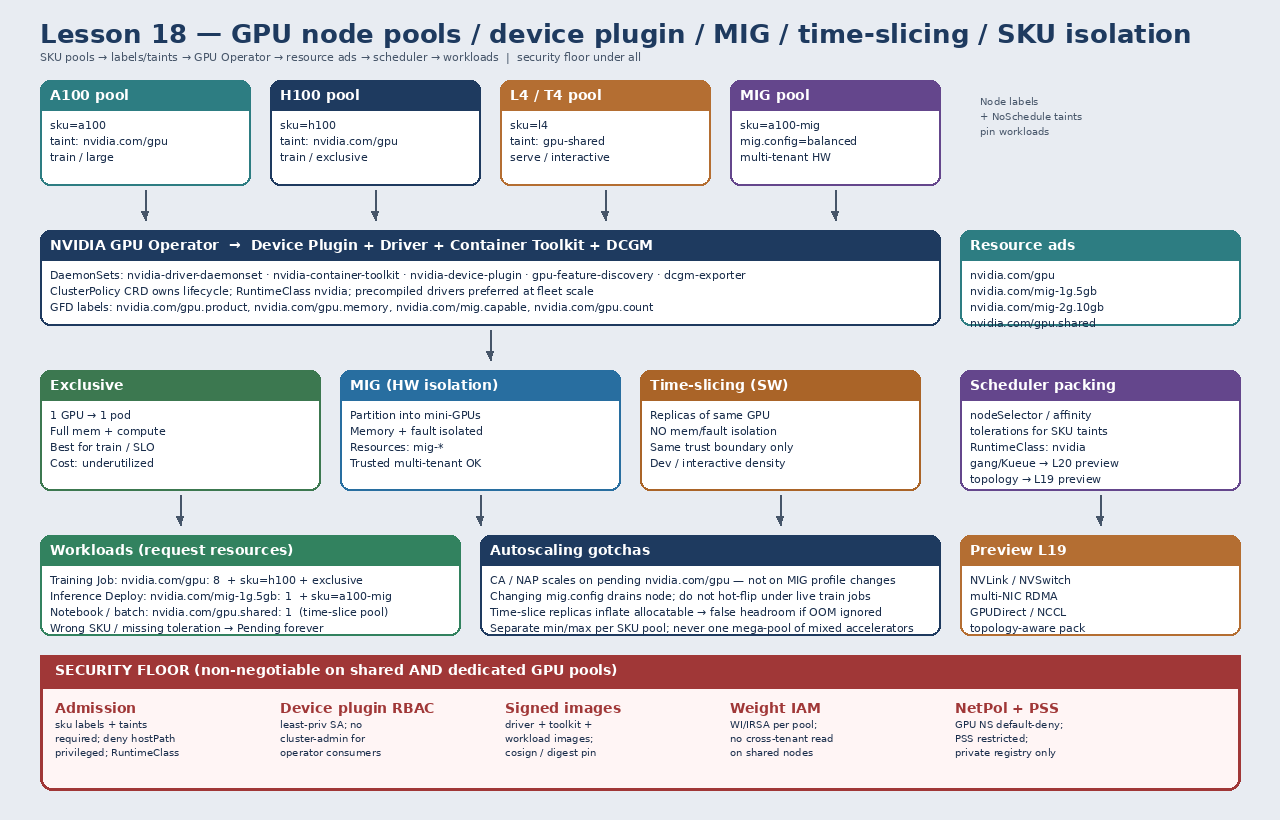
Read it top-down: SKU pools (labeled + tainted) feed the NVIDIA GPU Operator stack (driver, container toolkit, device plugin, GFD, DCGM). The plugin advertises nvidia.com/gpu, nvidia.com/mig-*, or nvidia.com/gpu.shared. You pick a sharing mode — exclusive (full GPU), MIG (HW memory/fault isolation), or time-slicing (SW replicas, no mem/fault isolation) — then the scheduler packs via nodeSelector/affinity + tolerations + RuntimeClass. Everything sits on a security floor: admission requiring SKU contracts, device-plugin RBAC, signed driver/workload images, NetworkPolicy on GPU namespaces, and WI/IRSA so weights never leak across tenants on shared nodes. Topology (NVLink/RDMA/NCCL) is Lesson 19 — preview only here.
Idiosyncrasies / operator depth
1. GPU node pools are products, not instance types
| Contract piece | Operator practice | Footgun |
|---|---|---|
| Labels | sku=h100, accelerator=nvidia-h100-80gb, pool=train-exclusive | Relying only on node.kubernetes.io/instance-type (opaque to app teams) |
| Taints | nvidia.com/gpu=true:NoSchedule or sku=h100:NoSchedule | Untainted GPU nodes become free CPU capacity for junk Deployments |
| Tolerations | Required on every GPU Pod template (Helm values, Kyverno mutate) | One chart without toleration → Pending; “GPUs are broken” tickets |
| Separate CA/NAP | Per-pool min/max/spot policy | One mixed pool: H100 jobs land on L4 or block behind notebooks |
| Golden image + SKU overlay | One CIS baseline AMI; driver/ABI differences via Operator, not 12 AMIs (L17) | Snowflake AMIs per SKU forever |
Interview sentence: “SKU isolation lives in labels, taints, and autoscaler pools — not in hoping the scheduler invents topology.”
2. NVIDIA device plugin vs GPU Operator
| Piece | Role | Gotcha |
|---|---|---|
| k8s-device-plugin | Ads nvidia.com/gpu (and MIG resources); allocates devices to pods | Alone does not install drivers or configure toolkit |
| GPU Operator | ClusterPolicy CRD → DaemonSets: driver, toolkit, device-plugin, GFD, DCGM, MIG manager | Privileged / hostPath by design on driver DS — gate who can edit ClusterPolicy |
| GFD | Labels product, memory, MIG capability, count | Stale labels after MIG flip until plugin/GFD restart |
| Container toolkit | Injects GPU devices into containers via RuntimeClass | Missing toolkit → pods schedule then fail to see /dev/nvidia* |
| DCGM exporter | Health + metrics for capacity/SEV | Metrics without alert on XID / ROW remap = flying blind |
Prefer Operator-managed stacks at fleet scale (L3 lifecycle). Pin Operator/chart versions; treat driver upgrades as drain waves (Temporal saga territory from L16).
3. Exclusive vs MIG vs time-slicing
| Mode | Isolation | When it wins | When it loses |
|---|---|---|---|
| Exclusive | Full GPU to one pod | Training, SLO inference, unknown memory footprint | Density; idle H100s eating budget |
| MIG | HW partition: dedicated SM + memory + fault isolation | Multi-tenant inference on A100/H100; regulated tenants sharing a node | Profile rigidity; resize = drain; not all SKUs support MIG |
| Time-slicing | SW replicas; no memory or fault isolation | Dev notebooks, batch within one trust domain | Cross-tenant; production SLO; any OOM kills neighbors’ luck |
Operator truth from NVIDIA docs: time-slicing trades MIG’s memory/fault isolation for higher share counts. Never put hostile tenants on the same time-sliced GPU. GKE can combine MIG partitions with time-sharing inside a partition — still same-trust only (L14).
Interview sentence: “Exclusive for train/SLO; MIG when multi-tenant needs HW walls; time-slice only inside one trust boundary — never as a security control.”
4. Resource names and what the scheduler actually sees
| Advertisement | Meaning |
|---|---|
nvidia.com/gpu | Whole GPU (or time-sliced replica if config renames/overrides) |
nvidia.com/mig-1g.5gb, mig-2g.10gb, … | MIG profiles (strategy single vs mixed) |
nvidia.com/gpu.shared | Time-slice when renameByDefault: true |
| Allocatable vs capacity | Plugin may advertise replicas ≫ physical GPUs — fake headroom if apps ignore GPU memory |
Pods must request the exact resource name the pool ads. Requesting nvidia.com/gpu on a MIG-only node with strategy that hides whole GPUs → Pending.
5. RuntimeClass lockdown
# Workloads must opt into nvidia runtime — do not make it cluster default for all pods
apiVersion: node.k8s.io/v1
kind: RuntimeClass
metadata:
  name: nvidia
handler: nvidia
Admission should require runtimeClassName: nvidia (or your org’s name) for any pod requesting GPU resources, and forbid privileged + hostPID combos except the Operator’s own DaemonSets (L11).
6. Autoscaling gotchas (the pager at 2am)
| Symptom | Reality |
|---|---|
| Pending GPU pods, CA idle | Pod missing toleration / selector; CA never sees schedulable pending |
| CA scales wrong SKU | Node templates not labeled; NAP defaults to cheapest GPU |
| MIG config change “hangs” | Nodes need cordon/drain; in-place MIG reconfig is a lifecycle event |
| Time-slice “plenty of GPUs” then OOM | Replicas ≠ memory; enforce app-level GPU memory limits |
| Spot GPU reclaim mid-train | Checkpoint discipline + exclusive reserved pools for critical train (L13) |
7. Compose with prior security lessons
GPU pools are where L12–L14 become physical: signed images land on nodes that can read weight buckets. Shared pools need stricter IAM and NetPol, not looser — density is not an excuse to widen blast radius (L1).
Concrete commands & config
GKE-style GPU node pool (SKU + taint)
# Illustrative — separate pools per SKU
gcloud container node-pools create gpu-h100-exclusive \
  --cluster=cell-a --region=us-east1 \
  --machine-type=a3-highgpu-8g \
  --accelerator=type=nvidia-h100-80gb,count=8 \
  --num-nodes=0 --enable-autoscaling --min-nodes=0 --max-nodes=16 \
  --node-taints=sku=h100:NoSchedule,nvidia.com/gpu=true:NoSchedule \
  --node-labels=sku=h100,pool=train-exclusive,accelerator=nvidia-h100-80gb \
  --spot  # only if checkpointed; prefer on-demand for SLO train

gcloud container node-pools create gpu-l4-shared \
  --cluster=cell-a --region=us-east1 \
  --machine-type=g2-standard-8 \
  --accelerator=type=nvidia-l4,count=1,gpu-sharing-strategy=time-sharing,max-shared-clients-per-gpu=4 \
  --num-nodes=0 --enable-autoscaling --min-nodes=0 --max-nodes=32 \
  --node-taints=sku=l4-shared:NoSchedule \
  --node-labels=sku=l4,pool=interactive-shared,cloud.google.com/gke-gpu-sharing-strategy=time-sharing
Helm: NVIDIA GPU Operator (sketch)
helm repo add nvidia https://helm.ngc.nvidia.com/nvidia && helm repo update
helm upgrade --install gpu-operator nvidia/gpu-operator \
  -n gpu-operator --create-namespace \
  --set driver.enabled=true \
  --set mig.strategy=mixed \
  --set devicePlugin.config.name=time-slicing-config \
  --set operator.defaultRuntime=containerd
Device plugin time-slicing ConfigMap
apiVersion: v1
kind: ConfigMap
metadata:
  name: time-slicing-config
  namespace: gpu-operator
data:
  any: |-
    version: v1
    sharing:
      timeSlicing:
        renameByDefault: true
        failRequestsGreaterThanOne: true
        resources:
          - name: nvidia.com/gpu
            replicas: 4
Label nodes that should apply it: nvidia.com/device-plugin.config=any. Keep MIG pools on different nodes with nvidia.com/mig.config=all-balanced (or your profile) — do not time-slice and MIG-chaos the same unlabeled pool.
Workload: exclusive H100 train
apiVersion: batch/v1
kind: Job
metadata:
  name: train-llama-cell-a
  namespace: model-training
spec:
  template:
    spec:
      runtimeClassName: nvidia
      serviceAccountName: weight-writer
      restartPolicy: OnFailure
      nodeSelector:
        sku: h100
        pool: train-exclusive
      tolerations:
        - key: sku
          value: h100
          effect: NoSchedule
        - key: nvidia.com/gpu
          value: "true"
          effect: NoSchedule
      containers:
        - name: trainer
          image: registry.example.com/ml/trainer@sha256:REPLACE
          resources:
            limits:
              nvidia.com/gpu: "8"
Workload: MIG inference slice
apiVersion: apps/v1
kind: Deployment
metadata:
  name: infer-small
  namespace: model-serving
spec:
  template:
    spec:
      runtimeClassName: nvidia
      serviceAccountName: weight-reader
      nodeSelector:
        sku: a100-mig
      tolerations:
        - key: sku
          value: a100-mig
          effect: NoSchedule
      containers:
        - name: server
          image: registry.example.com/ml/infer@sha256:REPLACE
          resources:
            limits:
              nvidia.com/mig-1g.5gb: "1"
kubectl inventory (operator morning checks)
# Pool contract
kubectl get nodes -L sku,pool,accelerator,nvidia.com/gpu.product,nvidia.com/mig.capable

# What the plugin ads
kubectl describe node -l sku=h100 | sed -n '/Allocatable:/,/System Info:/p'
kubectl get cm -n gpu-operator time-slicing-config -o yaml

# Operator health
kubectl get pods -n gpu-operator -o wide
kubectl get clusterpolicies.nvidia.com
kubectl get runtimeclass

# Pending GPU truth
kubectl get pods -A -o custom-columns=NS:.metadata.namespace,N:.metadata.name,ST:.status.phase \
  | grep Pending
kubectl describe pod -n model-training TRAIN_POD | sed -n '/Events/,$p'

# DCGM / GPU feature labels
kubectl get nodes -l nvidia.com/gpu.count -o json \
  | jq '.items[] | {name:.metadata.name, labels:.metadata.labels | with_entries(select(.key|startswith("nvidia.com/")))}'
Admission sketch: require SKU + RuntimeClass for GPU requests
apiVersion: admissionregistration.k8s.io/v1
kind: ValidatingAdmissionPolicy
metadata:
  name: gpu-pool-contract
spec:
  failurePolicy: Fail
  matchConstraints:
    resourceRules:
      - apiGroups: [""]
        apiVersions: ["v1"]
        operations: ["CREATE", "UPDATE"]
        resources: ["pods"]
  validations:
    - expression: >
        !has(object.spec.containers) ||
        !object.spec.containers.exists(c,
          has(c.resources) && has(c.resources.limits) &&
          (c.resources.limits.exists(k, k.startsWith("nvidia.com/")))) ||
        (has(object.spec.runtimeClassName) && object.spec.runtimeClassName == "nvidia" &&
         has(object.spec.nodeSelector) && has(object.spec.nodeSelector.sku))
      message: "GPU pods require runtimeClassName=nvidia and nodeSelector.sku"
Failures & fixes
| Symptom | Likely cause | Fix / mitigation |
|---|---|---|
Pod Pending: 0/N nodes are available: insufficient nvidia.com/gpu | Wrong resource name (gpu vs mig-* vs gpu.shared); pool at max; missing CA template | Match ads; scale pool; fix NAP SKU labels |
| Pod Pending: untolerated taint | Chart omitted tolerations | Kyverno mutate tolerations by namespace; golden Helm defaults |
Scheduled but no /dev/nvidia* | Toolkit/RuntimeClass missing; wrong handler | Fix RuntimeClass; check toolkit DS; admission require nvidia |
| CrashLoop: driver mismatch | Node kernel vs driver container ABI | Pin Operator/driver; precompiled drivers; drain-wave upgrades |
| MIG resources missing after config | GFD/plugin not restarted; wrong mig.strategy | Verify nvidia.com/mig.config; restart plugin; use MIG manager |
| Time-slice OOM / XID storms | No mem isolation; hostile or unbounded apps | Split trust domains; prefer MIG; set app GPU memory limits |
| CA scales L4 for H100 Job | Shared autoscaler / unlabeled templates | Separate node pools + labels; NAP constraints per SKU |
| Notebook reads other tenant weights | Node SA / WI too broad on shared pool | Per-workload WI/IRSA; bucket IAM; never node-wide s3:* (L13) |
| Privileged escape via GPU DS pattern | Tenants copy Operator securityContext | PSS restricted on tenant NS; only Operator NS allowed privileged |
| “GPU utilization low” with Pending train | Interactive shared pool starved exclusive capacity | Quotas + separate pools; fair-share queues (upcoming L20) |
| Drain stuck on GPU node | Long train without eviction budget | PDB + checkpoint; Temporal drain saga (L16) |
Security & hardening
GPU nodes are high-value targets: they hold model weights in memory/disk cache, run privileged device stacks, and often share physical accelerators across teams. Soft density without a floor is how you get cross-tenant weight theft and driver-level escapes.
| Control | Why | Practice |
|---|---|---|
| SKU pool isolation | Blast walls between train / serve / interactive (L14) | Separate pools + taints; no default-scheduler freeloading on GPU nodes |
| Admission requires sku + RuntimeClass | Stops accidental or malicious GPU scheduling | ValidatingAdmissionPolicy / Kyverno; deny :latest; digest pins (L12) |
| Device plugin / Operator RBAC | ClusterPolicy edit ≈ fleet GPU root | Least privilege; break-glass only; audit ClusterPolicy changes |
| Privileged / device access | Driver DS needs privilege; tenants must not | PSS restricted on model-* NS; allow privileged only in gpu-operator |
| Signed driver + toolkit + workload images | Compromised GPU stack = host compromise | Cosign verify; private registry; SBOM for Operator charts (L12) |
| RuntimeClass lockdown | Prevents silent non-GPU runtimes and host escape paths | Named nvidia RuntimeClass; admission-enforced for GPU resource requests |
| No cross-tenant weight access on shared GPUs | Time-slice/MIG density ≠ shared IAM | Per-pod WI/IRSA; bucket IAM + CMEK; separate reader/writer SAs (L13) |
| NetworkPolicy on GPU namespaces | Exfil of weights / pivot to train | Default-deny; allow private registry + weight VPC endpoints only (L9, L14) |
| Secrets / WI-IRSA for pulls onto GPU nodes | Long-lived keys on GPU nodes are standing incidents | External Secrets / CSI; short-lived tokens; never HF tokens in images |
| PSS + no hostPath for tenants | hostPath + GPU ≈ host | Deny hostPath/hostNetwork/privileged for tenant GPU pods |
| Time-slicing trust rule | No mem/fault isolation | Same trust boundary only; regulated / prod → MIG or exclusive |
| Shared vs dedicated pools | Shared interactive pools still pull private weights | Dedicated train/serve pools for prod weights; shared pools use scrubbed/public fixtures or tightly scoped IAM |
AI/ML weight & registry hardening on GPU pools (required)
| Scenario | Weight / registry controls |
|---|---|
| Dedicated exclusive train pool | Writer SA + CMEK bucket; signed checkpoints; node pulls via WI only; no public HF |
| MIG multi-tenant serve | Per-tenant reader SA; digest-pinned model refs; NetPol per NS; no shared emptyDir for weights across pods |
| Time-sliced interactive | Prefer non-prod weights; if prod-like, per-user IAM + short TTL; never node instance role with broad s3:GetObject |
| All pools | Private registry for runtime + model images; cosign; admission blocks unsigned; provenance attestations on promote (L12/L13) |
# Sketch: shared GPU NS still gets the floor
apiVersion: policy.platform/v1
kind: GpuPoolGate
metadata:
  name: gpu-floor
spec:
  match:
    nodeSelectorKeys: ["sku"]
  require:
    runtimeClass: nvidia
    imageDigestPin: true
    cosignVerify: true
    podSecurity: restricted
    networkPolicy: deny-by-default
    weightBucketPublicAccess: false
    cmek: true
    workloadIdentity: true
    timeSliceSameTrustOnly: true
    forbidNodeWideObjectIAM: true
Punchline: MIG gives hardware walls; time-slicing does not. IAM, admission, NetPol, and signing are what stop a shared L4 notebook from becoming a weight exfil path — SKU taints alone are not enough.
Interview soundbites
- “GPUs are SKU pools with taints — not unlabeled capacity.”
- “Operator owns the device stack; the plugin only ads what the Operator configured.”
- “Exclusive for train/SLO; MIG for HW multi-tenant; time-slice only inside one trust domain.”
- “Time-slicing is density, not isolation — no mem, no fault walls.”
- “Pending GPU pods are a pool-contract bug until proven otherwise.”
- “MIG profile changes are drains, not ConfigMap daydreams.”
- “Replicas inflate allocatable; GPU memory is still finite.”
- “RuntimeClass nvidia is required, not decorative.”
- “Tenant NS stays PSS restricted — only gpu-operator may be privileged.”
- “Per-pod WI/IRSA for weights; never a node-wide models: role on shared pools.”*
- “Golden OS baseline; heterogeneity in labels and device plugins.”
- “Next: Lesson 19 — topology: NVLink, RDMA, NCCL — packing without fabric is half a design.”
How this maps to the JD
Hyperscale + AI/ML platform JDs that mention GPU fleets, inference/training, and 10K+ nodes are asking whether you can productize accelerators: pools, device plugins, sharing modes, and security. This lesson connects L1/L3/L4 (cells, lifecycle, Borg packing instincts), L11–L14 (admission, supply chain, weights, deploy isolation), L15 (pool IaC), and L17 (SKU vs golden image) into an operator-ready GPU pool story. Fuel: wafer-ai/gpu-perf-engineering-resources (opens in a new tab). Next up — Lesson 19: GPU topology (NVLink/NVSwitch, multi-NIC RDMA, GPUDirect, NCCL) so packing respects the fabric, not just the resource name.
Watch (talks & demos)
Real talks — watch after Failures & fixes.
Mastering GPU Management in Kubernetes Using the Operator Pattern (Shiva Krishna Merla & Kevin Klues, NVIDIA / KubeCon)
End-to-end GPU Operator lifecycle: drivers, toolkit, device plugin, MIG/MPS profiles, monitoring — the operator depth behind ClusterPolicy and fleet GPU stacks.
Open on YouTube (opens in a new tab)
A Deep Dive on Supporting Multi-Instance GPUs in Containers and Kubernetes (Kevin Klues, NVIDIA)
How MIG is exposed to containers and Kubernetes, resource naming, and lifecycle of MIG devices on a node — essential before you promise “multi-tenant A100” in an interview.
Open on YouTube (opens in a new tab)
Scaling GPU Clusters Without Melting Down (Alay Patel & Ryan Hallisey, NVIDIA / KubeCon EU 2025)
Control-plane cost of large GPU fleets, scheduler/apiserver pressure, KWOK simulation, and DRA direction — why GPU scale is a platform problem, not only a device-plugin problem.
Open on YouTube (opens in a new tab)
References
- NVIDIA GPU Operator docs (opens in a new tab) · Time-slicing GPUs (opens in a new tab) · MIG with Kubernetes (opens in a new tab)
- NVIDIA k8s-device-plugin (opens in a new tab) · GPU Feature Discovery (opens in a new tab)
- GKE GPU time-sharing (opens in a new tab) · GKE GPU sharing concepts (opens in a new tab) · GKE MIG (opens in a new tab)
- Kubernetes Device Plugins (opens in a new tab) · RuntimeClass (opens in a new tab)
- wafer-ai/gpu-perf-engineering-resources (opens in a new tab) — GPU fleets / topology / serving fuel
- Prior: 17 — Systems design tradeoffs · 15 — Terraform / Atlantis · 14 — ML deploy hardening · 13 — ML weights · 12 — Node/container hardening · 11 — Cluster security · 04 — Borg/Mesos · 03 — Cluster provisioning · 01 — Hyperscale mental model
- Next: Lesson 19 — GPU topology (NVLink/NVSwitch, multi-NIC RDMA, GPUDirect, NCCL)
Quick self-check
Out loud, in under two minutes:
- What labels and taints define a GPU SKU pool — and what happens if you skip the taint?
- What does the GPU Operator manage that the device plugin alone does not?
- Compare exclusive vs MIG vs time-slicing on memory isolation, fault isolation, and trust.
- Why can time-slice “allocatable GPUs” look healthy while training OOMs?
- Name three admission / IAM controls that must hold on a shared GPU pool when pods pull model weights.
- What breaks if a GPU pod omits
runtimeClassName: nvidiaor the matching SKU toleration?