Day 09 — Push recovery & disturbance rejection
Day 08 made stepping a mode machine on top of stance: intended gait clock vs measured contact_set, swing as soft tasks, landings into Day 07 friction / unilaterality, abort when torque_scale or confidence collapses. Day 07 owned the feasible program. Day 06 owned the estimate and impact settle. Day 05 owned sag honesty.
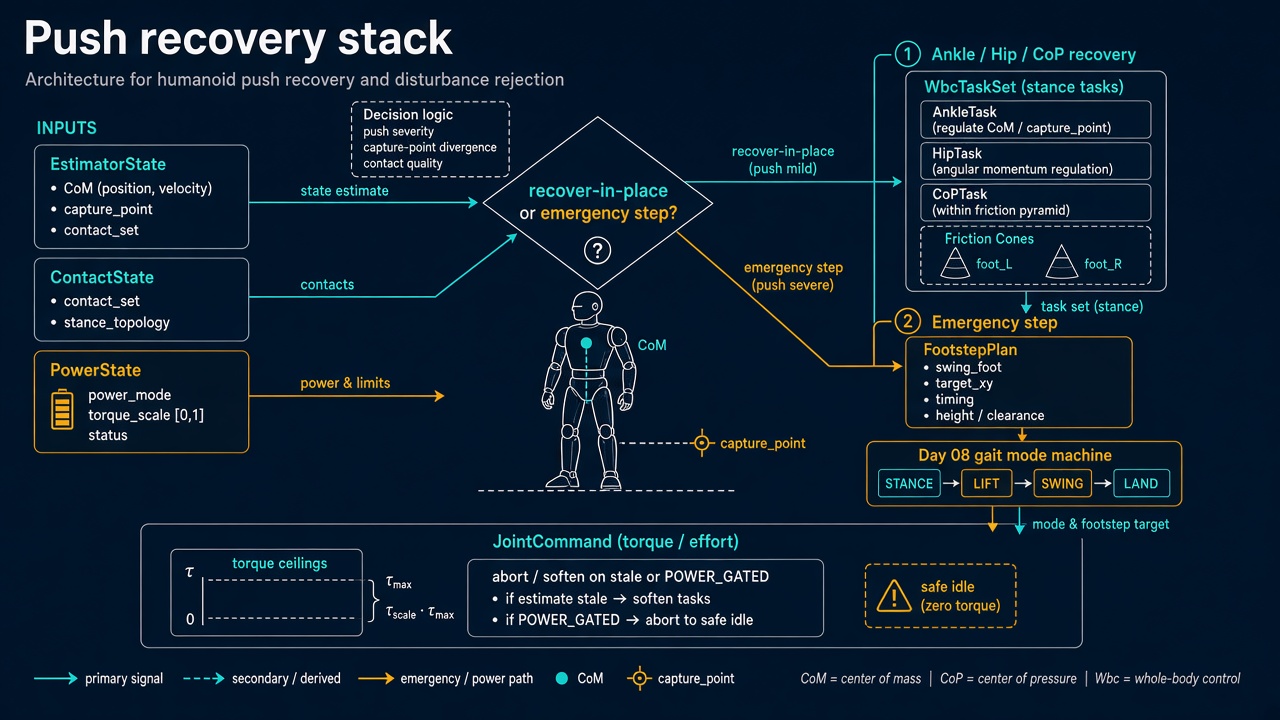
Today owns disturbance rejection on that same stack: detect CoM / capture-point escapes, choose recover-in-place vs emergency step, and keep abort / soften paths when power or contact confidence collapses mid-recovery — without inventing a second torque plant that “just catches pushes.”
Recovery is a decision layer, not a second plant
A push is not a new dynamics model. It is an escape of the capture-point / CoM relative to the current support polygon, under the same EstimatorState, contact quality, and torque_scale ceilings the stance and gait layers already trust.
| Layer | Owns | Must not own |
|---|---|---|
| Detection | CoM / capture-point excursion vs support; rate of escape | Joint FOC / AHRS |
| Decision | Recover-in-place vs emergency step vs abort/soften | Friction cones / BMS ceilings |
| Execution | Soft/hard tasks + Day 08 FootstepPlan when stepping | A parallel “recovery torque bus” |
| Honesty | Mid-recovery stale / POWER_GATED / low torque_scale | Heroic completion into brownout |
Core thesis: push recovery consumes capture-point / CoM escape + contact quality + torque_scale. It publishes tasks and (when needed) footsteps into the Day 07 / 08 faces. It does not replace QP constraints, FOC, or the BMS derate path.
Ownership rule: one writer for recovery intent (RecoveryCommand / recovery fields on GaitCommand) and one writer for measured support (contact_set). When they disagree mid-recovery, measured contact wins for constraints; the recovery layer aborts, softens, or re-plans — it does not fight a still-loaded sole or lean into air because a capture-point heuristic said so.
Detecting disturbance vs Day 06 impact settle
Not every CoP spike or CoM jolt is a push that needs a step.
| Event | Signature | Correct response |
|---|---|---|
| Heel-strike / touchdown settle | Brief / CoP transient; planned impact window | Day 06 impact soften; do not open recovery |
| Quiet stance noise | Capture-point inside margin; confidence healthy | Ignore; no mode flip |
| True push / disturbance | Capture-point escaping support; sustained CoM rate; not inside impact gate | Open recovery decision |
| Sensor lies | Stale IMU / FT; empty / wrong contact_set; low confidence | Soften / abort — never “recover” on garbage |
Do not confuse impact settle with disturbance rejection. Chasing a touchdown CoP spike as an escape will chatter feet and invent emergency steps on every heel-strike. Gate recovery behind: (1) not inside Day 06 impact window, (2) capture-point / CoM excursion past a frozen margin, (3) estimate age and confidence inside budget.
Capture-point intuition at the decision layer (planning, not a new plant):
- If the extrapolated capture-point stays inside an enlarged support with healthy
torque_scaleandcontact_set, prefer recover-in-place. - If it leaves the recoverable region, or in-place tasks would demand infeasible wrench under current cones / ceilings, prefer an emergency step that reuses Day 08’s
FootstepPlan+ gait mode machine. - If confidence or power already collapsed, prefer abort / soften over either.
Decision table: in-place vs emergency step vs abort
| Condition | Choice | Notes |
|---|---|---|
Escape small; DS polygon healthy; torque_scale ok | Recover-in-place | Soft → harden CoM / capture / posture tasks under Day 07 cones |
| Escape large; in-place wrench infeasible; contact green | Emergency step | Single (or few) FootstepPlan; SS mode flip tied to measured contact_set |
INPUT_STALE / low confidence | Abort / soften | Freeze new recovery steps; hold DS or soft tasks |
POWER_GATED / low torque_scale | Abort / soften or shorten | Raise friction margins; prefer DS; no heroic SS |
Empty / wrong contact_set | Soften; no SS commit | Do not free a loaded sole or trust a free foot as support |
| Mid-recovery ceilings collapse | Abort / soften | Same honesty as Day 08 mid-step faults |
Do not let a high-level net “push through” a recovery the ceilings already declared infeasible. The net may choose in-place vs step or a shorter foothold; it may not replace friction cones, unilaterality, or FOC.
In-place recovery under Day 07 ceilings
Recover-in-place is still the Day 07 program with raised priorities, not a special torque mode:
| Piece | Role |
|---|---|
| CoM / capture-point task | Soft → temporarily higher weight; miss → residual, not NaN |
| Posture / angular momentum bias | Soft; dump excess into arms/torso only within joint limits |
| Support feet | Hard friction + ; tagged from measured contact_set |
| Swing candidate (if any) | Stay soft or off until SS is honestly committed |
| Ceilings | torque_scale / iq_ceiling still bind every tick |
Hard vs soft: support constraints stay hard. Recovery authority lives in task weights and foothold choice. If the QP goes infeasible, the honest answer is soften / abort / step — not silently dropping friction.
Emergency step reuses Day 08
When in-place cannot contain the escape, recovery does not invent a parallel walker. It issues a short-horizon FootstepPlan and rides the Day 08 gait mode machine:
- Mode: DS → weight-shift → SS → impact settle → DS, same ownership rules.
- Swing: soft clearance + foot tasks; measured
contact_setowns constraints. - Touchdown: Day 06
ContactStategate, then Day 07 cones on the new support. - Abort / shorten: first-class if stale / gated / derate hits mid-step — same as locomotion.
| Recovery need | Day 08 reuse |
|---|---|
| Next foothold pose / window | FootstepPlan.footholds[] + abort_policy |
| Intended mode | GaitCommand.mode (STEP / ABORT / HOLD) |
| Swing tagging | WbcTaskSet.foot_refs[] vs contact_set every tick |
| Capture hint | capture_ref as planning input — not a torque override |
If teleop, a learned recovery net, and a scripted capture heuristic each flip mode independently, the QP will fight a still-support foot or plant into sag. One writer for recovery intent; measured contact wins for constraints.
Mid-recovery abort / soften honesty
Recovery is where teams love to disable safety “just this once.” Do not.
| Signal mid-recovery | Required behavior |
|---|---|
INPUT_STALE / confidence cliff | Soften tasks; cancel pending emergency step; hold safest DS posture available |
POWER_GATED / falling torque_scale | Shorten or abort step; raise margins; never complete SS into brownout |
contact_set disagrees with intended SS | Hold swing soft; do not free loaded sole |
| QP infeasible under cones | Drop task weights / abort — do not drop unilaterality |
| Impact window on emergency touchdown | Soften briefly; then enable friction on new support |
Abort and soften are success paths when the world lied or the pack sagged. A robot that always finishes the planned recovery step into a collapsing bus is ignoring Day 05 with nicer branding.
Shared API: recovery face on the same stack
Keep Day 02 / 04 wire honesty. Cyclic commands still carry BusHeader. Extend Day 07 / 08 faces rather than inventing a parallel “push bus”:
BusHeader:
  node_id, seq
  t_sample, clock_domain, age_budget_ms
  faults

# Upstream (read-only here)
EstimatorState, ContactState, PowerState  ⊇ BusHeader

# Thin recovery face (host / mid-rate)
RecoveryCommand ⊇ BusHeader:
  intent               # IDLE | RECOVER_IN_PLACE | EMERGENCY_STEP | ABORT | HOLD
  escape_metric?       # capture / CoM excursion in named frames — document units
  prefer_step          # bool hint; ceilings may still force abort/soften
  relax_on_fault       # stale / POWER_GATED / low torque_scale → abort/soften

# Reuse / extend Day 08 locomotion face
GaitCommand ⊇ BusHeader:
  mode                 # DS | SS_L | SS_R | STEP | ABORT | HOLD | RECOVER
  phase_or_clock?
  cadence_hz?
  recovery_intent?     # optional mirror of RecoveryCommand.intent
  relax_on_fault

FootstepPlan ⊇ BusHeader:
  footholds[]
  swing_clearance?
  capture_ref?
  abort_policy         # shorten | freeze_ds | recover_in_place | abort
  urgency?             # nominal | emergency — same cones, tighter windows

# Extended Day 07 task face
WbcTaskSet ⊇ BusHeader:
  mode                 # STANCE_DS | STANCE_SS | SWING | IMPACT | RECOVER_IP | ...
  com_ref / capture_ref?
  foot_refs[]          # each tagged support | swing | settling
  posture_bias?
  priority_order[]     # temporarily raise CoM / capture during RECOVER_IP
  relax_on_fault

# Downstream muscle (Day 02) — ceilings still reflect torque_scale
JointCommand ⊇ BusHeader:
  q_des? / qd_des? / tau_ff?
  iq_ceiling? / tau_ceiling?
  flags                # STO / soften / hold
Higher layers publish recovery intent + optional emergency footholds + task priorities. Rate loops enforce BMS ceilings. Nobody re-implements FOC or AHRS inside the capture-point detector.
Physical ↔ digital pairing for push recovery
| Physical | Digital twin / backing |
|---|---|
Same EstimatorState / capture-point consumers | No perfect-state cheat bus for “easy recoveries” |
| Push impulse timing vs CoM / capture escape | Matched impulse profiles + same escape thresholds |
| In-place wrench vs friction / rubber | Same cone params or logged tables as Day 07 |
| Emergency step contact flip vs / CoP | Injected delay + Day 06 impact gate |
torque_scale under recovery peaks | Sag / derate replay — no infinite-torque catch |
| Mid-recovery stale / gated injection | Scheduler that can fail the same way as hardware |
| Measured mid-rate recovery tick + jitter | Cannot beat hardware cadence or hide age faults |
If the twin always recovers with perfect Boolean contacts and a full pack while hardware sees delayed contact_set and sag, you will tune recovery gains forever and never ship a catch that survives a real shove on a tired bus.
Bring-up sequence (before free push tests)
Day 07 stance green and Day 08 steps 1–5 stay green (controlled step + mid-step faults). Then:
- Stance + step green — Day 07 fault injection and Day 08 one controlled step + mid-step abort still behave.
- Small in-place only — gentle disturbance in DS; raised CoM / capture tasks; no emergency
FootstepPlan; confirm impact settle is not classified as recovery. - Scripted decision — force escape metric across the in-place vs step threshold in twin; confirm mode and task priorities flip cleanly.
- One emergency step — single recovery
FootstepPlan; mode flip tied to measuredcontact_set; land into cones. - Mid-recovery faults — force stale / gated / derate in twin and on hardware during in-place and during emergency swing; confirm abort or soften, not heroic completion.
- Then add learned residuals that choose intent or foothold above the QP — never replace cones, FOC, or
torque_scale.
Skip to “RL recovers in sim” and hardware’s first real shove becomes an unplanned brownout experiment with better video.
Failure gallery
| Symptom | Likely cause |
|---|---|
| Recovers on every heel-strike | Impact settle misclassified as push; Day 06 gate unused |
| In-place chatters then tips | Task weights raised without friction margins; ceilings ignored |
| Emergency step digs / tips “in air” | Support constraints left on swing foot; contact_set lag ignored |
| Twin catches, hardware faceplants | Perfect contacts / infinite torque_scale in sim |
| Completes recovery into brownout | Mid-recovery abort missing; ceilings not consulted |
| Capture chase pumps feet | Escape threshold too tight; no freeze on low confidence |
| Net recovers only on full pack | Residual learned without torque_scale / faults in observation |
| Mode clock frees loaded sole mid-catch | Recovery intent owns constraints instead of measured contact_set |
| QP infeasible → silent cone drop | Soften/abort path missing; “make it feasible” anti-pattern |
What to freeze this week
Extend frames and your control config with:
- Escape metric: capture-point / CoM margins, frames, and impact-settle exclusion aligned with Day 06
- Who owns recovery intent vs measured
contact_set(disagree → abort/hold) RecoveryCommandfields (or recovery fields onGaitCommand) + mid-rate tick budget- In-place task priority policy under Day 07 friction / unilaterality
- Emergency step: reuse
FootstepPlan/ gait mode; same abort/shorten as Day 08 - Mid-recovery abort / soften for stale,
POWER_GATED, and lowtorque_scale - Twin hooks: matched push impulses, contact delay, sag under recovery peaks — same as hardware
- Bring-up gate: no free push testing / learned recovery residuals until steps 1–5 above are green
The lesson is not “implement ankle strategy vs hip strategy vs a recovery transformer.” It is make disturbance rejection the same contact-rich program in silicon and in the twin: one estimate, honest power ceilings, in-place tasks that do not fight cones, emergency steps that inherit Day 08, and abort paths that stay honest when the world or the pack lies mid-catch.
Next
Day 10 — Upper-body / manipulation on shared balance ceilings: reach and grasp as soft tasks under the same EstimatorState + friction / unilaterality + torque_scale, without a second “arm plant” that steals support wrench or ignores mid-reach power and contact honesty.