Day 01 — Cold start: think before you buy
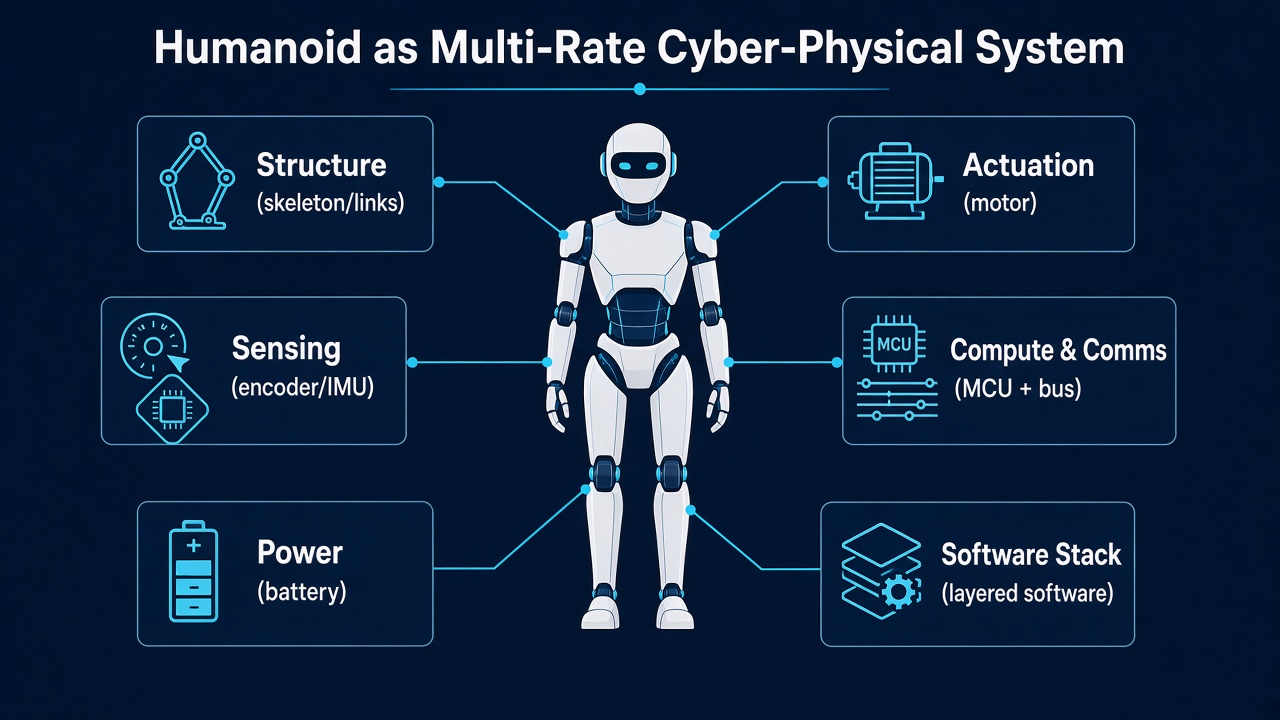
A humanoid is not “a robot that looks like a person.” It is a multi-rate cyber-physical system: motors and sensors on hard real-time loops, a body that must stay upright under gravity, and software that turns goals into joint torques. Skip that framing and you buy hardware too early.
The only useful first question: what closed loops must stay alive for the machine to not fall over or cook itself?
Those loops define the architecture. Everything else hangs off them.
Six subsystems
- Structure — links, joints, bearings, fasteners. Defines mass, inertia, and reachable workspace. Wrong here and every control gain fights the body.
- Actuation — motors, gearboxes, drives, brakes. Torque density + backdrivability decide whether you can do force control or only position bang-bang.
- Sensing — joint encoders, IMUs, force/torque, cameras, current sense. You control what you measure; everything else is open-loop hope.
- Compute & comms — MCUs for µs loops, a mid-tier board for ms planning, Ethernet / CAN / EtherCAT between them. Bandwidth and determinism matter more than “AI chips.”
- Power — battery chemistry, BMS, DC buses, brownout behavior. A humanoid dies when voltage sags mid-step, not when the model is “wrong.”
- Software stack — boot → RTOS / firmware → middleware (ROS 2 or custom) → state estimation → whole-body control → behaviors. The digital twin / sim sits beside this, not instead of it.
Physical build and digital backing are the same design, two embodiments. Design interfaces first (joint frames, message rates, units), then implement them in metal and in code.
Cold-start order (do not skip)
- Pick a scope thinner than “full humanoid.” Day-0 target: one leg, or a torso+arm on a fixed base. Walking bipeds are a graduate course in balance; earn them after you can track a joint trajectory under load.
- Freeze coordinates and units. Name every link, joint axis (right-hand rule), encoder zero, and SI units. Write them in frames before CAD. This is the contract between CAD, firmware, and sim.
- Build the digital skeleton first. URDF / MJCF of links + joint limits + approximate inertias. If the model cannot stand in sim with PD joint control, the physical one will not either.
- One joint, end-to-end. MCU → PWM / FOC → motor → encoder → current sense → logged torque / position at ≥1 kHz. That pipeline is the atom of every limb.
- Then chain joints, then contact, then balance. Contact and balance are where most “AI humanoid” projects quietly fail — they never instrumented force or CoM carefully.
Embedded mindset
The robot is a graph of hard deadlines.
| Loop | Typical rate |
|---|---|
| Joint torque / current | ~1–10 kHz |
| State estimation | ~100–500 Hz |
| Behavior planning | slower |
Never put a neural net inside a microsecond loop until you have measured jitter.
Next
Day 02 — Joint-level embedded: FOC, encoder types, and why current control is the real muscle.