Day 08 — Contact-rich stepping & locomotion
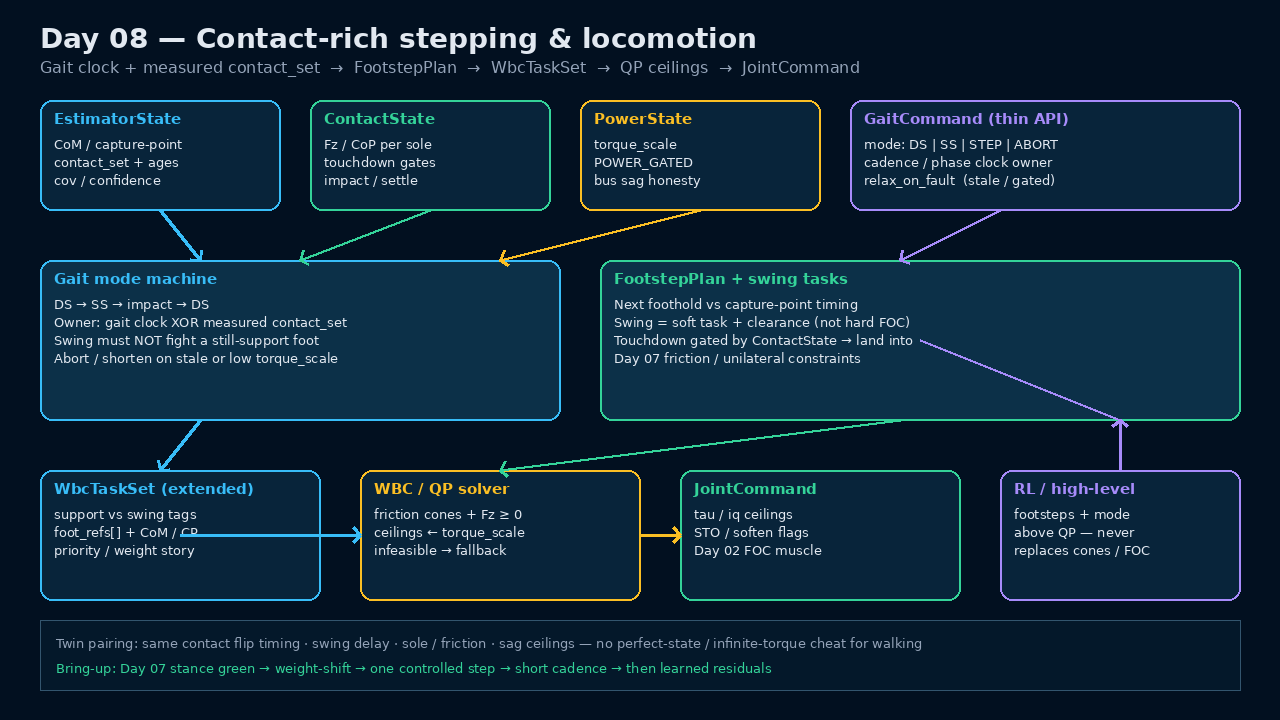
Day 07 made contact-rich balance a feasible program: tasks vs constraints, friction / unilaterality, and torque_scale as a ceiling — not a silent gain. Day 06 owned the estimate. Day 05 owned sag honesty.
Today owns motion that still respects that program: footstep timing, swing trajectories, and gait modes that consume EstimatorState + WBC ceilings instead of inventing a second plant that “just walks.”
Locomotion is a mode machine on top of stance
Walking is not “balance with a sine wave on the feet.” It is a sparse schedule of contact geometries the QP already knows how to treat:
| Phase | Contact story | Who must agree |
|---|---|---|
| Double support (DS) | Both feet in contact_set; CoP travels inside the polygon | Estimator + gait clock |
| Single support (SS) | One support frame; swing sole near-zero / free | Mode flip before swing tasks harden |
| Impact / settle | Brief soften; trust Day 06 impact gate | Do not chase CoP spike as a foothold |
| Abort / shorten | Planned SS cancelled or early touchdown | Stale / POWER_GATED / low torque_scale |
Ownership rule: pick one writer for intended mode (gait phase clock / GaitCommand) and one writer for measured support (contact_set from Day 06). The swing foot must not receive hard support constraints while it is still in contact_set, and the support foot must not be “freed” because a clock said so if the sole is still loaded. When they disagree, measured contact wins for constraints; the gait layer aborts, holds, or re-plans.
If teleop, a learned gait net, and a scripted clock each flip mode independently, the QP spends heel-strike fighting a foot that is still a support — or leaning into air.
Footstep timing, capture, and honest abort
A foothold is a promise about future support geometry. Capture-point / Divergent Component of Motion intuition still applies at the planning layer:
- Desired next contact should be reachable given CoM / capture-point state in
EstimatorState, not a video-game waypoint. - Step duration and length shrink when
cov_or_confidenceis poor, IMU / FT ages are near budget, ortorque_scaleis already derating the stance leg. - Abort and shorten are first-class behaviors, not shame states. A robot that always completes a planned swing into a sagging bus is not “brave” — it is ignoring Day 05.
| Signal | Planning response |
|---|---|
INPUT_STALE / low confidence | Freeze new footsteps; hold DS or shorten in-flight swing |
POWER_GATED / low torque_scale | Reduce step length / cadence; raise friction margins; prefer DS |
Empty / wrong contact_set | No SS commit; swing tasks stay soft or off |
| Capture-point drifting out | Re-target foothold or abort to DS recovery posture |
Do not let a high-level net “push through” a step the ceilings already declared infeasible. The net may choose a shorter step or a mode change; it may not replace friction cones or FOC.
Swing as soft tasks + clearance; land into Day 07 constraints
Swing is a task, not a second constraint world:
| Piece | Role |
|---|---|
| Clearance / toe height | Soft Cartesian (or joint) task — miss → scuff, not NaN |
| Foot orientation / yaw | Soft; respect joint limits as hard |
| Touchdown gate | ContactState (, CoP settle) — not only kinematic “z = 0” |
| Post-impact | Soften contact tasks briefly; enable unilateral + friction on the new support |
| Swing vs support tagging | foot_refs[] must match contact_set every tick |
Touchdown: kinematic sole height crossing zero is a hint, not a contact event. Gate landing with the same ContactState / impact policy Day 06 froze. Then hand the new support to Day 07’s friction cone and — do not keep treating the foot as a free end-effector after the sole is loaded.
RL / learned residuals: choose footsteps, cadence, or residual CoM bias above the QP. Never train a net that outputs joint torque while pretending cones and torque_scale do not exist. Prefer policies that read the same EstimatorState and fault bits the gait layer reads.
Shared API: thin gait face, honest muscle
Keep Day 02 / 04 wire honesty. Cyclic commands still carry BusHeader. Extend the Day 07 task face rather than inventing a parallel “walk bus”:
BusHeader:
  node_id, seq
  t_sample, clock_domain, age_budget_ms
  faults

# Upstream (read-only here)
EstimatorState, ContactState, PowerState  ⊇ BusHeader

# Thin locomotion face (host / mid-rate)
GaitCommand ⊇ BusHeader:
  mode                 # DS | SS_L | SS_R | STEP | ABORT | HOLD
  phase_or_clock?      # who owns intended timing — document it
  cadence_hz?
  relax_on_fault       # stale / POWER_GATED / low torque_scale → abort/shorten

FootstepPlan ⊇ BusHeader:
  footholds[]          # frame + pose + earliest/latest touchdown window
  swing_clearance?
  capture_ref?         # optional planning hint in named frames
  abort_policy         # shorten | freeze_ds | recover

# Extended Day 07 task face
WbcTaskSet ⊇ BusHeader:
  mode                 # STANCE_DS | STANCE_SS | SWING | IMPACT | ...
  com_ref / capture_ref?
  foot_refs[]          # each tagged support | swing | settling
  posture_bias?
  priority_order[]     # or weights — same story as Day 07
  relax_on_fault

# Downstream muscle (Day 02) — ceilings still reflect torque_scale
JointCommand ⊇ BusHeader:
  q_des? / qd_des? / tau_ff?
  iq_ceiling? / tau_ceiling?
  flags                # STO / soften / hold
Higher layers publish mode + footholds + tasks. Rate loops enforce BMS ceilings. Nobody re-implements FOC or AHRS inside the swing interpolator.
Physical ↔ digital pairing for stepping
| Physical | Digital twin / backing |
|---|---|
Same EstimatorState / ContactState consumers | No perfect-state cheat bus for “easy walking” |
| Contact flip timing vs / CoP | Injected delay + same threshold / impact gate |
| Swing duration + clearance scuff | Matching sole thickness / early-contact noise |
| Friction / rubber under heel-strike | Same cone params or logged tables as Day 07 |
torque_scale under push-off / landing peaks | Sag / derate replay — no infinite-torque stance leg |
| Measured mid-rate gait tick + jitter | Scheduler that cannot beat hardware cadence |
If the twin walks with perfect Boolean contacts and a full pack while hardware sees delayed contact_set and sag, you will tune swing gains forever and never ship a step.
Bring-up sequence (before free walking)
Day 07 steps 1–5 stay green (gravity hold → quiet DS → weight shift → controlled SS unload → fault injection). Then:
- Stance green — DS/SS unload, friction, and ceilings behave under Day 07 fault injection.
- Weight-shift only — CoP travels; no swing tasks; confirm
contact_settracking. - One controlled step — single
FootstepPlan; mode flip tied to measured contact; land into cones. - Short cadence — a few steps at low speed; plot abort/shorten paths even if unused.
- Mid-step faults — force stale / gated / derate in twin and on hardware during swing; confirm abort or soften, not a heroic completion.
- Then add learned footstep / mode residuals that consume the same state — never replace QP cones or FOC.
Skip to “RL walks in sim” and you will discover that hardware’s first free walk is an unplanned impact experiment.
Failure gallery
| Symptom | Likely cause |
|---|---|
| Swing digs / tips while “in air” | Support constraints left on swing foot; contact_set lag ignored |
| Lands, then QP infeasible | Impact not softened; unilaterality / friction enabled late or wrong foot |
| Twin trots, hardware aborts every step | Perfect contacts / infinite torque_scale in sim |
| Completes swing into brownout | Abort policy missing; ceilings not consulted mid-step |
| Capture-point chase chatters feet | Footstep rate too hot; no shorten/freeze on low confidence |
| Net “walks” only on full pack | Residual learned without torque_scale / faults in the observation |
| Heel scuff every touchdown | Clearance task weak or kinematic gate without ContactState |
| Mode clock frees loaded sole | Gait clock owns constraints instead of measured contact_set |
What to freeze this week
Extend frames and your control config with:
- Who owns intended gait mode vs measured
contact_set(and the disagree → abort/hold rule) GaitCommand/FootstepPlanfields + mid-rate tick budget- How swing feet are tagged in
WbcTaskSetevery sample relative tocontact_set - Abort / shorten policy for stale,
POWER_GATED, and lowtorque_scale - Touchdown gate:
ContactStatethresholds aligned with Day 06 impact policy - Twin hooks: contact delay, swing early-contact, sag under push-off — same as hardware
- Bring-up gate: no free walking / learned locomotion residuals until steps 1–5 above are green
The lesson is not “implement Raibert vs DCM vs a walking transformer.” It is make stepping the same contact-rich program in silicon and in the twin: one estimate, honest power ceilings, swing that does not fight support, and landings that inherit Day 07’s cones.
Next
Day 09 — Push recovery & disturbance rejection on the same EstimatorState + WBC ceilings: detect CoM / capture-point escapes, choose recover-in-place vs emergency step, and keep abort / soften paths when power or contact confidence collapses mid-recovery.