Day 03 — Sensing beyond the joint: IMU, contact, estimation rates
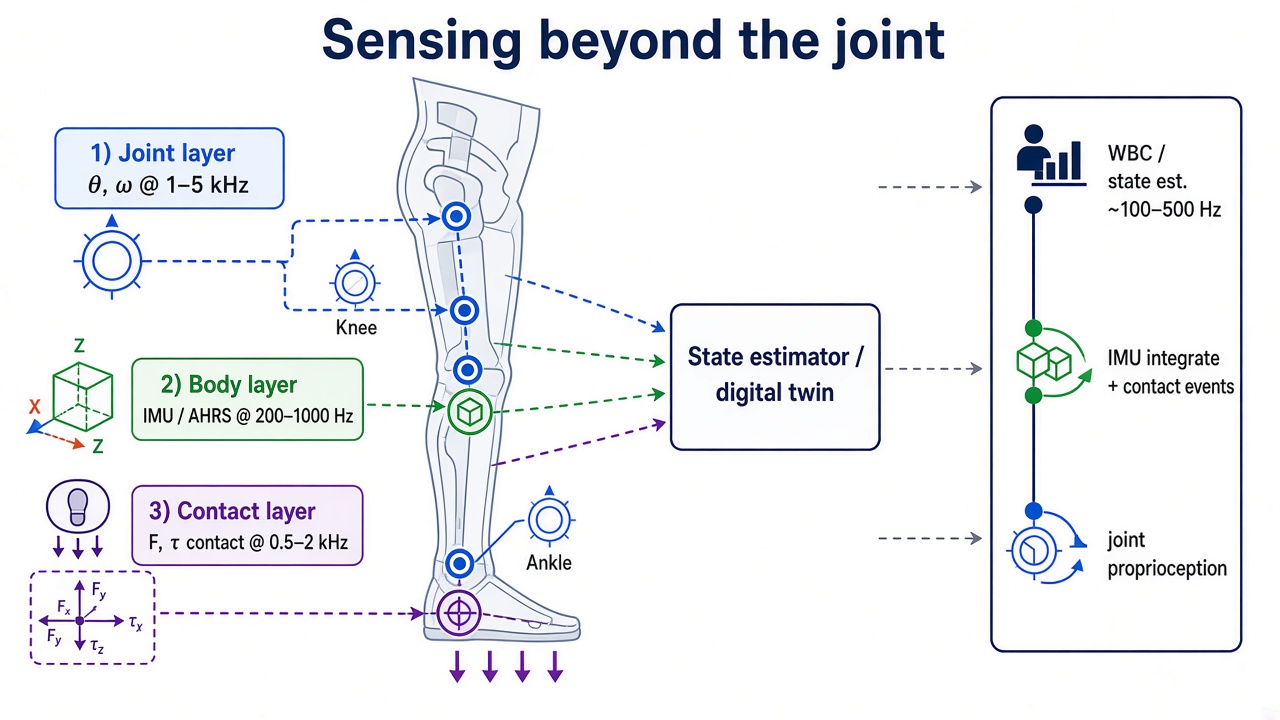
Day 02 made current the muscle and encoders the joint eyes. Standing, balancing, and touching the world need two more senses: body (where is up, how is the base accelerating) and contact (is this foot loaded, and with what wrench). Without them, whole-body control is kinematics theater — you know every , but not whether the robot is falling or whether the sole is still on the ground.
Today freezes those layers the same way Day 02 froze FOC: physical sensors and the digital twin publish the same samples, frames, and rates.
Three sensing layers
Think in layers, not in a pile of ROS topics.
| Layer | What you measure | Typical rate | Job |
|---|---|---|---|
| Joint (Day 02) | , , | 1–5 kHz (FOC faster) | Proprioception / muscle |
| Body | specific force + angular rate → orientation / base twist | 200–1000 Hz | Gravity, balance, inertial |
| Contact | , or CoP / pressure | 0.5–2 kHz | Support polygon, impact, compliance |
Rule: outer balance and contact policies are only as honest as the slowest, noisiest, most delayed sensor they treat as truth. An estimator at 400 Hz fed by a 50 Hz IMU with unknown transport lag is a fiction generator.
Physical build and digital twin share this graph. In firmware you DMA the IMU and FT. In sim you subscribe to the same ImuSample / ContactState structs from a plugin — not from a secret MuJoCo-only path the real robot will never see.
IMU placement is a design choice, not a checkbox
An IMU does not hand you “orientation.” It hands you:
- Specific force (accelerometer):
- Angular rate (gyro):
Orientation (AHRS / EKF / complementary filter) is an estimate. Indoors, magnetometers lie near steel and motors — prefer gravity+gyro for roll/pitch; treat yaw as weakly observable until you have vision, a good map, or an external reference.
Mount frame vs body frame
Name the IMU frame in frames the same way you named joint zeros:
- Which link? Pelvis / torso is the usual humanoid choice for “base” attitude. Shin IMUs are useful for contact and swing, but they are not your world attitude by themselves.
- Rigid vs soft mount: elastomer kills vibration and adds phase lag. For control, rigid + software filter often beats soft foam you cannot model.
- Lever arm to CoM / contact points: linear acceleration at the IMU is not CoM acceleration. If the twin assumes they are the same, balance residuals will not match hardware.
Rates and delay
| Choice | Typical | Failure if wrong |
|---|---|---|
| Raw IMU stream | 200–1000 Hz | Aliasing of vibration into “tilt” |
| Orientation filter | 100–500 Hz | Soft lag → balance overshoots |
| Transport (CAN / SPI / USB) | declare max age | Estimator uses stale direction |
Physical ↔ digital pairing for IMU
| Physical | Digital twin / backing |
|---|---|
| Mount link + extrinsic | Same transform in URDF / MJCF / pinocchio |
| Full-scale, bias, temp coeffs | Bias states or logged calibration table |
| Sample timestamp (MCU clock) | Same timebase as joints/contact, or explicit offset |
| Filter cutoff / AHRS gains | Identical filter in twin or twin publishes raw and host filters once |
Exercise: hold the robot (or a rigid fixture with the same IMU) still for 30 s. Log mean and . Rotate 90° about a known axis. Confirm the gravity vector in the named body frame matches frames. If sign or axis swap is wrong here, every later “upright” controller will fight you.
Contact and force: “on ground” is an estimate
A GPIO “foot switch” is a training wheel. Real contact is a wrench (or a pressure field) evolving through impact, slip, and soft tissue / rubber.
Sensor options on humanoids
| Approach | Strengths | Costs / failure modes |
|---|---|---|
| 6-axis FT at ankle / wrist | Full wrench; clean for CoP | Mass, cable, overload on impact; calibration drift |
| Sole pressure / taxels | Spatial CoP, local slip cues | Wiring, wear, nonlinear rubber |
| Current-based + kinematics | Free with Day 02 muscle API | Model error, friction, no true external Fz alone |
| Combined (FT + current + threshold) | Redundant; safe defaults | Needs fusion policy and quality flags |
Contact events are sparse but high-stakes. Sample fast enough to catch heel-strike transitions — often 0.5–2 kHz on the wrench — even if your WBC only runs at 200 Hz. Downsample with a defined anti-alias filter; do not peek at a random latest sample from a slow USB poll.
Soft contact from Day 02’s impedance / muscle meets measured (or CoP) as a guardrail: torque commands that would drive through the floor are lies you can catch.
Digital twin side
Penalty, soft-constraint, or complementarity contacts are all fine — if they expose the same ContactState the firmware publishes:
in_contactwith a documented threshold (not a silent engine flag)- wrench or + CoP in a named contact frame from frames
- a quality / confidence field when the model is soft or the FT is near saturation
If sim reports Boolean contacts from the physics engine while hardware reports filtered , your RL policy will learn the wrong event timing.
Estimation rate is first-class
Day 01 already said the machine is multi-rate. Sensing makes that concrete.
Never upsample lies. Repeating a 100 Hz IMU sample into a 1 kHz control tick without declaring age makes the controller think it has fresh inertial data. Prefer:
- Sensor timestamp + max-age check
- Hold last sample with
stale=true, or propagate with a process model - One estimator that owns fusion; many consumers read
EstimatorState
Clocks matter. CAN, EtherCAT DC, and free-running MCU timers drift. Freeze a timebase story in frames / bus docs: who is master, how joints and IMU share , what happens on dropout.
Minimum log set for Day-03 bring-up
- Raw IMU: , ,
- Filter output: quat or RPY + bias estimates
- Per-foot: (or full wrench),
in_contact, CoP if available - Joint (same as Day 02)
- Estimator latency (in → out) and packet age
If you cannot plot those on one time axis, you do not yet have a base state — you have disconnected sensors.
Shared APIs: firmware and twin obey the same structs
Mirror Day 02’s JointCommand / JointState pattern:
ImuSample:
  t, a_lin_body[3], omega_body[3], quat_wxyz[4]? , temp, faults, age_ms

ContactState:
  t, frame_id, wrench[6] | (Fz, cop_x, cop_y), in_contact, quality, faults

EstimatorState:
  t, base_pose, base_twist, contact_set[], cov_or_confidence, faults
Higher layers (WBC, teleop, RL) should not know whether ImuSample came from SPI or from a MuJoCo sensor plugin.
Bring-up sequence (do this before “balance”)
- Bench the IMU unmounted: bias, noise, axis map.
- Mount and re-check signs against frames.
- Free-space attitude vs a fixture or motion-capture snippet — not vs hope.
- Calibrate contact with known masses / a calibrated load cell.
- Threshold
in_contacton slow presses and on light taps (impact path). - Only then close a balance or multi-contact loop on hardware that matches the twin’s API.
Skip ahead and you will debug “walking” while the estimator is integrating a flipped accel axis or a contact flag that never clears.
Failure gallery
| Symptom | Likely layer |
|---|---|
| Robot “leans” constantly in software while standing level | IMU axis / mount extrinsic / gravity sign |
| Balance OK until motors spin up | Magnetic yaw or vibration coupling into accel |
| Heel-strike always late in logs | Contact rate too low, USB poll, or sim Boolean vs Fz threshold mismatch |
| Works in twin, hardware tips | Estimator delay not in twin; or FT saturation clipped silently |
| CoP chatters at stance | Unfiltered pressure / FT; rubber modes; missing low-pass before WBC |
| Joints fine, base pose drifts in yaw | Expected without mag/vision — do not trust yaw for closed-loop heading yet |
What to freeze this week
Extend frames:
- IMU mount link, extrinsic, units (, ), target rate, who timestamps
- Contact frame(s) per foot/hand; wrench units;
in_contactthreshold policy - Estimator output rate and max sensor age
- The
ImuSample/ContactState/EstimatorStatefields your bus and sim will carry
Also fill the message-rate table already on that page: state estimation stays 100–500 Hz unless you have measured jitter and delay that justify otherwise.
The lesson is not “buy a better IMU.” It is make body and contact the same story in silicon and in the twin, at rates you can defend.
Next
Day 04 — Bus topology and time sync: CAN-FD / EtherCAT, who owns the clock, and how JointState + ImuSample share one timeline without silent lag.