Day 05 — Power domain & BMS: brownout, bus sag, safe torque
Day 02 treated as muscle — the current that makes torque. Day 04 froze BusHeader: t_sample, clock_domain, age_budget_ms, and fault bits that force a safe torque policy. None of that survives a silent voltage collapse.
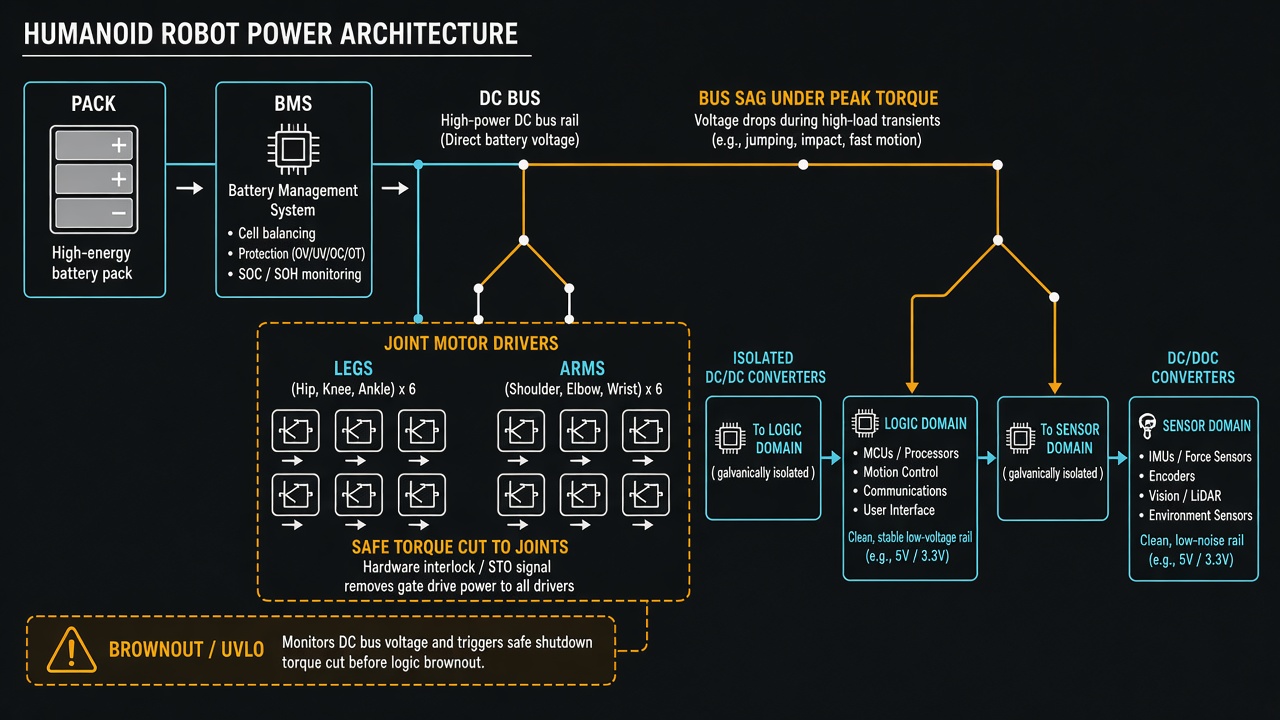
Today freezes the power domain: pack → BMS → high-power DC bus → actuators on the raw rail, logic and sensors behind isolation — and how brownout / bus sag must derate or cut torque before the estimator invents a new reality.
Power is a control surface
Peak torque without bus headroom is not “strong.” It is a race between the legs and the logic rails.
| Failure mode | What actually happens |
|---|---|
| Bus sag | Simultaneous hip/knee peaks drop ; FOC still commands but voltage headroom for the inverter vanishes |
| Soft brownout | Logic / MCU rails dip; clocks glitch, ADCs lie, comms drop — often before you notice torque loss |
| Silent collapse | Current loop saturates or PWM duty hits the rail; commanded torque ≠ delivered; twin still thinks the joint obeyed |
| Hard UVLO cut | Undervoltage lockout trips gate power — safer than a half-alive MCU, worse if it is your first and only policy |
Rule: higher layers consume usable power state the same way they consume sample age. If you cannot defend bus voltage, SOC headroom, and a torque scale, you cannot defend multi-joint peaks.
Physical firmware and the twin publish the same power messages. In sim you may inject ideal infinite bus — but then you must document the lie and add a sag / derate model before you claim transfer of jump or impact policies.
Domains: pack, bus, logic, actuators, sensors
Humanoid power is not one rail with pretty stickers. Separate domains, sequence them, isolate what must stay clean.
| Domain | What lives there | Isolation / notes |
|---|---|---|
| Pack | Cells, contactor / precharge, pack fuse | Energy source; never assume “full” means peak-capable |
| High-power DC bus | Direct pack (or pack-converted) voltage to drivers | Actuators ride this rail; sag shows up here first |
| Actuator / driver | Inverters, gate drive, STO / torque-cut path | Hardware interlock must remove gate power, not “ask nicely” |
| Logic | MCUs, motion, communications, UI | Galvanically isolated DC/DC; clean 5 V / 3.3 V |
| Sensors | IMUs, encoders, FT, vision / LiDAR | Often further isolated / filtered; noise here poisons Day 03 fusion |
Physical ↔ digital pairing for domains
| Physical | Digital twin / backing |
|---|---|
| Pack capacity, series count, max continuous / peak current | Twin energy model + peak current limits |
| Bus capacitance, cable inductance, sag under N-leg peaks | Optional bus dynamics or lookup derate curve |
| Isolated DC/DC rails and UVLO thresholds | Publish PowerState / faults the same as hardware |
| STO / safe-torque-cut wiring | Twin must honor torque_scale / hard cut — not ignore faults |
Exercise: sketch your real pack → bus → limb power tree once. Mark which rails brown out first under a jump. If logic shares a noisy path with drivers, fix that before you tune balance gains.
BMS: protect, publish, trip vs degrade
A BMS that only opens a contactor is a fuse with a microcontroller. Useful humanoid BMS work is three jobs:
- Protect — OV / UV / OC / OT (and often cell imbalance); hardware paths beat “software will notice.”
- Publish usable state — SOC, SOH, pack / cell voltages, current, temperature, fault bits — stamped like Day 04 samples.
- Trip vs degrade — derate available torque before hard cut whenever physics allows; reserve hard cut for irreversible risk.
| Mode | Intent | Example (illustrative) |
|---|---|---|
| Full | Headroom OK | above soft floor; SOC and in band |
| Derate | Stay upright with less muscle | Scale max as approaches soft limit |
| Soft cut / limp | Preserve logic and structure | Stop peak commands; controlled kneel / freeze posture |
| Hard STO | Protect pack / silicon / humans | UVLO, hard OC, thermal runaway path — gate drive off |
Illustrative numbers only — measure your pack and drivers:
| Region | Illustrative story (e.g. ~48 V class) | Policy sketch |
|---|---|---|
| Nominal | Near pack OCV under light load | Full torque envelope |
| Soft sag | Brief dip under simultaneous leg peaks | Temporary derate; log age of sag |
| Soft UV | Approaching logic / driver comfort floor | Aggressive derate + fault bit |
| UVLO | Hardware lockout | STO — do not “retry FOC” in software alone |
Label every threshold illustrative in docs and configs until you have your own characterization.
Brownout vs UVLO vs soft sag under leg peaks
Three different animals; treat them differently.
| Term | Meaning | Typical response |
|---|---|---|
| Soft sag | Transient dip from + inductance under peak torque (jump, catch, impact) | Expect it; size bus caps / cable; derate peaks; do not panic-trip if within budget |
| Brownout | Rails (especially logic) leave the guaranteed operating region — weird MCU / ADC / PHY behavior | Detect early on the bus monitor; cut torque before logic lies |
| UVLO | Undervoltage lockout — chip or board hardware removes operation below a hard floor | Last line; wire it to STO / gate-power kill |
Day 02 link: when sags, the inverter cannot realize the voltage vector FOC wants. Commanded and delivered torque diverge. The twin that assumes infinite bus will train policies that demand impossible simultaneous peaks.
Day 04 link: power faults ride the same honesty rules as bus faults — publish them with t_sample and age; never “hold last forever” after PowerFault.
Shared power API (extend Day 04 BusHeader)
Mirror muscle and sensing: every cyclic power sample carries the wire header, then usable state.
BusHeader:
  node_id, seq
  t_sample, clock_domain, age_budget_ms
  faults            # include power bits or parallel PowerFault

BmsState ⊇ BusHeader:
  v_pack, v_cell_min, v_cell_max
  i_pack
  soc, soh?         # publish what you trust
  t_pack_max
  bal_active?
  protect_flags     # OV UV OC OT imbalance ...

PowerState ⊇ BusHeader:
  v_bus
  i_bus?            # if measured on the rail
  torque_scale      # 0..1 — multiply |iq| / torque commands
  max_iq_abs?       # optional absolute ceiling (A)
  domain_ok         # logic / sensor rails healthy
  mode              # FULL | DERATE | LIMP | STO

PowerFault ⊇ BusHeader:
  kind              # SAG | BROWNOUT | UVLO | OC | OT | CONTACTOR | STO
  severity          # WARN | DERATE | CUT
  v_bus_at_fault?
Higher layers (WBC, RL, teleop) should not invent their own “battery percentage UI.” They consume torque_scale / max_iq_abs and treat PowerFault like bus_off: policy must change, not hope.
If the twin publishes torque_scale = 1 forever and hardware sags to 0.4 under a jump, policies will hate the real pack. Either model sag / derate in sim or keep a power replay layer both sides can feed.
Bring-up sequence (before multi-joint peak torque)
- Pack + BMS — contactor / precharge sequence documented; protect flags visible.
- Publish contracts —
BmsState/PowerStateon the sameclock_domainas Day 04; age budgets set. - STO path — brownout / UVLO monitor → hardware torque cut verified with a bench load (gate power actually dies).
- Single-joint peaks — log vs ; learn soft-sag budget on one limb.
- Multi-joint peaks — coordinated leg currents; freeze a derate curve (
torque_scalevs / SOC). - Fault injection — twin and hardware: force sag, WARN, DERATE, STO; confirm policy does not “hold last torque.”
- Then enable jump / impact / high-CoM maneuvers that need simultaneous peaks.
Skip to step 7 and you will debug “estimator diverged on landing” when the real bug was logic brownout or silent collapse.
Failure gallery
| Symptom | Likely power cause |
|---|---|
| Jump OK in twin, collapses on hardware | Twin infinite bus; no torque_scale / sag model |
| Joints “weak” only when all legs peak | Soft sag; voltage headroom gone; FOC saturates |
| Random MCU resets at impact | Brownout on shared / poorly isolated logic rail |
| STO never fires, FETs smoke | UVLO / OC not wired to gate-power kill — software-only “safe” |
| Contactor opens mid-walk | Hard UV / OC with no prior derate; thresholds too tight or sensing wrong |
| SOC UI fine, robot dies under load | SOC ≠ power capability; missing current / sag headroom in PowerState |
| Estimator diverges when bus dips | ADC / IMU rail noise or MCU glitch; power fault not fused into policy |
| Teleop still commands full after WARN | Higher layer ignores torque_scale / PowerFault |
What to freeze this week
Extend frames (and your power config) with:
- Pack class (nominal voltage, series count), bus architecture, isolation boundaries
- Soft-sag / soft-UV / UVLO thresholds — labeled measured vs illustrative
BmsState,PowerState,PowerFaultfields firmware and sim will carrytorque_scale/max_iq_abscontract consumed by Day 02 joint commands- STO / safe-torque-cut path: what removes gate drive, who may clear it
- Bring-up rule: no multi-joint peak maneuvers until steps 1–6 above are green
The lesson is not “buy a fancier BMS because humanoids are scary.” It is make voltage and torque limits the same story in silicon and in the twin, so Day 02’s muscle and Day 04’s fault bits stay honest when all six legs ask for current at once.
Next
Day 06 — Estimation deep-dive: contact-rich balance, fusing JointState / ImuSample / ContactState on one clock — and respecting PowerState so a sag does not look like a new dynamics model.