Day 07 — Contact-rich balance policies & whole-body control
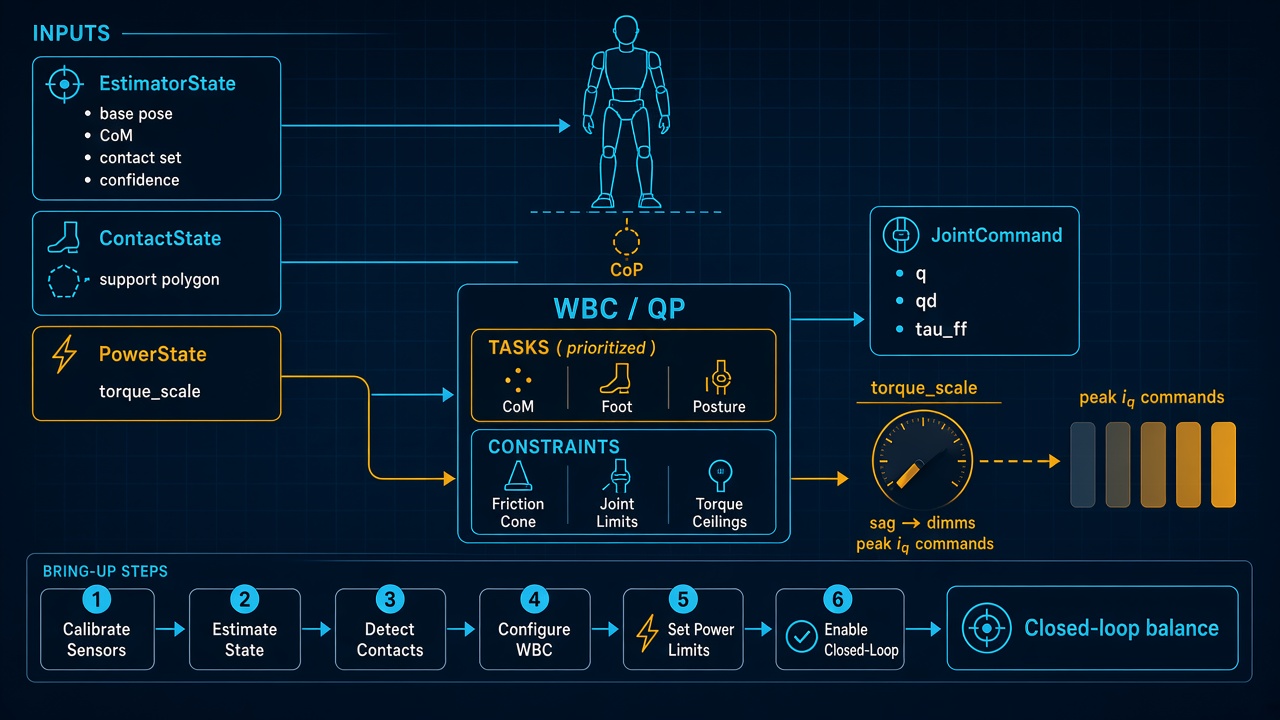
Day 06 gave you one balance-ready EstimatorState on a shared clock, with ages, contact modes, and power honesty. Day 05 already made torque_scale a control surface. Day 02 made the muscle.
Today owns the consumer: how contact-rich balance and whole-body control (WBC) turn that estimate into JointCommand without inventing a second plant — and without stuffing residual physics into a black-box net that runs inside a microsecond loop.
Policy consumes estimates; it does not re-fuse them
Balance and WBC answer a different question than the estimator:
| Layer | Question | Owns |
|---|---|---|
| Estimator | What is true enough about the plant right now? | EstimatorState (+ faults / ages) |
| Balance / WBC | What should the joints do given that story and power ceilings? | Tasks, constraints, JointCommand |
| RL / high-level net | Which task set / footstep / gait mode next? | Sparse decisions above the rate loops |
Rule: one writer for fusion (Day 06). Many readers. If teleop, WBC, and a learned policy each run their own AHRS or “quick CoM fix,” twins and hardware diverge on day one.
Treat INPUT_STALE, POWER_GATED, low cov_or_confidence, and empty / wrong contact_set the way Day 05 treats brownout: behavior must change. Soften peaks, freeze aggressive tasks, widen friction margins, or open a safe torque path — do not hope the QP will “average it out.”
Tasks vs constraints (and where power sits)
A practical WBC / QP sketch (hierarchical or weighted — the contract matters more than the brand):
| Kind | Examples | If violated / ignored |
|---|---|---|
| Tasks (soft / prioritized) | Keep CoM / capture-point in support; track foot pose; posture / arm bias | Soft failure → tip or flail, but solver still returns something |
| Hard constraints | Friction cone, unilaterality (), joint limits, collision margins | Infeasible QP → you need an explicit fallback, not NaN torque |
| Power ceilings | abs(tau) ≤ torque_scale * tau_max, or abs caps from BMS | Ignoring sag → commanded muscle the bus cannot deliver |
Put torque_scale on the constraint / ceiling side, not as a silent gain inside a learned residual. When the pack sags, the feasible set shrinks; the policy that pretends otherwise only balances on a full pack.
Neural nets: fine for gait mode, footstep choice, or residual correction above measured-jitter rate loops. The site principle still holds — never put a net inside a microsecond current or torque loop until you have measured jitter and proven the plant contract. Prefer nets that read the same EstimatorState the QP reads.
Contact-rich: the support story changes the program
Contact events are sparse; the QP’s geometry is not optional flavor text.
| Mode | What the solver should see | Typical failure |
|---|---|---|
| Double support | Both feet in contact_set; CoP inside support polygon | Over-trusting a lifting foot’s wrench |
| Single support | One support frame; swing foot near-zero / free | Still constraining the swing sole → lean into air |
| Impact / settle | Brief soften of contact tasks; trust estimator impact gate | Treating heel-strike spike as steady CoP target |
| Flight / jump (if ever) | No unilaterality from feet; IMU-heavy estimate | Floor constraints left enabled |
Physical and twin must agree on when contact_set flips relative to / CoP (Day 06 exercise). A policy that learned Boolean contacts from a perfect physics engine will heel-strike late on hardware every time.
Shared API: command the muscle honestly
Keep Day 02 / 04 wire honesty. Cyclic commands still carry BusHeader. A thin balance / WBC face looks like this:
BusHeader:
  node_id, seq
  t_sample, clock_domain, age_budget_ms
  faults

# Upstream (read-only here)
EstimatorState, ContactState, PowerState  ⊇ BusHeader

# Optional task face (host / mid-rate)
WbcTaskSet ⊇ BusHeader:
  mode                 # STANCE_DS | STANCE_SS | STEP | ...
  com_ref / cop_ref?   # in named frames from frames contract
  foot_refs[]          # support vs swing tagged
  posture_bias?
  priority_order[]     # or weights — pick one story and freeze it
  relax_on_fault       # what to drop when POWER_GATED / INPUT_STALE

# Downstream muscle (Day 02)
JointCommand ⊇ BusHeader:
  q_des? / qd_des? / tau_ff?
  iq_ceiling? / tau_ceiling?   # must reflect torque_scale
  flags                        # STO / soften / hold
Higher layers should not re-implement FOC or AHRS. They publish tasks or setpoints; the rate loops enforce ceilings the BMS already declared.
Physical ↔ digital pairing for balance / WBC
| Physical | Digital twin / backing |
|---|---|
Same EstimatorState consumer API | Same structs in sim — no perfect-state cheat bus |
| Friction / sole model you can defend | Matching cone / rubber params or logged tables |
torque_scale under peak legs | Sag / derate replay so QP feasibility matches |
| Contact flip timing vs | Injected delay + same threshold policy |
| Measured loop rates + jitter | Scheduler that cannot magically beat hardware |
Bring-up sequence (before trusting closed-loop balance)
Day 06 steps 1–6 stay green. Then:
- Gravity compensate / hold — joint-level honesty with estimator watched, balance tasks off or weight≈0.
- Quiet double support — small posture + CoM regulation; plot CoP vs polygon and
contact_set. - Slow weight shift — CoP travels; solver stays feasible; no swing-foot constraints left on.
- Single-support unload — mode switch matches hardware; swing foot free.
- Fault injection — force stale /
POWER_GATED/ lowtorque_scalein twin and on hardware; confirm soften / freeze paths. - Then add steps or learned residuals that consume the same state — never replace the QP’s friction and power ceilings.
Skip to “just stand with the net” and you will tune “balance gains” while fighting a flipped contact bit or an infinite bus in sim.
Failure gallery
| Symptom | Likely cause |
|---|---|
| Twin stands forever, hardware tips in 2 s | Cheat state bus, missing delay, or infinite torque_scale in sim |
| QP infeasible every heel-strike | Contact mode / unilaterality wrong; impact not softened |
| Legs “want more” as pack sags | Ceilings ignore torque_scale; policy treats sag as weak gains |
| Works in DS, dies on first SS | Swing foot still constrained; contact_set lag |
| Estimator calm, torque chatters | Task weights too hot; no low-pass / rate limit on CoM error |
| Net “fixes” tip only when plugged in | Residual learned against perfect plant; not reading faults |
| Current loop starved by inference | Net inside / coupled to μs path — measure jitter, move net up |
| Perfect sim transfer, wrong CoP on rubber | Friction / sole model mismatch; threshold policy drift |
What to freeze this week
Extend frames and your control config with:
- Who may write
JointCommandduring stance (WBC only vs teleop overlay rules) - Task list + priority / weight story for DS vs SS (and impact soften)
- How
torque_scale/PowerFaultmaps to tau or abs ceilings every tick - Fallback when QP is infeasible or
EstimatorStateis stale / gated - Twin hooks: delay, contact timing, sag — same budgets as hardware
- Bring-up gate: no free stepping / learned residuals until steps 1–5 above are green
The lesson is not “pick OSQP vs a hierarchy.” It is make contact-rich balance the same feasible program in silicon and in the twin, reading one estimate, honoring power, and keeping black-box residuals above the loops you can measure.
Next
Day 08 — Contact-rich stepping & locomotion: footstep timing, swing trajectories, and gait modes that still consume EstimatorState + WBC ceilings instead of bypassing them.