Chapter 8 — Physical Containment
Part III of IV — Control architecture. This chapter separates the accredited physical-security discipline that already exists from the unsolved standards problem at frontier GPU-cluster scale.PreviousThis paragraph was added in this version.NowPart III of IV — Control architecture. This chapter separates the accredited physical-security discipline that already exists from the unsolved standards problem at frontier GPU-cluster scale.
Physical containment is a mature, accredited engineering discipline for classified IT and human-occupied compartmented spaces, yet remains an unsolved standards problem for frontier GPU clusters. Each individual layer ships and carries accreditation today. What does not exist is an accredited standard that composes those layers at the power, thermal, and penetration density of a tens-of-megawatt liquid-cooled training hall [1].
What. Accredited physical-security layers and their proposed GPU-hall composition.
Who / where. ICD-705 and TEMPEST for the left node; NIST SP 800-239 defers the physical half of the compute environment, as later sections record.
Why. Layer accreditation does not establish hall accreditation.
Caveat. Concept only on the right.
The DVIDS photograph below is a human-scale SCIF, not a training hall.
Not a photograph of an AI-SCIF, because none is accredited.
The perimeter, layer by layer
Ordered outermost (the building) to innermost (the chip), each layer blocks a distinct attacker position, so layers stack rather than substitute.PreviousThis paragraph was added in this version.NowOrdered outermost (the building) to innermost (the chip), each layer blocks a distinct attacker position, so layers stack rather than substitute.
SCIF accreditation (ICD-705). A Sensitive Compartmented Information Facility is an accredited space cleared to store and process compartmented classified information under Intelligence Community Directive 705 and its technical specs (ICS 705-1, ICS 705-2), administered by the DNI. It specifies perimeter construction, access control, acoustic and visual protection, and emanations security. Accreditation is granted by a cognizant security authority rather than bought off a shelf. (Clause text is unquoted because the DNI ICD_705_SCIF.pdf returned HTTP 403 on 2026-07-17.) SCIF rules represent the closest existing accreditation regime for frontier weight containment.PreviousThis paragraph was added in this version.NowSCIF accreditation (ICD-705). A Sensitive Compartmented Information Facility is an accredited space cleared to store and process compartmented classified information under Intelligence Community Directive 705 and its technical specs (ICS …
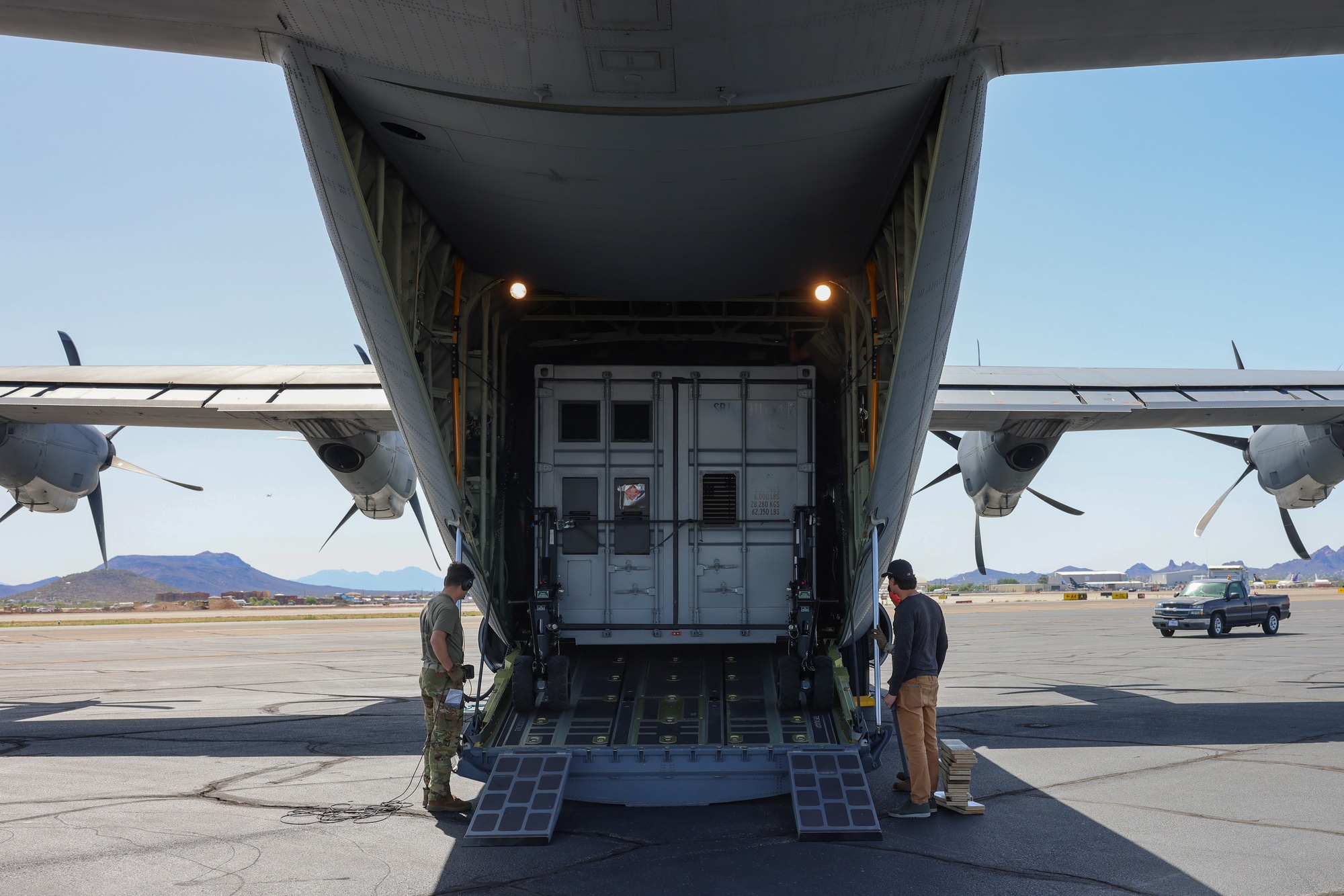
Observed. A mobile modular SCIF sits secured inside a C-130 at Tucson International Airport on May 24, 2023.
The photograph makes the transport and integration burden visible; it does not show interior controls, TEMPEST performance, or successful accreditation.
U.S. Air National Guard photograph by Senior Master Sgt.
Charles Givens, DVIDS image 7828342 , public domain.
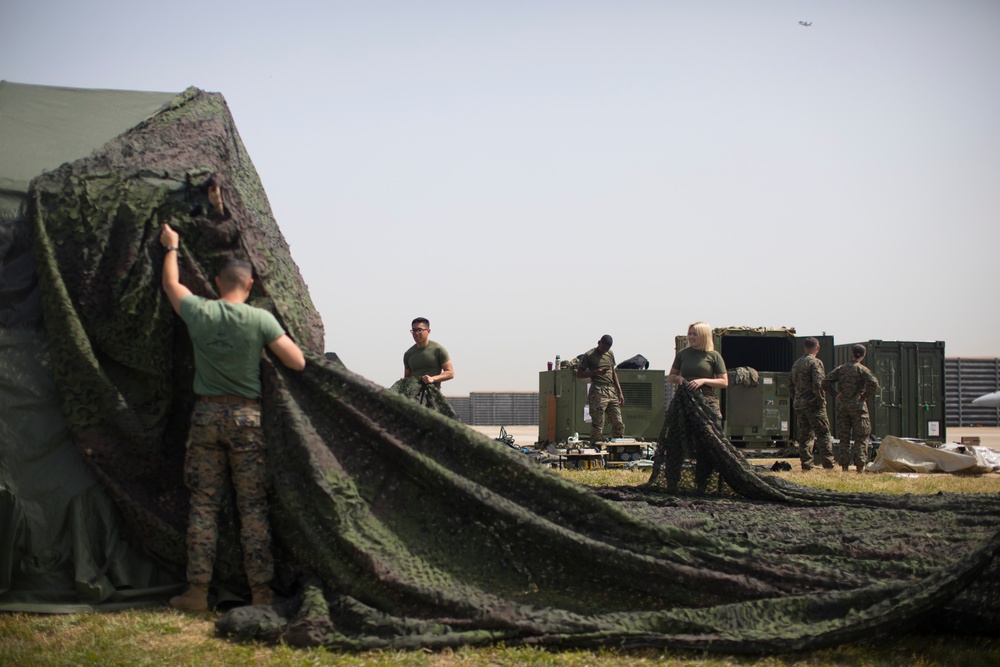
Observed. Marines with Marine Aircraft Group 12 rig camouflage netting over a temporary SCIF (T-SCIF) at Gwangju Air Base, Republic of Korea, during Fiscal Year 2023 Korea Flying Training.
A second, physically distinct example of the same accreditable class as the Tucson unit above: field concealment layered on a temporary containment structure.
It does not show the interior, RF-shielding performance, or accreditation status.
U.S. Marine Corps photograph by Cpl.
Tyler Harmon, DVIDS image 7766513 , public domain [2].
TEMPEST / EMI shielding. Electronic hardware leaks exploitable signals through electromagnetic, RF, and conducted emanations. TEMPEST is the US national standard governing compromising emanations (tracing to NSTISSAM TEMPEST/1-92), implemented via continuous copper or welded-steel Faraday envelopes, shielded doors, waveguide penetrations, honeycomb vents, and RED/BLACK isolation separating plaintext equipment from non-secure wiring.PreviousThis paragraph was added in this version.NowTEMPEST / EMI shielding. Electronic hardware leaks exploitable signals through electromagnetic, RF, and conducted emanations. TEMPEST is the US national standard governing compromising emanations (tracing to NSTISSAM TEMPEST/1-92), …
US defense procurement enforces this via DFARS 252.239-7000 (“Protection Against Compromising Emanations (OCT 2019)”), requiring contractors to supply IT accredited under “The National Security Agency National TEMPEST Standards (NSTISSAM TEMPEST 1-92, Compromising Emanations Laboratory Test Requirements, Electromagnetics (U))” and permitting government verification testing [3]. NIST SP 800-53’s PE-19 (“Information Leakage”) and enhancement PE-19(1) similarly mandate EMSEC protection [4], though both instruments target delivered IT equipment rather than megawatt training halls.
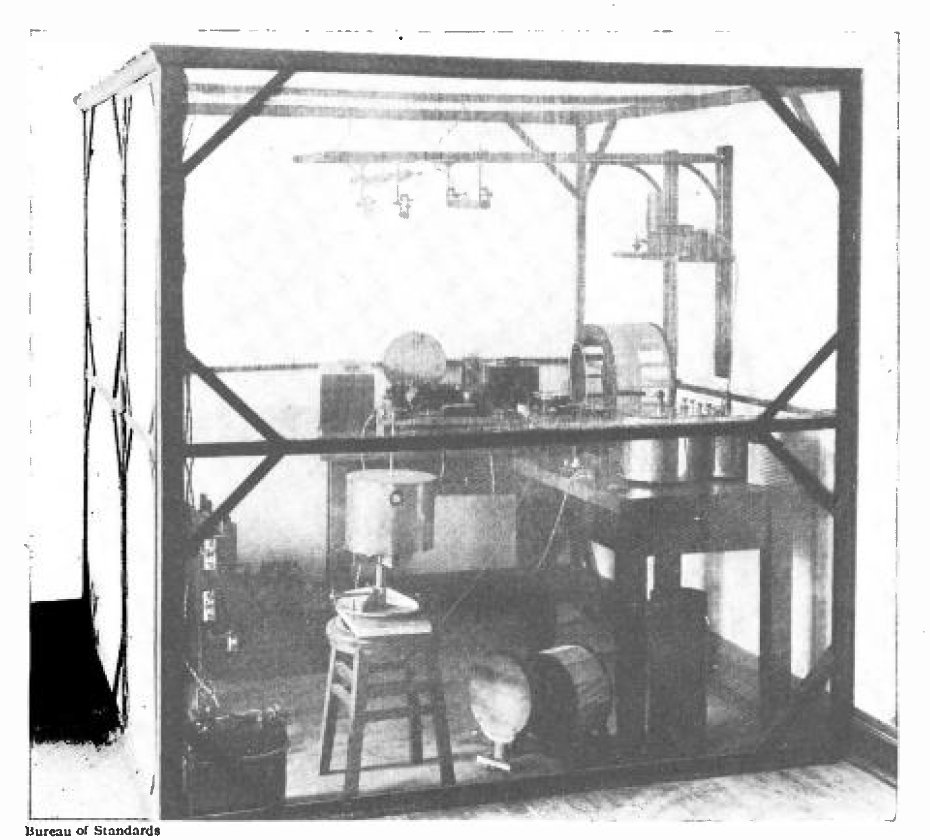
Observed. A copper-screen Faraday cage at the U.S. National Bureau of Standards Radio Laboratory, published in Popular Radio magazine, June 1925.
The oldest working instance of the shielding principle the TEMPEST envelope generalizes: a continuous conductive enclosure keeping external fields off sensitive instruments inside.
It shows the electromagnetic-shielding principle in a laboratory context nearly a century before TEMPEST codified it as a national program; it does not show shielding-attenuation figures, a modern TEMPEST test result, or any connection to classified-facility or datacenter construction.
U.S. National Bureau of Standards, public domain (17 U.S.C. §105) [5].
Acoustic isolation. SCIF walls, door seals, and acoustic masking prevent speech and equipment vibration from leaking outside. Peer-reviewed side-channel attacks show why this extends to compute: Genkin, Nissan, Schuster, and Tromer demonstrated at USENIX Security that commodity PC microphones “inadvertently capture electromagnetic side-channel leakage from ongoing computation” sufficient to steal “the secret ECDSA signing keys of the counterparty in a voice call” [6]. NIST’s adversarial-ML taxonomy likewise notes researchers “used electromagnetic side channels to recover simple neural network models” [7]. Acoustic isolation mitigates this leakage class broadly.
Filtered / secure power. Every conductor crossing a shield perimeter can leak conducted emanations or carry injected transients. Low-pass EMI filters, isolation transformers, and conditioned UPS power close that path. ETS-Lindgren (an operating company inside ESCO Technologies Inc., ESE [8]) catalogs “EMP Commercial and Defense Tempest Powerline Filters” and its LKV-4500 filter for “high-performance electromagnetic attenuation for TEMPEST” applications [9].
Those catalog listings are vendor self-descriptions with no independent test report or published price [9]. The operational failure mode is procurement and penetration discipline: TEMPEST power filters carry specialty lead times, and any single unfiltered conductor crossing the shield defeats the envelope.
Tamper-evident / tamper-responsive hardware. Tamper-evident seals and coatings expose intrusion after the fact, while tamper-responsive hardware actively detects probing and zeroizes keys. FIPS 140-3 adopts ISO/IEC 19790:2012 across Levels 1–4 [10], and CMVP policy rules require modules to specify “tamper-evident seals, locks, tamper response and zeroisation switches, and alarms” [11].
CMVP certificate #4558 (IBM 4770-001 Enterprise PKCS#11 HSM, Overall Level 4, Physical Security Level 4) demonstrates the top tier: “tamper response and zeroization circuitry” monitors continuously without external power, triggering on overvoltage, extreme temperature rates, or penetration of the tamper matrix so “Module secrets are immediately destroyed” in sub-milliseconds and “The Module becomes permanently inoperative” [12]. Chapter 5 includes a photograph of another module the CMVP records as tamper responsive, an nCipher nShield F3 PCIe card whose black potted boundary covers most of the board [13].
Two scope limits govern that example. It is a FIPS 140-2 certificate carrying a sunset date of 21 September 2026 under the predecessor standard [12]. More fundamentally, CMVP scope ends at the cryptographic module: Validating one does not validate the accelerator beside it holding the plaintext weights.
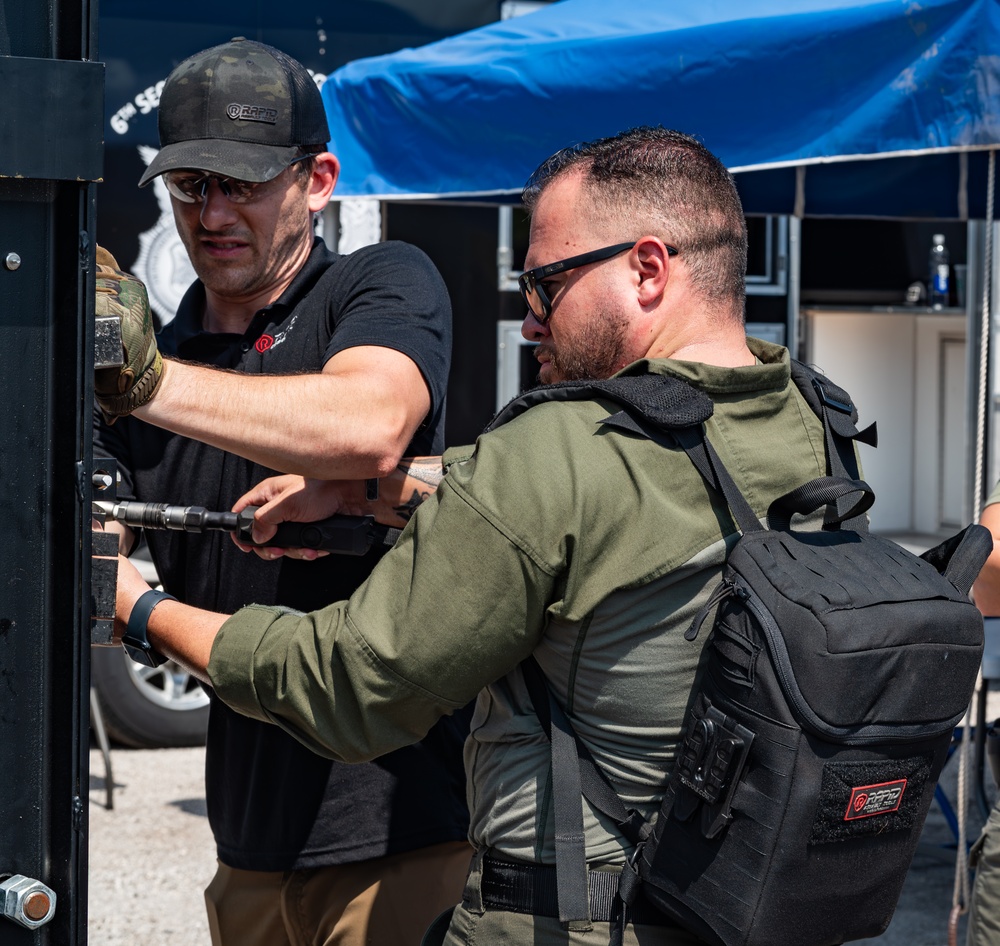
Demonstrated. A breaching-equipment representative and a police officer test a hydraulic breaching tool against a SCIF-grade door at a 6th Security Forces Squadron breaching symposium, MacDill Air Force Base, 2024, part of a multi-year effort with AFWERX to evaluate entry against previously hard-to-breach SCIF doors.
The counterpart image to the tamper-responsive HSM above: where the module answers intrusion in software (key zeroization), the door answers it in mechanical rating.
It shows one breaching method tested against one door under exercise conditions; it does not show the door’s certified rating, a comprehensive vulnerability assessment, or the facility’s intrusion-detection response.
U.S. Air Force photograph by Senior Airman Michael Killian, DVIDS image 8424319 , public domain [14].
Airgap + data-diode one-way transfer. An airgap severs network paths, while a hardware data diode restores controlled one-way flow (for ingesting training data or exporting telemetry) with no physical return path. Waterfall Security’s Unidirectional Gateway states reverse communication is “physically impossible” across >1,000 government and defense sites (waterfall-security.com, retrieved 2026-07-17), alongside Owl Cyber Defense’s accredited cross-domain diodes (owlcyberdefense.com, 2026-07-17). However, diodes enforce electrical direction only: an 810 GB open-weight checkpoint (at two bytes per parameter [15]) fills about 54% of one 1.5 TB microSDXC card [16].
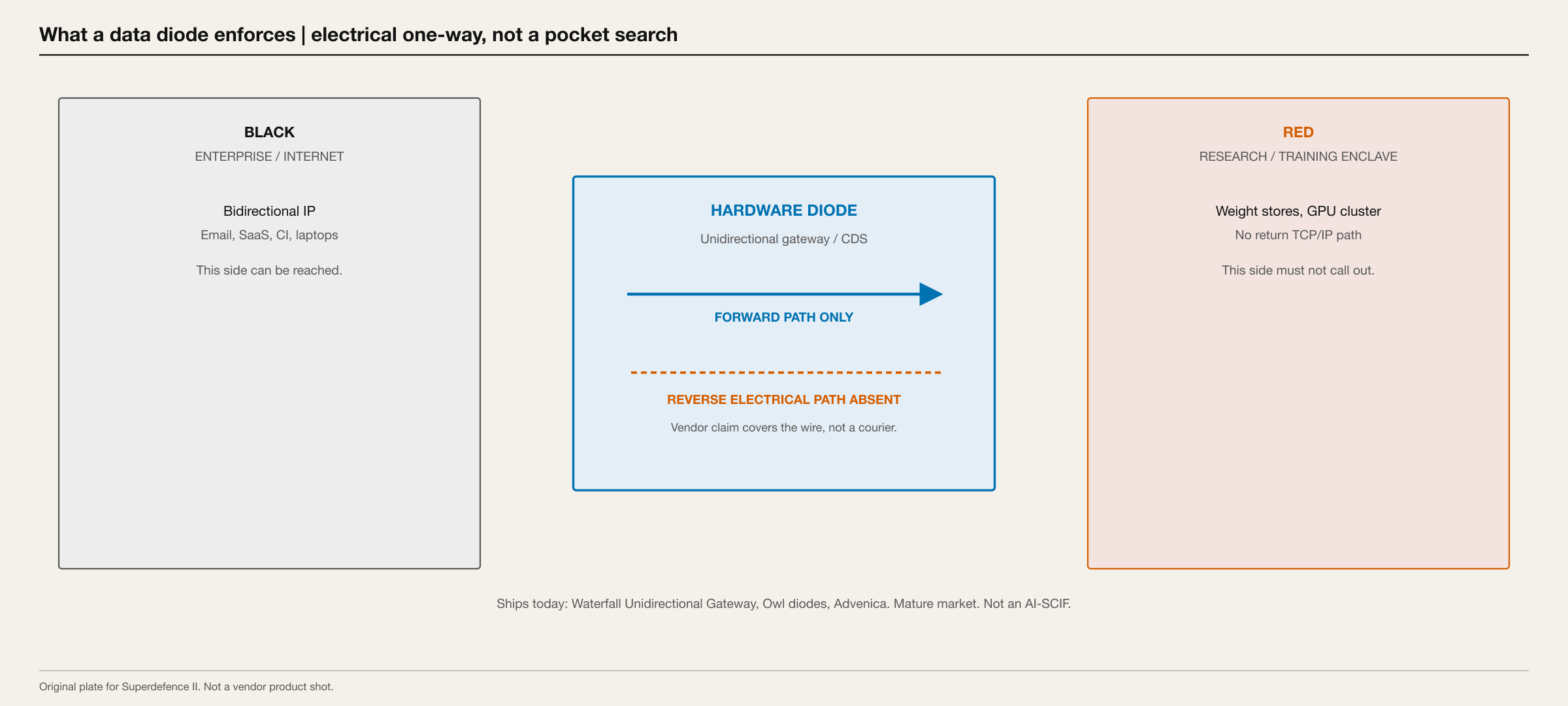
Claim. A hardware data diode enforces one-way flow on the electrical path.
Vendors named in this chapter. Waterfall Unidirectional Gateway, Owl diodes, Advenica.
Caveat. The vendor absolute covers the wire.
An 810 GB checkpoint still fits on a couriered card, as the paragraph above measures.
Exclusion. This is not an accredited AI-SCIF, and it is not a TEMPEST envelope.
The perimeter as seven concentric layers, outermost to innermost in the chapter’s own order: SCIF accreditation (ICD-705), the TEMPEST/EMI shield, acoustic isolation, filtered power, tamper-evident and tamper-responsive hardware, the airgap plus one-way data diode, and the chip at the core whose sealed key zeroizes on tamper.
Each ring defends a distinct attacker position, so they stack rather than substitute.
Every individual layer ships and is accredited today, and a binding federal rule now compels three of them — perimeter walls, emergency exit doors, and intrusion detection — at facilities holding frontier weights under an export authorization.
What does not exist is an accredited standard that composes all seven, emanation security included, at the power, thermal, and scale envelope of a tens-of-megawatt liquid-cooled training hall.
Mermaid has no native onion type, so the rings are drawn as nested boxes — outermost enclosing innermost.
Who sells the layers
Accreditation is a regulatory status rather than a SKU. Supply sits across five tiers from the weight owner: Degree 0 is the frontier lab; Degree 1 is the integrator and general contractor assembling site envelopes; Degree 2 is the product OEM; Degree 3 is private component supply; and Degree 4 is the evaluation laboratory certifying individual modules.PreviousThis paragraph was added in this version.NowAccreditation is a regulatory status rather than a SKU. Supply sits across five tiers from the weight owner: Degree 0 is the frontier lab; Degree 1 is the integrator and general contractor assembling site envelopes; Degree 2 is the …
The listed Degree-2 supplier is ESCO Technologies Inc. (ESE, NYSE). Its FY2025 Form 10-K (fiscal year ended September 30, 2025, filed December 1, 2025) reports RF Test & Measurement (Test) sales of $237,201 thousand out of $1,095,388 thousand total (“approximately 21%, 23% and 26% of our total revenue from continuing operations in 2025, 2024 and 2023”), across five US and eight foreign facilities anchored by ETS-Lindgren and UK subsidiary MPE Limited [8].
Item 1 confirms Test supplies “a broad range of turnkey systems, including RF test facilities and measurement systems, RF and magnetically shielded rooms, and secure communication facilities,” operating as “a vertically integrated supplier of electro-magnetic (EM) shielding, RF absorbing products and EMC/EMP/Tempest filters” [8]. That filing confirms the catalog line [9], contains one Tempest occurrence, and contains zero occurrences of SCIF [8].
ESCO also highlights on-site integration with general contractors on “secure communication rooms and MRI facilities” alongside Asia/China exposure on the Test segment (“changes in the Chinese political climate, or economic or territorial aggression by China against Taiwan or other nearby countries, could significantly and negatively affect our business”) [8]. However, the 10-K does not isolate TEMPEST or SCIF revenue, names no AI-training-hall SKU, and records US government sales (“approximately 23%”) as sitting primarily in its separate Aerospace & Defense segment [8].
Other Degree-2 suppliers retain their narrow slots: Advenica (ADVE.ST) for listed diodes, Vertiv (VRT) for datacenter power (its FY2025 Form 10-K contains no occurrence of the string “TEMPEST” [17]), and private OEMs Owl Cyber Defense, Waterfall, Everfox, and Thales for diodes. None sells a composed, accredited AI-SCIF [8][17].
Degrees of relationship, not a portfolio.
Degree 0 holds the bundle.
Degree 1 assembles the envelope.
Degree 2 sells a named product class.
Degree 3 is private component supply.
Degree 4 certifies modules, not GPU halls.
Solid edges are named in a fetched filing or catalogue.
Dashed edges are adjacency the filings do not isolate.
ESCO’s Test segment is the listed US name this chapter had cited only as ETS-Lindgren.
The 10-K still prints no AI-SCIF, no SCIF string, and no TEMPEST revenue line.
Because ESCO’s Test segment already installs shielded rooms and EMC/EMP/Tempest filters alongside general contractors [8], scaling to a megawatt GPU hall extends an existing product class across denser penetrations rather than requiring an unannounced SKU—even though the 10-K itself announces no AI-SCIF pivot [8].
The key gap: a partial federal floor and no accredited “AI-SCIF” standard
No accreditation authority has published a standard composing all seven physical layers for a frontier GPU training or inference cluster [1]. Three primary findings define the current regulatory gap [1].
NIST deferred the physical layer in writing. NIST SP 800-239’s initial public draft (AI Data Center Security Analysis, July 27, 2026) scopes strictly to the computing environment, excluding site perimeters, buildings, power/cooling OT, supply chains, and personnel: “These components are beyond the scope of this document and will be covered by a correlative initiative” [18]. That correlative initiative has produced no draft or project page; its sole public appearance was a July 22–23, 2026 NIST workshop agenda listing CAISI and OT physical-security sessions [19]. A conference agenda is not a standard.
A binding federal physical floor does exist. Under License Exception AIA, 15 CFR 740.27(a)(3) conditions transfers of ECCN 4E091 weights on storage “in a facility that complies with paragraphs 14, 15 and 18 of the guidelines outlined in supplement no. 10” “(regardless of whether the facility is designated as a VEU)” [20]. Because Supplement No. 5 lists the United States as a destination, the rule binds domestic facilities effective January 15, 2026 [20].
Supplement No. 10 paragraph 14 mandates FedRAMP-High-consistent NIST 800-53 controls, FIPS-199 {HIGH, HIGH, HIGH} weight categorization, and annual accredited 3PAO attestation [20]. Paragraph 14(f) mandates physical measures: “No windows permitted in server core areas”, “24/7/365 roving guard patrol or Perimeter Intrusion Detection System (PIDS) with a 15-minute response time”, and three DoD UFC 4-010-05 subsections [20], while paragraph 15(c) mandates dedicated devices and output-rate limits [20].
Critically, BIS selected only the burglary-resistance subsections of DoD UFC 4-010-05 (the SCIF construction manual): §3-4.4.1 (Perimeter Wall Variations), §3-4.6.10 (Emergency Exit Doors), and §3-4.17.3 (Electronic Security System intrusion detection) [20][21]. BIS omitted §3-4.3 (Acoustic Protection), §3-4.13 (Duct Acoustic Protection), §3-4.20 (Protected Distribution Systems), and §3-4.22 (TEMPEST) [21], so it left the emanation-security layer on the shelf.
A private non-profit wrote the missing profile without accreditation authority. Security Level 5 (a 501(c)(3) non-profit) publishes a 60-control NIST SP 800-53/161 overlay whose normative “ICD 705 Facility Requirements” cover Red Zones, acoustic attenuation, TEMPEST, IDS, and Protected Distribution Systems [22]. Its companion project AI705 (presented at the July 2026 NIST workshop [19]) maps ICD 705 to frontier AI datacenters, but remains “Standards Analysis, In Development” [23].
Private profiles cannot grant third-party accreditation. Asked who accredits an SL5 facility, the profile states the “Chief Security Officer (CSO) or Site Security Manager serves as accreditation authority” [22]—so the operator accredits itself. SL5 Inc. explicitly acknowledges that its designation “does not replace or constitute a government security clearance” and that SL5 “may generally warrant an updated version of ICD 705 plus potential additional AI-datacenter and AI-SCIF specific overlays” [22].
NIST SP 800-53B confirms why high-baseline cyber compliance still misses emanations: in Table 3-11 (Physical and Environmental Protection), PE-18 (Location of System Components) is checked for the High baseline, while PE-19 and PE-19(1) (Information Leakage / EMSEC) carry no mark in Low, Moderate, or High [24].
In summary, federal export rules enforce walls, doors, alarms, vetting, and cyber baselines, while no government or accreditation body has issued even a draft emanation-secure AI-cluster standard [1]. That finding holds until a standards body publishes an AI-SCIF draft, BIS incorporates UFC 4-010-05 §3-4.22, or an independent assessor accredits a facility against such a standard [1].
RAND’s August 2026 report Secure Inference Data Centers (RR-A4827-1) prices a conceptual OC5 inference facility—explicitly not a training hall or accredited AI-SCIF—at $37M–$50M (250 kW proof-of-concept) and $277M–$345M (3 MW enterprise) using commodity compute, optical diodes, and FPGA channel controllers [25]. Its authors label these “order-of-magnitude estimates suitable for strategic planning, not as procurement-ready budgets” and avoid the SL5 label [25]. Separately, RAND RR-A4704-1 (August 2026) specifies 262 voluntary SP 800-53 controls for SL3 while excluding SL4 and SL5 [26].
Registered forecast. Population: critical IT capacity (MW) inside AI clusters third-party-accredited against an emanation-security standard (commissioned or under signed contract). Prediction: below 1 GW as of 30 June 2028 (falsified if documented accredited capacity reaches 1 GW by that date). Because no accrediting regime exists today, this author forecast tests whether one arrives at scale within two years.PreviousThis paragraph was added in this version.NowRegistered forecast. Population: critical IT capacity (MW) inside AI clusters third-party-accredited against an emanation-security standard (commissioned or under signed contract). Prediction: below 1 GW as of 30 June 2028 (falsified if …
Physics explains why ICD-705 does not scale directly to a frontier training hall: SCIFs assume low-power human workspaces, whereas tens-of-megawatt liquid-cooled halls require dense power and coolant penetrations that create simultaneous TEMPEST, acoustic, and power-filtering paths [27]. Individual components are Exists today; the binding federal floor is Exists today, narrowly scoped; and the emanation-secure cluster composition standard remains Concept / needs maturity.
What product availability does not settle
Buying accredited components does not prove a facility can be integrated, accredited, and operated at frontier scale. Five engineering parameters remain unsettled, as documented in SL5’s own open-questions register [28]. [Scope note: negative claims in this section are bounded by two DoD DD Form 1391 filings, two consultancy pages, the SL5 profile and open-questions register, and one named campus’s disclosures.]
Composition. Unset architectural parameters prevent deterministic construction or auditing. SL5’s open questions still ask for “TEMPEST zone classification for Red Zones,” “Shared infrastructure isolation (power, cooling, fire suppression) between distributed Red Zones,” and “Level of physical isolation required for Weight Enclaves (rack, room, or building level separation)” [28].
Accreditation. SL5’s authors list as unresolved “Whether CSO or Site Security Manager self-certification provides meaningful assurance relative to government accreditation, and the implications for security posture” [28].
Throughput. Owl Cyber Defense diodes span “up to 1 Gbps” on single-card units to “up to 100 Gbps” on backbone platforms [29], yet required AI-facility thresholds remain undefined (“Specific bandwidth thresholds for exfiltration prevention (calibrated to model size and threat model)” [28]). SL5 warns that if inter-enclave links cannot be secured, “the physical media requirement for high-bandwidth transfers would significantly constrain or preclude geographically distributed training” [28]. While Owl publishes no unit price, USAspending.gov records 165 Owl Cyber Defense contract actions since 2007 (~$76.9M DoD, ~$3.3M DOJ, ~$1.1M DHS), led by DoD contract HC102811C0124 (“DATA DIODE SUPPLIES/SERVICES,” 2011–2015, $5,457,044 across devices and services) [30].
Physical media. Network rate limits govern only wires. At idealized line rates, an 810 GB checkpoint (405B parameters at 2 bytes/parameter [15]) takes 1.8 hours at 1 Gbps or 18 hours at 100 Mbps [29], creating measurable, throttleable telemetry.
The same 810 GB checkpoint occupies ~54% of a single 1.5 TB SanDisk Ultra UHS-I microSDXC card [16] (its “up to 150 MB/s” spec is a USB 3.0 reader offload read speed, not write speed). Physical media crossing a boundary in a pocket generates zero network telemetry, bypassing ¶ 15(c) output-rate limits [20] and exposing a tension in SL5’s own model, which requires moving weights on media across the same boundary it guards [28].
Maintenance and emergency response. The SL5 profile is a construction spec (“Physical security facility construction requirements with no direct NIST SP 800-53 equivalent”) requiring pre-engineered TEMPEST seals and perimeter-maintaining utility penetrations [22], yet sets no maintenance interval, post-service shield re-verification, or emergency procedure [22]. While software baselines mandate periodic reviews and incident drills [31] and CMVP module policies mandate seal/switch inspection schedules [11], no cited physical standard defines room-scale operational maintenance [22][11].
Cost and schedule. No cited source prices a composed AI-SCIF; available primary prices cover human-occupied SCIFs only.PreviousThis paragraph was added in this version.NowCost and schedule. No cited source prices a composed AI-SCIF; available primary prices cover human-occupied SCIFs only.
Two FY 2026 DoD DD Form 1391 budget requests anchor federal SCIF construction unit costs. At Fort George G. Meade, NSAW East Campus Building #5 (Increment 3, June 2025) budgets 760,000 SF at $751.11/SF ($570,844 thousand primary facilities), specifying “The entire structure will be built to Sensitive Compartmented Information Facility (SCIF) standards” [32]. At Fort Bragg, SOCOM’s SOF Mission Command Center (June 6, 2025) budgets 9,281 SM (99,900 SF) at $8,652/SM ($80,300 thousand primary facilities, ~$804/SF by division), “built to sensitive compartmented information facilities standards” [33]. Both exclude contingency, supervision, and overhead.
Consultancy estimates show wider, seller-stated spreads. PSC Consultant (July 21, 2026) quotes Southern California new-construction SCIFs at “$700 to $1,200 per square foot,” renovations at $600–$1,100/SF, and modular builds at $700–$1,000/SF [34]. Turnkey seller Salian Defense cites “$350 to $1,000 per square foot” from unnamed “Published industry sources” [35] (metadata date June 12, 2026, unverified).
| Figure | Unit and basis | Year or document date | Source type |
|---|---|---|---|
| $751.11 per square foot | Operations Building line, 760,000 SF, entire structure to SCIF standards; building line only | FY 2026 request, form dated Jun. 2025 | US government primary, DD Form 1391 [32] |
| $8,652 per square meter, on 9,281 SM that the form also prints as 99,900 SF | SOF Mission Command Center line, built to SCIF standards; building line only | FY 2026 request, form dated 6 Jun. 2025 | US government primary, DD Form 1391 [33] |
| $700 to $1,200 per square foot | Ground-up new-construction SCIF, Southern California market | Article published 21 Jul. 2026 | Consultancy-stated, not independently verified [34] |
| $600 to $1,100 per square foot | SCIF renovation or tenant improvement, Southern California market | Article published 21 Jul. 2026 | Consultancy-stated, not independently verified [34] |
| $700 to $1,000 per square foot | Factory-built modular SCIF, trucked to site | Article published 21 Jul. 2026 | Consultancy-stated, not independently verified [34] |
| $350 to $1,000 per square foot | General range the page attributes to unnamed “Published industry sources” | 2026 (metadata date, not displayed on the page) | Vendor-stated, no underlying source named [35] |
Published SCIF construction cost per square foot, with the year of each figure and the standing of its source.
Construction cost is strongly time-dependent, so every row carries the date of its own figure and the basis of that date.
The top two rows are US government primary documents from one budget cycle; the lower four are seller-published and are not independently verified.
Every figure describes a human-occupied SCIF.
None of them prices a GPU hall, and the paragraphs below explain why none of them can be made to.
Why SCIF per-square-foot rates cannot multiply a datacenter footprint. Multiplying human-SCIF unit rates by training-hall area produces an invalid estimate for five structural reasons:PreviousThis paragraph was added in this version.NowWhy SCIF per-square-foot rates cannot multiply a datacenter footprint. Multiplying human-SCIF unit rates by training-hall area produces an invalid estimate for five structural reasons:
-
Different building program. NSA’s $751.11/SF rate prices “private offices and open flexible seating space, collaborative multidiscipline work spaces, support spaces, and conference areas” plus “food service and dining area” [32], rather than GPU racks.
-
Wrong scaling denominator. Occupied SCIFs scale by floor area and shielded perimeter; training halls scale by electrical and thermal megawatts (switchgear, UPS, chillers, liquid loops). NSA’s entire electric-service line for 760,000 SF is $12,894 thousand against $570,844 thousand primary construction [32].
-
Unbounded directional error. Office finishes drop out at cluster scale, while multi-megawatt power and coolant plants are absent from every SCIF rate, leaving the net error direction unknown.
-
Inverted penetration density. Human SCIFs minimize penetrations; liquid-cooled halls require dense, continuous power and coolant penetrations that create unpriced TEMPEST, acoustic, and power-filtering burdens.
-
Intradomain variance. Even within DoD SCIFs, unit costs vary ($751.11/SF vs. ~$804/SF) and seller ranges span $350–$1,200/SF depending on TEMPEST scope [32][33][34][35].
Accordingly, no total AI-SCIF capital cost is extrapolated from these rates. Construction timelines face similar uncertainty: SL5 flags “Availability of accelerators meeting SL5 hardware security requirements in time for deployment” as unresolved [28], while unverified seller estimates cite 12–36 months for SCIF accreditation [35] and 15–30% schedule penalties over commercial builds [34].
The two footprints, drawn. Figure 8.9 and Table 8.2 place the two FY 2026 DoD SCIF projects beside one frontier AI campus using only dimensions printed in their primary documents.PreviousThis paragraph was added in this version.NowThe two footprints, drawn. Figure 8.9 and Table 8.2 place the two FY 2026 DoD SCIF projects beside one frontier AI campus using only dimensions printed in their primary documents.
The two footprints as their own primary documents describe them.
Left: two funded Department of Defense projects, each of which its own form requires to be built to sensitive compartmented information facility standards, and the larger of which its form requires to be built entirely to those standards.
The left side is anchored on those two projects rather than on any standard.
Right: one named frontier training campus, whose building area is published by its operator and whose interconnect capacity is published by its campus developer.
The point of the diagram is the label on each group rather than the size of any box: the left side is sized in square feet and its forms print no electrical load at all, while the right side is named first in gigawatts.
Mermaid cannot draw true geometric scale, so every quantity is carried in the node text and no box is drawn to size.
| Building or campus | Area as published | Electrical load as published | Source type | Ref |
|---|---|---|---|---|
| NSAW East Campus Building #5, Increment 3, Operations Building, Fort George G. Meade; the form states the entire structure will be built to SCIF standards | 760,000 SF | None printed on the form; electric service appears only as a supporting-facilities cost line of $12,894 thousand | US government primary, DD Form 1391 | [32] |
| SOF Mission Command Center, Fort Bragg; the form describes it as permanent construction built to sensitive compartmented information facilities standards | 9,281 SM, which the same form also prints as 99,900 SF | None printed on the form | US government primary, DD Form 1391 | [33] |
| Abilene AI data center campus, Taylor County, Texas | Eight buildings on 1,100 acres, 4 million square feet of building space | 1.2 GW ERCOT interconnect | Operator-published area, developer-published interconnect | [36], [37] |
| Crusoe AI factory campus adjacent to the above, two buildings | Not published | 900 MW site; 336 MW critical IT load per building | Developer-published | [38] |
Raw sourced footprints for the two building types, with every quantity taken verbatim from a primary document and no dimension estimated.
The two Department of Defense rows are DD Form 1391 pages from one federal budget cycle; the two campus rows are published by the site’s operator and by its developers.
The empty cells are themselves evidence: neither federal form prints a connected load, and the adjacent Crusoe campus publishes a load but no area.
No row is an illustrative figure, and no row has been converted between units except where the source document prints both units itself.
Comparing those raw figures directly: Oracle states of Abilene that “The campus consists of eight buildings on 1,100 acres, encompassing 4 million square feet of building space” [36], while Lancium states “Our Abilene campus features a 1.2GW interconnect, which has been fully approved by ERCOT” [37]. By direct arithmetic, Abilene is 5.3 times NSAW Building #5 (760,000 SF) and 40 times Fort Bragg (99,900 SF), with 300 W/SF across 4,000,000 SF [36][37]. Adjacent to it, Crusoe states “the 900 MW site includes two new buildings and an onsite power plant to support grid resilience” and “Each of the two new buildings is designed to deliver 336 MW of critical IT load” [38].
Neither DoD DD Form 1391 prints a kW or MW capacity [32][33], whereas training campuses lead with megawatts and closed-loop liquid cooling (Microsoft notes of its Wisconsin datacenter that “More than 90 percent of the facility will rely on a state-of-the-art closed-loop liquid cooling system” [39]). Consequently, the two building types do not share the quantity that would have to be held constant [32][33][36][37].
What the step from SL4 to SL5 would cost. No cited source prices the marginal delta from an SL4 facility to SL5 [1]. The sole public SL5 cost figure is Sella Nevo’s Institute for Progress total-program estimate: “this massive undertaking would require tens of billions in funding, involve multiple agencies, including DOD for physical security and intelligence agencies for counterintelligence, and necessitate coordination with frontier AI labs, chip manufacturers, cloud providers, and specialized construction firms” [40]. That advocacy estimate covers hardware, software, personnel, and construction combined rather than an SL4-to-SL5 increment, while SL5’s open-questions register still leaves accelerator availability unresolved [28].
The personnel floor: what paragraph 18 requires, and what it costs
Supplement No. 10 paragraph 18 (“Personnel Security Standards and Practices”) extends License Exception AIA’s US-facility requirements beyond walls to personnel vetting [20], requiring a VEU operator to:
-
develop “a plan to implement a personnel vetting model covering all individuals granted access to the VEU data center facility or corresponding systems” [20];
-
vet all unescorted-access personnel against OFAC sanctions lists and foreign-tie risks (employment history with Macau or Country Group D:5 governments, militaries, or intelligence services, or Entity List / OFAC parties) [20]; and
-
“establish and maintain a comprehensive program for detecting, assessing, disclosing, and managing insider threats, in accordance with the Cybersecurity and Infrastructure Security Agency Insider Threat Mitigation Guide, with particular consideration for insider threats that could enable access or prohibited uses by individuals or any other entities” [20].
CISA’s guide defines a scalable four-phase insider-threat framework (Define, Detect/Identify, Assess, Manage) [41]. On the federal supplier side (Chapter 10), Peraton and ManTech represent dominant PE-backed clearance primes: Peraton reports an inherited $474M/$500M-ceiling NBIS OTA (HS00212190001) supporting Trusted Workforce 2.0 [42] and a five-year DCSA fieldwork IDV ceiling “worth up to $2.25 billion” (HS002123D0001, $0 initial obligation at IDV level) [43]. ManTech discloses collecting employee fingerprints for US clearance submission [44], while EyeDetect vendor Converus notes that “DoD Directive 5210.91 and ODNI Security Agent Directive 2 currently prohibit the use of any credibility assessment solution other than polygraph” [45].
What vetting costs. While paragraph 18 requires narrower OFAC and employment-history checks than a full clearance, DCSA’s FY 2027 reimbursable schedule anchors the upper bound: $5,890 for a standard Tier 5 investigation ($6,361 priority), or $6,240 bundled with adjudication ($6,739 priority), plus $83.40 to $94.80 per enrollee annually for continuous vetting [46].
Which door is cheaper? Cyber-exfiltration records in Chapters 2 and 4 list CVSS scores rather than attacker budgets. By contrast, a federal prosecution priced an insider approach directly: in August 2020, Russian national Egor Igorevich Kriuchkov was charged with conspiring to recruit a Tesla Nevada Gigafactory employee to plant network malware, opening at $500,000 before offering “$1 million dollars after the malware was introduced” before the employee reported the plot to the FBI [47][48].
How the three layers compose
Physical containment (Chapter 8), silicon root-of-trust (Chapter 5), and confidential computing (Chapter 6) form interlocking layers across three distinct attacker positions:PreviousThis paragraph was added in this version.NowPhysical containment (Chapter 8), silicon root-of-trust (Chapter 5), and confidential computing (Chapter 6) form interlocking layers across three distinct attacker positions:
| Layer | Defends against the attacker who is… | Primary mechanism |
|---|---|---|
| Physical perimeter (Ch8) | in or near the building (emanations, acoustic side-channels, physical extraction, network exfiltration) | SCIF/ICD-705 envelope, TEMPEST shield, acoustic isolation, filtered power, tamper-response, airgap + diode |
| Silicon root-of-trust (Ch5) | swapping, counterfeiting, or tampering with the chip or boot chain | Device identity (DICE), measured boot, attestation, boot-bound key sealing |
| Confidential compute (Ch6) | owning the host, hypervisor, or cloud provider while weights run | Hardware TEE: weights encrypted in use, attested enclave |
The three-layer defense-in-depth stack, each layer matched to the attacker position it gates and the mechanism it uses.
Bold leaders name the layer and its home chapter.
The layers are not alternatives — removing any one opens a distinct class of attacker a clean path, which is the argument the seam figure below makes explicit.
The three layers lock together at three seams. First, removing a tamper-responsive chip from its shielded enclosure triggers zeroization of sealed keys, binding weights to both chip and room. Second, data diodes gate on RoT boot attestation before admitting data into an enclave. Third, confidential compute closes the runtime gap inside a shielded room against privileged host operators, while physical shielding blocks emanation and hardware-removal attacks outside the TEE threat model. Removing any single layer reopens an unguarded entry path.PreviousThis paragraph was added in this version.NowThe three layers lock together at three seams. First, removing a tamper-responsive chip from its shielded enclosure triggers zeroization of sealed keys, binding weights to both chip and room. Second, data diodes gate on RoT boot …
The three layers as an interlock, not a menu.
Each attacker position on the left is gated by one layer on the right: the attacker in or near the building by the physical perimeter, the chip-swap or boot-chain attacker by silicon root-of-trust, the privileged host or cloud operator by confidential compute.
The dashed edges are the seams where two layers together close a gap neither closes alone — pulling the chip from its enclosure zeroizes the sealed key (physical meets silicon), the data diode releases only after the cluster proves its attested boot state (silicon meets physical), and the TEE closes the privileged-operator runtime gap the shield and the chip leave open.
Remove any one layer and its attacker position walks straight through.
Individual physical layers exist, and a partial federal floor is in force. Yet an accredited, emanation-secure AI-SCIF standard for megawatt GPU clusters remains absent until either NIST’s correlative initiative covers site perimeters or a binding rule incorporates UFC 4-010-05 §3-4.22 [1]. Chapter 9 examines whether hardware-enabled governance proposals can bridge that gap.
References
[1] Method note for the three refinements that follow this claim: a primary-source sweep run 9 Aug. 2026 against the instruments cited in this section, namely the NIST SP 800-239 initial public draft and the NIST workshop agenda [18], [19], the export-control text and the DoD construction criteria it incorporates [20], [21], and the SL5 physical-security control profile with its own register of open questions [22], [28]. The sweep is the author’s own retrieval work, and every claim it produced is cited to the primary document rather than to the sweep.
[2] Cpl. Tyler Harmon, U.S. Marine Corps, “MAG-12 Marines set up T-SCIF, South Korea, KFT 23,” photograph, DVIDS image 7766513, dated Apr. 12, 2023. https://www.dvidshub.net/image/7766513/mag-12-marines-set-up-t-scif-south-korea-kft-23 , accessed Sep. 9, 2026 (live fetch). U.S. Government work, marked public domain on the DVIDS asset page under 17 U.S.C. §105. Full notice: site/public/media/dvids-tscif-korea-7766513.LICENSE.txt.
[3] U.S. Department of Defense, Defense Federal Acquisition Regulation Supplement clause 252.239-7000, “Protection Against Compromising Emanations (OCT 2019),” 48 C.F.R. § 252.239-7000, prescribed at DFARS 239.7103(a). Full clause text retrieved 10 Aug. 2026 (HTTP 200) from the eCFR renderer endpoint https://www.ecfr.gov/api/renderer/v1/content/enhanced/current/title-48?chapter=2&subchapter=H&part=252&subpart=252.2§ion=252.239-7000 — the eCFR web page for the same section blocks automated retrieval. Cited as the fetchable instrument that names NSTISSAM TEMPEST 1-92 and makes accreditation against it a contract condition; the NSTISSAM document itself is not public and is not quoted.
[4] Joint Task Force, Security and Privacy Controls for Information Systems and Organizations, NIST Special Publication 800-53, Revision 5, Sep. 2020 (includes updates as of 10 Dec. 2020), controls PE-19 and PE-19(1). https://nvlpubs.nist.gov/nistpubs/SpecialPublications/NIST.SP.800-53r5.pdf , URL resolved Aug. 14, 2026 (HTTP 200; cited content not confirmed)
[5] U.S. National Bureau of Standards, “Faraday cage at US Bureau of Standards, 1925,” photograph published in Popular Radio, Jun. 1925, hosted on Wikimedia Commons. https://commons.wikimedia.org/wiki/File:Faraday_cage_at_US_Bureau_of_Standards_1925.jpg , accessed Sep. 9, 2026 (live fetch). Public domain, U.S. federal government work per the Commons file page. Full notice: site/public/media/faraday-cage-nbs-1925.LICENSE.txt.
[6] D. Genkin, N. Nissan, R. Schuster, and E. Tromer, “Lend Me Your Ear: Passive Remote Physical Side Channels on PCs,” in Proceedings of the 31st USENIX Security Symposium, Boston, MA, 10–12 Aug. 2022. https://www.usenix.org/system/files/sec22-genkin.pdf , URL resolved Aug. 14, 2026 (HTTP 200; cited content not confirmed)
[7] National Institute of Standards and Technology, Adversarial Machine Learning: A Taxonomy and Terminology of Attacks and Mitigations, NIST AI 100-2e2025, Mar. 2025. https://nvlpubs.nist.gov/nistpubs/ai/NIST.AI.100-2e2025.pdf , URL resolved Aug. 14, 2026 (HTTP 200; cited content not confirmed)
[8] ESCO Technologies Inc. (SEC CIK 0000866706), Annual Report on Form 10-K for the fiscal year ended September 30, 2025, filed with the U.S. Securities and Exchange Commission Dec. 1, 2025, accession 0001104659-25-117276. https://www.sec.gov/Archives/edgar/data/866706/000110465925117276/ese-20250930x10k.htm , retrieved Aug. 29, 2026 (live fetch). Quoted for the Test segment’s approximately 21% of continuing-operations revenue; Test sales $237,201 thousand of total $1,095,388 thousand; five US and eight foreign Test facilities; ETS-Lindgren and MPE Limited as Test subsidiaries; “RF and magnetically shielded rooms, and secure communication facilities”; “EMC/EMP/Tempest filters”; on-site work with general contractors on “secure communication rooms and MRI facilities”; Asia/China risk named on Test; US Government or contractor sales approximately 23%, “primarily within our A&D segment.” The fetched HTML contains one Tempest/TEMPEST occurrence and zero occurrences of SCIF.
[9] ETS-Lindgren, “Filters” product category page, https://www.ets-lindgren.com/product-category/filters/ , accessed Aug. 12, 2026 (live fetch, HTTP 200). The page lists a product titled “EMP Commercial and Defense Tempest Powerline Filters” and describes the “LKV-4500 Power Filter” as delivering “high-performance electromagnetic attenuation for TEMPEST” applications. Vendor self-description on the manufacturer’s own catalogue page: it establishes that the product line is offered for sale, and nothing about measured attenuation, price, or lead time, none of which the page states.
[10] National Institute of Standards and Technology, Security Requirements for Cryptographic Modules, FIPS PUB 140-3, approved 22 Mar. 2019. https://nvlpubs.nist.gov/nistpubs/FIPS/NIST.FIPS.140-3.pdf , URL resolved Aug. 14, 2026 (HTTP 200; cited content not confirmed)
[11] D. Hawes, A. Calis, and R. Crombie, Cryptographic Module Validation Program (CMVP) Security Policy Requirements: CMVP Validation Authority Updates to ISO/IEC 24759 and ISO/IEC 19790 Annex B, NIST Special Publication 800-140B Revision 1, Nov. 2023, § 7 Physical Security. https://nvlpubs.nist.gov/nistpubs/SpecialPublications/NIST.SP.800-140Br1.pdf , URL resolved Aug. 14, 2026 (HTTP 200; cited content not confirmed)
[12] National Institute of Standards and Technology and Canadian Centre for Cyber Security, Cryptographic Module Validation Program, certificate #4558, IBM 4770-001 Enterprise PKCS#11 HSM Cryptographic Coprocessor Security Module: standard FIPS 140-2, status Active, Overall Level 4, caveat “When operated in FIPS mode”, sunset date 21 Sep. 2026. Certificate record https://csrc.nist.gov/projects/cryptographic-module-validation-program/certificate/4558 and the linked non-proprietary security policy https://csrc.nist.gov/CSRC/media/projects/cryptographic-module-validation-program/documents/security-policies/140sp4558.pdf (document version 1.4, last update Mar. 2025, prepared by atsec information security, 56 pp.), both accessed Aug. 11, 2026 (live fetch, HTTP 200). Table 1 of the security policy rates Physical Security at Level 4 and Overall at 4; § 4 is the source of the monitoring, tamper-response, zeroization and permanent-inoperability language. Cited as the worked Level 4 example because FIPS 140-3 itself sets no level-specific physical-security text — it adopts ISO/IEC 19790:2012 by reference, and that standard is not publicly available and is not quoted here.
[13] A. Klink, “NCipher nShield F3 Hardware Security Module,” photograph, Wikimedia Commons, dated Dec. 17, 2008 on the file description page, accessed Aug. 12, 2026 (live fetch, HTTP 200). https://commons.wikimedia.org/wiki/File:NCipher_nShield_F3_Hardware_Security_Module.jpg — the file page’s license template reads {{self|cc-by-3.0}} and renders as “This file is licensed under the Creative Commons Attribution 3.0 Unported license.”; license deed https://creativecommons.org/licenses/by/3.0/ . The photograph is reproduced in Chapter 5, resized from 3308 x 2205 to 1600 x 1066 and recompressed as JPEG with no other change; full notice at site/public/media/ncipher-nshield-f3-hsm.LICENSE.txt. Cited here for the card and its potted boundary only; the tamper-responsive validation record for the nShield F3 family is Chapter 5’s, not this chapter’s.
[14] Senior Airman Michael Killian, U.S. Air Force, “6th SFS makes breakthrough breaching technology,” photograph, DVIDS image 8424319, dated May 16, 2024. https://www.dvidshub.net/image/8424319/6th-sfs-makes-breakthrough-breaching-technology , accessed Sep. 9, 2026 (live fetch). U.S. Government work, marked public domain on the DVIDS asset page under 17 U.S.C. §105. Full notice: site/public/media/dvids-scif-breach-macdill-8424319.LICENSE.txt.
[15] Meta, “Llama-3.1-405B” model card, Hugging Face, accessed Aug. 11, 2026 (live fetch, HTTP 200). https://huggingface.co/meta-llama/Llama-3.1-405B — source of the parameter count only, as in Chapter 2. The repository is gated (“gated”:“manual”; the page states “You need to agree to share your contact information to access this model”), so no file listing or artifact size is taken from it and the byte totals here are the author’s arithmetic at two bytes per parameter.
[16] SanDisk, “SanDisk Ultra UHS-I microSD,” product page and disclosures, accessed Aug. 11, 2026 (live fetch, HTTP 200). https://www.sandisk.com/products/memory-cards/microsd-cards/sandisk-ultra-uhs-i-microsd — the page states “With capacities up to 1.5TB” and its disclosures define “1TB=1,000,000,000,000 bytes. Actual user storage less,” which is the basis for reading 810 GB as about 54% of advertised capacity. The same disclosures rate the card “[256GB-512GB; 1TB-1.5TB] Up to 150MB/s read speed” and add “Write speeds lower. Based on internal testing”; the body text ties that figure to offloading through a “MobileMate® USB 3.0 microSD™ card reader.” The rating is therefore a read figure and is expressly not used here to time a write. No price is quoted, and the figures in this paragraph are held identical to Chapter 2’s.
[17] Vertiv Holdings Co (SEC CIK 0001674101), Annual Report on Form 10-K for the fiscal year ended December 31, 2025, filed with the U.S. Securities and Exchange Commission Feb. 13, 2026. https://www.sec.gov/Archives/edgar/data/1674101/000167410126000008/vrt-20251231.htm , retrieved Aug. 29, 2026 (live fetch). Cited for the zero-occurrence count of the string TEMPEST across the filing’s full text. The same filing is Ticker Honesty’s Vertiv row and Maturity Matrix [9].
[18] Y. Guo and B. Tomlinson, AI Data Center Security Analysis: A High-Performance Computing (HPC) Driven Approach, NIST Special Publication 800-239 (initial public draft), National Institute of Standards and Technology, Jul. 2026. https://doi.org/10.6028/NIST.SP.800-239.ipd , URL resolved Aug. 14, 2026 (HTTP 200; cited content not confirmed)
[19] National Institute of Standards and Technology, Securing AI Data Center Architecture: Security Posture and Emerging Technologies — workshop agenda, 22–23 Jul. 2026. https://www.nist.gov/system/files/documents/2026/07/23/AIDCSecurityWorkshopAgenda-Final.pdf , URL resolved Aug. 14, 2026 (HTTP 200; cited content not confirmed) (event page: https://www.nist.gov/news-events/events/2026/07/securing-ai-data-center-architecture-security-posture-and-emerging ). Cited as a record of who presented what; a workshop agenda is not a NIST standard, guidance document, or endorsement of any presented work.
[20] Bureau of Industry and Security, Export Administration Regulations, 15 C.F.R. § 740.27(a)(3) (License Exception Artificial Intelligence Authorization) and Supplement No. 10 to Part 748, ¶¶ 14, 15, 18. Quoted from the eCFR full-text snapshot of 6 Aug. 2026, https://www.ecfr.gov/current/title-15/part-748 , URL resolved Aug. 14, 2026 (HTTP 200; cited content not confirmed). Compliance date 15 Jan. 2026; reaches US facilities because the United States is a listed destination in Supplement No. 5 to Part 740 para. (a).
[21] U.S. Department of Defense, Unified Facilities Criteria 4-010-05: Sensitive Compartmented Information Facilities Planning, Design, and Construction, 2023 edition. https://www.wbdg.org/dod/ufc/ufc-4-010-05 , URL resolved Aug. 14, 2026 (HTTP 200; cited content not confirmed). Cited both for the three subsections incorporated by ref. [20] (§§ 3-4.4.1, 3-4.6.10, 3-4.17.3) and for the sections present in the criteria but not incorporated (§§ 3-4.3, 3-4.13, 3-4.20, 3-4.22). The 2013 edition is cancelled and its section numbering does not match the citations in ref. [20].
[22] Security Level 5, SL5 Standard — ICD 705 Facility Requirements, release 0.1.2, Jun. 2026. https://standard.sl5.org/icd-705 , URL resolved Aug. 14, 2026 (HTTP 200; cited content not confirmed). A control profile — 60 controls across 12 families — published by a private 501(c)(3); the publisher is not an accreditation authority and no third party accredits facilities against it.
[23] Security Level 5, AI705 — overlay on ICD 705 for nation-state-secure work areas and emanation protection for frontier AI datacenters, project page, status “Standards Analysis, In Development,” accessed 9 Aug. 2026. https://sl5.org/projects/ai705
[24] Joint Task Force, Control Baselines for Information Systems and Organizations, NIST Special Publication 800-53B, Oct. 2020 (includes updates as of 10 Dec. 2020), Table 3-11, Physical and Environmental Protection Family. https://nvlpubs.nist.gov/nistpubs/SpecialPublications/NIST.SP.800-53B.pdf , URL resolved Aug. 14, 2026 (HTTP 200; cited content not confirmed)
[25] S. F. Comer et al., Secure Inference Data Centers: A Vertically Integrated Strategy for Security Engineering, RAND Corporation, RR-A4827-1, Aug. 4, 2026. https://www.rand.org/pubs/research_reports/RRA4827-1.html , accessed Aug. 22, 2026 (live fetch)
[26] J. Aguirre, P. Robertson, S. F. Comer, M. J. Malone, and W. Hurd, Achieving AI Model Weight Security Level 3 (SL3), RAND Corporation, RR-A4704-1, Aug. 2026. PDF https://www.rand.org/content/dam/rand/pubs/research_reports/RRA4700/RRA4704-1/RAND_RRA4704-1.pdf , accessed Sep. 3, 2026 (live fetch) — feasible-rung SL3 catalog, not a mandate, not an AI-SCIF, SL4/SL5 out of scope. Distinct from RR-A4827-1 [25].
[27] Author’s prior research compilation on model-weight protection (unpublished, Jun. 2026). Cited once in this chapter, and only for the author’s own framing of the anti-tamper integration and funding problem; the physical-security and tamper-response claims it formerly carried are now sourced to FIPS 140-3 [10], the CMVP security-policy requirements [11], and the CMVP validation record and module security policy for certificate #4558 [12].
[28] Security Level 5, SL5 Standard — Open Questions, accessed 10 Aug. 2026. https://standard.sl5.org/open-questions . The standard’s own register of unresolved architectural and policy questions, including Appendix A.
[29] Owl Cyber Defense, “Data Diode Products,” product line page, accessed 10 Aug. 2026. https://owlcyberdefense.com/products/data-diode-products/ . Vendor-published throughput figures; cited for the rate range the product line spans, not as an independent benchmark.
[30] U.S. Government, USAspending.gov, award-search API (spending_by_category/awarding_agency, spending_by_award_count, and spending_by_award endpoints), keyword query “Owl Cyber Defense,” queried Aug. 18, 2026 (live API fetch). https://api.usaspending.gov/ , URL resolved Aug. 18, 2026 (HTTP 200; cited content not confirmed) — source of the 165-contract-action count (spending_by_award_count: 165 contracts, 5 IDVs), the awarding-agency breakdown (Department of Defense $76,927,229.76; Department of Justice $3,282,091.00; Department of Homeland Security $1,121,755.88), and the individual award record for contract number HC102811C0124, recipient Owl Cyber Defense Solutions LLC, awarding agency Department of Defense, description “DATA DIODE SUPPLIES/SERVICES,” period of performance Aug. 26, 2011 to Aug. 25, 2015, award amount $5,457,044.00 — the largest Owl Cyber Defense award whose own description names the diode category directly; three later Owl Cyber Defense awards for a different product line (“Secure Collaborative Technology,” SCTECH) are individually larger but do not name diodes.
[31] Frontier Model Forum, “Issue Brief: Foundational Security Practices,” 31 Jul. 2024. https://www.frontiermodelforum.org/updates/issue-brief-foundational-security-practices/ , accessed Aug. 14, 2026 (live fetch)
[32] Office of the Under Secretary of Defense (Comptroller), Department of Defense Fiscal Year (FY) 2026 Budget Estimates: Military Construction, Defense-Wide, National Security Agency, June 2025, DD Form 1391, form header “FY 2026 MILITARY CONSTRUCTION PROJECT DATA”, for NSAW East Campus Building #5, Increment 3, Fort George G. Meade, Maryland (category code 14190, project number 41695). https://comptroller.war.gov/Portals/45/Documents/defbudget/FY2026/budget_justification/pdfs/07_Military_Construction/11-National_Security_Agency.pdf , accessed Aug. 12, 2026 (live fetch, HTTP 200). The cost-estimate table reads “OPERATIONS BUILDING (CC 14190) SF 760,000 $ 751.11 (570,844)” and the supporting-facilities table reads “ELECTRIC SERVICE LS (12,894)”; costs are in thousands of dollars and the unit cost is per square foot. The description states “The entire structure will be built to Sensitive Compartmented Information Facility (SCIF) standards” and describes “private offices and open flexible seating space, collaborative multidiscipline work spaces, support spaces, and conference areas” plus “Amenity spaces include food service and dining area.” This is a budget request, not an awarded or completed contract cost.
[33] Office of the Under Secretary of Defense (Comptroller), Department of Defense Fiscal Year (FY) 2026 Budget Estimates: Military Construction, Defense-Wide (consolidated), DD Form 1391 for the SOF Mission Command Center, Fort Bragg, North Carolina, component US Special Operations Command, form dated 20250606 (category code 141, project number 92107). https://comptroller.war.gov/Portals/45/Documents/defbudget/FY2026/budget_justification/pdfs/07_Military_Construction/Military_Construction_Defense-Wide_Consolidated.pdf , accessed Aug. 12, 2026 (live fetch, HTTP 200). The cost-estimate table reads “SOF MISSION COMMAND CENTER (CC14190) (99,900 SF) SM 9,281 8,652 (80,300)”; the unit cost is per square meter and costs are in thousands of dollars. The description states the building will be “built to sensitive compartmented information facilities standards and connected to the existing Building 3-2147.” This is a budget request, not an awarded or completed contract cost.
[34] P. Chance, “What a SCIF Actually Costs, and What Makes the Number Move,” PSC Consultant, published 21 Jul. 2026 (date taken from the page’s own article publication metadata). https://www.psc-consultant.com/post/what-a-scif-actually-costs , accessed Aug. 12, 2026 (live fetch, HTTP 200). The page states that in the Southern California market “a ground-up new-construction SCIF runs approximately $700 to $1,200 per square foot” and that “A SCIF is not commercial construction with extra security on top.” Consultancy-stated and not independently verified; the page closes by advertising the author’s own ICD 705 training material, so it is a seller of related services rather than a disinterested party.
[35] Salian Defense, “How Much Does a SCIF Cost? Budgetary Ranges & Cost Drivers,” https://saliandefense.com/scif-cost , accessed Aug. 12, 2026 (live fetch, HTTP 200). The page states “Published industry sources commonly put SCIF construction in the range of about $350 to $1,000 per square foot” and qualifies that “Ranges are drawn from public industry sources and are budgetary only.” Vendor-stated: Salian Defense sells turnkey accredited facilities and the page is a lead-generation page for its own cost estimator. It names none of the “public industry sources” it aggregates, so the range cannot be traced back to a measurement. The page displays no date, but its embedded schema.org metadata gives datePublished and dateModified as 2026-06-12. Cited here as an example of how the widely repeated range is sourced, not as evidence of the range itself.
[36] Oracle, “Abilene, Texas data center,” Oracle Cloud Infrastructure site page, page metadata gives an Updated Date of Jan. 21, 2026. https://www.oracle.com/data-centers/abilene/ , accessed Aug. 12, 2026 (live fetch, HTTP 200). Under the heading Size the page states “The campus consists of eight buildings on 1,100 acres, encompassing 4 million square feet of building space.” Operator-published: Oracle is the cloud operator of the site and the page is a marketing page for its own capacity, so the area is a self-reported figure rather than an audited one. The page prints no electrical load, which is why the interconnect capacity in the same table row is taken from the campus developer [37] rather than from here.
[37] Lancium, “Locations,” campus page for the Abilene, Texas clean campus, embedded schema.org metadata gives datePublished 2025-04-28 and dateModified 2026-01-06. https://lancium.com/locations/ , accessed Aug. 12, 2026 (live fetch, HTTP 200). The page states “Our Abilene campus features a 1.2GW interconnect, which has been fully approved by ERCOT” and lists “Seamless 1.2GW grid interconnect” among the campus features. Developer-published: Lancium develops and powers the campus and the page sells its interconnect expertise, so the figure is self-reported. It is an approved interconnect capacity and not a measured draw, and it is cited here only as the quantity by which the campus is named, never as an operating load.
[38] Crusoe, “Crusoe Announces New 900 MW AI Factory Campus in Abilene, Texas to Support Microsoft AI Infrastructure,” newsroom item dated Mar. 27, 2026 on the page itself. https://www.crusoe.ai/resources/newsroom/crusoe-announces-new-900-mw-ai-factory-campus-in-abilene-texas-to-support-microsoft-ai-infrastructure , accessed Aug. 12, 2026 (live fetch, HTTP 200; 219,887 bytes, 7,189 characters of extractable text). The page states “the 900 MW site includes two new buildings and an onsite power plant to support grid resilience” and that “Each of the two new buildings is designed to deliver 336 MW of critical IT load.” Developer-published and announcement-stated: these are design intents for a campus the page describes as new, not measured loads on a running facility, with “the first building expected to be energized in mid-2027.” Three further figures on the same page fix how this campus relates to the one in refs [36] and [37], and all three are the operator’s own arithmetic rather than this chapter’s. The body states “bringing the total projected capacity across the full Abilene site to 2.1 gigawatts (GW),” and the standfirst repeats it as an expectation rather than a fact. The same page describes the earlier campus as “The second phase, which added six additional buildings to bring total campus capacity to 1.2 GW, is expected to reach completion by the end of 2026,” which independently corroborates both the eight-building count published by the operator [36] and the 1.2 GW figure published by the interconnect developer [37], from a third party. This chapter therefore does not add the two campuses together anywhere; where the total appears it is quoted from this page. One live-page observation is worth recording because it will confuse a later reader who fetches the URL: as of Aug. 12, 2026 the page’s HTML title reads “Crusoe Scales Abilene AI Campus to 2.1 GW for Microsoft” while its printed headline and its URL slug still read “Crusoe Announces New 900 MW AI Factory Campus”; the headline and the dateline of Mar. 27, 2026 are cited here, and the page also carries a later marker of Aug. 4, 2026. The page publishes no building area, which is why that cell of the table is empty.
[39] B. Smith, “Made in Wisconsin: The world’s most powerful AI datacenter,” Microsoft On the Issues, published Sep. 18, 2025 per the page’s article:published_time metadata; reached through the short link https://aka.ms/WIdatacenter which redirects to https://blogs.microsoft.com/on-the-issues/2025/09/18/made-in-wisconsin-the-worlds-most-powerful-ai-datacenter/ , accessed Aug. 12, 2026 (live fetch, HTTP 200). The page states “More than 90 percent of the facility will rely on a state-of-the-art closed-loop liquid cooling system, filled during construction and recirculated continuously.” Operator-published and forward-looking: the sentence describes a facility Microsoft was building at the time of writing. Cited here only for the cooling method that a training hall requires, and not for any area or load figure.
[40] S. Nevo, “A Sprint Toward Security Level 5,” Institute for Progress, published Aug. 11, 2025, accessed Aug. 18, 2026 (live fetch, HTTP 200). https://ifp.org/a-sprint-toward-security-level-5/ — under “Highly secure data center construction,” the essay states: “This massive undertaking would require tens of billions in funding, involve multiple agencies, including DOD for physical security and intelligence agencies for counterintelligence, and necessitate coordination with frontier AI labs, chip manufacturers, cloud providers, and specialized construction firms.” A proposal-stage total-program estimate from a policy institute advocating for the program, not a delta above an SL4 baseline and not a figure measured against a built facility.
[41] Cybersecurity and Infrastructure Security Agency, Insider Threat Mitigation Guide, PDF, 5.40 MB, resource landing page accessed Aug. 18, 2026 (live fetch, HTTP 200). https://www.cisa.gov/resources-tools/resources/insider-threat-mitigation-guide — the page states the guide “accomplishes this objective in a scalable manner that considers the level of maturity and size of the organization” and that it “details an actionable framework for an effective insider threat mitigation program: Defining the Threat, Detecting and Identifying the Threat, Assessing the Threat, and Managing the Threat.” Cited for the framework structure named in Supplement No. 10 ¶18(c) [20]; the guide’s own control-level content (the PDF itself) was not separately fetched.
[42] Peraton, “Peraton to Fulfill $474 Million DOD Contract for Advanced Background Investigation Services,” press release, dated Jun. 15, 2021 (article:published_time metadata). https://www.peraton.com/news/peraton-to-fulfill-474-million-dod-contract-for-advanced-background-investigation-services , accessed Sep. 7, 2026 (live fetch, HTTP 200). The release states Peraton “will support the Defense Counterintelligence and Security Agency (DCSA) by delivering Enterprise Information Technology Application Development services under the direction of DCSA’s National Background Investigation Services (NBIS) Program Management Office,” that “the Other Transaction Agreement (OTA), HS00212190001, is worth nearly $474 million and has a ceiling value of $500 million with a base period of 12 months and four option years,” that “the OTA was awarded to Perspecta Enterprise Solutions LLC, which Peraton acquired in May 2021,” and that the OTA “includes the newly established requirement for continuous vetting known as Trusted Workforce 2.0.” Company self-published; USAspending query for HS00212190001 returned HTTP 404 on Sep. 28, 2026, so the $474M figure remains unverified against federal award records.
[43] Peraton, “Peraton Awarded $2.25 Billion Contract to Provide Background Investigation Field Work Services to the Defense Counterintelligence and Security Agency,” press release, dated Jan. 3, 2023 (article:published_time metadata). https://www.peraton.com/news/peraton-awarded-2-25-billion-contract-to-provide-background-investigation-field-work-services-to-the-dcsa , accessed Sep. 7, 2026 (live fetch, HTTP 200). The release states “DCSA is the primary investigative service provider for the federal government and conducts over two million investigations per year for civilian and military applicants and current employees, including federal contractors and consultants,” and that “Peraton’s DCSA background investigation field work services contract is worth up to $2.25 billion over five years.” Company self-published. USAspending award HS002123D0001 (retrieved Sep. 28, 2026, capture sources/raw/usaspending-award-hs002123d0001-peraton-idv-2026-09-28.json) records an IDV to Peraton Risk Decision Inc. from the Defense Counterintelligence and Security Agency for “BACKGROUND INVESTIGATION FIELDWORK SERVICES”, signed Dec. 7, 2022, with a ceiling (base and all options) of $2,250,000,000.00 and total obligation $0.00 at the IDV level: the $2.25B is a ceiling, not spend. An earlier fieldwork IDV, HS002119D0128 (ceiling $1,779,938,073.98), is a different award.
[44] ManTech International Corporation, “CCPA HR Notice — Employees,” legal notice page, accessed Sep. 7, 2026 (live fetch, HTTP 200). https://www.mantech.com/legal/ccpa-hr-notice-employees/ . Section 5.1 states the company collects “biometric information, including the following: fingerprints,” and section 5.2 gives the purpose of use as “for submission to the U.S. government for security clearance processing and to conduct criminal history background checks.” This is ManTech’s own disclosure about processing its own employees’ clearance paperwork; the page names no DCSA or NBIS prime-contractor role for ManTech, and no such role was found elsewhere in this sweep.
[45] D. Boguslaw, “Lie Detector Firm Lobbies CIA, DOD on Automated Eye-Scanning Tech,” The Intercept, published Apr. 7, 2023 (byline timestamp), accessed Sep. 7, 2026 (live fetch, HTTP 200). https://theintercept.com/2023/04/07/lie-detector-dod-cia-converus/ . The article states Converus “has spent hundreds of thousands of dollars lobbying intelligence and defense agencies, including the CIA and DHS, to adopt its automated lie detection technology,” and quotes Converus co-founder Russ Warner: “DoD Directive 5210.91 and ODNI Security Agent Directive 2 currently prohibit the use of any credibility assessment solution other than polygraph. For this reason, we have contacted government agencies to consider the use of EyeDetect and other new technologies.” Cited for Converus’s lobbying and its own admission of the regulatory bar it operates under, not for any claim that EyeDetect is validated or approved for federal personnel-security vetting.
[46] Defense Counterintelligence and Security Agency, FY 2027 DCSA Billing Rates, FIN 25-03, Attachment 1. Retrieved via Wayback Machine snapshot, http://web.archive.org/web/20251011155315/https://www.dcsa.mil/Portals/128/Documents/about/err/DCSA_FIN_25-03_FY27_Billing_Rates.pdf , accessed Aug. 18, 2026 (live fetch, HTTP 200; direct dcsa.mil retrieval failed on every attempt, so the archived snapshot is cited instead). Table 1.1 prices a standard Tier 5 background investigation at $5,890 ($6,361 priority); Table 1.2 prices the same tier bundled with adjudication services (case type T5A) at $6,240 ($6,739 priority). Table 2.1 prices TW 2.0 continuous-vetting subscriptions at $6.95–$7.90 per month per active enrollee, footnoted ”($83.40 Annual Subscription Fee*)” to ”($94.80 Annual Subscription Fee*),” with the page footnote “*Annual Subscription Fee assumes the subject is actively enrolled the entire year.” These are DCSA’s federal-government reimbursable billing rates, not a market price for private-sector screening.
[47] U.S. Attorney’s Office, District of Nevada, “Russian National Arrested For Conspiracy To Introduce Malware Into A Nevada Company’s Computer Network,” Department of Justice press release, dated Aug. 25, 2020. Retrieved via Wayback Machine snapshot captured Sep. 4, 2020, https://web.archive.org/web/20200904003129/https://www.justice.gov/usao-nv/pr/russian-national-arrested-conspiracy-introduce-malware-nevada-companys-computer-network , accessed Aug. 18, 2026 (live fetch, HTTP 200; the current live justice.gov URL returns an interstitial that blocks automated retrieval, so the contemporaneous archive snapshot is cited instead). The release states defendant Egor Igorevich Kriuchkov “was charged in a complaint with one count of conspiracy to intentionally cause damage to a protected computer” and that “Kriuchkov promised to pay the employee $1 million dollars after the malware was introduced.” The release does not name the victim company.
[48] P. Howell O’Neill, “How a $1 million plot to hack Tesla failed,” MIT Technology Review, Aug. 28, 2020, accessed Aug. 18, 2026 (live fetch, HTTP 200). https://www.technologyreview.com/2020/08/28/1007752/how-a-1-million-plot-to-hack-tesla-failed/ — names the victim the DOJ release [47] does not: “Tesla’s Nevada-based Gigafactory was the target of the hackers, Tesla CEO Elon Musk confirmed on Twitter. He called it a ‘serious attack.’” States the offer opened lower before reaching the DOJ-confirmed $1 million figure: “first for a payment of $500,000 and then $1 million in cash or Bitcoin.” Attributes a development-cost figure to the recruited employee’s own account to the FBI, not to a DOJ filing: “The Tesla employee… told the FBI that Kriuchkov said the ransomware cost $250,000 to develop” — that number is the alleged conspirators’ claim about their own tooling cost, not an independently verified figure.