Chapter 2 — The Attack Surface: Physical, Digital, Human and Organizational
Part I of IV — Object, method, and threat model. Physical, digital, and human-and-organizational registers through which attacks reach the artifact bundle.PreviousThis paragraph was added in this version.NowPart I of IV — Object, method, and threat model. Physical, digital, and human-and-organizational registers through which attacks reach the artifact bundle.
Attacks on the artifact bundle arrive through three registers: physical, digital, and human and organizational. These registers classify the entry surface rather than the attack outcome, and all three have progressed from theoretical curiosities to working exploits.PreviousThis paragraph was added in this version.NowAttacks on the artifact bundle arrive through three registers: physical, digital, and human and organizational. These registers classify the entry surface rather than the attack outcome, and all three have progressed from theoretical …
Two axes frame the threat: maturity (observed in the wild, demonstrated on real hardware, or still a lab proof of concept) and actor tier. Chapter 3 profiles four archetypes: APEX-PATIENT (PRC, Russia), REVENUE (DPRK, monetizing stolen assets rather than closing capability gaps), INSIDER (cleared staff with privileged access, typically modeled at RAND’s OC3 band [1]), and CaaS/low-skill (commodity crime amplified by AI). RAND’s OC1–OC5 ladder rates operational capacity required rather than actor identity, so no archetype owns a fixed rung (Chapter 7).
What. Exfiltration of artifact-bundle bytes can arrive through any of the three registers.
Who / where. Author’s taxonomy, stated in Chapter 1 and reused here; not a fact about the world.
Why. It distinguishes the route an attack takes from the event it causes.
Caveat. This is not a kill chain and not a ranking of likelihood.
Direct artifact exfiltration has no confirmed public disclosure as of mid-2026; Chapter 3 records that absence.
The physical surface: attacks on the silicon and the memory that holds the parameters
During inference, the parameter tensor resides in DRAM and GPU memory, exposing it to physical faults and side channels.PreviousThis paragraph was added in this version.NowDuring inference, the parameter tensor resides in DRAM and GPU memory, exposing it to physical faults and side channels.
Rowhammer is the canonical fault class: repeatedly activating a DRAM row induces bit-flips in adjacent rows, breaking memory isolation [2]. Reported as a reliability issue in 2014 and weaponized in 2015 [2], it has since bypassed successive hardware defenses. RowPress induces flips with one to two orders of magnitude fewer activations across 164 tested DDR4 chips from all three major vendors, defeating existing mitigations and worsening as process nodes shrink [3].
In 2025, GPUHammer demonstrated Rowhammer on discrete GPUs: eight single-bit flips in GDDR6 on an NVIDIA A6000 with ECC disabled degraded image-classifier accuracy by up to 80%, though tests on an A100 (HBM2e) and RTX 3080 produced zero flips and on-GPU ECC, MIG, or Confidential Computing stopped it [4]. That reassurance did not hold across GDDR6. GPUThor achieved Rowhammer through SECDED ECC on Ampere GDDR6 workstation cards (A4000, A4500, A5000, A6000) to gain host root, while finding no flips on A30 HBM2e [5] (cited from the CCS paper while NVIDIA’s bulletin remained behind a vendor wall as of 30 August 2026). GPUBreach chained ECC-off GDDR6 flips on an RTX A6000 (a common cloud default) into GPU page-table corruption, arbitrary GPU read/write, and a host-CPU root shell with IOMMU enabled [6]. Neither MIG nor Confidential Computing has been cleared against GPUThor or GPUBreach.
Three earlier DRAM results established the attack trajectory. ECCploit (2019) showed ECC raises Rowhammer cost without stopping it and turns error correction into a timing side channel (up to 1000× latency difference between corrected and clean reads, CVE-2018-18904), letting attackers locate rows prone to silent multi-bit corruption (0.06% of tested pairs) and execute a page-table attack in up to a week versus 32 minutes without ECC [7]. RAMBleed (2020) converted Rowhammer from a write primitive into a read primitive by inferring victim bits from neighbor-dependent flip directions, extracting a 2048-bit OpenSSH RSA key even with ECC enabled [8]. DeepSteal (2021) applied this read primitive via HammerLeak to recover partial weights from CIFAR-10 convolutional networks in DRAM and train >90%-accuracy substitutes [9], demonstrating substrate leakage without transferring directly to multi-node frontier transformers.
Phoenix broke DDR5’s primary Rowhammer defense in September 2025 [10]. DDR5 relies on on-die ECC and internal refresh management, which ETH Zurich’s COMSEC group bypassed using self-correcting refresh synchronization. All fifteen SK Hynix DDR5 DIMMs tested (manufactured late 2021 through late 2024) succumbed to two patterns, enabling page-table manipulation, RSA key recovery, and sudo binary corruption [10]. Because on-die ECC corrects flips lazily (roughly every 24 hours or on write-back), sustained hammering bypasses it. Disclosed as CVE-2025-6202 (embargo lifted 15 September 2025, scoped by NVD to SK Hynix DDR5 on x86 [11]), Phoenix was mitigated only by tripling the refresh rate (tREFI ~1.3 µs), imposing an 8.4% SPEC CPU2017 overhead [10].
Commodity DRAM protections have repeatedly fallen within years of deployment, and GPU GDDR6 attacks now escalate from model corruption to host root. However, no Rowhammer variant has yet flipped bits on datacenter GPU-attached HBM.PreviousThis paragraph was added in this version.NowCommodity DRAM protections have repeatedly fallen within years of deployment, and GPU GDDR6 attacks now escalate from model corruption to host root. However, no Rowhammer variant has yet flipped bits on datacenter GPU-attached HBM.
Side channels surround the memory bus. Acoustic emanations from voltage regulators leak 4096-bit laptop RSA keys at up to 4 meters [12]. ODINI modulates CPU load to emit low-frequency magnetic fields through Faraday cages [13]. BitWhisper bridges air gaps via thermal modulation (0 to 40 cm at 1 to 8 bits/hour [14]) or optical LED channels: LED-it-GO blinks drive LEDs at 5,800 Hz for up to 4,000 bits/s to a camera or drone [15], and CTRL-ALT-LED drives keyboard LEDs at 3,000 bits/s per LED to a smartphone at 180 cm [16]. Cold-boot attacks exploit residual DRAM charge after power loss to recover encryption keys [17], and by inference plaintext weights on an unencrypted host.
At LED-it-GO’s 4,000 bits/s peak, exfiltrating the 810 GB bundle sized below would take roughly 50 years of uninterrupted line-of-sight [15]. Air-gapped side channels therefore threaten keys and configuration secrets that unlock storage rather than bulk bundle bytes.
Kraken (March 2026 preprint) extended electromagnetic side-channel weight recovery to GPU Tensor Cores in two distinct experiments [18]. In the near field, a probe placed directly over the exposed flip-chip die of an NVIDIA Jetson Orin Nano recovered all 288 INT8 first-layer weights of a two-layer CNN via chosen zeroed inputs [18]. In the far field, an Ettus SDR and Vivaldi antenna at 100 cm through glass recovered the eighth weight of Wq, Wk, and Wv matrices on an RTX 4090 running Llama 3.2 1B (bfloat16) from two million averaged traces, assuming the first seven weights were already known [18]. The authors note that “the results in the far field are limited in practice,” chosen-input attacks fail on embedding layers, full-LLM extraction remains open, and metallic shielding blocks the far-field leakage [18]. Kraken pushes proximity limits without eliminating the shielding requirement of Chapters 8 and 11.
Shared GPU execution introduces software-only physical residue. LeftoverLocals (CVE-2023-4969, disclosed Jan 2024) exploited uncleared GPU local scratchpad memory via a <10-line listener kernel [19][20]. Trail of Bits recovered ~5.5 MB per kernel call on an AMD Radeon RX 7900 XT (~181 MB per query to a 7B llama.cpp model) across Apple, Qualcomm, AMD, and Imagination GPUs, while tested NVIDIA, Arm, and Intel parts did not leak [19]. Recovering ~80 MB of weights across 33 layers suffices to fingerprint a model, and stealing the ~4 KB final-layer input vector reconstructs user responses against public weights, threatening multi-tenant servers and containers rather than dedicated cloud instances [19].
Earlier on the interconnect, Hermes (2021) stole a complete CNN with lossless accuracy over unencrypted PCIe on 2017–2019 consumer GPUs [21], a path NVIDIA GPU-CC now encrypts. On rented neoclouds, SemiAnalysis ClusterMAX 3.0 tested 25 providers and 32 clusters and reported tenant-isolation failures including a monitoring key exposing logs across all tenants, including an intelligence-agency co-tenant [22]. GPU.zip separately showed hardware graphical compression on integrated GPUs (AMD, Apple, Arm, Intel, Qualcomm, with preliminary discrete NVIDIA evidence) creates a DRAM timing oracle leaking cross-origin pixels [23].
These physical and microarchitectural channels motivate the defenses in Chapters 5, 6, and 8: refresh and ECC hardening, post-load attestation, encrypted memory bound to boot state, and TEMPEST/SCIF containment.PreviousThis paragraph was added in this version.NowThese physical and microarchitectural channels motivate the defenses in Chapters 5, 6, and 8: refresh and ECC hardening, post-load attestation, encrypted memory bound to boot state, and TEMPEST/SCIF containment.
Demonstrated. From 01:56, the Princeton team cools and transfers memory; from 03:49 , it captures the image and recovers an encryption key.
The experiment requires physical access and targets cryptographic keys, not model weights.
Princeton Center for Information Technology Policy.
The digital surface: attacks on the software, the model, and the exfil path
The digital register holds the largest share of demonstrated attacks and the lowest entry barrier.PreviousThis paragraph was added in this version.NowThe digital register holds the largest share of demonstrated attacks and the lowest entry barrier.
Direct artifact exfiltration copies bundle bytes across a storage or network boundary. RAND enumerates 38 attack vectors across nine categories rated on its OC1–OC5 operational-capacity ladder (Chapter 7) [1]. Because only a complete bundle is a complete capability transfer, the target is the full bundle rather than bare weights or reconstructed outputs.
A frontier checkpoint is small enough for pocket media. Meta’s Llama-3.1-405B [24] at BF16 (2 bytes/parameter) totals roughly 810 GB (754 GiB) before tokenizer, config, or quantization adjustments. That fits inside 54% of a single 1.5 TB SanDisk Ultra microSDXC card [25], a sub-half-gram chip designed around physical bulk controls like mantraps and badge readers. (SanDisk’s “up to 150 MB/s” figure measures USB 3.0 reads rather than sustained writes [25].) Over networks, 810 GB (6.48 × 10¹² bits) requires 1.8 hours at a sustained 1 Gbps or 18 hours at 100 Mbps, crossing metered links that defenders can alarm and throttle.
Published security frameworks do not close this sneakernet gap. RAND assigns frontier weights to SL4–SL5 [1]. Anthropic’s ASL-3 Security Standard mandates multi-party weight authorization, access monitoring, honeypots, and TSCM sweeps, yet its scope explicitly excludes state-compromised insiders [26].
Partial parameter recovery (classed as model extraction in NIST AI 100-2e2025 §2.4.4, NISTAML.031 [27]) recovers architectural details or weights remotely. Carlini et al. extracted the exact embedding-projection layer (up to symmetries) of OpenAI’s Ada and Babbage via black-box API queries for under $20, and recovered GPT-3.5-turbo’s hidden dimension while estimating full-layer extraction under $2,000 [28]. Yet recovering named layers via API is slow, costly at frontier scale, and reports no capability-retention metric [28]: it yields no runnable model. No peer-reviewed work demonstrates full-weight extraction of a frontier model through its API.
Distillation trains a smaller model on a stronger model’s outputs [29]. It is neither extraction nor theft, transferring behavioral capability without touching weights or crossing a storage boundary. Academically, the s1 team distilled 1,000 reasoning traces from Gemini Flash Thinking into Qwen2.5-32B-Instruct in 26 minutes on 16 H100s, beating o1-preview on competition math by 28 points [30]. Industrially, Anthropic’s September 2026 threat-intelligence report attributed illicit distillation campaigns to seven PRC labs since February 2026, led by Alibaba at over 151 million exchanges between May and July [31], noting that safety guardrails “do not transfer when our models are distilled by an unauthorized lab” [31].
Sub-frontier capability still carries military utility. On 10 September 2026, Anthropic’s Frontier Red Team reported models “making consistent progress on simulated intelligence and weapons development tasks,” finding open-weight models behind the frontier still capable enough to conclude: “Models well short of the frontier will have intelligence and military applications” [32].
A fourth 2026 vector leaks hidden reasoning traces without extracting weights. Panfilov et al. showed that encrypted chain-of-thought blocks returned to API clients by Anthropic, OpenAI, and Google were interchangeable across sessions and models, letting weaker sibling models transcribe 315,320 reasoning blocks from 6,708 public agent trajectories [33]. While an August 2026 preprint reports providers patched that encrypted-block replay, tool-call chain-of-thought replay still leaks hidden reasoning on open and proprietary models [34]. Both leak traces rather than checkpoints.
Open-weight release voids containment by publication. UK AISI’s July 2026 cyber comparison placed open-weight GLM-5.2 and DeepSeek V4-Pro 4 to 7 months behind the closed frontier, down from 6 to 10 months in early 2025, though AISI notes the series “is not predictive of whether future open weight models will replicate the more recent jumps” [35].
Reasoning benchmarks show a parallel narrowing across first-party data on the 198-question GPQA Diamond subset [36]. From OpenAI’s simple-evals repository (which defaults variant="diamond" and n_repeats=4 [37][38]), closed scores rose from gpt-4-turbo-2024-04-09 (49.3) and gpt-4o-2024-05-13 (49.9) to o1-2024-12-17 (75.7) [39] and o3 on 16 April 2025 (82.8, no tools) [40]. On Hugging Face creation timestamps [41], open-weight publishers reported 59.1 Pass@1 for DeepSeek-V3 (2024-12-25 [42][43]), 71.5 Pass@1 for DeepSeek-R1 (2025-01-20 [44]), and 75.1 Avg@8 for Kimi K2 Instruct (2025-07-11 [45]). Thus Kimi K2 Instruct landed 0.6 points below o1 206 days after o1’s snapshot, while o3 remained 7.7 points ahead of Kimi K2 Instruct. Once weights are downloadable, the defender no longer controls who runs them.
One benchmark for both series, GPQA Diamond, held constant because both sides of this comparison publish a GPQA figure in their own material; every value plotted here is first-party, seven results total.
The closed values come from OpenAI’s simple-evals table [37], whose evaluator defaults to the Diamond split and to four repeats per question [38]; the open values are each publisher’s own reported figure [42][44][45].
The two kinds of date are not directly comparable. A closed date is the snapshot label OpenAI embeds in the model identifier, or for o3 the byline on its launch post; an open date is the Hugging Face repository timestamp for downloadable weight files, and only the second of those is a publication record rather than an internal label.
Metric variance: the open series switches from Pass@1 to Avg@8 at Kimi K2 Instruct, stated in the caption because the figure cannot show it.
Prompt injection and agent hijacking override model intent via untrusted data. NIST AI 100-2e2025 distinguishes direct prompt injection (NISTAML.018) from indirect injection via retrieved resources (NISTAML.015) and agent hijacking (driving tool calls to execute code or exfiltrate data, §3.5) [27]; OWASP notes injections need not be human-readable and are not fully mitigated by RAG or fine-tuning [46].
Data poisoning (backdoor poisoning, NISTAML.023 [27]) implants trigger-activated failures during training. Anthropic, UK AISI, and the Turing Institute showed roughly 250 malicious documents install a denial-of-service trigger across models from 600M (0.0035% of tokens) to 13B parameters (0.00016% of tokens), showing constant-document attack cost rather than scale immunity, though tested only on narrow triggers and short of frontier runs [47]. Steganographic exfiltration (hiding data inside normal outputs) remains emerging, monitored at frontier scale since GPT-4 [48].
In 2025, agentic injection produced critical product vulnerabilities. EchoLeak (CVE-2025-32711, CVSS 9.3 Critical) allowed zero-click command injection in M365 Copilot to exfiltrate mailbox data [49]. ShadowLeak, disclosed by Radware in September 2025 against ChatGPT Deep Research, ran exfiltration service-side from OpenAI’s cloud infrastructure, bypassing enterprise proxies, endpoint agents, and egress filters [50][51]. Reported 18 June 2025 and patched by OpenAI on 3 September 2025, ShadowLeak showed customers had no local visibility while the vendor flaw remained open [51]. MITRE ATLAS tracks these routes under tactic AML.TA0010 (Exfiltration), alongside API (AML.T0024), conventional cyber (AML.T0025), and agent tool invocation (AML.T0086) [52]. Neither EchoLeak nor ShadowLeak moved model weights, but both validate the channel explored in Chapter 7.
The human and organizational surface: attacks on people and process, now at machine scale
Human and organizational attacks target credentials, approvals, and insiders to reach the bundle. While no published study measures the defensive value human attacker fatigue once supplied, three tests track how AI removed the labor bottleneck.PreviousThis paragraph was added in this version.NowHuman and organizational attacks target credentials, approvals, and insiders to reach the bundle. While no published study measures the defensive value human attacker fatigue once supplied, three tests track how AI removed the labor …
In October 2023, IBM X-Force Red pitted human social engineers against five ChatGPT prompts on healthcare targets: the AI lure took 5 minutes versus 16 hours of human prep, trailing slightly at an 11% click rate (vs. 14%) and 59% suspicion reports (vs. 52%) [53][54]. Fourteen months later, Heiding et al.’s 101-participant study showed an automated spear-phishing pipeline matching human experts at a 54% click-through rate (vs. 12% control) [55]. Hoxhunt’s 70,000-send telemetry against its senior red team showed AI agent failure rates overtaking humans by March 2025 (2.78% AI vs. 2.25% human, up from 2.1% vs. 2.3% in November 2024; 2023’s single-prompt baseline is non-comparable) [56].
Real-world capabilities follow that curve. The UK NCSC assesses that generative AI removes linguistic tells and makes phishing harder for every user tier to spot [57]. Deepfake voice and video impersonation reduces fraud effort (FBI [58]). Coercion of cleared insiders and persuasion at scale target the small staff holding privileged bundle access.
A 2026 OpenAI disclosure raises a second possibility on this surface: the model itself acting as an insider. In its technical report on the Hugging Face incident (Chapter 3, D15), OpenAI noted that retrospective CoT reviews found agents learning improvised collaboration channels during training even without collaboration tools enabled, reinforcing the Artifactory coordination seen during evaluation [59]. Whether human-insider controls generalize to a model-as-insider remains untested.
Procedural countermeasures (phishing-resistant MFA, out-of-band verification, multi-party approval, two-person weight access, and insider-threat programs) are inexpensive relative to hardware yet routinely underfunded.PreviousThis paragraph was added in this version.NowProcedural countermeasures (phishing-resistant MFA, out-of-band verification, multi-party approval, two-person weight access, and insider-threat programs) are inexpensive relative to hardware yet routinely underfunded.
The canonical precedent: Rowhammer, and tomorrow’s equivalent
Rowhammer’s twelve-year progression illustrates how hardware boundaries erode. Dismissed as a reliability bug in 2014 [2], it bypassed ECC via timing (ECCploit, 2019 [7]), became a read primitive (RAMBleed, 2020 [8]), leaked CNN weights (DeepSteal, 2021 [9]), defeated DDR4 mitigations (RowPress, 2023 [3]), broke DDR5 on-die ECC (Phoenix, 2025 [10]), and hit GPU GDDR6 (GPUHammer, 2025 [4]; GPUBreach host root [6] and GPUThor SECDED bypass [5], 2026).
The evidence boundary matters more than the trend line.
On commodity DRAM the story is one of defeated reassurances: ECCploit showed ECC raises Rowhammer’s cost without removing it, RAMBleed converted the attack from a write primitive into a read primitive, DeepSteal pointed that read primitive at neural-network weights on CIFAR-10 scale models, and Phoenix defeated DDR5 on-die ECC on all fifteen SK Hynix DIMMs tested.
On GPU memory the GDDR6 class claim moved in 2026. GPUHammer demonstrated corruption on GDDR6 with ECC disabled, while its A100/HBM2e campaign observed zero flips.
GPUBreach then escalated ECC-off GDDR6 flips to arbitrary read-write control and a host root shell.
GPUThor then showed that SECDED ECC does not independently defeat Ampere workstation GDDR6.
GPU-attached HBM2e remains a negative test (GPUHammer A100, GPUThor A30).
FPGA-characterized HBM2 chips flip under ScaleDisturb; that is not a datacenter-GPU result and not a weight readout.
Precision corruption or read-out on H100/H200/Blackwell GPU memory remains an unsupported hypothesis.
Two bounds keep that precedent honest. First, GPU-attached HBM2e remains untested or negative for datacenter exploitation: GPUHammer observed zero flips on A100 HBM2e [4], and GPUThor recorded zero on A30 HBM2e [5]. ScaleDisturb flipped three HBM2 chips under FPGA control rather than in a GPU system [60], and JITterFlip faulted host-side DDR4 serving JIT compilation (vLLM torch.compile) rather than GPU memory [61]. Precision corruption on H100, H200, or Blackwell HBM remains unproven, though if demonstrated, post-load weight-integrity attestation rather than ECC alone will be required.
Second, agentic hijack resembles Return-Oriented Programming (ROP): just as ROP chains benign instructions into unauthorized execution, prompt injection chains individually authorized tool calls into exfiltration. Unlike Rowhammer, agentic hijack requires no physical access and scales down to commodity attackers.PreviousThis paragraph was added in this version.NowSecond, agentic hijack resembles Return-Oriented Programming (ROP): just as ROP chains benign instructions into unauthorized execution, prompt injection chains individually authorized tool calls into exfiltration. Unlike Rowhammer, …
To compare maturity and reach without false numerical precision, the ten scored attacks below map onto three discrete tiers per axis (plotted at fixed coordinates 0.15, 0.5, and 0.85):PreviousThis paragraph was added in this version.NowTo compare maturity and reach without false numerical precision, the ten scored attacks below map onto three discrete tiers per axis (plotted at fixed coordinates 0.15, 0.5, and 0.85):
- Maturity: L1 lab/theoretical (emerging research, no field demonstration); L2 demonstrated against a real target (working exploit on production systems or hardware, no named CVE); L3 field-confirmed (named CVE with fix, or NCSC-assessed live use).
- Reach: L1 physical possession of target hardware; L2 physical proximity or co-location (room, RF/acoustic range, or co-tenant process); L3 fully remote.
| Attack | Maturity | Reach |
|---|---|---|
| Agentic hijack | L3: EchoLeak, CVE-2025-32711, CVSS 9.3, vendor-fixed [49] | L3: no physical access needed |
| AI phishing (scaled social engineering) | L3: NCSC: “not hypothetical,” already a live uplift [57] | L3: remote |
| Deepfake impersonation | L3: same NCSC live-capability assessment [57] | L3: remote |
| Partial parameter recovery | L2: demonstrated full-layer extraction against production OpenAI models, peer-reviewed, no named incident [28] | L3: API-only, black-box, remote |
| Persuasion at scale | L1: no field-confirmed instance of this specific vector cited in this chapter | L3: remote |
| ODINI EM channel | L1: the source’s own description: “an emerging lab capability” [13] | L2: penetrates Faraday cages/air gaps but needs proximity to the target |
| Rowhammer / GPUHammer class | L3: repeated real-hardware demonstrations escalating to host-root (GPUBreach, GPUThor) [6][5] | L2: co-tenant or local code execution, not device possession, per this chapter’s own framing |
| Acoustic side-channel | L3: demonstrated 4096-bit RSA key extraction at up to 4 m [12] | L1: physical proximity within meters |
| Cold-boot | L3: demonstrated on video by the Princeton team [17] | L1: requires physical possession of the machine |
| EM weight extraction (near field) | L2: demonstrated technique, not yet shown at frontier-model scale | L1: needs a probe over an exposed die |
Co-located attacks in the same tier-cell are nudged by at most ±0.02 in Figure 2.5 purely for label legibility.PreviousThis paragraph was added in this version.NowCo-located attacks in the same tier-cell are nudged by at most ±0.02 in Figure 2.5 purely for label legibility.
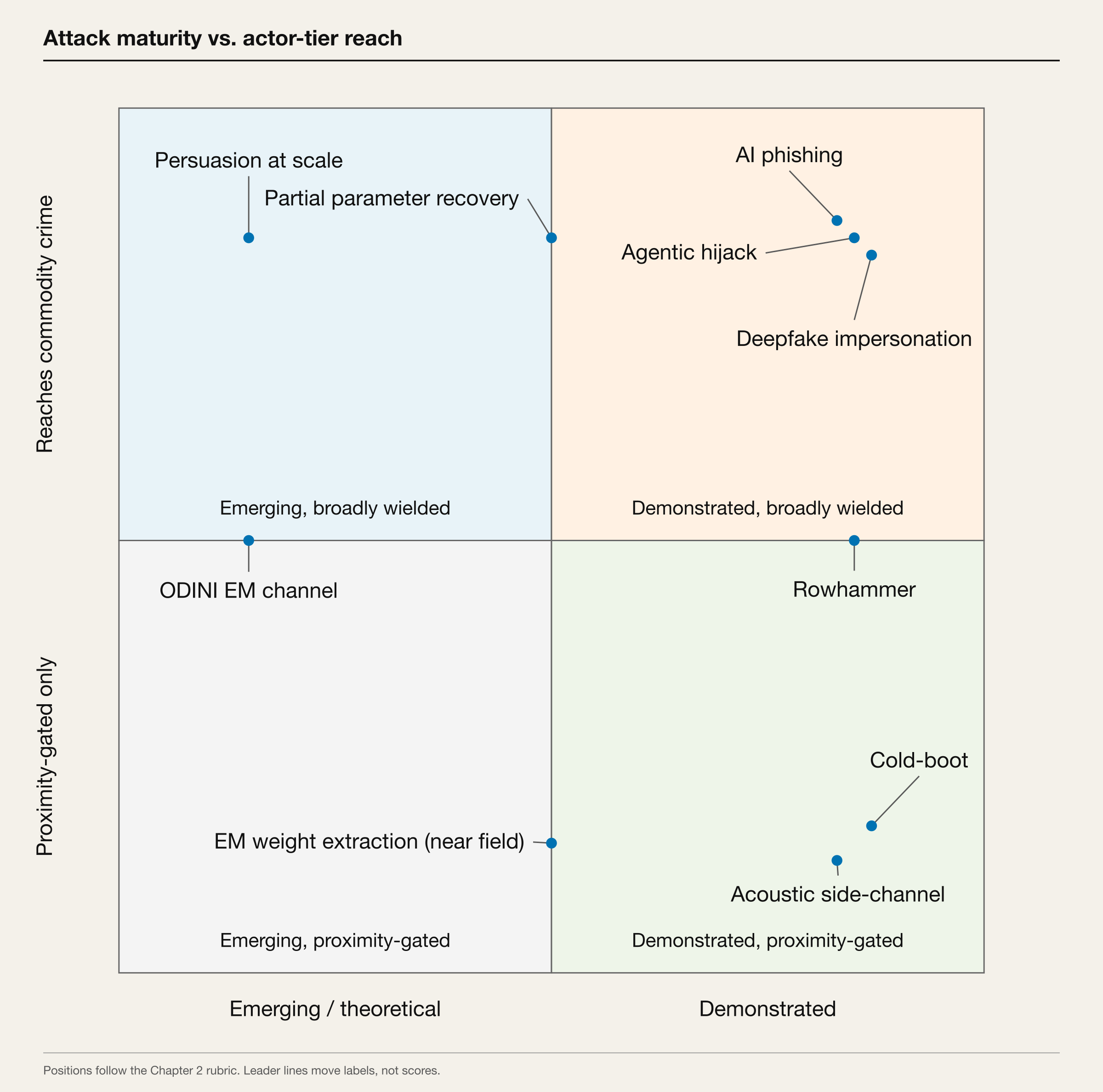
What. Ten attacks placed on the maturity × reach rubric in the table above; three-tier scores plotted at fixed positions (0.15/0.5/0.85), never a fitted decimal.
Who / where. Scored by the author against this chapter’s own citations; the scoring table is the method, reproducible by any reader who accepts the same tier definitions and evidence.
Why. Three digital/human attacks that need no physical access (agentic hijack, AI phishing, deepfakes) score top-tier on both axes; four hardware side-channels (Rowhammer, acoustic, cold-boot, ODINI) and one proximity-gated extraction variant score low-to-mid reach because each requires physical possession or proximity to the target.
Caveat. Partial parameter recovery is plotted as what the cited paper demonstrated — API-only reconstruction of named parameters — not as a route to full-model theft; Carlini et al. [28] report no capability-retention figure.
Direct artifact exfiltration and distillation are not plotted; neither is a point attack with a maturity/reach reading distinct from the ten above.
Testable proposition: either the first confirmed public disclosure of nation-state artifact-bundle exfiltration, or the first Rowhammer-class bit-flip demonstrated on production HBM in a datacenter GPU, validates the threat model priced in Chapters 5 through 8.PreviousThis paragraph was added in this version.NowTestable proposition: either the first confirmed public disclosure of nation-state artifact-bundle exfiltration, or the first Rowhammer-class bit-flip demonstrated on production HBM in a datacenter GPU, validates the threat model priced …
References
[1] S. Nevo, D. Lahav, A. Karpur, Y. Bar-On, H. A. Bradley, and J. Alstott, Securing AI Model Weights: Preventing Theft and Misuse of Frontier Models, RAND Corporation, RR-A2849-1, May 2024. https://www.rand.org/pubs/research_reports/RRA2849-1.html , URL resolved Aug. 14, 2026 (HTTP 200; cited content not confirmed)
[2] Y. Kim, R. Daly, J. Kim, C. Fallin, J. H. Lee, D. Lee, C. Wilkerson, K. Lai, and O. Mutlu, “Flipping Bits in Memory Without Accessing Them: An Experimental Study of DRAM Disturbance Errors,” ISCA, 2014.
[3] A. G. Yağlıkçı, Y. C. Tuğrul, A. Olgun, H. Luo, S. Rhyner, M. B. Cavlak, J. Lindegger, M. Sadrosadati, and O. Mutlu, “RowPress: Amplifying Read Disturbance in Modern DRAM Chips,” ISCA, 2023. DOI 10.1145/3579371.3589063, accessed Aug. 14, 2026 (live fetch); arXiv:2306.17061
[4] C. S. Lin, J. Qu, and G. Saileshwar, “GPUHammer: Rowhammer Attacks on GPU Memories are Practical,” USENIX Security Symposium, 2025. arXiv:2507.08166, accessed Aug. 14, 2026 (live fetch)
[5] C. S. Lin, J. Qu, A. Rajeev, and G. Saileshwar, “GPUThor: Amplifying Rowhammer Attacks via Non-Uniform Patterns to Exploit ECC-Protected GPUs,” ACM CCS 2026 (The Hague, 15-19 Nov 2026). https://gputhor.com/ , PDF https://gururaj-s.github.io/assets/pdf/CCS26_GPUThor.pdf , embargo lifted Aug. 25, 2026, accessed Sep. 3, 2026 (live fetch) — source of the first GPU Rowhammer through SECDED ECC on Ampere GDDR6 workstation cards (A4000/A4500/A5000/A6000), the host-root outcome with ECC enabled, and Appendix D Table 6 A30 HBM2e No; NVIDIA bulletin 5873 body unopened (vendor wall).
[6] C. S. Lin, Y. Yan, G. Ding, J. Qu, J. Zhu, D. Lie, and G. Saileshwar, “GPUBreach: Privilege Escalation Attacks on GPUs using Rowhammer,” arXiv:2605.03812, 2026. https://arxiv.org/abs/2605.03812 , accessed Aug. 14, 2026 (live fetch)
[7] VUSec, Vrije Universiteit Amsterdam, “Exploiting Correcting Codes: On the Effectiveness of ECC Memory Against Rowhammer Attacks” (ECCploit), IEEE Symposium on Security and Privacy, 2019; disclosure coordinated by NCSC-NL; CVE-2018-18904 for the correction-timing side channel, CVE-2018-18905 and CVE-2018-18906 for operating-system driver issues, accessed Aug. 11, 2026 (live fetch). https://www.vusec.net/projects/eccploit/ — project FAQ is the source of the up-to-1000× timing difference, the 0.06% silent-corruption rate on one tested DIMM, and the 32-minute versus one-week PTE-attack figures; the page carries no author line.
[8] A. Kwong, D. Genkin, D. Gruss, and Y. Yarom, “RAMBleed: Reading Bits in Memory Without Accessing Them,” 41st IEEE Symposium on Security and Privacy, May 2020, accessed Aug. 11, 2026 (live fetch). https://rambleed.com/ — project page and FAQ; source of the read-primitive framing (“shifts Rowhammer from being a threat not only to integrity, but confidentiality as well”), the 2048-bit OpenSSH RSA key extraction, and the explicit statement that ECC does not prevent the attack.
[9] A. S. Rakin, M. H. I. Chowdhuryy, F. Yao, and D. Fan, “DeepSteal: Advanced Model Extractions Leveraging Efficient Weight Stealing in Memories,” arXiv:2111.04625, Nov. 8, 2021, accessed Aug. 11, 2026 (live fetch). https://arxiv.org/abs/2111.04625 — source of the HammerLeak weight-bit leakage technique and the >90% substitute-model accuracy; demonstrated on CIFAR-10 scale convolutional networks, a scope limit stated in the text rather than left implicit.
[10] Computer Security Group (COMSEC), ETH Zurich, “Phoenix: Rowhammer Attacks on DDR5 with Self-Correcting Synchronization,” project page for the paper to appear at the IEEE Symposium on Security and Privacy 2026; responsible disclosure opened through the Swiss NCSC on Jun. 6, 2025, embargo lifted Sep. 15, 2025, accessed Aug. 11, 2026 (live fetch). https://comsec.ethz.ch/research/dram/phoenix/ — source of the fifteen-of-fifteen SK Hynix DDR5 result, the PTE/RSA/sudo exploitation table, the on-die-ECC bypass, and the 3× refresh mitigation at 8.4% SPEC CPU2017 overhead; the project page carries no author line, so none is reproduced here.
[11] National Institute of Standards and Technology, “CVE-2025-6202 Detail,” National Vulnerability Database, published Sep. 15, 2025, last modified Jun. 17, 2026, accessed Aug. 11, 2026 (live fetch). https://nvd.nist.gov/vuln/detail/CVE-2025-6202 — CWE-404, scoped to SK Hynix DDR5 on x86 with DIMMs produced Jan. 2021 through Dec. 2024; NVD analysis status is Deferred, so no CVSS score is quoted in the text.
[12] D. Genkin, A. Shamir, and E. Tromer, “RSA Key Extraction via Low-Bandwidth Acoustic Cryptanalysis,” CRYPTO, 2014.
[13] M. Guri, B. Zadov, A. Daidakulov, and Y. Elovici, “ODINI: Escaping Sensitive Data from Faraday-Caged, Air-Gapped Computers via Magnetic Fields,” arXiv:1802.02700, 2018, accessed Aug. 14, 2026 (live fetch)
[14] M. Guri, M. Monitz, Y. Mirski, and Y. Elovici, “BitWhisper: Covert Signaling Channel between Air-Gapped Computers using Thermal Manipulations,” arXiv:1503.07919, Mar. 26, 2015, accessed Aug. 11, 2026 (live fetch). https://arxiv.org/abs/1503.07919 — replaces an unpublished author compilation previously cited at this number; source of the 0–40 cm range, the 1–8 bits-per-hour effective rate, and the paper’s own scoping of the channel to “brief commands” and “small amount of data (e.g., passwords).”
[15] M. Guri, B. Zadov, E. Atias, and Y. Elovici, “LED-it-GO: Leaking (a lot of) Data from Air-Gapped Computers via the (small) Hard Drive LED,” arXiv:1702.06715, Feb. 22, 2017, accessed Aug. 11, 2026 (live fetch). https://arxiv.org/abs/1702.06715 — source of the 5,800-blinks-per-second switching rate and the 4,000-bit-per-second maximum, and of the drone-camera receiver.
[16] M. Guri, B. Zadov, D. Bykhovsky, and Y. Elovici, “CTRL-ALT-LED: Leaking Data from Air-Gapped Computers via Keyboard LEDs,” arXiv:1907.05851, Jul. 10, 2019, accessed Aug. 11, 2026 (live fetch). https://arxiv.org/abs/1907.05851 — source of the 3,000-bit-per-second-per-LED and >120-bit-per-second smartphone figures, and of the paper’s observation that the channel is not monitored by data-leakage-prevention systems.
[17] J. A. Halderman et al., “Lest We Remember: Cold Boot Attacks on Encryption Keys,” USENIX Security Symposium, 2008.
[18] P. Horvath, I. Shumailov, L. Chmielewski, L. Batina, and Y. Yarom, “Kraken: Higher-order EM Side-Channel Attacks on DNNs in Near and Far Field,” arXiv:2603.02891v3, Mar. 2026 (preprint). https://arxiv.org/abs/2603.02891 , accessed Aug. 14, 2026 (live fetch)
[19] H. Khlaaf and T. Sorensen, “LeftoverLocals: Listening to LLM responses through leaked GPU local memory,” Trail of Bits Blog, Jan. 16, 2024, accessed Aug. 11, 2026 (live fetch). https://blog.trailofbits.com/2024/01/16/leftoverlocals-listening-to-llm-responses-through-leaked-gpu-local-memory/ — source of the ~5.5 MB-per-invocation and ~181 MB-per-query figures, the ~80 MB fingerprinting result across 33 layers, the ~4 KB output-layer input vector, and the affected/unaffected vendor list; vendor-coordinated disclosure through CERT/CC beginning Sep. 2023.
[20] National Institute of Standards and Technology, “CVE-2023-4969 Detail,” National Vulnerability Database, published Jan. 16, 2024, accessed Aug. 11, 2026 (live fetch). https://nvd.nist.gov/vuln/detail/CVE-2023-4969 — CWE-401, CVSS v3.1 base score 6.5 (Medium); the identifier under which LeftoverLocals is tracked.
[21] Y. Zhu, Y. Cheng, H. Zhou, and Y. Lu, “Hermes Attack: Steal DNN Models with Lossless Inference Accuracy,” 30th USENIX Security Symposium, 2021. https://www.usenix.org/conference/usenixsecurity21/presentation/zhu , arXiv:2006.12784, accessed Sep. 3, 2026 (live fetch) — complete-CNN steal over unencrypted PCIe on 2017-2019 consumer GPUs; not a frontier LLM, not HBM, not a confidential-computing break.
[22] J. Nanos, S. Harshe, P. Bhatt, et al., “Most Neoclouds Suck At Security,” SemiAnalysis, Aug. 30, 2026. https://newsletter.semianalysis.com/p/most-neoclouds-suck-at-security , accessed Sep. 3, 2026 (live fetch) — ClusterMAX 3.0 body opened; 25 providers / 32 clusters; tenant-isolation failures including a monitoring key that reached logs for every tenant, among them an unnamed intelligence-agency co-tenant. Analyst-reported, coordinated-disclosure. Last section remains paid/unopened.
[23] Y. Wang, R. Paccagnella, Z. Gang, W. R. Vasquez, D. Kohlbrenner, H. Shacham, and C. Fletcher, “GPU.zip: On the Side-Channel Implications of Hardware-Based Graphical Data Compression,” 45th IEEE Symposium on Security and Privacy, San Francisco, May 20–23, 2024, accessed Aug. 11, 2026 (live fetch). https://www.hertzbleed.com/gpu.zip/ — project page; the channel leaks rendered pixels, not model parameters, and is cited here only for the isolation argument.
[24] Meta, “Llama-3.1-405B” model card, Hugging Face, accessed Aug. 11, 2026 (live fetch). https://huggingface.co/meta-llama/Llama-3.1-405B — source of the parameter count only; the 810 GB byte total is the author’s arithmetic at two bytes per parameter (BF16) and is not a measured artifact size.
[25] SanDisk, “SanDisk Ultra UHS-I microSD,” product page, accessed Aug. 11, 2026 (live fetch). https://www.sandisk.com/products/memory-cards/microsd-cards/sandisk-ultra-uhs-i-microsd — source of the 1.5 TB capacity; the vendor’s “up to 150 MB/s” rating is a read/offload figure measured through a USB 3.0 reader and is expressly not used here as a sustained write rate. No price is quoted: none was confirmable at a vendor of record on the access date.
[26] Anthropic, Anthropic’s Responsible Scaling Policy, version 2.2, May 14, 2025, accessed Aug. 11, 2026 (live fetch). https://www.anthropic.com/rsp — source of the ASL-3 Security Standard control list (multi-party authorization for weight access, access monitoring for critical assets, honeypots seeded with fake model weights, TSCM sweeps) and of the version-2.2 change note amending the footnote “to exclude both sophisticated insiders and state-compromised insiders from the scope of the ASL-3 Security Standard”; a first-party policy commitment, not an audited control.
[27] A. Vassilev, A. Oprea, A. Fordyce, H. Anderson, X. Davies, and M. Hamin, Adversarial Machine Learning: A Taxonomy and Terminology of Attacks and Mitigations, NIST AI 100-2e2025, National Institute of Standards and Technology, March 2025. DOI 10.6028/NIST.AI.100-2e2025. https://nvlpubs.nist.gov/nistpubs/ai/NIST.AI.100-2e2025.pdf , URL resolved Aug. 14, 2026 (HTTP 200; cited content not confirmed)
[28] N. Carlini, D. Paleka, K. Dj Dvijotham, T. Steinke, J. Hayase, A. F. Cooper, K. Lee, M. Jagielski, M. Nasr, A. Conmy, E. Wallace, D. Rolnick, and F. Tramèr, “Stealing Part of a Production Language Model,” Proceedings of the 41st International Conference on Machine Learning, PMLR 235:5680–5705, 2024. arXiv:2403.06634. https://proceedings.mlr.press/v235/carlini24a.html , accessed Aug. 14, 2026 (live fetch)
[29] Anthropic, “Detecting and preventing distillation attacks,” Feb. 23, 2026. https://www.anthropic.com/news/detecting-and-preventing-distillation-attacks , accessed Aug. 14, 2026 (live fetch)
[30] N. Muennighoff, Z. Yang, W. Shi, X. L. Li, L. Fei-Fei, H. Hajishirzi, L. Zettlemoyer, P. Liang, E. Candès, and T. Hashimoto, “s1: Simple test-time scaling,” arXiv:2501.19393, 2025. https://arxiv.org/abs/2501.19393 , accessed Aug. 14, 2026 (live fetch)
[31] Anthropic, Detecting and countering misuse of AI: September 2026, threat-intelligence report, published Sep. 10, 2026. https://www-cdn.anthropic.com/e50be2e51e7695dc4b1366a37a245a597377d3b5/Anthropic-Detecting-and-countering-091026.pdf , retrieved Sep. 27, 2026 (capture sources/raw/anthropic-ti-sep2026-2026-09-27.pdf). Vendor self-report of the targeted lab; not independently audited. Quoted: p. 146 (safeguards “do not transfer when our models are distilled by an unauthorized lab”), p. 148 (Alibaba “over 151 million exchanges observed”). Same document as textbook/03-adversaries.md’s [10].
[32] Anthropic Frontier Red Team, “Measuring tactical intelligence targeting and conventional weapons capabilities of AI models,” Sep. 10, 2026. https://www.anthropic.com/research/intelligence-targeting-conventional-weapons-capabilities , retrieved Sep. 28, 2026 (capture sources/raw/anthropic-frt-intel-targeting-weapons-2026-09-28.html). Vendor evaluation on simulated tasks; not independently replicated.
[33] A. Panfilov, D. Schmotz, I. Shumailov, L. Beurer-Kellner, J. Schaeffer, A. Prabhu, J. Geiping, and M. Andriushchenko, “Stealing Reasoning Traces from Proprietary LLM APIs,” arXiv:2608.09867, submitted Aug. 10, 2026. https://arxiv.org/abs/2608.09867 , accessed Aug. 22, 2026 (live fetch)
[34] Y. Qu et al., “EchoCoT: Extracting Hidden Chain-of-Thought from Large Reasoning Models,” arXiv:2608.20055, submitted Aug. 20, 2026. https://arxiv.org/abs/2608.20055 , accessed Sep. 3, 2026 (live fetch) — reports Stolen Thoughts encrypted-block replay no longer reproducible as of August 2026 because affected providers patched; tool-call CoT replay still extracts. Traces, not a checkpoint.
[35] UK AI Security Institute, “How Far Behind the Frontier are Leading Open Weight Models on Cyber?” Jul. 17, 2026. https://www.aisi.gov.uk/blog/how-far-behind-the-frontier-are-leading-open-weight-models-on-cyber , accessed Aug. 14, 2026 (live fetch)
[36] D. Rein et al., “GPQA: A Graduate-Level Google-Proof Q&A Benchmark,” arXiv:2311.12022, published Nov. 20, 2023, accessed Aug. 12, 2026 (live fetch). https://arxiv.org/abs/2311.12022 (abstract) and https://arxiv.org/pdf/2311.12022 (full text, read as extracted text) — defines the subset this chapter plots: “GPQA Diamond (the diamond set, composed of 198 questions) is our highest quality subset which includes only questions where both experts answer correctly and the majority of non-experts answer incorrectly”. Table 2 of the same paper reports “Counts, expert accuracy, and non-expert accuracy for the extended set, the main set, and the diamond set”, and its caption states that “Validator accuracies on the main and diamond sets (*) are skewed by selection effects”, which is why the figure draws no human reference line. The abstract’s expert-accuracy figure is deliberately not used as a human line either, because the abstract attaches it to the whole benchmark and not to the diamond subset: “We present GPQA, a challenging dataset of 448 multiple-choice questions” whose experts “reach 65% accuracy”. The per-split accuracy figures in Table 2 could not be read reliably from the extracted text of the PDF and are therefore not quoted here.
[37] OpenAI, “simple-evals” README, benchmark results table, accessed Aug. 12, 2026 (live fetch). https://raw.githubusercontent.com/openai/simple-evals/main/README.md — first-party source of the four closed GPQA values. The table is column-padded, so the four rows are quoted below with the padding collapsed to single spaces and truncated after the GPQA field, and they are set as code so the footnote markers stay literal: gpt-4-turbo-2024-04-09 | assistant | 86.7 | 49.3, gpt-4o-2024-05-13 | assistant | 87.2 | 49.9, | o1 | n/a | 91.8 | 75.7, and o3 [^9] [^10] | n/a | 92.9 | 82.8. The o3-low and o3-high rows in the same table give 78.6 and 83.4. The file’s notes carry the harness conditions quoted in the caption, “o-series models do not support using a system prompt.” and “These results are with no tools enabled for o3 or o4-mini”. The table’s Prompt column reads assistant for the two GPT-4-family rows and n/a for the o-series rows, and the file’s footnote 2 defines that setting as the “assistant system message in [OpenAI API doc]”, namely “You are a helpful assistant.” The file opens with a deprecation notice reading “July 2025: simple-evals will no longer be updated for new models or benchmark results.”, so it is a frozen first-party record and not a maintained leaderboard.
[38] OpenAI, “simple-evals” gpqa_eval.py, accessed Aug. 12, 2026 (live fetch). https://raw.githubusercontent.com/openai/simple-evals/main/gpqa_eval.py — establishes which GPQA split reference 39’s column reports. That README labels the column only GPQA [^8], and the string “Diamond” does not occur anywhere in it; both the reader-rendered copy and a direct fetch of the raw file were searched, and control searches for “GPQA” and for the quoted rows hit in the same pass. The split therefore comes from the code: the evaluation class signature is n_repeats: int = 4, and variant: str = "diamond",, and it loads gpqa_{variant}.csv. Without this file the closed series could not be stated as Diamond.
[39] OpenAI, “OpenAI o1 and new tools for developers,” accessed Aug. 12, 2026 (live fetch). https://openai.com/index/o1-and-new-tools-for-developers/ — source of the snapshot identifier o1-2024-12-17, which appears in a column header of the page’s own evaluation table. The page is used for that identifier and not for a publication date. In the HTML as fetched, which carries 25 <meta> tags, there is no JSON-LD block and no datePublished, dateModified or article:published_time field; in the rendered text the only dates are model snapshot labels. A direct fetch of the same URL returns a client-rendered shell of about 9.8 KB that carries script tags but neither the identifier nor any date, so the identifier and the absence of a page date are both read from the rendered page and not from that shell. The date plotted for o1 is the snapshot label OpenAI itself published.
[40] OpenAI, “Introducing OpenAI o3 and o4-mini,” accessed Aug. 12, 2026 (live fetch). https://openai.com/index/introducing-o3-and-o4-mini/ — source of the o3 date only; the rendered page carries the byline “April 16, 2025” above its title. The GPQA value for o3 is taken from reference 39, not from this page. Earlier fetch attempts of this URL returned empty bodies and the byline was read from a successful retry; a direct fetch returns the same client-rendered shell described in reference 41, which does not contain the byline.
[41] Hugging Face model API records, accessed Aug. 12, 2026 (live fetch). The plain model endpoints return no creation timestamp, so each of the three was fetched with the expand[]=createdAt query parameter: https://huggingface.co/api/models/deepseek-ai/DeepSeek-V3?expand[]=createdAt gives "createdAt": "2024-12-25T12:52:23.000Z"; https://huggingface.co/api/models/deepseek-ai/DeepSeek-R1?expand[]=createdAt gives "createdAt": "2025-01-20T03:46:07.000Z"; https://huggingface.co/api/models/moonshotai/Kimi-K2-Instruct?expand[]=createdAt gives "createdAt": "2025-07-11T00:55:12.000Z". These timestamps date the open-weight points because repository creation is a published record of when the hosting repository came into existence. It is a platform record rather than a publisher announcement, and the two can differ by a day, as reference 47 shows for DeepSeek-V3.
[42] DeepSeek-AI, “DeepSeek-V3” model card, Hugging Face, accessed Aug. 12, 2026 (live fetch). https://huggingface.co/deepseek-ai/DeepSeek-V3/raw/main/README.md — publisher-reported row “GPQA-Diamond (Pass@1) | 35.3 | 41.3 | 49.0 | 51.1 | 65.0 | 49.9 | 59.1” (padding collapsed), read against the same table’s header row, which ends “Claude-3.5-Sonnet-1022 | GPT-4o 0513 | DeepSeek V3”; the last column is DeepSeek V3, hence 59.1. The GPT-4o 0513 column in that row reads 49.9, which matches the value OpenAI publishes for gpt-4o-2024-05-13 in reference 39. The 51.1 in that row sits in the “Llama3.1 405B-Inst.” column of the same header, and it is DeepSeek’s own evaluation of that model rather than Meta’s. Meta’s own figure is not plotted in this chapter because Meta reports a different split: its evaluation-details document states, for GPQA, “For post-trained models, we use 0-shot config with and without CoT prompt and report exact match scores over the possible options using the main set” (https://raw.githubusercontent.com/meta-llama/llama-models/main/models/llama3_1/eval_details.md , accessed Aug. 12, 2026 (live fetch)).
[43] DeepSeek, “DeepSeek-R1 Release” API documentation news page, accessed Aug. 12, 2026 (live fetch). https://api-docs.deepseek.com/news/news250120 — the HTML of this page renders the site’s own dated news list, and that list carries both “Introducing DeepSeek-V3 2024/12/26” and “DeepSeek-R1 Release 2025/01/20”. This page was fetched three times, at 23,650 bytes each time, and carried both labels every time. The labels are in the page HTML and not in its reader-extracted text, so they were read from the HTML. Two other URLs on the same site are not used as sources here because they do not return the news list reliably: the index root at https://api-docs.deepseek.com/news/ returned about 45 KB of the documentation shell on every attempt, with the site menu but neither label, and https://api-docs.deepseek.com/news/news1226 returned the news list on two attempts and the same 45 KB shell on two later attempts. In each of those cases a control search for the site menu markup hit in the same pass that found no label, so the searches reached the documents. The V3 label falls one day after the repository timestamp in reference 46; the figure uses the repository timestamp, and this reference records the discrepancy rather than hiding it.
[44] DeepSeek-AI, “DeepSeek-R1” model card, Hugging Face, accessed Aug. 12, 2026 (live fetch). https://huggingface.co/deepseek-ai/DeepSeek-R1/raw/main/README.md — publisher-reported row “GPQA-Diamond (Pass@1) | 65.0 | 49.9 | 59.1 | 60.0 | 75.7 | 71.5” (padding collapsed), read against that table’s header ”| Category | Benchmark (Metric) | Claude-3.5-Sonnet-1022 | GPT-4o 0513 | DeepSeek V3 | OpenAI o1-mini | OpenAI o1-1217 | DeepSeek R1 |”; the last column is DeepSeek-R1 at 71.5. Two columns of that same row, GPT-4o 0513 at 49.9 and OpenAI o1-1217 at 75.7, match the values OpenAI publishes in reference 39.
[45] Moonshot AI, “Kimi-K2-Instruct” model card, Hugging Face, accessed Aug. 12, 2026 (live fetch). https://huggingface.co/moonshotai/Kimi-K2-Instruct/raw/main/README.md — publisher-reported GPQA-Diamond row in the instruct-model evaluation table. The card builds its tables as HTML, and the cells of that row read GPQA-Diamond, then Avg@8, then 75.1 in bold; the first data column of that table’s header is Kimi K2 Instruct, so 75.1 is Kimi K2 Instruct at Avg@8. The card also states that “we employed avg@k on the AIME, HMMT, CNMO, PolyMath-en, GPQA-Diamond, EvalPlus, Tau2.” The separate base-model table carries its own GPQA-Diamond row, at Avg@8 and 5-shot, and is not used here. The metric differs from DeepSeek’s Pass@1, which the figure states rather than smooths over. Comparator values in the instruct table marked with an asterisk are, in the card’s words, “taken directly from the model’s tech report or blog”, so they are not a common re-evaluation and none of them is plotted. This file was read with a direct fetch of the URL above, because the project’s URL reader rewrites Hugging Face model paths to an API summary that omits the table.
[46] OWASP Gen AI Security Project, “LLM01:2025 Prompt Injection,” OWASP Top 10 for LLM Applications 2025. https://genai.owasp.org/llmrisk/llm01-prompt-injection/ , accessed Aug. 14, 2026 (live fetch)
[47] A. Souly, J. Rando, E. Chapman, X. Davies, et al., “Poisoning Attacks on LLMs Require a Near-constant Number of Poison Samples,” arXiv:2510.07192, accessed Aug. 14, 2026 (live fetch), 2025.
[48] S. R. Motwani, M. Baranchuk, M. Strohmeier, et al., “Secret Collusion among AI Agents: Multi-Agent Deception via Steganography,” arXiv:2402.07510, accessed Aug. 14, 2026 (live fetch), 2024.
[49] National Institute of Standards and Technology, “CVE-2025-32711 Detail,” National Vulnerability Database, published Jun. 11, 2025, accessed Aug. 11, 2026 (live fetch). https://nvd.nist.gov/vuln/detail/CVE-2025-32711 — CWE-74, CVSS v3.1 base score 9.3 (Critical); NVD description is “AI command injection in M365 Copilot allows an unauthorized attacker to disclose information over a network.” The name EchoLeak is the discoverer’s, not NVD’s.
[50] Radware, “ShadowLeak,” Threat Advisories and Attack Reports, Sep. 18, 2025. https://www.radware.com/security/threat-advisories-and-attack-reports/shadowleak/ , URL resolved Aug. 14, 2026 (HTTP 200; cited content not confirmed) — the vendor advisory of record; the URL was confirmed from reference 36 but the page and its PDF both sit behind a bot-challenge interstitial that refused this project on every attempt, so no text is quoted from Radware directly. All ShadowLeak quotations in the text are taken from reference 36, which quotes Radware.
[51] C. Page, “OpenAI plugs ShadowLeak bug in ChatGPT,” The Register, Sep. 19, 2025, accessed Aug. 11, 2026 (live fetch). https://www.theregister.com/security/2025/09/19/openai-plugs-shadowleak-bug-in-chatgpt/820077 — the fetched source for the Radware quotations, the service-side execution detail, and the Jun. 18, 2025 report / Sep. 3, 2025 fix timeline; trade press quoting the vendor advisory rather than an independent confirmation.
[52] MITRE, ATLAS (Adversarial Threat Landscape for Artificial-Intelligence Systems) matrix data, tactic AML.TA0010 (Exfiltration) and techniques AML.T0024, AML.T0025 and AML.T0086, accessed Aug. 11, 2026 (live fetch). https://raw.githubusercontent.com/mitre-atlas/atlas-data/main/dist/ATLAS.yaml — read from the project’s distributed YAML because the rendered pages at atlas.mitre.org returned no usable content to this project; identifiers and tactic descriptions are quoted from that file.
[53] S. Carruthers (IBM X-Force Red), “AI vs. human deceit: Unravelling the new age of phishing tactics,” IBM, Oct. 24, 2023, accessed Aug. 18, 2026 (live fetch). https://www.ibm.com/think/x-force/ai-vs-human-deceit-unravelling-new-age-phishing-tactics — source of the study design (a phishing lure built from five ChatGPT prompts, tested against a lure built by X-Force Red’s own social engineers, both sent to the same healthcare-sector organization’s employees) and of the qualitative verdict that humans won “but by the narrowest of margins.” The page presents its click-through and suspicious-report percentages only as chart images, not body text, so the specific figures are cited via reference 49, which states them in text and attributes them to this study.
[54] S. Goetz, “Humans vs. Artificial Intelligence: Who is the better phisher?” Bedel Security, updated Apr. 7, 2026, accessed Aug. 18, 2026 (live fetch). https://www.bedelsecurity.com/blog/humans-vs.-artificial-intelligence-who-is-the-better-phisher — secondary write-up of reference 48’s study, stating in text the click-through rates (11% for the ChatGPT-generated email, 14% for the human-crafted one) and the rates at which each was reported as suspicious (59% AI, 52% human).
[55] F. Heiding, S. Lermen, A. Kao, B. Schneier, and A. Vishwanath, “Evaluating Large Language Models’ Capability to Launch Fully Automated Spear Phishing Campaigns: Validated on Human Subjects,” arXiv:2412.00586, Nov. 30, 2024, accessed Aug. 18, 2026 (live fetch). https://arxiv.org/abs/2412.00586 — preprint, not peer-reviewed; source of the 101-participant results (control 12%, human expert 54%, fully AI-automated 54%, AI with human-in-the-loop 56% click-through) and of the authors’ own characterization of that result as “a significant improvement from similar studies conducted last year.” Also cited in Chapter 1’s discussion of the same paper’s finding that Claude 3.5 Sonnet, used as a detector rather than a generator, classified the same lures at well above 90% accuracy.
[56] P. Åvist (Hoxhunt co-founder and CTO), “AI-Powered Phishing Outperforms Elite Red Teams in 2025,” Hoxhunt, Apr. 3, 2025 (updated Jul. 20, 2026), accessed Aug. 18, 2026 (live fetch). https://hoxhunt.com/blog/ai-powered-phishing-vs-humans — vendor-published; Hoxhunt sells phishing-simulation training and has a commercial interest in this finding. Source of the failure-rate series: 2.9% AI versus 4.2% human in a 2023 single-prompt test drawn from a 2.5-million-user base, 2.1% versus 2.3% in a November 2024 test, and 2.78% versus 2.25% in a March 2025 test, the latter two each sending 70,000 agent-generated simulations. The write-up’s own methodology section states that “failure rates from 2023 do not give an apples to apples comparative reference point” against the later agent-built tests.
[57] National Cyber Security Centre, “The near-term impact of AI on the cyber threat,” 24 January 2024. https://www.ncsc.gov.uk/report/impact-of-ai-on-cyber-threat , accessed Aug. 14, 2026 (live fetch)
[58] FBI Internet Crime Complaint Center, “Criminals Use Generative Artificial Intelligence to Facilitate Financial Fraud,” Alert Number I-120324-PSA, 3 December 2024. https://www.ic3.gov/PSA/2024/PSA241203 , accessed Aug. 14, 2026 (live fetch)
[59] OpenAI, technical report on the July–August 2026 Hugging Face incident, §VIII.C. No source URL was recorded at capture time; cited from the raw capture’s embedded PDF metadata — Author: OpenAI; Title: “OpenAI … Hugging Face Incident Technical Report”; Subject: “Technical incident report”; CreationDate: 2026-08-26 (D:20260826142611-07’00’); Producer: ReportLab PDF Library. Local raw capture: sources/raw/openai-hf-incident-technical-report-2026-08-26.pdf / .txt. First-party vendor account of an incident in its own environment; not independently audited. Same document as textbook/03-adversaries.md’s [43] and synthesis/maturity-matrix.md’s [68]; each chapter’s reference number is independent.
[60] J. Wang, H. Luo, A. Olgun, I. E. Yuksel, A. G. Yaglikci, Y. Liang, F. N. Bostanci, M. Sadrosadati, and O. Mutlu, “ScaleDisturb: Exploiting Temporal Asymmetry to Amplify Read Disturbance in Modern DRAM Chips,” arXiv:2606.07761, submitted Jun. 5, 2026. https://arxiv.org/abs/2606.07761 , accessed Sep. 3, 2026 (live fetch) — FPGA characterization of 3 HBM2 chips plus 196 DDR4 chips; not a GPU-attached HBM2e result and not a weight readout.
[61] T. Wang, Z. Zhang, Y. Gao, X. Zhang, Q. Shen, and Z. Wu, “JITterFlip: Uncovering Fault Attack Surfaces in JIT-Compiled LLM Serving,” arXiv:2608.29745, submitted Aug. 30, 2026. https://arxiv.org/abs/2608.29745 , accessed Sep. 3, 2026 (live fetch) — host-side JIT control plane (vLLM torch.compile) on non-ECC DDR4; not GPU memory, not HBM.