Chapter 1 — The Eroded Defender’s Advantage
Part I of IV — Object, method, and threat model. Central claim, protected asset, and the two organizing axes: attack register and defense layer.PreviousThis paragraph was added in this version.NowPart I of IV — Object, method, and threat model. Central claim, protected asset, and the two organizing axes: attack register and defense layer.
“I do not believe we have ASI, AGI or intelligence in any real shape or form. What we have are better models.”
— the author’s position, and the premise of this book
Frontier model weights require protection against nation-state adversaries today. The protected object is the artifact bundle: trained parameters plus everything needed to run, reproduce, or re-derive them. Superintelligence and alignment doom lie outside that problem. In February 2026, the UK AI Security Institute (AISI) estimated that the length of cyber task a frontier model completes with 80% reliability had been doubling every 4.7 months since late 2024 [1]. That measured capability, rather than claims about general intelligence, drives both the threat model and the procurement argument.
A serious objection holds that frontier capability diffuses to open weights and rivals regardless of any single lab’s perimeter, reducing containment to delay. In its sharper form, if rivals hold equivalent weights behind weaker security, an attacker targets the weakest copy and unilateral defense buys little. Chapter 13 evaluates both versions.PreviousThis paragraph was added in this version.NowA serious objection holds that frontier capability diffuses to open weights and rivals regardless of any single lab's perimeter, reducing containment to delay. In its sharper form, if rivals hold equivalent weights behind weaker security, …
Karp, on the record: who controls the weights
On July 1, 2026, Palantir CEO Alex Karp argued on CNBC’s Squawk Box that something had gone “completely wrong” with enterprise AI procurement. Companies hand proprietary data—their alpha—to Frontier Labs, only to have their business modeled back and resold. “Who controls the models? Who controls the weights? Who controls the value of your business?” he asked, characterizing the risk as “these people are stealing the weights and alpha of my business” [2].
Observed. At 00:30, Karp links control of model weights to control of business value; at 06:44 , he describes theft of weights and alpha.
This is evidence for his commercial-sovereignty argument, not proof of nation-state weight exfiltration.
CNBC, July 1, 2026.
Karp’s focus is commercial sovereignty: who captures the value an enterprise generates when running on someone else’s model. When the Department of War says “I need this application,” he asked, does the customer or the lab control the weights? “Are we really going to outsource the battlefield of this country to the consensus view in Silicon Valley? That is effing insane” [2].
Commercial sovereignty differs from nation-state exfiltration of the artifact bundle. Karp owns the commercial-sovereignty argument, and he owns the binary framing of the race as well: he told CNBC “There are positive and negative consequences, and either we win or China will win” [3], and told Axios “We are going to be the dominant player, or China is going to be the dominant player, and there will just be very different rules depending on who wins” [4].
The measured question: how fast is offense compounding
How does attack sophistication change when AI can both execute and refine intrusions? The working thesis here, carried from an earlier compilation [5], is that the defender’s advantage has eroded. Long-context models turned bespoke, manual attacks into scalable batch operations. Context windows expanded from GPT-3’s nctx = 2048 tokens in 2020 [6] to Gemini 1.5 Pro’s 1,000,000-token preview (alongside a 128,000-token standard window) in February 2024 [7]. Phishing shifted from craft to high-volume automation, losing the grammar and spelling errors that once revealed lures [8]. Because attacker per-target cost collapsed, defender economics worsened.
A second proposed mechanism is that human fatigue no longer constrains attackers. No measured baseline quantifies how much protection attacker fatigue once provided, so no offsetting figure can be stated. In principle the claim is testable: automation increases attack volume and persistence, leaving open whether defensive automation offsets that gain. Chapter 2 returns to this mechanism.PreviousThis paragraph was added in this version.NowA second proposed mechanism is that human fatigue no longer constrains attackers. No measured baseline quantifies how much protection attacker fatigue once provided, so no offsetting figure can be stated. In principle the claim is …
In February 2026, UK AISI estimated that the 80%-reliability cyber-task horizon had been doubling every 4.7 months since late 2024, accelerating from its November 2025 estimate of 8 months [1]. That figure was measured under a 2.5-million-token cap and a minimal scaffold, which AISI notes “artificially lowers success rates and understates what models can do” [1]. Two caveats travel with the number: Claude Mythos Preview and GPT-5.5 later exceeded both trendlines (“It is unclear whether this represents a new, faster trend”), the longest-horizon points rest on only six tasks of eight hours or more, and task-suite durations do not measure defended production networks [1].
AISI also tracked progress on multi-step cyber ranges. At a fixed 10-million-token budget on its 32-step corporate-network range, average steps completed rose from 1.7 for GPT-4o (August 2024) to 9.8 for Opus 4.6 (February 2026), showing log-linear returns to inference compute with no plateau [9]. The best single run reached 22 steps at a 100-million-token budget, whereas on a separate 7-step industrial-control range leading models averaged only 1.2 to 1.4 steps at 100 million tokens [9]. Capability gains are domain-specific, and neither range included an active defender.
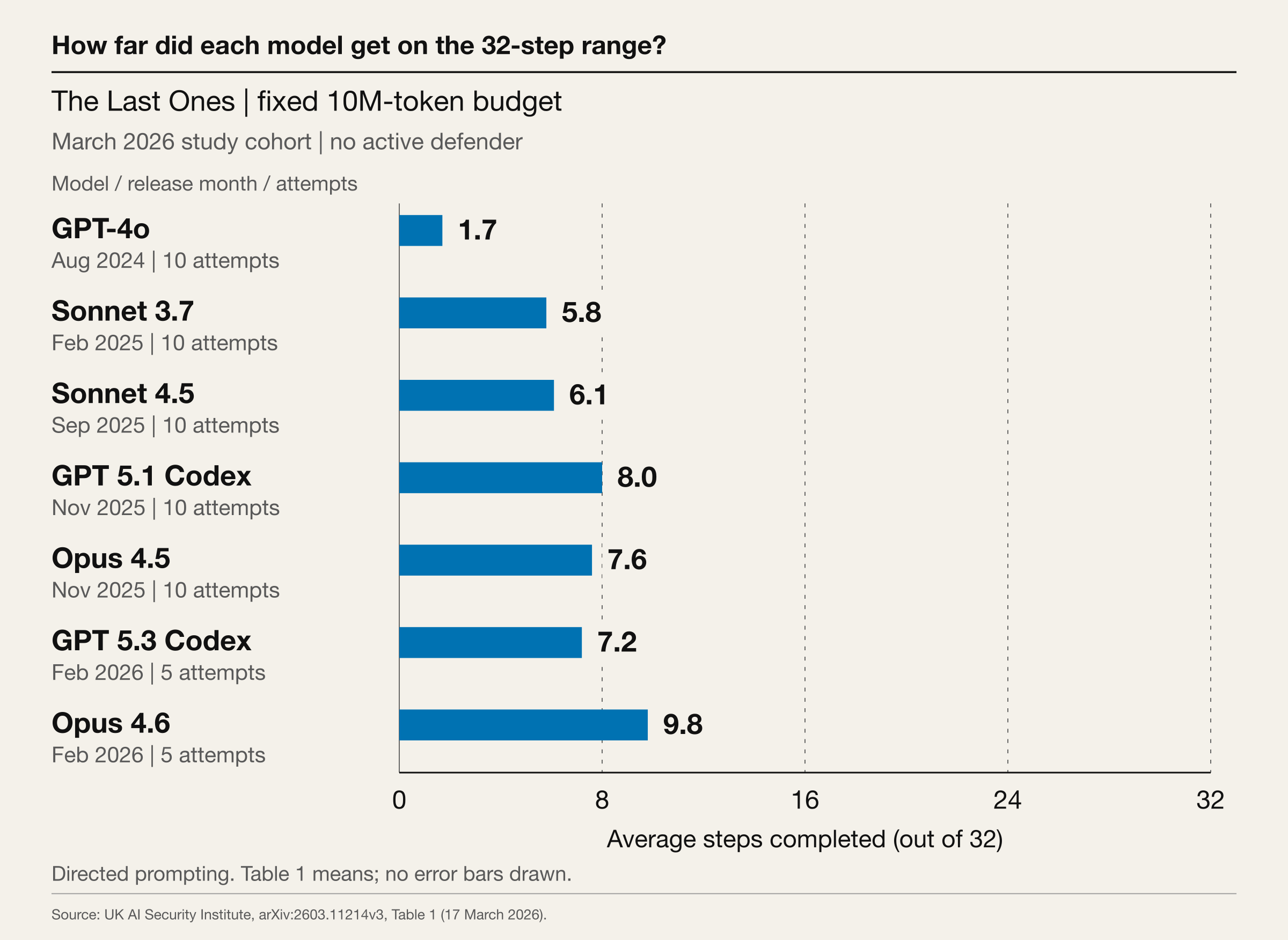
The complete seven-model cohort in AISI’s March 2026 preprint, not a current frontier ranking. Bars show the 10M-token means from Table 1 [9]. Each run starts at the beginning of The Last Ones, a 32-step corporate-network range. Dates are the paper’s model-release months.
The budget is cumulative token spend with context compaction, not context-window size.
Runs use directed prompting and AISI’s minimal agent scaffold.
Attempt counts appear beside each model; error bars are not reproduced.
No active defender intervenes, and steps differ in difficulty [9].
Opus 4.6 retains the authors’ reported 9.8. This book’s reconstruction from Appendix E’s flags yields 9.6; that unresolved difference does not replace Table 1’s score [9].
Checked as of September 9, 2026, inspected releases for Astra [10], Fable 5.1 [11], and GLM-5.3 [12], as well as subsequent AISI token-spend trajectories [1], [13], do not tabulate comparable 10M-token means on The Last Ones. Omission from Figure 1.2 reflects absent comparable data rather than a zero score.
Capability diffusion is also measurable. AISI’s first public open- versus closed-weight cyber comparison placed GLM-5.2 and DeepSeek V4-Pro 4 to 7 months behind the closed frontier, narrower than the 6 to 10 months measured internally on open-weight models released between January and September 2025 [13]. AISI cautions that this result “is not predictive of whether future open weight models will replicate the more recent jumps,” and the comparison covers cyber tasks only [13]. Chapter 13 addresses the resulting diffusion objection in detail.
Once weights are released, access-gated controls—monitoring, classifiers, account bans, and withdrawal—vanish. Refusal training alone is brittle: AISI observed DeepSeek V4-Pro’s occasional refusals “circumvented simply via a small number of repeat attempts at refused tasks” [13].
Per-target cost now has empirical non-vendor data. In a live penetration test of a roughly 8,000-host university network across 12 subnets, a Stanford, Carnegie Mellon, and Gray Swan AI preprint pitted ten human professionals against six existing scaffolds and a new scaffold, ARTEMIS [14]. ARTEMIS placed second of fifteen with 11 valid findings (82% validity, 95.2 points), outscoring 9 of 10 humans, while the top human still won (111.4 points, 13 findings, 100% validity) [14].
Four paper caveats matter here [14]. Agents produced more false positives and failed on graphical interfaces: 80% of humans found a Windows remote-code-execution path through a web console that ARTEMIS missed. The widely cited $18/hour figure applied to a cheaper configuration that ranked seventh; the second-place configuration cost about $59/hour against a $60/hour human rate. Human supervisors could terminate runs while target IT staff manually approved flagged actions that live defenses would block. Even so, the authors note that frontier models scoring at or below 50% on Cybench, CVEBench, and BountyBench Detect reflect benchmarks omitting real production complexity rather than weak model capability.
An obvious counterargument is that defenders receive identical AI uplift for triage, log correlation, scanning, and detection, making offensive advantage temporary [5]. CSET’s 2025 review states this conditional precisely: “[i]f these tasks can be done reliably by AI and if defenders can keep up with faster discoveries of new vulnerabilities and attack tactics, then defenders can take advantage of their ability to impose delays and frictions to gain more from AI than attackers” [15].
Empirical evaluation shows that conditional remains unmet. A nine-author team led from UC Berkeley’s Center for Responsible, Decentralized Intelligence combined benchmarks, agent testing, literature review, and practitioner surveys to find that “AI’s capabilities and applications in attacks have exceeded those on the defensive side” [16]. Current agents “struggle with flexible workflow planning and using domain-specific tools for complex security analysis — capabilities particularly critical for defensive applications,” and surveyed experts expect AI to continue favoring attackers in the near term, even as the gap narrows [16].
Dual-use symmetry in model weights does not translate to operational symmetry. In the 101-participant spear-phishing study discussed in Chapter 2, an unmodified Claude 3.5 Sonnet matched human experts at a 54% click-through rate as a generator while achieving “well above 90%” detection accuracy with low false positives as a classifier [17]. Yet an attacker needs one automated pipeline working against one target list, whereas a defender must deploy, tune against alert fatigue, and maintain detection across every inbox before the first click. Combined with Potter et al.’s workflow-planning deficit [16], procurement lag and asymmetric coverage keep the near-term balance tilted toward offense.
Why the weights, specifically
The protected asset is the artifact bundle, not a single file. It comprises the trained parameters together with everything required to run, reproduce, or re-derive them: training and intermediate checkpoints, optimizer and resume state, adapters and expert partitions, architecture and configuration, tokenizer and vocabulary, quantization and calibration assets, inference and orchestration code, safety classifiers, evaluation and red-team variants, backups, shards, and all governing signing, encryption, and key-policy metadata.PreviousThis paragraph was added in this version.NowThe protected asset is the artifact bundle, not a single file. It comprises the trained parameters together with everything required to run, reproduce, or re-derive them: training and intermediate checkpoints, optimizer and resume state, …
Two narrower terms sit inside that bundle: a checkpoint (one serialized on-disk copy of parameters, with optimizer and resume state where present) and a parameter tensor (bare numeric weights without serving assets). Thus, artifact bundle ⊃ checkpoint ⊃ parameter tensor. Unlike a fab or an airframe, a complete bundle copies at line rate without a yield ramp.PreviousThis paragraph was added in this version.NowTwo narrower terms sit inside that bundle: a checkpoint (one serialized on-disk copy of parameters, with optimizer and resume state where present) and a parameter tensor (bare numeric weights without serving assets). Thus, artifact bundle …
Portability still depends on a compatible serving stack. DeepSeek’s V3 technical report lists a minimum deployment unit of 4 nodes (32 GPUs) for prefilling and 40 nodes (320 GPUs) for decoding on an H800 cluster with intra-node NVLink and cross-node InfiniBand [18]. With that hardware and inference stack in place, a complete bundle becomes an operational capability; a bare parameter tensor provides far less, lacking the tokenizer, architecture config, serving code, calibration assets, safety layer, and deployment verification.
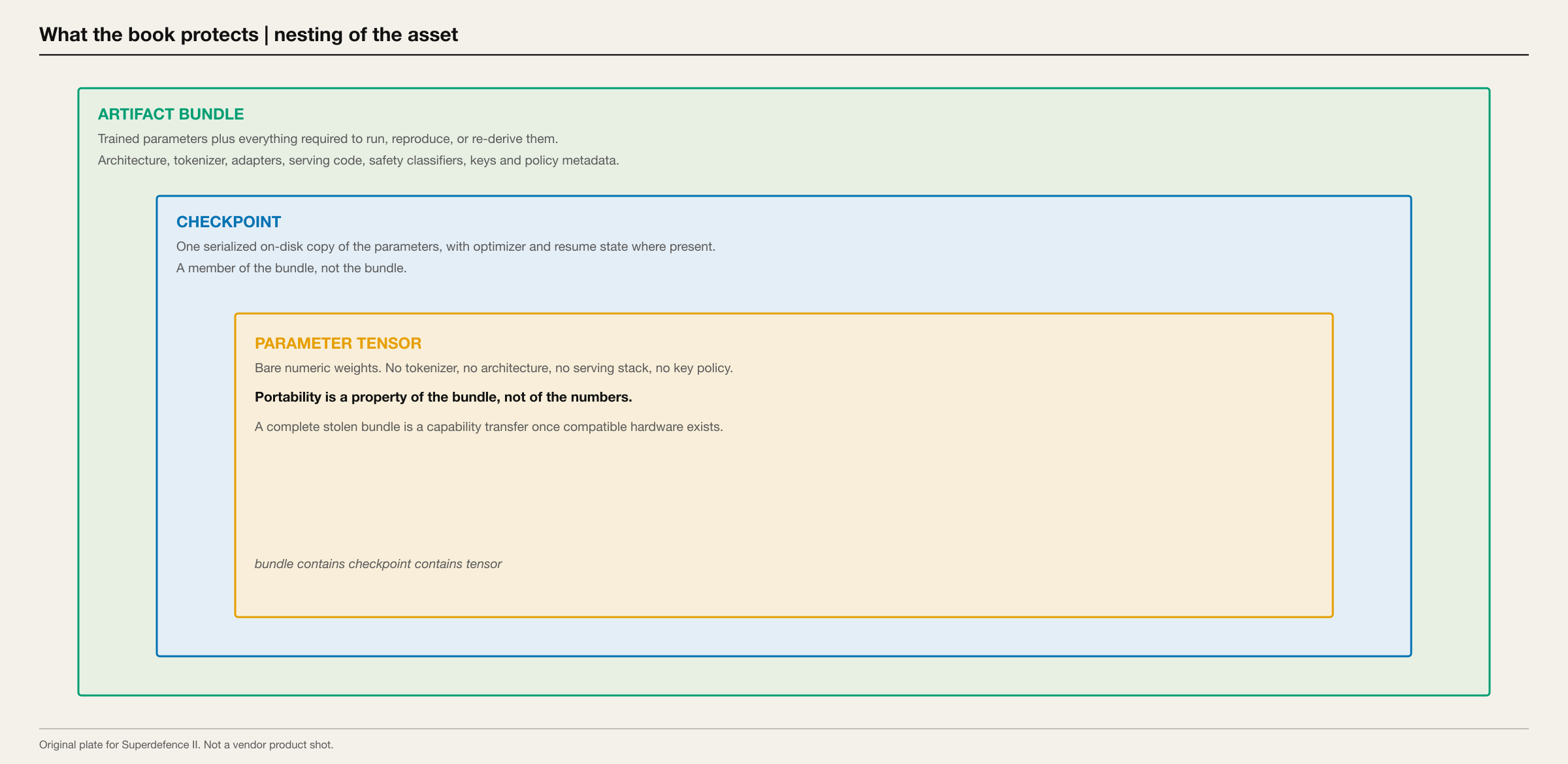
Claim. The protected object is the artifact bundle, not a bare parameter tensor.
Nesting. Bundle contains checkpoint contains tensor.
Caveat. Portability still requires a compatible serving stack; DeepSeek V3’s own minimum deployment unit is cited in the paragraph above.
Exclusion. This plate does not price a theft and does not assert that a tensor alone is useless in every case — only that it is the least complete of the three objects.
When complete, the artifact bundle is arguably the cheapest strategic capability transfer in espionage history. Neither side of that ratio has an open market price: no study prices bundle exfiltration, and no frontier lab discloses flagship program costs. Chapter 3 uses RAND’s attacker-budget ceilings to bound the asymmetry.PreviousThis paragraph was added in this version.NowWhen complete, the artifact bundle is arguably the cheapest strategic capability transfer in espionage history. Neither side of that ratio has an open market price: no study prices bundle exfiltration, and no frontier lab discloses …
The second International AI Safety Report (February 2026), chaired by Yoshua Bengio under UK DSIT research series DSIT 2026/001 with over 100 contributing experts and an advisory panel nominated by more than 30 nations plus the OECD, EU, and UN, reaches a similar conclusion [19]. Dedicating a section to model weight security, it describes closed weights as “attractive targets for actors ranging from amateur hackers to nation-states” and warns that “Current security levels vary across the industry, and may be insufficient against sophisticated attackers,” while noting that as of December 2025 there were “no confirmed, publicly documented instances of model weight theft” [19].
Weight security is a capex cycle, not a compliance checkbox
Weight security is a defense-integration capital cycle rather than a compliance exercise [20]. Industry posture still centers on policies, attestations, and audit paperwork. In reality, protecting the bundle requires purchasing, installing, and integrating physical and silicon hardware across four defense layers: digital, supply-chain, capability, and human and organizational. Root-of-trust silicon is covered in Chapter 5, confidential compute in Chapter 6, and shielded envelopes and cleared operations are both Chapter 8 (TEMPEST/EMI shielding and ICD-705 accredited spaces). Chapters 11 and 12 map who supplies and invoices each layer.
The organizing frame: physical | digital | human and organizational
The attack surface resolves into three registers—chosen analytical surfaces through which an attack arrives, rather than mutually exclusive event types, since bundle bytes can be stolen through any of the three:PreviousThis paragraph was added in this version.NowThe attack surface resolves into three registers—chosen analytical surfaces through which an attack arrives, rather than mutually exclusive event types, since bundle bytes can be stolen through any of the three:
- Physical: attacks on silicon and parameter-holding memory, including Rowhammer-class bitflips, side channels, fault injection, and cold-boot imaging.
- Digital: attacks on software and served models, including network exfiltration, partial parameter recovery, API distillation, prompt injection, agentic hijack, and data poisoning.
- Human and organizational: machine-scale attacks on people and workflows, including spear phishing, deepfake impersonation, insider coercion, and large-scale persuasion.
A register is an attack arrival surface, whereas a defense layer is a budgeted defensive stack. Chapter 2 plots attacks on the registers; Chapter 3 plots adversaries on the four defense layers to identify which layer each actor stresses.PreviousThis paragraph was added in this version.NowA register is an attack arrival surface, whereas a defense layer is a budgeted defensive stack. Chapter 2 plots attacks on the registers; Chapter 3 plots adversaries on the four defense layers to identify which layer each actor stresses.
The book’s organizing spine. The attack surface reads in three registers — physical, digital, human and organizational — which are surfaces an attack arrives through, not categories of attack.
The defense is a bill of materials across four procurement layers (digital, supply-chain, capability, human and organizational): root-of-trust silicon, shielded envelopes, confidential compute, cleared operations.
These are coordinates, not a one-to-one map; later chapters plot their attacks and defenses against them rather than redrawing them.
Chapter 11 names the firms that invoice the four line items, and it is the chapter that keeps the public cybersecurity product market from being mistaken for that invoice.
The forcing-function test
An earlier causal-chain decomposition of this thesis identified binding procurement-scale mandates as the weakest link between technical threat and funded defense [21]. While threats are documented and key defenses already ship, whether binding rules force full-stack adoption remains unresolved. Chapter 10 evaluates that forcing function across Chapters 10 through 12.
The urgency of that procurement claim is falsifiable. If UK AISI’s 80%-reliability cyber-task doubling slows below 4.7 months, or if open-weight releases match the closed frontier within two months on the same controlled AISI benchmark, the urgency case weakens materially.PreviousThis paragraph was added in this version.NowThe urgency of that procurement claim is falsifiable. If UK AISI's 80%-reliability cyber-task doubling slows below 4.7 months, or if open-weight releases match the closed frontier within two months on the same controlled AISI benchmark, …
Scope, method, and glossary
Audience and scope
These chapters are written for security engineers, infrastructure and procurement leads, policy staff, and technical readers evaluating what labs, cloud providers, and deployers must buy to protect frontier weights. Basic security concepts are assumed; confidential computing, hardware roots of trust, and AI-specific concepts are defined at first use. Alignment of legitimately held models and speculative superintelligence scenarios remain out of scope.PreviousThis paragraph was added in this version.NowThese chapters are written for security engineers, infrastructure and procurement leads, policy staff, and technical readers evaluating what labs, cloud providers, and deployers must buy to protect frontier weights. Basic security …
The central question is which defensive line items ship today, which are marketed but unverified, and which remain conceptual—and whether commercial and political forcing functions exist to fund the shipping layers at scale. Four results follow: a commercial vendor map distinguishing real weight-security suppliers from broad enterprise cybersecurity (Chapter 11), an evidence-scored defense-maturity taxonomy (Chapter 12), an attack-register versus defense-layer coverage map (Chapter 12), and a falsifiable analysis of the policy forcing function (Chapter 10).PreviousThis paragraph was added in this version.NowThe central question is which defensive line items ship today, which are marketed but unverified, and which remain conceptual—and whether commercial and political forcing functions exist to fund the shipping layers at scale. Four results …
Sourcing and evidence standards
Claims rest on primary records wherever available: datasheets, technical reports, standards, court and SEC filings, peer-reviewed papers, preprints, and on-the-record statements. Every source is retrieved directly rather than cited secondhand, with retrieval status logged in the references and full inclusion, contradiction, and rejection rules published on the Method and Limits page.PreviousThis paragraph was added in this version.NowClaims rest on primary records wherever available: datasheets, technical reports, standards, court and SEC filings, peer-reviewed papers, preprints, and on-the-record statements. Every source is retrieved directly rather than cited …
Source types travel with every claim (peer-reviewed, preprint, government filing, independent reporting, trade press, vendor self-report, or marketing) because vendor claims are not independent audits. Epistemic distinctions appear in plain prose—separating observed events and demonstrated test outcomes from reported vendor claims, inferred synthesis, testable hypotheses or forecasts, and author recommendations (Chapters 11–12). Preprints dominate the attack-surface chapters, vendor disclosures dominate product claims, and adjacent fields such as general model watermarking are scoped where cited.PreviousThis paragraph was added in this version.NowSource types travel with every claim (peer-reviewed, preprint, government filing, independent reporting, trade press, vendor self-report, or marketing) because vendor claims are not independent audits. Epistemic distinctions appear in …
Protected-asset glossary
- Artifact bundle: trained parameters plus all assets required to run, reproduce, or re-derive them (checkpoints, optimizer state, adapters, architecture config, tokenizer, quantization assets, serving code, safety classifiers, backups, shards, and key metadata).
- Checkpoint: one serialized on-disk copy of parameters, plus optimizer or resume state where present.
- Parameter tensor: bare numeric weights without supporting code or configuration (
artifact bundle ⊃ checkpoint ⊃ parameter tensor). - Shard: a partition of a checkpoint or bundle distributed across nodes or storage for parallelism or size.
- Weights: informal shorthand for the parameter tensor or artifact bundle; precise claims specify bundle, checkpoint, or tensor.
- Frontier model: a model near the current capability ceiling for its training-compute class, treated as warranting nation-state-grade protection without fixing a single universal threshold.
Event glossary
- Exfiltration: unauthorized copying of part or all of an artifact bundle outside its approved storage or execution boundary.
- Partial parameter recovery: reconstructing specific weights or architectural parameters via side channels, memory faults, or API queries.
- Distillation: training a new model on a served model’s outputs or reasoning traces, recovering behavior rather than parameter tensors.
- Unauthorized use: operating a held bundle outside owner authorization, including misuse by privileged insiders.
- Poisoning: corrupting training data, fine-tuning data, or checkpoints to implant unintended behavior, compromising bundle integrity rather than confidentiality.
References
[1] UK AI Security Institute, “How fast is autonomous AI cyber capability advancing?” May 13, 2026. https://www.aisi.gov.uk/blog/how-fast-is-autonomous-ai-cyber-capability-advancing , accessed Aug. 14, 2026 (live fetch)
[2] A. Karp, interview, CNBC Squawk Box, Jul. 1, 2026. https://www.youtube.com/watch?v=0A3sGymV6kY , URL resolved Aug. 14, 2026 (HTTP 200; cited content not confirmed)
[3] S. Subin, “Palantir CEO Karp says AI is dangerous and ‘either we win or China will win’,” CNBC, Jun. 5, 2025. https://www.cnbc.com/2025/06/05/palantir-karp-ai-dangerous-china.html — accessed Aug. 12, 2026 (live fetch); Karp speaking on CNBC’s Squawk on the Street, quoted as “My general bias on AI is it is dangerous … There are positive and negative consequences, and either we win or China will win.”
[4] C. Demarest, “U.S. must ‘absorb a lot of risk’ in AI race, says Palantir’s Karp,” Axios, Nov. 12, 2025. https://www.axios.com/2025/11/12/karp-palantir-ai-china-competition — accessed Aug. 12, 2026 (live fetch); Karp interviewed by Mike Allen on The Axios Show. Axios characterises him in its own voice as having “long espoused West-must-win views.”
[5] Author’s prior research compilation on model-weight protection (unpublished, Jun. 2026). Author’s own working notes; cited in this chapter only as the origin of the defender’s-advantage-erosion framing (author framing), never for checkable facts; the phishing-tells claim it formerly carried now rests on the NCSC assessment [8].
[6] T. B. Brown et al., “Language Models are Few-Shot Learners,” arXiv:2005.14165, May 2020. https://arxiv.org/abs/2005.14165 , accessed Aug. 14, 2026 (live fetch)
[7] Google, “Our next-generation model: Gemini 1.5,” Feb. 15, 2024. https://blog.google/technology/ai/google-gemini-next-generation-model-february-2024/ , accessed Aug. 14, 2026 (live fetch)
[8] UK National Cyber Security Centre, “The near-term impact of AI on the cyber threat,” NCSC Assessment, Jan. 24, 2024. https://www.ncsc.gov.uk/report/impact-of-ai-on-cyber-threat — accessed Aug. 11, 2026 (live fetch); cited for its assessment that AI “will almost certainly increase the volume and heighten the impact of cyber attacks” and that generative AI “can already” produce lures “without the translation, spelling and grammatical mistakes that often reveal phishing” — a probabilistic assessment, not a measured incidence series.
[9] UK AI Security Institute, “Measuring AI Agents’ Progress on Multi-Step Cyber Attack Scenarios,” arXiv:2603.11214, submitted Mar. 11, 2026 (v3, Mar. 17, 2026). https://arxiv.org/abs/2603.11214 , accessed Sep. 8, 2026 (live fetch). Table 1 supplies the plotted means; Sections 3.2 and 3.3 define scoring and protocol. Preprint, not peer-reviewed; AISI’s own blog [1] describes it as “our recent paper.”
[10] OpenAI, “GPT-6 Astra System Card,” cybersecurity-capabilities section, Sep. 2026. https://deploymentsafety.openai.com/gpt-6-astra/cybersecurity-capabilities , accessed Sep. 8, 2026 (live fetch). Also checked: https://deploymentsafety.openai.com/gpt-6-astra/gpt-6-astra.pdf , accessed Sep. 9, 2026 (host capture; title confirmed). Complete 117-page PDF retained; applicable text, metadata, and cyber/AISI figures inspected. Vendor self-report; reviewed for a matching AISI range measurement, not used to assign a bar.
[11] Anthropic, “System Card: Claude Fable 5.1 & Claude Mythos 5.1,” Sep. 1, 2026. https://www-cdn.anthropic.com/0339e6a7c5c7b87f5c07798616dc32c215d14235/Claude%20Fable%205.1%20&%20Claude%20Mythos%205.1%20System%20Card.pdf , accessed Sep. 8, 2026 (live fetch). Vendor self-report; these are differently safeguarded configurations, not interchangeable evaluation labels.
[12] Z.ai, “GLM-5.3: Frontier Coding with Emergent Cyber Capabilities,” Aug. 14, 2026. https://z.ai/blog/glm-5.3 . Authored article module: https://z.ai/blog/assets/glm-5.3-B8Uy_aqG.js , accessed Sep. 9, 2026 (host capture; title confirmed). Complete module and all three referenced figures inspected; shared runtime, CSS, and live rendered page uninspected. Vendor self-report; reviewed for a matching range measurement, not used to assign a bar.
[13] UK AI Security Institute, “How Far Behind the Frontier are Leading Open Weight Models on Cyber?” Jul. 17, 2026. https://www.aisi.gov.uk/blog/how-far-behind-the-frontier-are-leading-open-weight-models-on-cyber , accessed Aug. 14, 2026 (live fetch)
[14] J. W. Lin et al. (Stanford University, Carnegie Mellon University, Gray Swan AI), “Comparing AI Agents to Cybersecurity Professionals in Real-World Penetration Testing,” arXiv:2512.09882v1, Dec. 10, 2025. https://arxiv.org/abs/2512.09882 , accessed Aug. 14, 2026 (live fetch) — preprint, not peer-reviewed; supported by a Stanford HAI seed grant and, per the paper’s own acknowledgements, “an unrestricted gift from OpenAI.”
[15] A. Lohn, “Anticipating AI’s Impact on the Cyber Offense-Defense Balance,” Center for Security and Emerging Technology (CSET), Georgetown University, May 2025, accessed Aug. 18, 2026 (live fetch). https://cset.georgetown.edu/publication/anticipating-ais-impact-on-the-cyber-offense-defense-balance/ — cited for the executive summary’s conditional framing of defensive AI uplift, quoted in text, and for its own hedge in the same paragraph that the resulting defensive advantage “is far from guaranteed and there are several missteps that could push the balance toward offense instead of defense in the years to come.”
[16] Y. Potter, W. Guo, Z. Wang, T. Shi, H. Li, A. Zhang, P. G. Kelley, K. Thomas, and D. Song, “Frontier AI’s Impact on the Cybersecurity Landscape,” arXiv:2504.05408, Apr. 7, 2025, accessed Aug. 18, 2026 (live fetch). https://arxiv.org/abs/2504.05408 — preprint, not peer-reviewed; project hosted at UC Berkeley’s Center for Responsible, Decentralized Intelligence (RDI) per the paper’s own summary link. Combines quantitative benchmarks, a literature review, an empirical evaluation of agent systems on cybersecurity benchmarks, and a survey of AI and security researchers and practitioners; source of all three quoted findings in text.
[17] F. Heiding, S. Lermen, A. Kao, B. Schneier, and A. Vishwanath, “Evaluating Large Language Models’ Capability to Launch Fully Automated Spear Phishing Campaigns: Validated on Human Subjects,” arXiv:2412.00586, Nov. 30, 2024, accessed Aug. 18, 2026 (live fetch). https://arxiv.org/abs/2412.00586 — preprint, not peer-reviewed; source of the 101-participant click-through results (control group 12%, human-expert-crafted 54%, fully AI-automated 54%, AI with human-in-the-loop 56%) and of the same paper’s finding that Claude 3.5 Sonnet, used to classify the test emails rather than generate them, “scored well above 90%” on detection accuracy with a low false-positive rate and caught several emails that had fooled human recipients. Also the primary source for the phishing-effectiveness figures in Chapter 2’s discussion of the fatigue hypothesis.
[18] DeepSeek-AI, “DeepSeek-V3 Technical Report,” arXiv:2412.19437v2, Dec. 27, 2024 — see Section 3.4, “Inference and Deployment,” for the prefilling and decoding minimum deployment units. https://arxiv.org/abs/2412.19437 , accessed Aug. 14, 2026 (live fetch)
[19] Y. Bengio et al., “International AI Safety Report 2026,” arXiv:2602.21012, Feb. 24, 2026 — see Box 3.1, “Model weight security,” within §3.4 “Open-weight models.” Chair: Prof. Yoshua Bengio. Mandated by the nations attending the 2023 AI Safety Summit at Bletchley Park; Expert Advisory Panel nominated by over 30 countries and international organisations including the OECD, EU and UN; published under Crown copyright, research series number DSIT 2026/001. Expert synthesis of existing research, not a regulatory instrument; makes no policy recommendations. https://arxiv.org/abs/2602.21012 , accessed Aug. 14, 2026 (live fetch)
[20] R. Gudi, “The Superdefense Trade,” self-published, Jun. 9, 2026.
[21] R. Gudi, “Superdefense Protocol” causal analysis, author’s prior work, Jun. 2026 (unpublished). Cited in this chapter only for the recorded output of the author’s own prior analysis — the roughly 2.2% conviction figure and where it places the weakest link — never for checkable facts about the world.