Chapter 6 — Confidential Computing & Secure Enclaves
Part III of IV — Control architecture. This chapter assesses the major confidential-computing offerings against a single test: who actually holds the workload key.PreviousThis paragraph was added in this version.NowPart III of IV — Control architecture. This chapter assesses the major confidential-computing offerings against a single test: who actually holds the workload key.
Root-of-trust silicon proves which chip booted which code, but it cannot stop a privileged operator from reading plaintext weights during execution. Confidential computing aims to close that gap with hardware-isolated enclaves where weights decrypt only inside the CPU or GPU, hidden from the hypervisor, host OS, and cloud administrator. Intel TDX, AMD SEV-SNP, NVIDIA Confidential Computing, and Arm CCA all offer variants of this model. On three of the four major offerings the customer can hold the workload key, and NVIDIA runs no key service at all. The provider’s leverage sits elsewhere: appraising the evidence that gates key release.PreviousThis paragraph was added in this version.NowRoot-of-trust silicon proves which chip booted which code, but it cannot stop a privileged operator from reading plaintext weights during execution. Confidential computing aims to close that gap with hardware-isolated enclaves where …
What. Key custody and attestation verification are separate roles.
Who / where. This chapter’s reading of Azure, Google Cloud, AWS Nitro, and NVIDIA GPU-CC documentation in the table below.
Why. The claim “the provider holds your keys” misses the provider’s control over the attestation verdict.
Caveat. Google lets the customer replace the verifier.
Azure lets a relying party attest the verifier.
NVIDIA operates no key-release service.
None of those substitutions is a TEE that resists an active cloud-provider adversary.
Conflict C1 stays open.
The provider owns the verdict, not the keys
Confidential computing models the cloud provider as an untrusted adversary. The structural weakness is rarely that the provider holds the customer’s keys, because three offerings allow customer-held keys and the fourth has no key service. Instead, the provider controls the default attestation verdict.PreviousThis paragraph was added in this version.NowConfidential computing models the cloud provider as an untrusted adversary. The structural weakness is rarely that the provider holds the customer's keys, because three offerings allow customer-held keys and the fourth has no key service. …
Attestation-gated key release has five separable roles:PreviousThis paragraph was added in this version.NowAttestation-gated key release has five separable roles:
- Endorsement authority: who vouches that this is genuine hardware.
- Evidence generator: what measures the running state and signs a quote over it.
- Evidence verifier: who checks that quote against reference values and mints a claim set.
- Policy decision point: who authors the rule saying which claim sets are acceptable.
- Workload-key custodian: who actually holds the key that decrypts the weights.
Roles 4 and 5 belong to the customer on every major offering; roles 1, 2, and 3 generally do not. Role 3 is decisive because the verifier’s output feeds directly into the customer’s release policy. If a provider issues a passing claim set for an environment it controls, the customer’s own key manager wraps the model key to an attacker-chosen public key, exposing plaintext without stealing the key from custody.PreviousThis paragraph was added in this version.NowRoles 4 and 5 belong to the customer on every major offering; roles 1, 2, and 3 generally do not. Role 3 is decisive because the verifier's output feeds directly into the customer's release policy. If a provider issues a passing claim set …
Attestation-gated unwrap binds key release to hardware measurements rather than unwrapping into host RAM. Azure Secure Key Release wraps keys to the TEE’s public key only after matching Microsoft Azure Attestation (MAA) claims against a customer JSON policy [1]. AWS KMS with RecipientAttestation encrypts plaintext to the enclave’s public key and returns a null Plaintext field to the parent, conditioned on PCRs and ImageSha384 [2][3]. Google Cloud Confidential Space grants cloudkms.cryptoKeyDecrypter only when a customer’s Workload Identity Pool CEL condition passes [4], and Fortanix CCM+DSM checks composite CPU and GPU attestation before releasing keys [5]. Every mechanism couples unwrap to attestation, yet none resists an active cloud-provider adversary (conflict C1).
Azure confidential VMs (AMD SEV-SNP, Intel TDX). Microsoft does not store MAA signing keys in a Microsoft-managed HSM; every Microsoft specification describes a self-signed certificate generated inside MAA’s own confidential container and published via OpenID metadata: “The signing operation is performed using a self-signed certificate with subject name matching the AttestUri element of the attestation provider” [6]. Secure Key Release exports an HSM-backed key wrapped to “a public RSA key owned and protected by the target execution environment” [1], keeping the key off the host in clear.
Under Managed HSM, the security domain is customer-generated and quorum-split, with Microsoft stating it “can’t access your keys without the security domain. This is architecturally enforced by the HSM hardware” [7]. By contrast, Key Vault Premium is a multi-tenant Microsoft-operated HSM, limiting true customer-held key custody to Managed HSM.
Even on Managed HSM, Azure Key Vault “only understands and integrates with MAA today” [8]. Customers select which MAA endpoint to trust, relying on Microsoft’s opaque Trusted Hardware Identity Management baseline. MAA’s signing certificate embeds its own SEV-SNP report so relying parties can attest the verifier [9], but obtaining the expected measurement requires filing a support request. Meanwhile, Azure’s external key management states that “Sign, verify, encrypt, decrypt, Secure Key Release (SKR), and Confidential VM launch scenarios are out of scope” [10]. Buyers can keep keys off Microsoft hardware or use attestation-gated TEE release, not both.
Google Cloud (Confidential VM, Confidential Space). Release decisions belong to the customer through Workload Identity Pool CEL conditions and cloudkms.cryptoKeyDecrypter IAM bindings [4]. Customers can swap the verifier in three ways: selecting Intel Trust Authority by issuer URI, running a custom verifier on raw SEV-SNP or TDX quotes (Google presents its service as an alternative to “writing and running an attestation verifier yourself”), or validating PKI tokens offline [11][12]. Keys can also remain off Google servers through Cloud EKM, where “the key resides on the external system, and is never sent to Google” [13].
The remaining trust dependencies are specific. Google Cloud Attestation “upholds its own set of reference values and appraisal policies” [11] without publishing them or letting customers attest the verifier. On plain AMD SEV (distinct from SEV-SNP and TDX), a Google-managed vTPM signs the quote [12], placing Google rather than silicon at the evidence root. Google also classifies its verifier as “complex, crypto-heavy logic that is challenging to write defensively” and excludes “Attacks on Google Cloud, such as VM escapes” and supply-chain attacks on Google-built UEFI firmware and Confidential Space images from its threat model [14]. DeepMind’s August 27, 2026 double-blind evaluation pilot uses Confidential Space on Gemini Flash Lite so “The evaluator cannot see the Gemini model weights, and Google cannot see the evaluator’s test prompts” [15], scoping it as evaluation-contamination control rather than training-cluster weight binding.
AWS Nitro Enclaves. The root of trust is the Nitro Hypervisor, which measures the enclave and signs attestation documents under AWS Nitro Attestation PKI [2]. When an enclave calls kms:Decrypt with Recipient, KMS “encrypts the plaintext data with the public key in the attestation document” and leaves the Plaintext field null or empty [3], so the untrusted parent EC2 instance only relays ciphertext.
However, AWS remains the sole endorsement authority (“You cannot supply your own certificate to digitally sign the attestation document” [16]), and the Nitro Hypervisor both enforces isolation and signs the isolation quote. The six PCRs (PCR0–PCR4, PCR8) measure the enclave image, signing certificate, and parent instance identity [17], omitting the underlying platform while AWS updates hypervisor firmware under running instances [18]. Customers can swap AWS KMS for third-party key management or an external key store, yet cannot replace the endorsement root.
Nitro Enclaves also rely on hypervisor-enforced VM partitioning on AWS silicon rather than DRAM encryption. AWS describes this as “proven CPU-based technology for execution isolation, combined with the unique design of the Nitro System” [19]; L1 and L2 caches are isolated, though “some instance sizes can share some last level cache lines non-simultaneously” [18].
NVIDIA GPU confidential computing (Hopper, Blackwell, Rubin). NVIDIA ships no key-release service at all. The GPU stores only ephemeral session keys in “keyslots which cannot be accessed by the Hypervisor” [20]. Once a confidential VM is verified, “secrets such as model decryption keys can be deployed into the CVM” [21], where the customer’s process validates the attestation token against claims such as secboot, dbgstat, and measres [22][23].
NVIDIA’s control sits upstream in endorsement and reference values. Its device signing key “is fused at the time of manufacturing and never exposed to software, firmware, or the host system” under NVIDIA’s CA [20][21]. NVIDIA generates and hosts Reference Integrity Manifests in “a centralized repository maintained by NVIDIA” where “All RIM bundles are cryptographically signed by NVIDIA” [24], and runs the default NRAS verifier issuing tokens with a “24 hours of ttl” [20][25]. Even the local verifier relies on NVIDIA’s cloud RIM and OCSP services [26], while air-gapped Trust Outpost requires licensing agreements [27].
Hardware capability is strictly topology-scoped. NVIDIA’s v7.1 deployment guide supports only single-GPU CC and Protected PCIe multi-GPU on Hopper (where “NVLink interconnects and NVSwitches are outside the trust boundary and thus should not allow access to plain-text data”) [28][29]. Blackwell adds node-scale multi-GPU CC: “HGX B200 and HGX B300 GPUs support confidential computing across multiple GPUs (up to 8) with NVIDIA NVLink encryption” [21], marketed as “the first TEE-I/O capable GPU in the industry” [30].
Confidential Containers RA 1.1.0 (August 11, 2026) adds HGX B300 passthrough [31], though NVIDIA’s v7.1 guide lists only RTX PRO 6000 single-GPU and B200 single/multi-GPU configs and names no NVL72 rack [28]. NVIDIA’s marketing assigns rack-scale CC (“a unified security domain spanning 72 NVIDIA Rubin GPUs, 36 NVIDIA Vera CPUs, and interconnects”) to Vera Rubin NVL72 [32], with May 2026 Rubin production announcements gating shipments on a when-and-if-available basis [33] and Confidential Containers operator docs as of August 22, 2026 listing no Rubin or NVL72 row [31][34].
On October 21, 2026, NVIDIA announced Confidential Bare Metal, expanding NVIDIA CC across Grace Blackwell NVL72 rack-scale systems and x86-based HGX Rubin NVL8 and DGX Rubin NVL8 systems alongside NVIDIA DSX OS integration, with Cohere planning integration into Cohere Model Vault and Google Cloud extending support to A4X Max GB300 NVL72 instances [35]. As a vendor-authored announcement, it describes attestation, hardware access restrictions, and in-transit encryption; it makes no claim of HBM-at-rest encryption and makes no statement regarding resistance to DDR5 memory-bus interposer attacks (TEE.fail or DDRop) [35].
Verifier versioning has also become an operational dependency. NVIDIA Attestation SDK 2.0.0 (nvattest 2.0.0, October 7, 2026) and the October 6 opaque-data specification establish that GPU drivers from CUDA 13.5 onward emit a non-backwards-compatible opaque evidence format that causes older verifiers and NRAS endpoints to fail without upgrading to SDK 2.0.0 or NRAS v4 [36][37]. SDK 2.0.0 adds experimental CoRIM appraisal, C/Rust/CLI relying-party verification for detached EATs, and NVML evidence collection for Rubin GPUs in CC mode [36]. However, GB300 NVL72 2.0.0 release notes explicitly mark Trusted NVLink partition unsupported, leaving rack-wide confidential GPU execution and multi-node key release unestablished.
Finally, On-package HBM is not encrypted. NVIDIA states that HBM “is considered secure against common physical attack tools, such as interposers, and is not encrypted” and places “Sophisticated Physical attacks” out of scope [20]. That packaging assumption offers no cryptographic guarantee if an adversary gains physical access to the hardware.
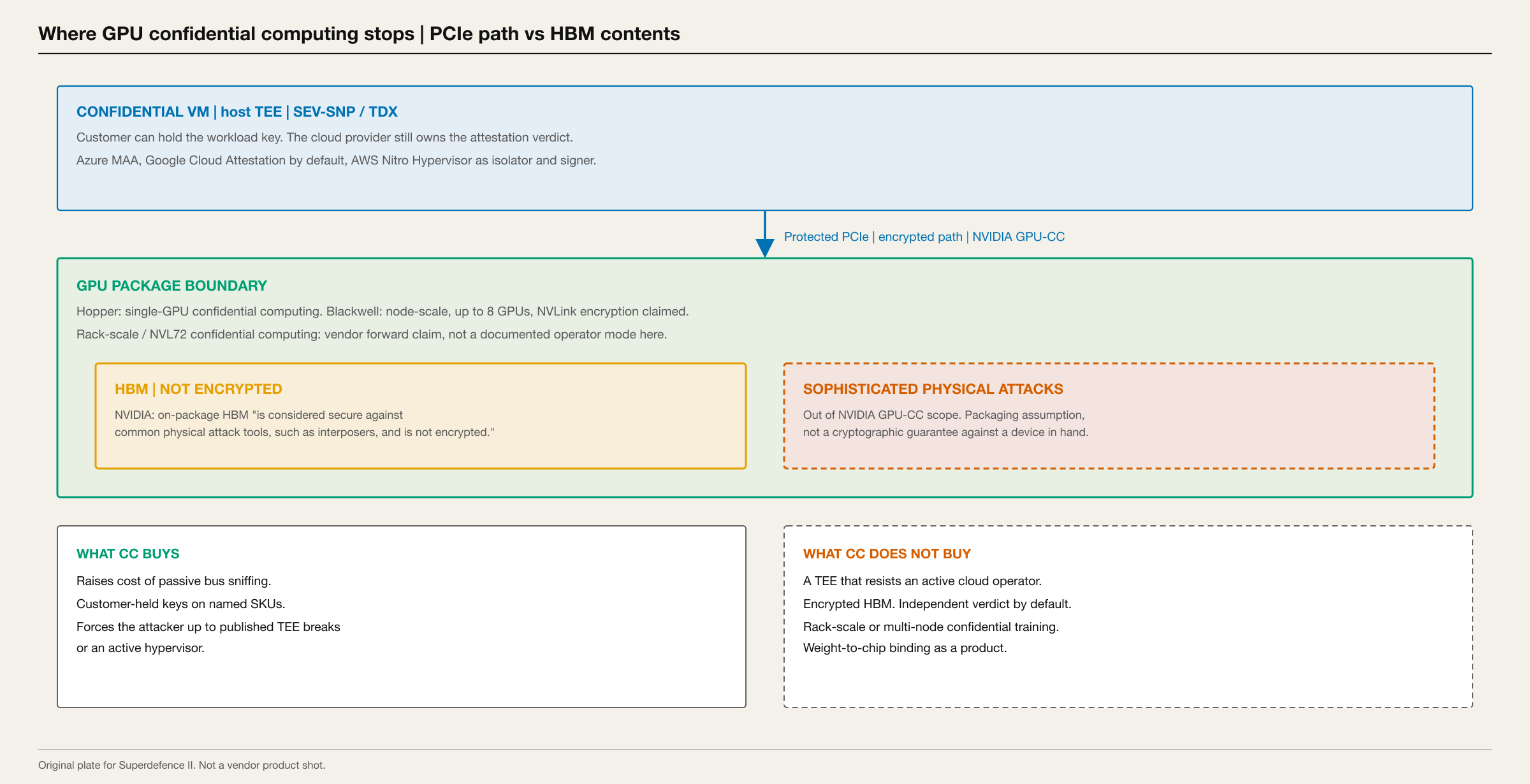
Claim. NVIDIA GPU confidential computing encrypts the PCIe path; on-package HBM is not encrypted [20].
Scope. NVIDIA documents CC on “HGX B200 and HGX B300 GPUs” as supporting “confidential computing across multiple GPUs (up to 8) with NVIDIA NVLink encryption” [21]. Hopper is single-GPU; Blackwell extends to node-scale (one host, up to eight GPUs, one CVM). The vendor-engineering claim is NVIDIA’s.
Out of scope. Sophisticated physical attacks, and rack-scale / NVL72 confidential computing as a documented operator mode.
Caveat. The customer can hold the workload key.
The cloud provider still owns the default attestation verdict.
This plate does not close conflict C1.
| Offering | Endorses the hardware | Signs the evidence | Runs the verifier | Authors the release policy | Holds the workload key |
|---|---|---|---|---|---|
| Azure (AMD SEV-SNP / Intel TDX CVM) | AMD or Intel silicon | Guest, via a per-VM vTPM ephemeral RSA key | Microsoft (MAA): no substitution; MAA is itself TEE-hosted and remotely attestable | Customer: JSON release policy matched on MAA claims | Customer, on one SKU: Managed HSM with a customer-held security domain; Key Vault Premium is Microsoft-operated multi-tenant HSM |
| Google Cloud (Confidential VM / Space) | AMD or Intel silicon, except plain AMD SEV, where a Google-managed vTPM signs | The Confidential VM instance (vTPM or hardware TSM) | Google by default; swappable for Intel Trust Authority, a customer-run verifier, or offline PKI validation | Customer: Workload Identity Pool attribute condition plus IAM binding | Customer: Cloud KMS on Google-operated HSMs, or Cloud EKM with material never sent to Google |
| AWS (Nitro Enclaves) | AWS Nitro Attestation PKI (no customer-supplied signer) | The Nitro Hypervisor (which also enforces the isolation) | AWS KMS by default; third-party key management explicitly supported | Customer: KMS key-policy conditions on PCRs and ImageSha384 | The enclave: KMS returns CiphertextForRecipient and a null Plaintext |
| NVIDIA (GPU-CC: Hopper, Blackwell) | NVIDIA, fused at manufacture; no third-party path exists | The GPU, with a per-reset attestation key; NVSwitches attest separately | NVIDIA NRAS by default; local verifier still depends on NVIDIA RIM and OCSP; Trust Outpost is licensed | Customer: local policy file evaluated in the customer’s process | Customer’s CVM: NVIDIA operates no key-release service |
The five roles of attestation-gated key release, resolved per offering against vendor documentation.
The last column is the one popular criticism gets wrong: in every case the customer can hold the workload key, and on NVIDIA there is no vendor key service to hold it.
The load-bearing column is the third.
The verifier converts hardware evidence into the claim set the customer’s policy matches, so whoever runs the verifier can cause a correctly-written policy to release a correctly-held key.
Azure is the only offering that lets a relying party attest the verifier itself; Google is the only one that lets the customer replace it.
One production system sits deliberately outside this table: Apple’s Private Cloud Compute fills the verifier role with the user’s own device, which wraps its request key only to nodes whose attested measurements appear in a public transparency log [38] — no rentable offering here works that way, and the serving section at the end of this chapter takes it up.
Published TEE breaks target different layers and require distinct attacker privileges. Recent AMD results (BreakFAST, Heracles, CounterSEVeillance, ASPBreaker, STALEUS, and FABRICKED) all assume a local, administratively privileged attacker (AV:L/PR:H): the untrusted hypervisor that confidential computing is designed to defend against. None is a remote exploit, separating them from unauthenticated network RCEs.PreviousThis paragraph was added in this version.NowPublished TEE breaks target different layers and require distinct attacker privileges. Recent AMD results (BreakFAST, Heracles, CounterSEVeillance, ASPBreaker, STALEUS, and FABRICKED) all assume a local, administratively privileged …
| Result | Affected configuration | Attacker position | Demonstrated impact | Status |
|---|---|---|---|---|
| RMPocalypse (CVE-2025-0033) [39] | AMD SEV-SNP, from the 2021 launch to disclosure | Malicious hypervisor, at SNP initialization | Single 8-byte corruption of the Reverse Map Table; secret exfiltration at 100% success in the authors’ setup | Patched by AMD (AMD-SB-3020) after the October 2025 disclosure |
HECKLER — int 0x80 (CVE-2024-25744) [40] | AMD SEV-SNP and Intel TDX guests | Malicious hypervisor injecting interrupts | Bypasses OpenSSH and sudo authentication inside the guest despite memory encryption | Patched on both SEV-SNP and TDX |
| HECKLER — signal injection (CVE-2024-25743) [40] | AMD SEV-SNP guests | Malicious hypervisor injecting interrupts | Same class of guest-control hijack | Unmitigated on AMD |
| CipherLeaks [41] | AMD SEV, deterministic XEX encryption of the saved register state (VMSA) | Observer of guest ciphertext, no timing needed | Recovers RSA and ECDSA keys from constant-time OpenSSL | Not stated by the cited source |
| BreakFAST (CVE-2025-61971, CVE-2025-61972) [42] | AMD SEV-SNP; end-to-end case studies on Zen 4 and Zen 5 | Local admin-privileged attacker — AV:L/PR:H in AMD’s own CVSS 4.0 vectors — i.e. the untrusted hypervisor of the SEV-SNP threat model | Malicious Platform Security Processor writes disable the IOMMU’s SEV-SNP enforcement, then forge a CVM attestation measurement and enable debug mode on a production CVM; 100% success in 1–25 ms | Mitigations shipped in AMD Platform Initialization packages, delivered onward as OEM BIOS updates (AMD-SB-3030). NVD still lists both CVEs “Awaiting Analysis”, so the 5.9 and 8.5 base scores are AMD’s own |
| ASPBreaker [43] | AMD SEV-SNP, AMD Secure Processor | Local privileged attacker with a vulnerable firmware version, then a later “fully-patched” one | Deterministic ASP jailbreak via memory aliasing and TOCTOU; decrypts CVM memory and forges attestation on later firmware. Authors call this “a fundamental break in the forward-security model of SEV-SNP” | No CVE named on the USENIX presentation page. Instance firmware patches do not close the class if a prior-firmware jailbreak subverts the next one |
| STALEUS (CVE-2025-54509) [44] | AMD SEV-SNP on EPYC 9004/9005/8004 | Malicious hypervisor (PR:H) rendering the PSP cache-incoherent with x86 caches | Arbitrary read/write in a fully attested CVM; authors enable debug, inject code, and bias the guest RNG | AMD assigned CVE-2025-54509. NVD CVSS 4.0 4.0 MEDIUM. PI packages listed as unaffected on the NVD record |
| FABRICKED (CVE-2025-54510) [45] | AMD SEV-SNP, Infinity Fabric routing | Local admin-privileged attacker (PR:H) redirecting interconnect transactions | Arbitrary R/W in the victim address space; attestation forgery and undetected debug-mode CVM execution | Distinct paper from BreakFAST. NVD CVSS 4.0 5.9 MEDIUM. PI unaffected versions overlap BreakFAST’s |
| Behind Bars [46] | NVIDIA MIG cache partitioning; documented as a GPU-CC isolation primitive | Co-tenant MIG instance, not a hypervisor | Cross-instance L2 interference: membars in one instance change load timing in another; fingerprints LLM kernel-launch patterns | Peer-reviewed USENIX Security 2026. Confidentiality of launch patterns, not weight readout. MIG as a GPUHammer defeat is an integrity claim; this paper is a confidentiality claim |
| SparSEEty [47] | Intel TDX CVM running sparsity-exploiting LLM serving | Privileged host watching GPA access patterns (page-fault controlled channel) | Reconstructs prompt and response tokens at BLEU >0.95; monitoring 100 first-layer FFN neurons (0.015%–0.028% of FFN neurons) suffices | Preprint, not peer-reviewed. Serving-time token extraction, not a complete bundle transfer |
| Heracles [48] | AMD SEV-SNP on 3rd- and 4th-Gen EPYC; page-move API verified on EPYC 9135 and EPYC 9334, SEV firmware 1.55 | Malicious hypervisor able to move guest pages and observe guest ciphertext | Re-encryption on a page move is deterministic, yielding a chosen-plaintext oracle; leaks at byte rather than block granularity — sudo and bash passwords, mbedTLS keys, kernel memory, and a web session cookie | No CVE, no patch. AMD-SB-3021 is graded “N/A - Informational” and states that SEV-SNP on 3rd/4th-Gen EPYC does not limit hypervisor visibility of guest ciphertext by design; AMD told the authors its page-move restriction is “a feature update, and not a mitigation” |
| CounterSEVeillance [49] | AMD SEV-SNP on an EPYC 7313P (Zen 3) | Malicious hypervisor reading hardware performance counters while single-stepping the guest via APIC interrupts | 228 of 335 performance-counter events are observable from outside the CVM; recovers a full 4096-bit RSA key from a single trace in 10 of 10 runs, and a TOTP inside its 30-second validity window in 50 of 50 | Unpatched on the tested parts, and the authors state the attack “works on fully patched systems”. AMD’s stated direction is Performance Monitoring Counter Virtualization, which the authors could not enable on their Zen 3 or Zen 4 machines |
| TDXRay [50] | Intel TDX | Host-side cache side-channel observer; no key compromise | Reconstructs user LLM prompts from an encrypted TDX VM by watching tokenization | Microarchitectural; the cited paper claims no vendor fix |
| TD migration escalation (CVE-2025-30513 / INTEL-SA-01397) [51] | Intel TDX Module before the fixed release | Privileged host abusing Trust Domain migration | Converts a secure TD into a debuggable one that exposes its memory | Patched in the TDX Module |
| Google–Intel audit of TDX Module 1.5 [52] | Intel TDX Module 1.5 | Code review, not an attacker position | 35 bugs and 5 CVEs | All patched |
| TDXploit [53] | Intel TDX | Malicious hypervisor single-stepping the guest | 99.99% single-step success; recovers ECDSA and RSA-2048 keys from OpenSSL and MbedTLS | Not stated by the cited source |
| GPU I/O surface [54] | NVIDIA GPU confidential computing as analysed by the authors | Host VMM | ~1,042 BAR0 register fields host-readable in confidential mode; command-buffer metadata and RPC unencrypted | Not stated; NVIDIA’s own documentation does not enumerate host-readable MMIO ranges |
| BadRAM (CVE-2024-21944) [55] | AMD SEV-SNP (demonstrated); Intel’s scalable SGX and TDX not exploitable — both ship dedicated boot-time alias-check countermeasures; classic SGX largely mitigated by its integrity and freshness guarantees; Arm CCA untested for lack of hardware | Physical attacker with roughly $10 of off-the-shelf equipment rewriting the DIMM’s SPD chip, or ring 0 software alone where the SPD chip ships unlocked | The module lies about its size at boot; the aliased “ghost” addresses that result let the authors read and replay SEV-SNP ciphertext, rewrite the unencrypted Reverse Map Table, and replay captured attestation so a backdoored VM passes as measured | Patched: AMD trusted firmware now treats SPD metadata as untrusted and alias-checks memory at boot (AMD-SB-3015, CVSS 5.3, severity Medium); the fixed firmware reports an ALIAS_CHECK_COMPLETE bit in the attestation report [56] |
| TEE.Fail [57] | Intel SGX and TDX, AMD SEV-SNP, on DDR5 | Physical attacker with a bus interposer costing under $1,000 | Extracts ECDSA attestation keys | Physical attack; outside all three vendors’ stated threat models |
| DDRop [58] | Intel TDX and AMD SEV-SNP on DDR5 RDIMM | Physical attacker installing a DDR5 active memory interposer plus privileged software execution | Drops DDR5 writes to subvert confidential VMs | Outside standard vendor CC threat models; Intel evaluating Platform Owner Endorsements [58] |
The named breaking results, each stated with the configuration it applies to, the position the attacker must already occupy, what was actually demonstrated, and where the fix stands.
Two cells read “not stated by the cited source” rather than assert a patch status the source does not establish.
Read the attacker-position column first: every entry except TEE.Fail, DDRop, and BadRAM presumes a malicious or compromised host, which is exactly the adversary confidential computing is sold against, while those three need hands on the hardware — DDR5 bus interposers or roughly $10 of SPD-rewriting equipment, which is the access a cloud operator’s insider has by definition.
And every entry except TEE.Fail, DDRop, BadRAM, CipherLeaks and Heracles attacks something other than the memory encryption itself.
Read the privilege precondition inside that same column second: BreakFAST, ASPBreaker, STALEUS, FABRICKED, Heracles and CounterSEVeillance all need local administrative access before they begin, which is a statement about who must already be inside rather than a discount on what they achieved.
Behind Bars is the exception in that group: a co-tenant MIG instance, not a hypervisor.
Memory encryption is only one of five defenses in a TEE, and most attacks target surrounding layers: RMPocalypse hits integrity metadata, BreakFAST hits the SoC interconnect, HECKLER hits interrupt delivery, and TDXRay, TDXploit, and CounterSEVeillance exploit unencrypted microarchitectural state. On the physical bus, TEE.Fail compromises DDR5 with under $1,000 of hardware [57] (following BadRAM, which manipulated DIMM SPD size metadata with ~$10 of tooling to alias and replay SEV-SNP ciphertext until AMD added boot-time alias checking [55][56]).
A second independent DDR5 active memory-interposer attack, DDRop (KU Leuven, ETH Zurich, Durham University, and Google), drops DDR5 RDIMM writes against Intel TDX and AMD SEV-SNP [58]. Intel’s first-party advisory (INTEL-2026-08-11-001-DDROP, Announcement ID 2026-09-14-001, preserving the advisory’s published 2026-08-11 vs. 2026-09-14 date discrepancy) confirms that the attack requires physical server access, physical interposer installation, and privileged software execution, placing it outside Intel’s standard confidential-computing threat model while Intel evaluates hardening and Platform Owner Endorsements to establish physical hardware possession [58].
Across memory-encryption breaks themselves (TEE.Fail, DDRop, BadRAM, CipherLeaks, Heracles), SEV-SNP’s deterministic ciphertext-by-location property lacks cryptographic freshness, which boot-time alias checks mitigate at the entry point without changing the underlying mode [56]. As France’s ANSSI concluded in October 2025, confidential computing provides “insufficient defense against active, well-resourced adversary with privileged infrastructure access — exactly the cloud provider threat model” [59].
Attestation-gated key release, drawn as the sequence it actually is rather than as a wall.
The customer owns the last two steps on every major offering: it writes the condition and it holds the key.
The provider owns the two before them — it signs the evidence and then grades that evidence into the claim set the customer’s condition is written against.
The consequence is the chapter’s central correction.
An attacker who controls the verifier does not steal a key; it obtains a verdict, and the customer’s own key manager then wraps the model key to a public key of the attacker’s choosing.
Custody is preserved throughout, and the weights are gone.
Only two nodes vary by provider: who signs the evidence (silicon vendor on Azure and on Google SEV-SNP and TDX, the Nitro Hypervisor on AWS, the fused GPU key on NVIDIA, a Google-managed vTPM on plain AMD SEV) and who signs the verdict.
Who can you actually trust
None of the default paths gives the customer an independent end-to-end verdict. Even when the customer holds the workload key, the infrastructure operator typically signs and appraises the evidence. Confidential computing still raises attacker costs above passive interception, satisfies DORA and export-control attestation rules, and forces adversaries toward side-channels or hypervisor compromise. It deters criminal syndicates and mid-tier operations, while offering limited resistance against an apex nation-state with physical or microarchitectural capabilities.PreviousThis paragraph was added in this version.NowNone of the default paths gives the customer an independent end-to-end verdict. Even when the customer holds the workload key, the infrastructure operator typically signs and appraises the evidence. Confidential computing still raises …
Operational edges further constrain deployment reliability:PreviousThis paragraph was added in this version.NowOperational edges further constrain deployment reliability:
-
Revocation. AWS instructs relying parties that “CRL must be disabled when doing the validation” [2], blocking intermediate revocation. NVIDIA checks three layers yet buries soft holds inside a warning claim (“The Attestation warning message is populated when the certificate is revoked with reason ‘CERT_HOLD’”) [22], which simple pass/fail checks miss.
-
Availability. NVIDIA attestation tokens report whether the verifier reached NVIDIA’s RIM service [22], failing closed on outage unless a customer licenses Trust Outpost. NVIDIA explicitly puts hypervisor denial-of-access out of scope [20], and AWS parent instances control Nitro Enclave termination and networking.
-
Firmware and rollback. AWS updates Nitro firmware beneath running enclaves without measuring it in the six PCRs [18]. NVIDIA lists “Software Roll back attacks” as in scope [20], yet no fetched NVIDIA document specifies a fuse counter, minimum security version, or live-migration policy.
-
Freshness and defaults. Azure fixes MAA token lifetime (“Validity time of the attestation token is 8 hours. There is currently no provision to customize the value”) [60] and defaults OS-disk encryption to platform- or customer-managed keys [61], leaving unconfigured labs with Microsoft-managed disk keys.
Chain-of-trust validation also dominates buyer friction. In a Confidential Computing Consortium-sponsored IDC survey (n = 600), validating attestation chains ranked as the top adoption obstacle at 84.5%, ahead of limited proof points (77.7%), skill shortages (74.7%), and compute overhead (21.3%) [62]. Because the consortium promotes the technology, this admission of verification difficulty survives sponsorship bias: firmware drift breaks parsers, providers control firmware TCBs, and Kubernetes lacks native TEE isolation outside immature Confidential Containers tooling.
Even so, cross-platform attestation products now exist commercially. Intel Trust Authority offers “a free, independent attestation platform with optional paid support” for “Intel and non-Intel confidential computing” [63]. Fortanix Confidential Computing Manager provides “composite attestation across CPU and GPU” across Intel TDX, AMD SEV-SNP, and NVIDIA Hopper/Blackwell [5]. Anjuna orchestrates enclave secrets across AWS, Azure, and Google Cloud [64]; Edgeless Systems Contrast delivers manifest-pinned attestation under Business Source License 1.1 with commercial production licensing [65]; and Opaque markets “hardware-attested agents, models, and AI workloads” [66]. These vendor-stated offerings shift the bottleneck from inventing verifiers to standardizing and pricing multi-vendor integration.
Performance overhead is manageable for single-node inference when properly tuned, though metrics vary sharply by measurement scope. A Phala Network (vendor-adjacent) H100 study reports per-query inference overhead “remains below 7%” for most typical queries and “The average overhead is less than 9%” [67], approaching zero on 4-bit-quantized Llama-3.1-70B. By contrast, an independent 2026 benchmark placing an H100 inside an Intel TDX instance reports 21.8% (Mistral-7B v0.1) and 27.8% (Qwen3-30B-A3B) higher time-to-first-token, with 17.7% and 21.1% global token throughput loss under fixed request rates [68].
On Blackwell, the same group behind [67] measured 13–27% LLM serving throughput loss under TDX plus GPU CC, recovering 57% of the dense-decode gap via a scheduling flag and up to 92% at high concurrency via a ~30-line vLLM async-output patch (labeled qualified because hardware access ended before independent rerun) [69]. Another vendor-adjacent Blackwell preprint (Confidential.ai, explicitly not auditing security) reports 1–3% tuned inference overhead, 30–40% on stock stacks, and 10–13% on 8-GPU training with encrypted collectives [70]. Distributed data-parallel training across four GPU TEEs shows an 8.68x average per-iteration slowdown (41.64x worst case on GPT-2-XL), dropping to 3.04x when enlarging the DDP gradient bucket [71].
Confidential-compute cost, charted only where it is commensurable on a percent scale, and labelled per bar, because these are two different metrics that the literature routinely blends.
The first bar is per-query overhead: NVIDIA H100 LLM inference under 7% for the majority of typical queries, drawn at its 7% upper bound, from a vendor-adjacent self-report whose own stated average is under 9% [67].
The middle two are global token throughput loss under a fixed request rate for one H100 inside an Intel TDX instance — 17.7% for Mistral-7B v0.1 and 21.1% for Qwen3-30B-A3B — the only independent measurement on the axis [68].
The last two are Blackwell LLM serving throughput loss at its endpoints, 13–27% [69], most of which is recoverable in software: 57% of the dense-decode gap from one scheduling flag, up to 92% at high concurrency from a ~30-line serving-runtime patch, the latter a result its authors label qualified.
The matching time-to-first-token overheads, 21.8% and 27.8%, are stated in the text rather than plotted, because a latency overhead and a throughput loss do not share an axis.
Nor does the distributed-training figure: an average 8.68x per-iteration slowdown across four GPU TEEs from all-reduce encryption [71] is a multiplier, not a percent, and plotting 8.68x as if it were 8.68% or 868% would misstate it in a different regime: distributed training, not single-device inference.
Anthropic’s November 2025 cloud partnerships span AWS, Google Cloud, and Azure [72]. Running across multiple providers mitigates single-verifier lock-in: when one vendor signs, appraises, and hosts execution, multi-cloud deployment ensures no single dishonest verdict compromises all capacity. Confidential computing also underpins RAND’s Security Level 4 (“when available”) for state-actor resistance, raising the question addressed in Chapter 7.
The labs deploy confidential computing for user data, not yet for model weights
Confidential computing runs at hyperscale today, but verified production deployments protect user data. None of them claims to protect model weights.PreviousThis paragraph was added in this version.NowConfidential computing runs at hyperscale today, but verified production deployments protect user data. None of them claims to protect model weights.
In production, independently audited. Meta’s WhatsApp Private Processing “utilizes CPU-based confidential virtualization technologies, along with Confidential Compute mode GPUs” (AMD SEV-SNP hosts plus NVIDIA CC GPUs) [73]. It is the sole deployment with a public external audit: NCC Group’s assessment of the Message Summarization Service recorded “a total of 21 findings,” led by a flaw where “The hypervisor could have assigned network interfaces to the CVM through which private data could be exfiltrated” [74]. Sixteen findings were fixed, one low-risk item remained pending, and four were risk-accepted. NCC Group cautioned that reviewed code might differ from launch builds and noted that guarantees “primarily rely on the robustness of AMD SEV-SNP and NVIDIA Confidential Compute technologies, which are relatively recent and have imperfect track records” [74].
In production, design-validated. Google’s Private AI Compute runs on custom TPUs behind Pixel 10 Magic Cue [75], using AMD SEV-SNP on CPU nodes and a hardened TPU platform that Google says “delivers privacy and security properties comparable to a typical TEE” [76]. An unnamed external auditor validated the initial system design rather than running code, with hardware attestation on the roadmap [76]. Two related claims collapse under inspection: Gemini inference runs inside Private AI Compute rather than a separate product, and Titanium Intelligence Enclaves are internal TPU hardware with no Google primary source offering them via Google Distributed Cloud or Google Cloud CC [75].
Research artifact, explicitly not a deployment. Anthropic and Pattern Labs published “Confidential Inference via Trusted Virtual Machines” in June 2025, explicitly stating “it is too soon to forecast how it will evolve into specific designs or features we might offer in the future” [77]. Meanwhile, Anthropic’s Project Rainier (“nearly half a million Trainium2 chips” [78]) and its three-cloud availability deal [72] make no mention of enclaves or attestation. Scale is not evidence of containment.
No public evidence in either direction. OpenAI’s Broadcom (10 GW) and AMD (6 GW) compute announcements contain no reference to “confidential computing,” “trusted execution environment,” “enclave,” or “attestation” [79][80]. xAI’s “$200M ceiling contract with the US Department of Defense” and GSA listing are similarly silent on confidential computing [81]. Silence does not prove absence, but it separates procurement announcements from audited deployments.
Across enterprises, the CCC-sponsored IDC survey reports 18% in full production and 57% piloting (37% production in financial services) [62]. Published market-size forecasts cannot be reconciled and are excluded here: 2026 estimates span $5.73B (Business Research Insights [82]), $15.15B (Mordor Intelligence [83]), and $42.74B (Fortune Business Insights [84]), while MarketsandMarkets projects $59.4B by 2028 [85] and Grand View Research projects $153,843.1M by 2030 [86]. By contrast, discrete hardware security modules show tight 2026 estimates of $1.82B, $2.00B, and $2.04B [87][88][89].
Reported enterprise motives are similarly mixed. In the IDC survey (n = 600), 77% said EU DORA’s “in use” rule made them more likely to consider confidential computing (52.1% “a little more likely,” 24.9% “much more likely”), while rating data integrity (88%) and technical confidentiality assurances (73%) above compliance (68%) [62]. Export controls proved even weaker as a driver: Commerce issued the AI Diffusion Rule on January 15, 2025 to license weight transfers, announced non-enforcement on May 13, 2025 [90], and left it unrescinded, a posture GAO ruled in May 2026 violated the Congressional Review Act [91], with no replacement issued [90][91].
What is actually serving inside an enclave
Outside frontier labs, enclave-backed inference services fall into three observed tiers.PreviousThis paragraph was added in this version.NowOutside frontier labs, enclave-backed inference services fall into three observed tiers.
In production, first-party, and independently inspectable: exactly one. Apple’s Private Cloud Compute (PCC) uses “custom-built server hardware that brings the power and security of Apple silicon to the data center,” carrying iPhone Secure Enclave and Secure Boot [38]. In October 2024 Apple released the PCC Security Guide, limited-use source code, and a Virtual Research Environment allowing researchers to boot builds and run demonstration inference on Apple silicon Macs [92].
PCC solves the operator-in-the-boundary problem by engineering out administrator access rather than using third-party key custody. Nodes lack remote shells or debugging (“PCC nodes cannot enable Developer Mode”), restrict telemetry to audited structured logs, and randomize data-volume keys in the Secure Enclave on every reboot for cryptographic erasure [38]. User requests use RSA Blind Signatures and third-party OHTTP relays to strip source IP addresses, while user devices encrypt payloads only to node keys matching software measurements in an “append-only and cryptographically tamper-proof” public transparency log publishing images within 90 days alongside plaintext sepOS and iBoot binaries [38], backed by up to $1,000,000 bug bounties [92]. That pattern mirrors the governance hardware designs of Chapter 9, yet protects user prompts against Apple on Apple’s own weights.
In production, third-party, and serving weights that are already public. Tinfoil hosts open-source models in AMD SEV-SNP confidential VMs with pinned firmware, CVM image, and weights [93][94]. Edgeless Systems’ Privatemode API makes a parallel claim (“Not even we, as the service provider, have access to your data”) across open-weight models such as gpt-oss-120b, Kimi K2.6, Qwen3-Embedding 4B, Voxtral Mini 3B, and Whisper large-v3 [95][96]. Both are live vendor-claimed services, unverified by public audits here, and protect user prompts rather than proprietary weights.
Research artifact. The independent H100-under-TDX benchmark measures serving latency and throughput overhead rather than a commercial service [68].
No publicly documented production service serves closed, frontier-scale weights inside a TEE to withhold them from the infrastructure operator [77]. Inspectable production enclaves protect user prompts, third-party enclaves serve open weights, and frontier weight protection inside TEEs remains at the proposal stage [77].
References
[1] Microsoft, “Secure Key Release flow with confidential VMs on AMD SEV-SNP,” accessed Aug. 12, 2026 (live fetch). https://learn.microsoft.com/en-us/azure/confidential-computing/skr-flow-confidential-vm-sev-snp
[2] Amazon Web Services, “Verifying the root of trust,” AWS Nitro Enclaves User Guide, accessed Aug. 12, 2026 (live fetch). https://docs.aws.amazon.com/enclaves/latest/user/verify-root.html
[3] Amazon Web Services, “Decrypt,” AWS Key Management Service API Reference, accessed Aug. 12, 2026 (live fetch). https://docs.aws.amazon.com/kms/latest/APIReference/API_Decrypt.html
[4] Google, “Create and grant access to confidential resources,” Confidential Space documentation, accessed Aug. 12, 2026 (live fetch). https://docs.cloud.google.com/confidential-computing/confidential-space/docs/create-grant-access-confidential-resources
[5] Fortanix, “Confidential Computing Manager,” vendor product page, undated, accessed Aug. 11, 2026 (live fetch). https://www.fortanix.com/platform/confidential-computing-manager — vendor marketing page; source of the unified-control-plane and composite-attestation quotes and the supported-hardware list (Intel TDX, AMD SEV-SNP, NVIDIA Hopper and Blackwell GPUs); the page publishes no price.
[6] Microsoft, “Basic concepts — Microsoft Azure Attestation,” accessed Aug. 12, 2026 (live fetch). https://learn.microsoft.com/en-us/azure/attestation/basic-concepts
[7] Microsoft, “About the Managed HSM security domain,” accessed Aug. 12, 2026 (live fetch). https://learn.microsoft.com/en-us/azure/key-vault/managed-hsm/security-domain
[8] Microsoft, “Secure Key Release with Azure Key Vault and Azure Confidential Computing,” accessed Aug. 12, 2026 (live fetch). https://learn.microsoft.com/en-us/azure/confidential-computing/concept-skr-attestation
[9] Microsoft, “Microsoft Azure Attestation overview,” accessed Aug. 12, 2026 (live fetch). https://learn.microsoft.com/en-us/azure/attestation/overview
[10] Microsoft, “External key management overview,” Azure Managed HSM, accessed Aug. 12, 2026 (live fetch). https://learn.microsoft.com/en-us/azure/key-vault/managed-hsm/external-key-management-overview
[11] Google, “Google Cloud Attestation,” Confidential Computing documentation, accessed Aug. 12, 2026 (live fetch). https://docs.cloud.google.com/confidential-computing/docs/attestation
[12] Google, “Confidential VM attestation,” Google Cloud documentation, accessed Aug. 12, 2026 (live fetch). https://docs.cloud.google.com/confidential-computing/confidential-vm/docs/attestation
[13] Google, “Cloud External Key Manager,” Cloud KMS documentation, accessed Aug. 12, 2026 (live fetch). https://docs.cloud.google.com/kms/docs/ekm
[14] Google, “Confidential Space security overview,” Google Cloud documentation, accessed Aug. 12, 2026 (live fetch). https://docs.cloud.google.com/docs/security/confidential-space
[15] W. Isaac, S. Messing, and K. Lum, “Piloting the world’s first double-blind AI evaluations,” Google DeepMind, Aug. 27, 2026. https://deepmind.google/blog/piloting-the-worlds-first-double-blind-ai-evaluations/ , accessed Sep. 3, 2026 (live fetch) — Confidential Space used to hide Gemini weights from the evaluator and evaluator prompts from Google. Eval-contamination control, not cluster binding, not a CL-C2 closer. Linked technical report not opened.
[16] Amazon Web Services, “How to make attested calls to AWS KMS,” AWS Key Management Service Developer Guide, accessed Aug. 12, 2026 (live fetch). https://docs.aws.amazon.com/kms/latest/developerguide/attested-calls.html
[17] Amazon Web Services, “Cryptographic attestation,” AWS Nitro Enclaves User Guide, accessed Aug. 12, 2026 (live fetch). https://docs.aws.amazon.com/enclaves/latest/user/set-up-attestation.html
[18] Amazon Web Services, The Security Design of the AWS Nitro System, AWS whitepaper, accessed Aug. 12, 2026 (live fetch). https://docs.aws.amazon.com/pdfs/whitepapers/latest/security-design-of-aws-nitro-system/security-design-of-aws-nitro-system.pdf
[19] Amazon Web Services, “AWS Nitro Enclaves FAQs,” accessed Aug. 12, 2026 (live fetch). https://aws.amazon.com/ec2/nitro/nitro-enclaves/faqs/
[20] R. Nertney, Confidential Compute on NVIDIA Hopper H100, NVIDIA whitepaper WP-11459-001, version 1.0, July 25, 2023, accessed Aug. 12, 2026 (live fetch). https://images.nvidia.com/aem-dam/en-zz/Solutions/data-center/HCC-Whitepaper-v1.0.pdf . Title, document number, author, version and date are taken from the whitepaper’s own cover and document-history table, which records version 1.0 as “Initial Release - Early Access.” The document covers Hopper only and is cited here only for Hopper.
[21] NVIDIA, “Hardware-Rooted AI Security That Won’t Slow You Down,” NVIDIA Technical Blog, Jul. 2, 2026, accessed Aug. 12, 2026 (live fetch). https://developer.nvidia.com/blog/hardware-rooted-ai-security-that-wont-slow-you-down/
[22] NVIDIA, “GPU Claims,” NVIDIA Attestation advanced documentation, accessed Aug. 12, 2026 (live fetch). https://docs.nvidia.com/attestation/advanced-documentation/latest/claims-guide/gpu_claims.html
[23] NVIDIA, “Hopper Single GPU Attestation Example,” NVIDIA Attestation Quick Start Guide, accessed Aug. 12, 2026 (live fetch). https://docs.nvidia.com/attestation/quick-start-guide/latest/attestation-examples/hopper_single_gpu.html
[24] NVIDIA, “RIM Service Introduction,” NVIDIA Attestation Cloud Services, accessed Aug. 12, 2026 (live fetch). https://docs.nvidia.com/attestation/cloud-services/latest/rim/rim_introduction.html
[25] NVIDIA, “NRAS Introduction,” NVIDIA Attestation Cloud Services, accessed Aug. 12, 2026 (live fetch). https://docs.nvidia.com/attestation/cloud-services/latest/nras/nras_introduction.html
[26] NVIDIA, “Attestation using Local Verifier,” NVIDIA Attestation POC to Production, accessed Aug. 12, 2026 (live fetch). https://docs.nvidia.com/attestation/poc-to-production/latest/integration-options/local_verifier.html
[27] NVIDIA, “Customer-Managed Attestation (Trust Outpost),” NVIDIA Attestation POC to Production, accessed Aug. 12, 2026 (live fetch). https://docs.nvidia.com/attestation/poc-to-production/latest/integration-options/trust_outpost.html
[28] NVIDIA, Deployment Guide for Confidential Computing, DU-12302-001_v7.1, Apr. 2026, accessed Aug. 12, 2026 (live fetch). https://docs.nvidia.com/cc-deployment-guide-snp.pdf
[29] NVIDIA, “PPCIE Verifier Introduction,” NVIDIA Attestation Client Tools, accessed Aug. 12, 2026 (live fetch). https://docs.nvidia.com/attestation/attestation-client-tools-ppcie/latest/ppcie_introduction.html
[30] NVIDIA, “NVIDIA Blackwell Architecture,” data-center technologies page, accessed Aug. 10, 2026. https://www.nvidia.com/en-us/data-center/technologies/blackwell-architecture/ — vendor marketing page. Source of the claim “NVIDIA Blackwell is the first TEE-I/O capable GPU in the industry.” No independent corroboration of that priority claim was located for this chapter.
[31] NVIDIA, “Release Notes,” NVIDIA Confidential Containers, RA 1.1.0, Aug. 11, 2026. https://docs.nvidia.com/datacenter/cloud-native/confidential-containers/latest/release-notes.html , accessed Aug. 22, 2026 (live fetch)
[32] NVIDIA, “Confidential Computing,” data-center solutions page, accessed Aug. 10, 2026, re-checked Aug. 22, 2026. https://www.nvidia.com/en-us/data-center/solutions/confidential-computing/ — vendor marketing page. Assigns rack-scale confidential computing to Vera Rubin NVL72. NVIDIA’s own Confidential Computing Deployment Guide DU-12302-001_v7.1 [28] contains no Grace-Blackwell part and no NVL72 configuration. Hardware for that generation is arriving in 2H 2026 [33]; rack-scale CC is still absent from the Confidential Containers operator matrix [31][34].
[33] NVIDIA, “NVIDIA Vera Rubin Ramps Into Full Production to Power the Age of Agentic AI,” May 31, 2026. https://nvidianews.nvidia.com/news/vera-rubin-full-production-agentic-ai-factory , URL resolved Aug. 22, 2026 (HTTP 200; cited content not confirmed)
[34] NVIDIA, “Supported Platforms,” NVIDIA Confidential Containers, retrieved Aug. 22, 2026. https://docs.nvidia.com/datacenter/cloud-native/confidential-containers/latest/supported-platforms.html
[35] J. Fanelli, “NVIDIA Confidential Computing Expands to Securely Scale Global Infrastructure,” NVIDIA Blog, Oct. 21, 2026, https://blogs.nvidia.com/blog/confidential-computing-model-builders-infrastructure/ , accessed 2026-11-16 (live fetch sources/raw/nvidia-confidential-bare-metal-2026-11-16.md) — vendor-authored announcement, not independently audited; covers attestation, access-control, and in-transit encryption without claiming HBM-at-rest encryption or memory-bus interposer resistance.
[36] NVIDIA, “NVIDIA Attestation SDK Release 2026.10.02 (nvattest 2.0.0),” GitHub release API, published Oct. 7, 2026, https://api.github.com/repos/NVIDIA/attestation-sdk/releases/tags/2026.10.02 , accessed 2026-10-13 (capture sources/raw/hardware-superdefence-20261013-hardware-source-nvidia-attestation-sdk-2026.10.02-captured-2026-10-13.json).
[37] NVIDIA, “Opaque Data Format Specification,” NVIDIA Attestation Specifications, updated Oct. 6, 2026, https://docs.nvidia.com/attestation/specs/latest/opaque-data-format.html , accessed 2026-10-13 (capture sources/raw/hardware-superdefence-20261013-hardware-source-nvidia-opaque-data-format-captured-2026-10-13.html).
[38] Apple Security Engineering and Architecture (SEAR), User Privacy, Core Operating Systems, Services Engineering, and Machine Learning and AI, “Private Cloud Compute: A new frontier for AI privacy in the cloud,” Apple Security Research Blog, Jun. 10, 2024, accessed Aug. 10, 2026 (live fetch). https://security.apple.com/blog/private-cloud-compute/ — vendor first-party description of a shipped system.
[39] B. Schlüter and S. Shinde, “RMPocalypse: How a Catch-22 Breaks AMD SEV-SNP,” ACM Conference on Computer and Communications Security, 2025. Project page https://rmpocalypse.github.io/ , accessed Aug. 12, 2026 (live fetch); the page names those two authors and no others. CVE-2025-0033 and its severity come not from the project page, which prints neither, but from AMD Security Bulletin AMD-SB-3020, https://www.amd.com/en/resources/product-security/bulletin/amd-sb-3020.html , accessed Aug. 12, 2026 (live fetch), which scores it 6.0 (Medium) under CVSS 3.1 (AV:L/AC:L/PR:H/UI:N/S:C/C:N/I:H/A:N) and 5.9 (Medium) under CVSS 4.0. The 6.0 cited in the table above is the CVSS 3.1 score.
[40] B. Schlüter, S. Sridhara, M. Kuhne, A. Bertschi, and S. Shinde, “HECKLER: Breaking Confidential VMs with Malicious Interrupts,” USENIX Security Symposium, 2024. arXiv:2404.03387, accessed Aug. 14, 2026 (live fetch). Tracked as CVE-2024-25744 (int 0x80; patched on SEV-SNP and TDX) and CVE-2024-25743 (signal injection; unmitigated on AMD).
[41] M. Li, Y. Zhang, H. Wang, K. Li, and Y. Cheng, “CipherLeaks: Breaking Constant-Time Cryptography on AMD SEV via the Ciphertext Side Channel,” USENIX Security Symposium, 2021.
[42] P. Giersfeld, B. Schlüter, and S. Shinde, “BreakFAST: Confused Deputy Attack on Infinity Fabric to Break AMD SEV-SNP,” 47th IEEE Symposium on Security and Privacy, 2026 (Distinguished Paper Award). Project page https://xca-attacks.github.io/breakfast/ , accessed Aug. 12, 2026 (live fetch); title, author list and award are as printed there, which also states “We informed AMD about the vulnerability on September 26, 2025” and an embargo date of May 12, 2026 agreed with AMD PSIRT. Tracked as CVE-2025-61971 (CVSS 4.0 base score 5.9, AV:L/AC:L/AT:N/PR:H/UI:N/VC:N/VI:N/VA:N/SC:N/SI:H/SA:N) and CVE-2025-61972 (CVSS 4.0 base score 8.5, AV:L/AC:H/AT:N/PR:H/UI:N/VC:H/VI:H/VA:N/SC:H/SI:H/SA:N), both scored by AMD in AMD-SB-3030, https://www.amd.com/en/resources/product-security/bulletin/amd-sb-3030.html , initial release May 12, 2026, accessed Aug. 12, 2026 (live fetch). Both NVD records were published May 13, 2026 and still read “Awaiting Analysis” when queried Aug. 12, 2026.
[43] M. Shen, H. Ma, K. Shang, R. Qu, Y. Qin, and D. Feng, “Jailbreaking the AMD Secure Processor: Enabling Live Analysis of SEV-SNP’s Undocumented Security Boundaries,” 35th USENIX Security Symposium, Aug. 12–14, 2026. https://www.usenix.org/conference/usenixsecurity26/presentation/shen , accessed Aug. 22, 2026 (live fetch)
[44] B. Schlüter and S. Shinde, “STALEUS: Breaking AMD SEV-SNP via Memory Incoherence,” 35th USENIX Security Symposium, Aug. 12-14, 2026. https://www.usenix.org/conference/usenixsecurity26/presentation/schlueter-2 , accessed Aug. 22, 2026 (live fetch) . CVE-2025-54509: https://nvd.nist.gov/vuln/detail/CVE-2025-54509
[45] B. Schlüter, C. Wech, and S. Shinde, “FABRICKED: Misconfiguring Infinity Fabric to Break AMD SEV-SNP,” 35th USENIX Security Symposium, Aug. 12-14, 2026. https://www.usenix.org/conference/usenixsecurity26/presentation/schlueter-1 , accessed Aug. 22, 2026 (live fetch) . CVE-2025-54510: https://nvd.nist.gov/vuln/detail/CVE-2025-54510
[46] C. Gu, R. Levine, Z. Zhang, T. Sorensen, Y. Guo, “Behind Bars: A Side-Channel Attack on NVIDIA MIG Cache Partitioning Using Memory Barriers,” 35th USENIX Security Symposium, Aug. 12–14, 2026. https://www.usenix.org/conference/usenixsecurity26/presentation/gu-cheng , accessed Aug. 22, 2026 (live fetch)
[47] Y. Jo, J. Park, E. Lee, and D. Song, “SparSEEty: Extracting Tokens from Sparsity-Exploiting LLM Serving Systems via Deterministic Side Channels,” arXiv:2608.02995v1, Aug. 4, 2026. https://arxiv.org/abs/2608.02995 , accessed Aug. 22, 2026 (live fetch)
[48] B. Schlüter, C. Wech, and S. Shinde, “Heracles: Chosen Plaintext Attack on AMD SEV-SNP,” ACM Conference on Computer and Communications Security (CCS ‘25), Taipei, Oct. 2025. DOI 10.1145/3719027.3765209, resolved through the CrossRef record Aug. 12, 2026, which gives that title and a publication date of Nov. 19, 2025; the DOI is not printed on the project page. Project page https://heracles-attack.github.io/ , accessed Aug. 12, 2026 (live fetch). No CVE assigned; AMD Security Bulletin AMD-SB-3021 is graded “N/A - Informational,” https://www.amd.com/en/resources/product-security/bulletin/AMD-SB-3021.html , accessed Aug. 12, 2026 (live fetch)
[49] S. Gast, H. Weissteiner, R. L. Schröder, and D. Gruss, “CounterSEVeillance: Performance-Counter Attacks on AMD SEV-SNP,” Network and Distributed System Security Symposium (NDSS), 2025, accessed Aug. 12, 2026 (live fetch). https://www.ndss-symposium.org/wp-content/uploads/2025-1038-paper.pdf
[50] M. Hornetz et al., “TDXRay: Microarchitectural Side-Channel Analysis of Intel TDX for Real-World Workloads,” IEEE Symposium on Security and Privacy, 2026. DOI 10.1109/SP63933.2026.00170, accessed Aug. 14, 2026 (live fetch).
[51] Intel Corporation, “Intel TDX Module Trust-Domain migration privilege escalation,” CVE-2025-30513 / INTEL-SA-01397 (patched in the latest TDX Module).
[52] Google Cloud Security and Intel, “Security review of Intel TDX Module 1.5,” 2025 — 35 bugs and 5 CVEs (CVE-2025-32007, CVE-2025-27940, CVE-2025-30513, CVE-2025-27572, CVE-2025-32467), all patched.
[53] F. Rauscher et al., “TDXploit: Novel Techniques for Single-Stepping and Cache Attacks on Intel TDX,” USENIX Security Symposium, 2025.
[54] “Blueprint, Bootstrap, and Bridge: A Security Look at NVIDIA GPU Confidential Computing,” arXiv:2507.02770, accessed Aug. 14, 2026 (live fetch).
[55] J. De Meulemeester, L. Wilke, D. Oswald, T. Eisenbarth, I. Verbauwhede, and J. Van Bulck, “BadRAM: Practical Memory Aliasing Attacks on Trusted Execution Environments,” 46th IEEE Symposium on Security and Privacy (S&P), May 2025. Project page https://badram.eu/ , accessed Aug. 11, 2026 (live fetch) — the researchers’ first-party project page; source of the roughly-$10 equipment figure, the SEV-SNP read/replay and Reverse Map Table findings, the statement that scalable SGX and TDX ship alias-check countermeasures and were not exploitable, the classic-SGX integrity-and-freshness mitigation, and the note that Arm CCA could not be tested for lack of hardware.
[56] AMD, “Undermining Integrity Features of SEV-SNP with Memory Aliasing,” Security Bulletin AMD-SB-3015 (CVE-2024-21944, CVSS 5.3, severity Medium), updated Dec. 10, 2024, accessed Aug. 11, 2026 (live fetch). https://www.amd.com/en/resources/product-security/bulletin/amd-sb-3015.html — vendor bulletin; source of the mitigation description (SPD metadata treated as untrusted and validated in trusted firmware, boot-time alias checking) and the ALIAS_CHECK_COMPLETE attestation-report field.
[57] “TEE.fail,” IEEE Symposium on Security and Privacy, 2026.
[58] Intel Corporation, “INTEL-2026-08-11-001-DDROP” (Announcement ID: 2026-09-14-001; Revision History 1.0 dated 2026-09-14 — internal date inconsistency preserved as published), https://www.intel.com/content/www/us/en/security-center/announcement/intel-security-announcement-2026-08-11-001.html , accessed 2026-11-16 (live fetch sources/raw/intel-ddrop-security-announcement-2026-11-16.md).
[59] ANSSI, “Technical Position Paper on Confidential Computing,” published 17 October 2025, accessed Aug. 12, 2026 (live fetch). https://cyber.gouv.fr/en/publications/technical-position-paper-confidential-computing . The landing page displays no version designation; an earlier draft of this chapter cited it as “v1.0” and that designation has been removed.
[60] Microsoft, “Frequently asked questions — Microsoft Azure Attestation,” accessed Aug. 12, 2026 (live fetch). https://learn.microsoft.com/en-us/azure/attestation/faq
[61] Microsoft, “About Azure confidential VMs,” accessed Aug. 12, 2026 (live fetch). https://learn.microsoft.com/en-us/azure/confidential-computing/confidential-vm-overview
[62] P. Bues, Unlocking the Future of Data Security: Confidential Computing as a Strategic Imperative, IDC White Paper #US53866125, sponsored by the Confidential Computing Consortium, Nov. 2025. n = 600 global IT leaders, accessed Aug. 12, 2026 (live fetch). https://confidentialcomputing.io/wp-content/uploads/sites/10/2025/11/US53866125.pdf
[63] Intel, “Intel Trust Authority,” vendor product page, undated, accessed Aug. 11, 2026 (live fetch). https://www.intel.com/content/www/us/en/security/trust-authority.html — vendor marketing page; source of the “free, independent attestation platform with optional paid support” pricing description and the “Intel and non-Intel confidential computing” scope claim.
[64] Anjuna, vendor homepage, undated, accessed Aug. 11, 2026 (live fetch). https://www.anjuna.io/ — vendor marketing page; source of the cryptographic-attestation-policy-manager quote and the AWS, Azure and Google Cloud coverage claim.
[65] Edgeless Systems, “Contrast — Manage and scale Confidential Containers,” vendor product page, undated, accessed Aug. 11, 2026 (live fetch). https://www.edgeless.systems/products/contrast — vendor marketing page; source of the one-attestation-statement quote and the licensing terms: Business Source License 1.1, free to test, “requires a commercial license for production deployments,” enterprise pricing by direct contact.
[66] Opaque Systems, vendor homepage, undated, accessed Aug. 11, 2026 (live fetch). https://www.opaque.co/ — vendor marketing page; source of the hardware-attested-workloads and “immutable, hardware-signed audit reports” quotes.
[67] J. Zhu, H. Yin, P. Deng, A. Almeida, and S. Zhou, “Confidential Computing on NVIDIA Hopper GPUs: A Performance Benchmark Study,” arXiv:2409.03992, Sep. 2024, accessed Aug. 12, 2026 (live fetch). https://arxiv.org/abs/2409.03992
[68] W. Wang, A. H. Waqas, and B. Smith, “Benchmarking Confidential GPU Inference on NVIDIA H100 under Intel TDX,” arXiv:2607.19353v1, May 20, 2026, accessed Aug. 12, 2026 (live fetch). https://arxiv.org/abs/2607.19353
[69] H. Yin and K. Wang, “The Serialized Bridge: Understanding and Recovering LLM Serving Performance under Blackwell GPU Confidential Computing,” arXiv:2606.23969, Jun. 2026, accessed Aug. 12, 2026 (live fetch). https://arxiv.org/abs/2606.23969
[70] D. Khan, A. Asad, and A. Grunseid, “Benchmarking Confidential Computing Performance on NVIDIA Blackwell GPUs,” arXiv:2608.26575, submitted Aug. 27, 2026. https://arxiv.org/abs/2608.26575 , accessed Sep. 3, 2026 (live fetch) — vendor-adjacent preprint (Confidential.ai); 1-3% well-configured vs 30-40% stock vs 10-13% 8-GPU training. Authors: does not audit any security property.
[71] J. Lee, Y. Wang, R. Rajat, M. Li, and M. Annavaram, “Characterization of GPU TEE Overheads in Distributed Data Parallel ML Training,” arXiv:2501.11771, Jan. 2025, accessed Aug. 12, 2026 (live fetch). https://arxiv.org/abs/2501.11771
[72] Microsoft, “Microsoft, NVIDIA and Anthropic announce strategic partnerships,” Microsoft Blog, Nov. 18, 2025, accessed Aug. 12, 2026 (live fetch). https://blogs.microsoft.com/blog/2025/11/18/microsoft-nvidia-and-anthropic-announce-strategic-partnerships/
[73] Meta, “Building Private Processing for AI tools on WhatsApp,” Engineering at Meta, Apr. 29, 2025, accessed Aug. 12, 2026 (live fetch). https://engineering.fb.com/2025/04/29/security/whatsapp-private-processing-ai-tools/
[74] NCC Group Security Services, Inc., Security and Privacy Assessment: WhatsApp Message Summarization Service, prepared for Meta Platforms, Version 1.0, August 26, 2025, accessed Aug. 12, 2026 (live fetch). https://www.nccgroup.com/media/ymskbe40/ncc_group_metaplatforms_whatsapp-message_summarization_report_2025-08-27_v10.pdf . Title, version and date are taken from the report’s own cover page; the 2025-08-27 in the publisher’s filename is one day later than the cover date and an earlier draft of this chapter cited that filename date.
[75] J. Yagnik, “Private AI Compute: our next step in building private and helpful AI,” Google Blog, Nov. 11, 2025, accessed Aug. 12, 2026 (live fetch). https://blog.google/innovation-and-ai/products/google-private-ai-compute/
[76] Google, Private AI Compute Technical Brief, Nov. 2025, accessed Aug. 12, 2026 (live fetch). https://services.google.com/fh/files/misc/private_ai_compute_technical_brief.pdf
[77] Anthropic and Pattern Labs, “Confidential Inference via Trusted Virtual Machines,” Anthropic Research, Jun. 18, 2025, accessed Aug. 12, 2026 (live fetch). https://www.anthropic.com/research/confidential-inference-trusted-vms
[78] Amazon Web Services, “AWS’s Project Rainier: the world’s most powerful computer for training AI,” About Amazon, Oct. 29, 2025, accessed Aug. 12, 2026 (live fetch). https://www.aboutamazon.com/news/aws/aws-project-rainier-ai-trainium-chips-compute-cluster . Title as printed by the publisher; the cited date matches the page’s JSON-LD dateModified.
[79] OpenAI, “OpenAI and Broadcom announce strategic collaboration to deploy 10 gigawatts of OpenAI-designed AI accelerators,” Oct. 13, 2025, accessed Aug. 12, 2026 (live fetch). https://openai.com/index/openai-and-broadcom-announce-strategic-collaboration/ — contains no reference to confidential computing, trusted execution, enclaves, or attestation.
[80] OpenAI, “AMD and OpenAI announce strategic partnership to deploy 6 gigawatts of AMD GPUs,” Oct. 6, 2025, accessed Aug. 12, 2026 (live fetch). https://openai.com/index/openai-amd-strategic-partnership/ — contains no reference to confidential computing, trusted execution, enclaves, or attestation.
[81] xAI, “Announcing xAI for Government,” Jul. 14, 2025, accessed Aug. 12, 2026 (live fetch). https://x.ai/news/government
[82] Business Research Insights, “Confidential Computing Market Size, Share, Growth, and Industry Analysis, By Type (Product, Service, Other), By Application (Government, Financial, Block Chain, Internet Industry, Research and Education, Other), and Regional Insights and Forecast From 2026 To 2035,” report BRI121910; page states “Last Updated: 23 February 2026,” base year 2025. Internet Archive capture of Mar. 10, 2026, accessed Aug. 12, 2026 (live fetch), https://web.archive.org/web/20260310220922/https://www.businessresearchinsights.com/market-reports/confidential-computing-market-121910 — archived capture, not a live fetch; the live page returned HTTP 403 to this project. Paywalled analyst report whose headline figure is visible on the free landing page. The Europe section of that page carries text unrelated to the subject, including “influential style magazines that set global traits,” which is reason to treat the figure as unaudited vendor output.
[83] Mordor Intelligence, “Confidential Computing Market Size & Share Analysis — Growth Trends and Forecast (2026 - 2031),” segmented by component, deployment mode, end-user industry, security mechanism and geography, accessed Aug. 10, 2026 (live fetch). https://www.mordorintelligence.com/industry-reports/confidential-computing-market — paywalled analyst report whose headline figure is visible on the free landing page. The page carries no publication date; it states only that figures are “updated with the latest available data and insights as of 2026.”
[84] Fortune Business Insights, “Confidential Computing Market,” report FBI107794; page states “Last Updated: February 16, 2026,” estimated year 2026, forecast period 2026-2034, segmented by component, deployment, enterprise type, application and industry. Internet Archive capture of Mar. 3, 2026, accessed Aug. 12, 2026 (live fetch), https://web.archive.org/web/20260303135128/https://www.fortunebusinessinsights.com/confidential-computing-market-107794 — archived capture, not a live fetch; the live page returned HTTP 403 to this project. Paywalled analyst report whose headline figure is visible on the free landing page.
[85] MarketsandMarkets, “Confidential Computing Market by Component (Hardware, Software, Services), Application (Data Security, Secure Enclaves, Pellucidity Between Users), Deployment Mode, Vertical (Retail & Consumer Goods, BFSI) and Region — Global Forecast to 2028,” report code TC 8668, May 2023, page marked “Updated on : Feb 17, 2026”; base year 2022, forecast period 2023-2028, accessed Aug. 10, 2026 (live fetch). https://www.marketsandmarkets.com/Market-Reports/confidential-computing-market-27796261.html — paywalled analyst report whose headline figure is visible on the free landing page. The report states no 2026 figure.
[86] Grand View Research, “Confidential Computing Market (2024 - 2030) Size, Share & Trends Analysis Report By Component (Hardware, Software), By Application (Data Security, Security Enclaves), By Deployment (On premise, Cloud), By Vertical, By Region,” report GVR-4-68040-344-6; base year 2023, forecast period 2024-2030. Internet Archive capture of Oct. 30, 2025, accessed Aug. 12, 2026 (live fetch), https://web.archive.org/web/20251030143550/https://www.grandviewresearch.com/industry-analysis/confidential-computing-market-report — archived capture, not a live fetch; the live page returned HTTP 403 to this project on four URL variants, and the Internet Archive holds no capture later than Oct. 30, 2025. This edition states no 2026 figure. Cited here for its scope definition and for its own stated 2024 and 2030 values only.
[87] Fortune Business Insights, “Hardware Security Modules Market Size, Share & Industry Trends Analysis, By Application (Payment Processing, Database Encryption, Authentication, Public Key Infrastructure (PKI) Management, and Others), By Type, By Deployment, By End-User, and Regional Forecast, 2026 – 2034,” report FBI110459; page states “Last Updated: February 02, 2026,” base year 2025, estimated year 2026. Internet Archive capture of Feb. 17, 2026, accessed Aug. 12, 2026 (live fetch), https://web.archive.org/web/20260217232407/https://www.fortunebusinessinsights.com/hardware-security-modules-market-110459 — archived capture, not a live fetch; the live page returned HTTP 403 to this project. Paywalled analyst report whose headline figure is visible on the free landing page.
[88] Global Market Insights, “Hardware Security Modules Market Size, Forecasts 2026-2035,” report GMI14251, published Jul. 2026, accessed Aug. 10, 2026 (live fetch). https://www.gminsights.com/industry-analysis/hardware-security-modules-market — paywalled analyst report whose headline figure is visible on the free landing page.
[89] MarketsandMarkets, “Hardware Security Modules Market Size, Share, Latest Trends & Growth Analysis, 2026-2032,” report code SE 5117, published Jun. 2026; base year 2025, forecast period 2026-2032, segmented by type, technology, deployment type, organization size, application and vertical, accessed Aug. 10, 2026 (live fetch). https://www.marketsandmarkets.com/Market-Reports/hardware-security-modules-market-162277475.html — paywalled analyst report whose headline figure is visible on the free landing page.
[90] U.S. Department of Commerce, Bureau of Industry and Security, “Department of Commerce Announces Rescission of Biden-Era Artificial Intelligence Diffusion Rule, Strengthens Chip-Related Export Controls,” press release, May 13, 2025, accessed Aug. 12, 2026 (live fetch). https://www.bis.gov/press-release/department-commerce-announces-rescission-biden-era-artificial-intelligence-diffusion-rule-strengthens
[91] U.S. Government Accountability Office, Department of Commerce, Bureau of Industry and Security—Applicability of the Congressional Review Act to the Rescission of the Artificial Intelligence Diffusion Rule, decision B-337935, May 12, 2026, accessed Aug. 12, 2026 (live fetch). https://www.gao.gov/products/b-337935
[92] Apple Security Engineering and Architecture (SEAR), “Security research on Private Cloud Compute,” Apple Security Research Blog, Oct. 24, 2024, accessed Aug. 10, 2026 (live fetch). https://security.apple.com/blog/pcc-security-research/ — announces the Private Cloud Compute Security Guide, the limited-use source release for key components, and the Virtual Research Environment.
[93] Tinfoil, “Model catalog — Overview,” Tinfoil Documentation, undated page, accessed Aug. 10, 2026 (live fetch). https://docs.tinfoil.sh/models — vendor documentation; the model list and the enclave claim are the vendor’s own and are not independently attested here.
[94] Tinfoil, “Backend infrastructure,” Tinfoil Documentation, Verification & Attestation section, undated page, accessed Aug. 10, 2026 (live fetch). https://docs.tinfoil.sh/verification/attestation-architecture — vendor documentation describing the confidential VM image, the OVMF firmware pinning, and the release pipeline.
[95] Edgeless Systems, “Introduction,” Privatemode documentation (Continuum), version 1.51, undated page, accessed Aug. 10, 2026 (live fetch). https://docs.edgeless.systems/continuum/ — vendor documentation; the no-provider-access claim is the vendor’s own and is not independently attested here.
[96] Edgeless Systems, “Models,” Privatemode documentation (Continuum), version 1.51, undated page, accessed Aug. 10, 2026 (live fetch). https://docs.edgeless.systems/continuum/models/overview — vendor documentation; source of the served-model list quoted in the text.