Chapter 7 — Model Weight Protection & the SL1–SL5 Ladder
Part III of IV — Control architecture. This chapter applies RAND’s SL1–SL5 ladder to the artifact bundle and states where the ladder tops out.PreviousThis paragraph was added in this version.NowPart III of IV — Control architecture. This chapter applies RAND's SL1–SL5 ladder to the artifact bundle and states where the ladder tops out.
Protecting a frontier model requires securing the entire artifact bundle: trained parameters, intermediate checkpoints, optimizer and resume state, architecture configs, tokenizers, quantization and calibration data, orchestration code, and key-policy metadata. Capturing enough of that bundle lets an adversary bypass the training run’s compute and data expense, making it a prime espionage target. Protection must scale with attacker capability, yet RAND’s framework (RR-A2849-1) states the upper limit plainly: against a top-tier nation-state, “Achieving SL5 is currently not possible” [1].
Why weights matter: two failure axes
Weight security fails along two axes: unauthorized reading violates confidentiality, and unauthorized modification violates integrity. NIST’s adversarial machine-learning taxonomy separates both classes. Model-extraction attacks aim “to extract information about the model architecture and parameters by submitting queries to the ML model trained by an MLaaS provider” as a stepping stone to downstream attacks [2].
Model-poisoning attacks “attempt to directly modify the trained ML model to inject malicious functionality into it,” and NIST notes that “malicious backdoors in pre-trained models can persist even after downstream users fine-tune the model for their own use” [2]. Google DeepMind’s Frontier Safety Framework pairs both axes when setting capability-threshold security levels against “the exfiltration, unauthorized modification, and leak of model weights” [3].
Four operational exposures sit under those two axes:PreviousThis paragraph was added in this version.NowFour operational exposures sit under those two axes:
-
Intellectual property (confidentiality). Weights “encode the core intelligence of an AI” [1], representing the full investment in data, compute, and post-training inside the bundle.
-
Reverse-engineering (confidentiality). Offline bundle access removes API rate limits and logging, exposing architecture, training-data signals, and proprietary post-training methods.
-
Tampering (integrity). Modifying a deployed checkpoint corrupts downstream outputs in critical systems without stealing parameters.
-
Persistence through fine-tuning (integrity). Injected backdoors or silent degradations survive downstream training stages consumed from a compromised checkpoint [2].
RAND frames its motivation around “protecting intellectual property” and “potentially safeguarding national security” [1], scoping its SL ladder around exfiltration while setting aside integrity and availability [1]. Integrity belongs primarily to Chapter 5’s measured-boot chain. At the executive level, Anthropic CEO Dario Amodei lists weight-theft prevention alongside chip export enforcement and anti-distillation controls in his September 2026 essay (“Strengthen security at the AI companies and prevent model weight theft”) [4], stating a policy objective rather than disclosing new technical architecture.
The method catalog
Each defense below maps to the protection axis it covers and its deployment maturity.PreviousThis paragraph was added in this version.NowEach defense below maps to the protection axis it covers and its deployment maturity.
Encryption at rest, in transit, and in use. Storage and transport encryption are solved commodity controls: RAND SL1 specifies “Weight encryption (best effort)” and SL4 adds “Security During Transport and Use” [1] via standard KMS and TLS (deployed today). Encryption in use remains the bottleneck because GPU execution normally requires plaintext weights in memory. RAND places “Confidential computing (when available)” at SL4, noting it is “more challenging to implement than the others … but backed by a strong consensus in industry” [1] (partially deployed; maturity gap, examined in Chapter 6).
Model-as-a-Service (MaaS) isolation. Keeping bundles on operator-controlled servers behind an inference API turns a distribution problem into centralized access control. RAND codifies this as Permitted Interfaces at SL3: authorized users “interact with the weights … only through a software interface that reduces risk of the weights being illegitimately copied” [1] (deployed today). However, MaaS defends against external API users rather than insiders or server compromises, and leaves API-level distillation open (Chapter 3).
The permitted interface has its own supply chain. SL3’s Permitted Interface assumes direct client-to-provider connections, yet traffic increasingly routes through LLM API intermediaries such as LiteLLM and OpenRouter. Architecturally, these routers act as configured on-path intermediaries: “the router terminates the client-side TLS connection, and it originates a separate TLS connection upstream” [5]. Because TLS is hop-by-hop rather than end-to-end, the router sees plaintext prompts, completions, and tool-call credentials.
Vendor documentation confirms this visibility. OpenRouter’s provider-logging policy notes that opting out of provider training “has no bearing on OpenRouter’s own policies and what we do with your prompts” [6], and its Zero Data Retention setting binds upstream providers rather than the router itself [7]. LiteLLM logs request and response payloads to configured callbacks unless turn_off_message_logging is set [8].
Empirical testing shows how permissive configurations fail: a 2026 preprint testing 28 paid and 400 free routers found “17 touching researcher-owned AWS canary credentials, and 1 draining ETH from a researcher-owned private key” [5], albeit from consumer marketplaces rather than enterprise lab deployments. Even honest deployments inherit proxy flaws: CVE-2026-59822 (patched in LiteLLM 1.84.0) “could allow an unauthenticated attacker to establish an authenticated MCP session using an arbitrary Bearer token” and invoke MCP tools [9]. Routers expose credentials and prompts rather than model weights, degrading the interface SL3 depends on (deployed today as an exposure).
No integrity binding above the interface. Intermediaries can modify traffic as well as read it. In the same sample, “1 paid and 8 free routers inject malicious code into returned tool calls,” including triggers firing “only after 50 prior calls” or targeting “YOLO-mode sessions targeting Rust or Go projects” that auto-approve tool execution [5]. Deployed protocols lack end-to-end tool integrity because “no provider-level integrity mechanism binds the arguments returned by the model to the arguments received by the client,” and multi-hop chains hide downstream relays from the client [5].
No provider ships the paper’s proposed signed response envelope. In decoy testing by the same authors, all 440 observed Codex sessions were command-injectable and “401 of 440 observed sessions were autonomous enough for simple payload injection to succeed” [5]. At the agentic layer, safety rests on client approval settings rather than hardware controls (deployed today as an unmitigated exposure).
Hardware-level protections. RAND specifies five hardware measures, each gating a distinct attacker position.PreviousThis paragraph was added in this version.NowHardware-level protections. RAND specifies five hardware measures, each gating a distinct attacker position.
| Measure (RAND level) [1] | Defends against the attacker who is… | Fails when… |
|---|---|---|
| Confidential computing / secure enclaves (SL4) | running on the same host: hypervisor, cloud operator, or co-tenant reading plaintext weights from accelerator memory | the enclave root of trust breaks, or the job spans devices outside the TEE (Chapter 6) |
| “Specialized hardware for all external interfaces,” source-code audited (SL4) | communicating through general-purpose ports (NIC, USB, debug interface) as an entry or exfiltration path | an uncategorized interface bypasses audit; RAND names the control, with no shipping product identified |
| ”Hardware-enforced limits on output rate” (SL4) | already authorized (insider or hijacked session) copying the bundle through a permitted channel | fragments exit below the rate ceiling or beyond the monitoring window |
| Hardware-level log protection (SL4) | inside with privileges attempting to alter or erase read logs | extraction leaves no log record (side-channel or physical capture) |
| Side-channel countermeasures (“noise injection, time delays”) plus “Formal hardware verification of key components” (SL5) | measuring physical emanations (power, timing, electromagnetic leakage) | never in production, because these sit at the level RAND states “is currently not possible” [1] |
RAND’s five hardware-level measures, each matched to the attacker position it gates and the condition under which it stops gating it.
Absence of a shipping product is recorded rather than filled in.
RAND also calls a foundational primitive missing: “We recommend the development of hardware security module (HSM)-like devices with an interface that is specialized for ML applications” [1] (aspirational). That missing device corresponds to Chapter 5’s unproved datacenter-scale weight-to-chip binding, whereas general-purpose HSMs already ship across multiple form factors without ML interfaces.
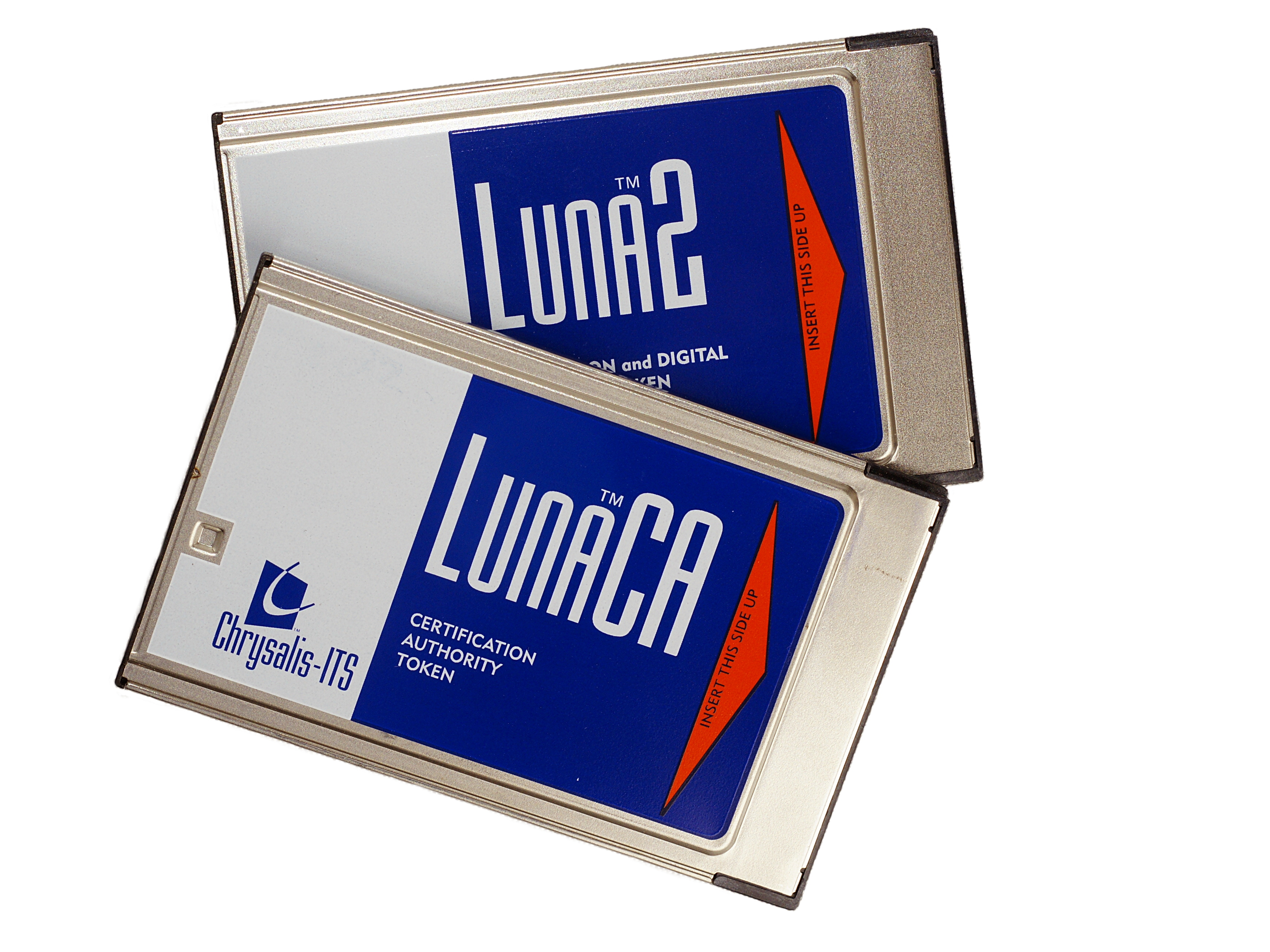
Observed. A Chrysalis-ITS Luna hardware security module in the legacy PCMCIA card form factor, photographed in 2008.
Chapter 5’s HSM-form-factor figure, reused here for the same reason RAND names the gap: general-purpose key-protection hardware is a mature product category, and ML-specialized weight-protection hardware is not.
It shows one physical form key-protection hardware has taken; it does not show internal tamper-response mechanisms, a FIPS certificate, or any ML-specific interface.
Photograph by Alexander Klink, CC BY 3.0 [10].
The same photograph is Chapter 5’s PCMCIA HSM figure.
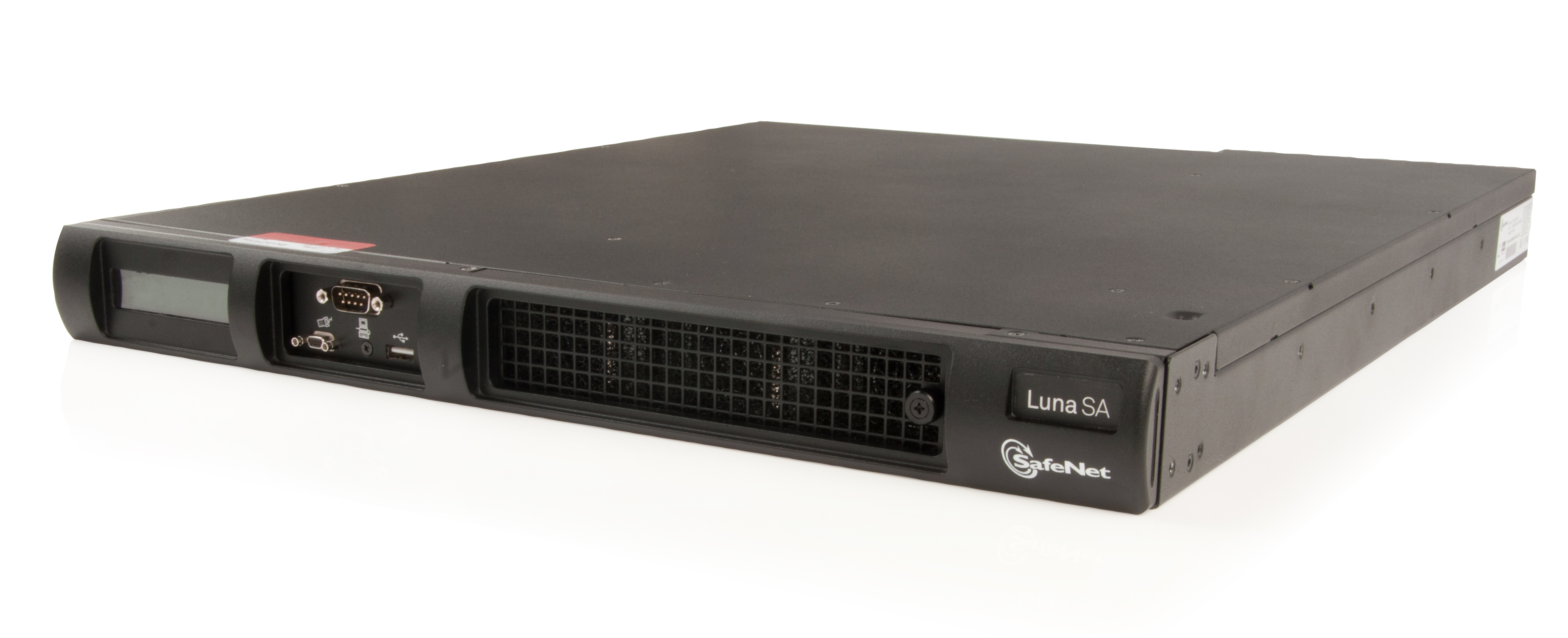
Observed. A Thales Luna SA 5 chassis, a network-attached rack-mount HSM, photographed in 2012.
The same certified-custodian role as the card above, at rack scale — the closest existing shape to the datacenter-scale device RAND is asking for, minus the ML-specialized interface.
It shows the appliance form factor the market moved to; it does not show FIPS certification status, internal tamper-resistance mechanisms, or deployment scale.
Photograph by HelmSE1, Wikimedia Commons, CC BY-SA 3.0 [11].
The same photograph is Chapter 5’s rack-mount HSM figure.
The SL1–SL5 ladder
RAND defines five cumulative security levels, “broadly defined as the level of security a system requires to thwart increasingly capable operations” [1], paired 1:1 with its OC1–OC5 attacker tiers.
| SL | Definition [1] | Stops (OC) | Signature new measures | Deployed today? |
|---|---|---|---|---|
| SL1 | ”can likely thwart amateur attempts (OC1)“ | OC1 hobbyists | Cloud platform, MFA/SSO, best-effort weight encryption, RoT device architectures | Yes (table stakes) |
| SL2 | ”thwart most professional opportunistic efforts (OC2)“ | OC2 individual pros | Hardened SL1 | Yes |
| SL3 | ”thwart cybercrime syndicates or insider threats (OC3)“ | OC3 syndicates + insiders | Dedicated weight storage, Permitted Interfaces, multiparty auth, anomaly monitoring, NIST 800-171/CMMC L3 | Mostly (achievable now) |
| SL4 | ”thwart most standard operations by leading cyber-capable institutions (OC4)“ | OC4 standard state ops | Weight-storage isolation, confidential computing (when available), hardware output-rate limits, audited interface hardware, advanced insider program | Partially (CC is gating) |
| SL5 | ”could plausibly be claimed to thwart most top-priority operations by the top cyber-capable institutions (OC5)“ | OC5 apex nation-state | Completely isolated network, formal hardware verification, side-channel noise injection, irrecoverable-key policy, TS/SCI-equivalent, “eight independent security layers” | No (“currently not possible”) |
RAND security levels SL1–SL5: what each stops, its signature new measures, and deployment status.
SL5 remains “currently not possible.”
SL1 and SL2 establish basic cyber-hygiene against opportunists. SL3 is the first weight-specific tier, pairing Permitted Interfaces with insider controls using commodity components. In August 2026 RAND published a concrete catalog for that rung, Achieving AI Model Weight Security Level 3 (SL3) (RR-A4704-1), specifying 262 NIST SP 800-53-adapted controls (140 standard, 122 supplemental) against 31 OC3 attack vectors for 6-to-12-month implementation [12]. RAND explicitly scopes RR-A4704-1 as voluntary (“in its current form should be voluntary”) and omits SL4 and SL5 [12].
SL4 targets standard state operations and hits the hardware maturity ceiling because confidential computing is listed only “when available” (Chapter 6). SL5 requires an air-gapped SCIF, formal hardware verification, and “eight independent security layers” [1], likely requiring national-security assistance, and even its definition is hedged (“could plausibly be claimed to thwart” OC5).
How to use the ladder: a benchmark, not an architecture
A security level states adversary-scaled control objectives rather than prescribing a network topology, key hierarchy, or operating procedure; two compliant SL3 facilities can share few components. Google DeepMind’s Frontier Safety Framework v3.1 (April 17, 2026) adopts the ladder on these exact terms, aligning with “the security goals and principles in the RAND framework, rather than the benchmarks (i.e. concrete measures) also described in the RAND report” while quoting RAND’s disclaimer that its levels “represent neither a complete standard nor a compliance regime” [3]. DeepMind also introduces “Security Level 2+,” adding insider and well-resourced non-state controls atop SL2 [3].
The unit of assessment is a workload at a lifecycle stage rather than an entire organization. The Frontier Model Forum baseline notes that security strategy “will also need to account for the distinct security challenges involved in the training and inference stages of frontier AI” [13]. Claims like “lab X is at SL4” lack a verifiable referent unless tied to a stage, objective, and checkable evidence.
| Lifecycle stage | Asset in scope | Control objective | Evidence an assessor can check |
|---|---|---|---|
| Training run | live parameter tensors, optimizer and resume state | no bulk copy leaves the cluster boundary through an authorized session | egress rate and volume limits, and the alert records they produced |
| Checkpoint archive | cold checkpoints inside the artifact bundle | no single administrator can release a stored bundle | key policy requiring multiparty authorization; release audit logs |
| Fine-tuning and evaluation | derived checkpoints, evaluation harness, third-party access | derived artifacts inherit parent controls | provenance records linking derived checkpoints to parents; external evaluator access lists |
| Served inference | weights in use on the accelerator | plaintext parameters are unreadable by the host operator | attestation reports and measurements from the serving fleet (Chapter 6) |
| Decommissioning | superseded checkpoints, backups, key material | retired bundles become unrecoverable | key destruction records; backup inventories reconciled against retention policy |
Assessing a security level per workload and lifecycle stage: asset in scope, control objective, and the evidence an assessor can check.
The mapping is this book’s, not RAND’s.
What. Five stages of one bundle, each with a different asset, objective, and evidence.
Who / where. This book’s mapping, not RAND’s.
The Frontier Model Forum draws the training-versus-inference split [13].
Why. “Lab X is at SL4” has no checkable referent.
Caveat. The diagram is a sequence of stages, not a control architecture and not a claim that any named lab has been assessed at any rung.
Preventive level lists also under-specify ongoing operational practices. SL5 release 0.1.2 had to append NIST SP 800-53 Incident Response and Risk Assessment families missing from the initial draft [14]. Likewise, the Frontier Model Forum baseline requires pre-deployment and periodic security reviews, penetration testing, compromise assessments, patch management, tested incident response, and independent auditing [13]—the operational disciplines that keep hardware controls effective over time.
The lifecycle control catalog
Operating the lifecycle stages above requires 18 underlying controls, graded by four evidence tiers: design claim (stated intent without artifacts), test result (internal pen test or drill), independent assessment (third-party verification), and production telemetry (live operational output). Almost no public lab control reaches independent assessment for weight stores.PreviousThis paragraph was added in this version.NowOperating the lifecycle stages above requires 18 underlying controls, graded by four evidence tiers: design claim (stated intent without artifacts), test result (internal pen test or drill), independent assessment (third-party …
| Control | Lifecycle stage(s) | Function | Owner | Trust boundary crossed | Evidence grade | Residual risk |
|---|---|---|---|---|---|---|
| Artifact inventory | All stages | Preventive | ML platform / MLOps | Team boundary between training and serving orgs | Design claim | Unregistered copies bypass all downstream controls |
| Classification | Training run onward | Preventive | Security / compliance | Inherited by downstream controls | Design claim | Misclassification under-provisions every later control |
| IAM | All stages | Preventive | Identity / security engineering | Account boundary at every access point | Test result (SOC 2 audits scope IAM) | Valid credentials grant access without device attestation |
| JIT / PAM | Checkpoint archive, Served inference | Preventive | Security engineering | Time-bounded session boundary | Design claim (RAND names multiparty auth at SL3; unverified per lab) | Windows can be widened administratively without joint approvals |
| Approvals workflow (two-person rule) | Checkpoint archive release | Preventive | Security + ML leadership | Individual-authority boundary | Design claim | Stops single rogue approver, not two-person collusion |
| Network segmentation | Training run, Served inference | Preventive | Network / infra engineering | Cluster-to-corporate-network boundary | Design claim (RAND “dedicated devices” at SL3, unverified per lab) | Dual-homed jump hosts or route misconfigurations bridge it |
| Egress policy / monitoring | Training run, Served inference | Preventive + Detective | Security operations | Cluster network edge | Design claim in policy; rate physics testable | Transfers fragmented below rate ceiling or beyond monitoring window bypass it |
| DLP | Fine-tuning & evaluation, external sharing | Preventive + Detective | Security operations | Egress channels (email, cloud storage, repos) | Design claim | Signature DLP misses re-encoded or partial checkpoints |
| Logging | All stages | Detective | Security operations / SRE | Records every boundary crossing | Production telemetry once deployed | Side-channel or physical reads leave no log entry |
| Anomaly detection | All stages, especially Served inference | Detective | Security operations | Statistical boundary around normal access | Test result (Anthropic distillation disclosure is one public case) | Slow exfiltration inside normal usage triggers no alert |
| Canary weights / fingerprints | Embedded at Training, checked at Decommissioning/leak | Detective | ML research / security | Travels with artifact | Design claim (Chapter 12 files as concept only) | No public proof marks survive fine-tuning, quantization, or pruning |
| Provenance tracking | Training run, Fine-tuning & evaluation | Preventive + Detective | ML platform | Parent-to-derived-artifact boundary | Design claim | Records authorized copies only |
| Incident response | All stages | Responsive | Security operations, legal / leadership | External disclosure and law enforcement | Committed, no public evidence (White House and Seoul commitments) | Untested IR plans fail under pressure |
| Recovery | Decommissioning and post-incident | Recovery | Security operations + ML platform | Re-entry into production | Design claim | Requires verified uncompromised backup |
| Backup handling | Checkpoint archive | Recovery | ML platform / infra | Secondary storage surface | Design claim | Inherits primary-store access gaps unless independently enforced |
| Key / credential rotation | All stages, scheduled | Preventive + Recovery | Security engineering / KMS | Compromised-to-clean key boundary | Test result (scheduled KMS rotation is commodity) | Live attacker rotating alongside survives scheduled rotation |
| Deletion | Decommissioning | Recovery | ML platform / compliance | Unrecoverable state transition | Design claim | Unreconciled backups survive deletion |
| Ownership verification | Served inference, on suspected leak | Detective | Legal + ML research | External adversarial check | Design claim (same gap as canary weights) | Assertion without validated fingerprint |
The eighteen operational controls this chapter’s own lifecycle-stage table (above) presupposes but does not name individually.
Lifecycle stages reuse that table’s five-stage vocabulary.
Evidence grade is the strongest this book’s own sources support for that control, not a claim about what any single lab has deployed.
The mapping is this book’s own synthesis, built from the RAND, NIST, and lab-disclosure sources cited elsewhere in this chapter — no row introduces a new external citation.
These controls depend on seams across separate engineering domains. JIT/PAM access relies on identity providers and Chapter 5’s attestation state; egress controls split between network segmentation and hardware rate limits; and physical containment (Chapter 8) cannot track copies without an artifact inventory (a template crossing bundle components and stages sits at synthesis/model-artifact-inventory-template.md).PreviousThis paragraph was added in this version.NowThese controls depend on seams across separate engineering domains. JIT/PAM access relies on identity providers and Chapter 5's attestation state; egress controls split between network segmentation and hardware rate limits; and physical …
Recent vendor disclosures illustrate floor-layer progress without providing hardware weight custody. Anthropic’s August 31, 2026 update reports “Reducing human and automated accounts with standing access to systems that contain model weights or customer data” and “Setting our computing clusters to block all outbound traffic by default” [15] (unaudited self-report). Its September 2026 threat report (GTG-50020, p. 31) documents credential theft hitting evaluation vendors (“the keys involved were customers’ keys stolen from customers’ environments”) [16], exposing sandbox credentials as a supply-chain chokepoint. Microsoft’s Humanist AI Code of Conduct draft (September 14, 2026) remains a consultation document not yet used for training [17].
Mapping the 18 controls against seven threat classes exposes a structural asymmetry: confidentiality leaks have no true recovery control.PreviousThis paragraph was added in this version.NowMapping the 18 controls against seven threat classes exposes a structural asymmetry: confidentiality leaks have no true recovery control.
| Threat event | Preventive | Detective | Responsive | Recovery |
|---|---|---|---|---|
| Direct artifact exfiltration (whole bundle copied) | IAM, segmentation, egress policy, key rotation | DLP, logging, anomaly detection, egress monitoring | Incident response | None: key rotation restores operator access control, not secrecy |
| Partial parameter recovery (side-channel / black-box query) | Hardware output-rate limits, API design, rate limits | Anomaly detection, logging | Incident response, rate-limit tightening | None: extracted information cannot be un-extracted |
| Distillation / behavior cloning | IAM, rate limits, output policy | Anomaly detection (Anthropic disclosure is one public case) | Incident response, legal enforcement, account termination | None: account bans do not erase cloned capability |
| Training-data or model poisoning (integrity) | Provenance tracking, signed inputs, review | Anomaly detection, reproducible-build comparison | Incident response | Recovery, backup handling: rollback to verified clean checkpoint |
| Insider abuse of legitimate access (OC3) | JIT/PAM, approvals workflow, segmentation | Logging, anomaly detection, canary weights for attribution | Incident response, revocation | None for disclosed data; credential rotation only |
| Key or credential compromise | Key rotation, IAM | Logging, anomaly detection | Incident response, emergency rotation | Recovery, backup handling: re-key and re-issue |
| Retirement-time residual exposure (orphaned copy, undeleted backup) | Deletion policy reconciled against backup inventory | Ownership verification, artifact inventory audit | Incident response if found | Deletion closes exposure once located |
Preventive/detective/responsive/recovery coverage for seven threat-event classes, each control drawn from the eighteen-row catalog above.
The Recovery column is genuinely empty for three of seven rows, and that emptiness is deliberate rather than an omission this table should paper over.
Once a bundle, partial parameters, or distilled behavior leaves, no control restores confidentiality; rotating keys only restores future access control. By contrast, integrity poisoning and key compromises are genuinely recoverable whenever clean, verified backups exist.PreviousThis paragraph was added in this version.NowOnce a bundle, partial parameters, or distilled behavior leaves, no control restores confidentiality; rotating keys only restores future access control. By contrast, integrity poisoning and key compromises are genuinely recoverable …
Which level stops which actor
RAND pairs its security levels directly against the OC1–OC5 attacker capability scale:PreviousThis paragraph was added in this version.NowRAND pairs its security levels directly against the OC1–OC5 attacker capability scale:
| Attacker (OC) | Archetype | Budget / scale | Min SL that stops them | In one line |
|---|---|---|---|---|
| OC1 | Hobbyist (“spray and pray”) | days, ≤$1K | SL1 | Basic cloud hygiene stops the opportunist. |
| OC2 | Individual professional | weeks, ≤$10K | SL2 | Best-practice security stops the freelancer. |
| OC3 | Criminal syndicates, terrorist orgs, disgruntled employees, industrial espionage | months, ≤$1M, ~10 pros | SL3 | Weight controls and insider programs stop syndicates and insiders. |
| OC4 | ”leading state-sponsored groups and … foreign intelligence agencies” (>100 ops/yr) | ~1yr, ≤$10M, ~100 pros | SL4 | Confidential computing and isolation stop standard state ops when deployed. |
| OC5 | ”the handful of operations most prioritized by the world’s most capable nation-states” | years, ≤$1B, ~1,000 pros, decade-scale | SL5 | Nothing fully stops the apex state today; SL5 “is currently not possible.” |
Attacker operational-capacity tiers OC1–OC5: archetype, budget/scale, and the minimum security level that stops each.
Defense levels (SL1–SL5) aligned to attacker capability (OC1–OC5).
SL1–SL3 ship today; SL4 is maturity-gated on confidential computing; SL5 — the level that would stop the apex nation-state OC5 — is “currently not possible,” leaving the headline adversary mapped to an undefended rung.
Attacker budget ceiling by capability tier — six orders of magnitude from the hobbyist to the apex state.
Commodity controls stop OC1–OC2; SL3 stops syndicates and insiders; OC4 waits on production confidential computing; and OC5 (top-priority PRC and Russian state operations) maps to SL5, which RAND concludes cannot be achieved today [1]. The core frontier threat therefore aligns with the one unbuilt rung.
Who is trying to build the missing rung
RAND named SL5 without specifying its controls. Three non-regulatory efforts illustrate how the ecosystem stops short of the apex rung.PreviousThis paragraph was added in this version.NowRAND named SL5 without specifying its controls. Three non-regulatory efforts illustrate how the ecosystem stops short of the apex rung.
A private consortium writing the standard. SL5 Inc., a 501(c)(3) non-profit with “over 50 participants” led by CEO Lisa Thiergart [18], publishes the SL5 Standard for AI Security as a volunteer NIST SP 800-53 Rev 5 overlay covering “only the long lead time interventions” [19]. On May 8, 2026 (arXiv:2605.08449v1) it listed 43 controls across 10 families; release 0.1.2 (June 23, 2026) expanded to 60 controls across 12 families by adding Incident Response (IR-4) and Risk Assessment (RA-3) [14], noting “These 17 controls are selection-only additions; this release adds no SL5 supplemental guidance or parameter assignments to them” [14].
Thiergart presented SL5 and the companion unpublished physical overlay AI705 at NIST’s July 22–23, 2026 workshop [18][20]. NIST hosted the event without authoring, adopting, or accrediting either draft, leaving SL5 at Version 0.1 with no ratifying authority.
A lab writing its own ladder without a top rung. Anthropic’s Responsible Scaling Policy (v3.4, July 8, 2026) [21] activates the ASL-3 Security Standard, relying on “more than 100 different security controls” that target “sophisticated non-state actors” while excluding “Nation-state threats (other than those using non-novel attack chains) and sophisticated insider risk” [22]. Its changelog records dropping future-level commitments (“We have decided not to maintain a commitment to define ASL-N+1 evaluations by the time we develop ASL-N models”) [21], replacing numbered future rungs in v3.0. One ASL-3 measure, “preliminary egress bandwidth controls” [22], implements RAND’s SL4 output-rate limit in production.
A second lab topping out at SL4, with an SL2+ posture self-attestation. Google DeepMind’s Frontier Safety Framework v3.1 caps recommendations at SL4: CBRN, cyber, and manipulation level 1 map to SL2+, ML R&D acceleration level 1 maps to SL3, and ML R&D automation level 1 recommends SL4 with the caveat that “this must be taken on by the frontier AI field as a whole” [3]. SL5 appears nowhere in the framework [3].
In October 2026, DeepMind’s Gemini 4 Argon Safety & Security Report (printed p. 159) gave the clearest lab-to-RAND posture statement to date: Google states it has implemented RAND SL2 as a baseline plus insider and well-resourced non-state controls (“SL2+”), routes most model interactions through “hardened, mediated interfaces that limit permissible actions with respect to model weights,” and is working toward SL3 alongside insider-risk teams, enhanced background checks, training-data tamper checks, input sandboxing, APT-level red teaming, and 24/7 threat hunting [23]. That disclosure narrows the public-posture gap, but remains vendor self-attestation rather than an independent third-party audit.
Across consortium drafts and frontier lab frameworks, sub-state tiers (SL2–SL3) are actively specified while state-actor tiers remain unstandardized or unverified.PreviousThis paragraph was added in this version.NowAcross consortium drafts and frontier lab frameworks, sub-state tiers (SL2–SL3) are actively specified while state-actor tiers remain unstandardized or unverified.
Commitment versus verified evidence
Statements of intent differ from verifiable third-party artifacts. [Scope note: negative claims in this section are bounded by the OpenAI trust portal [24], Anthropic transparency hub [25], Anthropic RSP log [26], Claude Opus 4.6 risk report [27], and DeepMind’s Gemini 4 Argon report [23].]
Four evidence states classify public claims:PreviousThis paragraph was added in this version.NowFour evidence states classify public claims:
-
COMMITTED AND EVIDENCED: public commitment backed by an obtainable third-party artifact.
-
COMMITTED, SELF-ATTESTED ONLY: public commitment supported only by the operator’s own account.
-
COMMITTED, NO PUBLIC EVIDENCE: public commitment with no compliance artifact from either party.
-
NOT COMMITTED: recommended or aspirational practice with no formal undertaking.
| Commitment or claim | Source and date | State | What a reader can check |
|---|---|---|---|
| ”Invest in cybersecurity and insider threat safeguards to protect proprietary and unreleased model weights” [28] | White House voluntary commitments, Jul. 2023 | COMMITTED, NO PUBLIC EVIDENCE | None of the examined lab docs contains an assessment scoped to a weight store. |
| ”implementing robust security controls for unreleased model weights” [29] | Seoul Frontier AI Safety Commitments, 2024 | COMMITTED, NO PUBLIC EVIDENCE | Self-published frameworks (e.g., RSP [21]) exist, with no public assessment against the commitment. |
| Encrypt “model weights stored at rest in databases, file systems, and backups” with AES-256 [13] | FMF issue brief, 31 Jul. 2024 | NOT COMMITTED | Advisory recommendation noting it “may not apply to all firms in all situations.” |
| ISO/IEC 27001:2022 certificate | OpenAI trust portal [24] | COMMITTED AND EVIDENCED | Public certificate scoped to “OpenAI’s API, ChatGPT Enterprise, and ChatGPT Edu services,” excluding training clusters and weight stores. |
| SOC 2 Type 2, period 1 Jan. to 30 Jun. 2025 [24] | OpenAI trust portal | COMMITTED, SELF-ATTESTED ONLY | Period and scope appear publicly; full report is gated behind portal credentials. |
| ”we will commission a third-party review that assesses whether we adhered to this policy’s main procedural commitments” [21] | Anthropic RSP v3.4, 8 Jul. 2026 | COMMITTED, NO PUBLIC EVIDENCE | The RSP updates log publishes no such review [26]. |
| ”We will work toward a practice of seeking comprehensive, public external review on our Risk Reports” [21] | Anthropic RSP v3.4, 8 Jul. 2026 | NOT COMMITTED | Described as an experiment; Claude Opus 4.6 risk report limits future external review to appropriateness of redactions [27]. |
| ”We engage independent assessors to evaluate the effectiveness of our cybersecurity measures” [25] | Anthropic transparency hub, updated 23 Jul. 2026 | COMMITTED, SELF-ATTESTED ONLY | Underlying reports sit behind the gated trust center. |
| ISO/IEC 42001:2023 for the AI management system [25] | Anthropic transparency hub, updated 23 Jul. 2026 | COMMITTED, SELF-ATTESTED ONLY | Links ISO catalogue and trust center; no public certificate posted. |
| RAND SL2+ baseline via mediated weight interfaces, working toward SL3 [23] | DeepMind Gemini 4 Argon Safety Report, Oct. 2026 | COMMITTED, SELF-ATTESTED ONLY | Names control classes (insider risk, red teaming, 24/7 threat hunting) without an independent audit report. |
Public weight-security commitments and compliance claims, each assigned one of four evidence states.
Rows are drawn from documents fetched directly and quoted verbatim; the state describes what a reader can obtain, not whether the control is in place.
No row asserts that any control is implemented.
Two industry-wide gaps emerge from Table 7.7.PreviousThis paragraph was added in this version.NowTwo industry-wide gaps emerge from Table 7.7.
Public certifications cover product APIs rather than training weight stores. OpenAI’s ISO/IEC 27001:2022 certificate covers “OpenAI’s API, ChatGPT Enterprise, and ChatGPT Edu services,” and its SOC 2 Type 2 covers “the API Platform, ChatGPT Enterprise, ChatGPT Edu, and ChatGPT Team” [24]; neither names a training cluster or checkpoint store. Anthropic similarly states its program has “attempted to broadly align” with SOC 2 Type 2, ISO 27001, and ISO 42001 “while extending these to address AI-specific risks to model weights” under “ASL-3 protections against non-state actors and unsophisticated insiders” [27], claiming alignment rather than certification of the weight extension. DeepMind’s SL2+ disclosure [23] maps controls to RAND explicitly, yet remains unverified by an independent assessor.
The independent assessment market remains immature. The Frontier Model Forum reports that “The third-party ecosystem for frontier models remains relatively nascent” and “few third-party organizations exist in the ecosystem to conduct rigorous, secure, and fit-for-purpose assessments” [30]. Anthropic’s RSP echoes that “there are no well-established organizations or procedures for this sort of practice, and we are approaching it as an experiment” [21]. In practice, Anthropic’s Fable 5.1 / Mythos 5.1 system card concedes that “the publicly disclosed cyber-evaluation incidents and the more mild case of accessing external information… were caught by external evaluators, not by these internal evaluations” [31].
Silence in public documentation does not prove controls are absent, as labs have valid operational-security reasons to withhold architecture details. However, outside observers cannot verify from public filings whether any frontier weight store achieves a named security level. Reaching RAND’s SL5 also requires air-gapped, TEMPEST-shielded physical containment—explored in Chapter 8.PreviousThis paragraph was added in this version.NowSilence in public documentation does not prove controls are absent, as labs have valid operational-security reasons to withhold architecture details. However, outside observers cannot verify from public filings whether any frontier weight …
References
[1] S. Nevo, D. Lahav, A. Karpur, Y. Bar-On, H. A. Bradley, and J. Alstott, Securing AI Model Weights: Preventing Theft and Misuse of Frontier Models, RAND Corporation, RR-A2849-1, May 2024. https://www.rand.org/pubs/research_reports/RRA2849-1.html , URL resolved Aug. 14, 2026 (HTTP 200; cited content not confirmed)
[2] National Institute of Standards and Technology, Adversarial Machine Learning: A Taxonomy and Terminology of Attacks and Mitigations, NIST AI 100-2e2025, Mar. 2025. https://nvlpubs.nist.gov/nistpubs/ai/NIST.AI.100-2e2025.pdf , URL resolved Aug. 14, 2026 (HTTP 200; cited content not confirmed)
[3] Google DeepMind, Frontier Safety Framework, Version 3.1, published 17 Apr. 2026. https://storage.googleapis.com/deepmind-media/DeepMind.com/Blog/strengthening-our-frontier-safety-framework/frontier-safety-framework_3-1.pdf , URL resolved Aug. 14, 2026 (HTTP 200; cited content not confirmed)
[4] D. Amodei, “We Must Pace the Frontier,” darioamodei.com, Sep. 2026. https://darioamodei.com/post/we-must-pace-the-frontier , retrieved Sep. 27, 2026 (capture sources/raw/amodei-pace-the-frontier-2026-09-27.html). The page prints no date; its metadata carries Sep. 14, 2026. Industry self-report.
[5] H. Liu, C. Shou, H. Wen, Y. Chen, R. J. Fang, and Y. Feng, Your Agent Is Mine: Measuring Malicious Intermediary Attacks on the LLM Supply Chain, arXiv:2604.08407, 9 Apr. 2026 (preprint, not peer-reviewed). https://arxiv.org/abs/2604.08407 , URL resolved Aug. 14, 2026 (HTTP 200; cited content not confirmed)
[6] OpenRouter, “Provider Logging,” OpenRouter documentation (accessed Aug. 2026). https://openrouter.ai/docs/guides/privacy/provider-logging
[7] OpenRouter, “Zero Data Retention,” OpenRouter documentation (accessed Aug. 2026). https://openrouter.ai/docs/guides/features/zdr
[8] BerriAI, “Logging,” LiteLLM proxy documentation (accessed Aug. 2026). https://docs.litellm.ai/docs/proxy/logging
[9] GitHub Security Advisory GHSA-7488-6r32-c95q / CVE-2026-59822, “LiteLLM: MCP Authentication Bypass via OAuth2 Passthrough Fallback,” reviewed, severity high (CVSS v4 8.8), published 2026-07-22; fixed in LiteLLM 1.84.0. https://github.com/advisories/GHSA-7488-6r32-c95q , accessed Aug. 14, 2026 (live fetch)
[10] A. Klink, “Luna Hardware Security Modules PCMCIA,” photograph, Wikimedia Commons, dated Dec. 17, 2008 on the file description page, accessed Sep. 9, 2026 (live fetch). https://commons.wikimedia.org/wiki/File:Luna_Hardware_Security_Modules_PCMCIA.jpg — CC BY 3.0, license deed https://creativecommons.org/licenses/by/3.0/ . Full notice: site/public/media/luna-hsm-pcmcia-2008.LICENSE.txt. The same photograph is Chapter 5’s [27].
[11] HelmSE1, “Luna SA Hardware Security Module,” photograph, Wikimedia Commons, dated Jan. 23, 2012 on the file description page, accessed Sep. 9, 2026 (live fetch). https://commons.wikimedia.org/wiki/File:Luna_SA_Hardware_Security_Module.jpg — CC BY-SA 3.0, license deed https://creativecommons.org/licenses/by-sa/3.0/ . Full notice: site/public/media/luna-sa-hsm-2012.LICENSE.txt. The same photograph is Chapter 5’s [28].
[12] J. Aguirre, P. Robertson, S. F. Comer, M. J. Malone, and W. Hurd, Achieving AI Model Weight Security Level 3 (SL3), RAND Corporation, RR-A4704-1, Aug. 2026. PDF https://www.rand.org/content/dam/rand/pubs/research_reports/RRA4700/RRA4704-1/RAND_RRA4704-1.pdf , accessed Sep. 3, 2026 (live fetch) — 262 = 140+122 SP 800-53 controls; 31 OC3 vectors; 6-12 month; “should be voluntary”; “SL4 and SL5 are not addressed.” Not a mandate.
[13] Frontier Model Forum, “Issue Brief: Foundational Security Practices,” 31 Jul. 2024. https://www.frontiermodelforum.org/updates/issue-brief-foundational-security-practices/ , accessed Aug. 14, 2026 (live fetch)
[14] SL5 Inc., “Changelog,” release 0.1.2, 2026-06-23 (accessed Aug. 2026). https://standard.sl5.org/changelog
[15] Anthropic, “Improving our alignment and security efforts,” Aug. 31, 2026. https://www.anthropic.com/news/improving-alignment-security-efforts , retrieved Sep. 28, 2026 (capture sources/raw/anthropic-alignment-efforts-2026-09-28.html). Lab self-report, not independently audited; quoted for two weight-access controls.
[16] Anthropic, “Detecting and countering misuse of AI: September 2026,” Sep. 10, 2026, p.31 (GTG-50020). https://www-cdn.anthropic.com/e50be2e51e7695dc4b1366a37a245a597377d3b5/Anthropic-Detecting-and-countering-091026.pdf , retrieved Sep. 27, 2026 (capture sources/raw/anthropic-ti-sep2026-2026-09-27.pdf). Vendor self-report; quoted for eval-sandbox credential theft.
[17] Microsoft AI, “Code of Conduct” (Humanist AI Code of Conduct for MAI Models), published Sep. 14, 2026 (page metadata). https://microsoft.ai/code-of-conduct/ , retrieved Sep. 28, 2026 (capture sources/raw/microsoft-humanist-coc-2026-09-28.html). Draft shared for public consultation; states it is “still under development” and not yet used to train models.
[18] SL5 Inc., “About” and “AI705” project pages (accessed Aug. 2026). https://sl5.org/about and https://sl5.org/projects/ai705
[19] SL5 Standard for AI Security, arXiv:2605.08449v1, submitted 2026-05-08. https://arxiv.org/abs/2605.08449 , URL resolved Aug. 14, 2026 (HTTP 200; cited content not confirmed)
[20] NIST, Securing AI Data Center: Architecture, Security Posture, and Emerging Technologies — workshop agenda, 22–23 Jul. 2026. https://www.nist.gov/system/files/documents/2026/07/23/AIDCSecurityWorkshopAgenda-Final.pdf , URL resolved Aug. 14, 2026 (HTTP 200; cited content not confirmed)
[21] Anthropic, Responsible Scaling Policy, version 3.4, 8 Jul. 2026. https://cdn.sanity.io/files/4zrzovbb/website/0bacdc8440ea96e62a8766d99ebe1d4eea6d5f3a.pdf , URL resolved Aug. 14, 2026 (HTTP 200; cited content not confirmed)
[22] Anthropic, “Activating AI Safety Level 3 protections,” 22 May 2025. https://www.anthropic.com/news/activating-asl3-protections , accessed Aug. 14, 2026 (live fetch)
[23] Google DeepMind, Gemini 4 Argon Safety & Security Report, Oct. 2026 (linked from Gemini 4 Argon Model Card, Oct. 13, 2026), p. 159 (PDF p. 160), https://storage.googleapis.com/deepmind-media/gemini/gemini_4_safety_report.pdf , accessed 2026-10-13 (capture sources/raw/labs-deepmind-gemini-4-argon-safety-report-2026-10-13-captured-2026-10-13.pdf) — vendor self-attestation of RAND SL2+ posture, mediated weight interfaces, and stated path toward SL3; not an independent audit.
[24] OpenAI, “Trust Portal” — certifications and reports index, page last updated 12 Aug. 2026. Accessed Aug. 12, 2026 (live fetch). https://trust.openai.com/
[25] Anthropic, “Voluntary Commitments,” Transparency Hub, last updated 23 Jul. 2026. Accessed Aug. 12, 2026 (live fetch). https://www.anthropic.com/transparency/voluntary-commitments
[26] Anthropic, “Anthropic’s Responsible Scaling Policy” — policy page and version history, last updated 8 Jul. 2026. Accessed Aug. 12, 2026 (live fetch). https://www.anthropic.com/rsp-updates
[27] Anthropic, Claude Opus 4.6 Risk Report, published PDF. Accessed Aug. 12, 2026 (live fetch). https://anthropic.com/claude-opus-4-6-risk-report
[28] The White House, Ensuring Safe, Secure, and Trustworthy AI — voluntary commitments from leading AI companies, Jul. 2023 (archived). Accessed Aug. 12, 2026 (live fetch). https://bidenwhitehouse.archives.gov/wp-content/uploads/2023/07/Ensuring-Safe-Secure-and-Trustworthy-AI.pdf
[29] UK Government, “Frontier AI Safety Commitments, AI Seoul Summit 2024,” policy paper, 2024. Accessed Aug. 12, 2026 (live fetch). https://www.gov.uk/government/publications/frontier-ai-safety-commitments-ai-seoul-summit-2024/frontier-ai-safety-commitments-ai-seoul-summit-2024
[30] Frontier Model Forum, “Technical Report: Third-Party Assessments,” 4 Aug. 2025. Accessed Aug. 12, 2026 (live fetch). https://www.frontiermodelforum.org/technical-reports/third-party-assessments/
[31] Anthropic, “System Card: Claude Fable 5.1 & Claude Mythos 5.1,” Sep. 1, 2026. https://www-cdn.anthropic.com/0339e6a7c5c7b87f5c07798616dc32c215d14235/Claude%20Fable%205.1%20&%20Claude%20Mythos%205.1%20System%20Card.pdf , accessed Sep. 8, 2026 (live fetch). Vendor self-report; Fable 5.1 and Mythos 5.1 are differently safeguarded configurations, not interchangeable evaluation labels. Local raw capture: sources/raw/fable-mythos-51-card-2026-09-08.txt. Same document as textbook/03-adversaries.md’s [50]; each chapter’s reference number is independent.