Chapter 5 — Built-in Chip Trust: Root-of-Trust Silicon
Part II of IV — Observed operations and supply chains. This chapter separates the roles bundled into “root of trust,” states which ship in production silicon today, and names the one that does not.PreviousThis paragraph was added in this version.NowPart II of IV — Observed operations and supply chains. This chapter separates the roles bundled into "root of trust," states which ship in production silicon today, and names the one that does not.
Previous chapters assumed the machine running the weights could be trusted. An attacker who swaps a chip, tampers with the boot chain, or passes a compromised host off as clean defeats encryption, access control, and confidential computing. Root-of-trust (RoT) silicon addresses the prerequisite: is this specific chip, in this specific boot state, the expected one?PreviousThis paragraph was added in this version.NowPrevious chapters assumed the machine running the weights could be trusted. An attacker who swaps a chip, tampers with the boot chain, or passes a compromised host off as clean defeats encryption, access control, and confidential …
Production silicon must be separated from specifications, roadmaps, and proposed architectures. Root of trust has an open, audited design available as production-silicon samples. Binding a model checkpoint to an authorized chip at datacenter scale, however, does not ship today.PreviousThis paragraph was added in this version.NowProduction silicon must be separated from specifications, roadmaps, and proposed architectures. Root of trust has an open, audited design available as production-silicon samples. Binding a model checkpoint to an authorized chip at …
Three things that are not the same thing
Root-of-trust discussions frequently treat OpenTitan, Caliptra, and Rambus as competing brands of one product. They occupy different architectural slots:PreviousThis paragraph was added in this version.NowRoot-of-trust discussions frequently treat OpenTitan, Caliptra, and Rambus as competing brands of one product. They occupy different architectural slots:
- OpenTitan is the trust anchor itself: a complete discrete or embeddable RoT design (“Open source silicon root of trust”) [1]. Earl Grey reached production-silicon samples for laboratory evaluation in February 2025; Darjeeling is the integratable subsystem [2][3]. Open-source and vendor-agnostic.
- Caliptra is an IP block dropped inside a host SoC. The project defines itself as “IP and firmware for an integrated Root of Trust block” targeting “datacenter-class SoCs like CPUs, GPUs, DPUs, TPUs” [4]. Governed under CHIPS Alliance and OCP, it delivers RTL and firmware rather than a purchasable chip. The 2.1 RTL released on 2025-10-15 [5], and no primary source cited here places Caliptra inside shipping silicon [4][6].
- Rambus fills the same on-die IP slot as Caliptra with proprietary cores: the CryptoManager RT-6xx family of “hardware security cores” [7] (vendor claim, medium trust). One family member, the RT-660, holds a FIPS 140-3 CMVP validation (Certificate #4758, detailed below).
Observed. From 00:49, the presenters identify OpenTitan’s open RTL, verification, firmware, and documentation; at 14:17 , they describe the general offering as soft IP.
The talk explains architecture and delivery form.
It does not establish current shipment or deployment status.
RISC-V International, February 19, 2025.
Six roles, not one box
“Root of trust” often collapses device identity, boot-state proof, foundry provenance, and key release into a single box. In practice these are distinct roles held by separate parties with independent failure modes. Chapter 6 traces an attestation-gated key release across them.PreviousThis paragraph was added in this version.Now"Root of trust" often collapses device identity, boot-state proof, foundry provenance, and key release into a single box. In practice these are distinct roles held by separate parties with independent failure modes. Chapter 6 traces an …
-
Device. The hardware holding a secret and signing with it. Only this role resides in the RoT silicon itself.
-
Endorsement authority. The issuer (usually the silicon vendor CA, sometimes the OEM or silicon owner) certifying that a device public key belongs to genuine hardware of a stated type. Compromise here lets an attacker mint non-existent devices.
-
Evidence. The signed bundle produced by the device: identity, measurements, and a verifier-supplied nonce for freshness. Evidence is raw data, not a verdict.
-
Verifier. The party checking signatures, certificate-chain validity, revocation status, and measurement alignment against reference values. Verifier trustworthiness is independent of the device, and the workload owner rarely operates the default verifier.
-
Policy decision point. The party deciding whether a verified state is acceptable. Verification establishes what code booted; authorization decides whether to run weights there, and belongs to the weight owner.
-
Key custodian. The service holding the workload decryption key and releasing it once policy passes.
An auditor capable of reconstructing past decisions is a seventh role that silicon cannot supply, requiring logs stored outside operator rewrite reach. None of these roles belongs inherently to the cloud provider; their placement is a deployment decision. The decisive question is who occupies the verifier and policy seats.PreviousThis paragraph was added in this version.NowAn auditor capable of reconstructing past decisions is a seventh role that silicon cannot supply, requiring logs stored outside operator rewrite reach. None of these roles belongs inherently to the cloud provider; their placement is a …
The IETF Remote ATtestation procedureS (RATS) architecture, RFC 9334 (January 2023), standardizes three core actors: an Attester “produces believable information about itself” so a Relying Party can “decide whether or not to consider that Attester a trustworthy peer,” mediated by a Verifier that “appraises Evidence via appraisal policies and creates the Attestation Results to support Relying Parties in their decision process” [8]. In this vocabulary, the device is the Attester, the key custodian is the Relying Party, and the verifier performs appraisal.
RFC 9334 Section 2.2, “Confidential Machine Learning Model Protection,” describes an owner protecting weights from the hardware operator: “If remote attestation succeeds, then the manufacturer service releases either the model or a key to decrypt a model already deployed on the Attester in encrypted form to the requester” [8]. Two limits leave the governance gap open. First, RFC 9334 is an informational specification, not an Internet Standards Track rule [8], so nothing compels a weight owner to hold the Relying Party seat. Second, the word “auditor” never appears in the text [8]. While the Entity Attestation Token (RFC 9711, April 2025) puts the evidence claim format on the Standards Track [9], a standardized token format does not decide who is entitled to appraise it.
What. Six concurrent roles around one attestation, plus a seventh the silicon does not provide.
Endorsement is shown on the device node.
Who / where. RFC 9334 names Attester, Verifier, and Relying Party [8].
Device, endorsement authority, evidence, policy decision point, and auditor are this chapter’s breakdown of roles around that vocabulary.
Why. A root-of-trust chip cannot fill all these roles.
Caveat. RFC 9334 is informational.
It standardizes terms, not obligations, and does not require the weight owner to be the Relying Party.
The four device-side primitives, in the order trust is built
Silicon supplies only the device role, doing so through four stacked primitives. Every Caliptra quotation below reflects specification and reference design rather than observed shipping silicon.PreviousThis paragraph was added in this version.NowSilicon supplies only the device role, doing so through four stacked primitives. Every Caliptra quotation below reflects specification and reference design rather than observed shipping silicon.
Device identity. An unforgeable, per-chip cryptographic identity (DICE IDEVID) minted at manufacture. OpenTitan allows “Silicon Owners … deploy their own Root of Trust (RoT) Public Key Infrastructure (PKI) after taking ownership” [1]. Caliptra 2.1 reports measurements “rooted in unique per-asset cryptographic entropy,” serving as a “Root of Trust for Identity (RTI) for the SoC” [6]. (Specific IDEVID/LDEVID key-layering mechanics follow standard TCG DICE, inferred because OpenTitan’s detailed layering spec was absent from July 2026 documentation [1].)
Measured boot. Each boot stage hashes the next stage before execution, accumulating measurements in hardware registers. Caliptra 2.1 requires that “The SoC must measure the code and configuration it boots into Caliptra” and that “Caliptra must store these measurements” [6], acting as a “Root of Trust for Measurement (RTM) block inside an SoC” [4]. OpenTitan likewise supplies “full boot attestation measurements to allow Silicon Owners to verify the boot chain configuration” [1].
Remote attestation. The chip signs its identity and measurements with its device key, letting a remote verifier check boot state before releasing secrets. Caliptra 2.1 requires the block to “report them with signed attestations rooted in unique per-asset cryptographic entropy” [6], giving an SoC “Identity, Measured Boot and Attestation capabilities” [4]. Data diodes and confidential-computing verifiers anchor on this primitive.
Key sealing / weight-to-chip binding. Secrets unlock only when measurements match an expected boot state. OpenTitan provides “a key manager implementation strongly bound to the boot chain. Only a boot chain signed with the expected set of keys shall be able to unlock stored keys/secrets” [1].
Extending sealing to datacenter weight binding runs into two obstacles. First, no cited vendor (OpenTitan, Caliptra, or Rambus) ships a turnkey weight-to-chip binding capability [1][4][7][6]; building it across a datacenter remains an unproved architectural extension and belongs in “needs maturity.” Second, sealing to a single chip and measurement state breaks fleet operations. Training runs span thousands of accelerators that fail, swap out, and update firmware. Production fleets require release to a revocable policy domain so a retired or suspect part loses access immediately without re-encrypting the weights. That is a fleet key-management system, not a fuse inside silicon.
The four primitives in the order trust is built — identity, measured boot, attestation, key sealing — each depending on the one before it.
All four exist in the OpenTitan design, which reached production-silicon samples for laboratory evaluation in 2025.
The dashed link is the last mile: binding a checkpoint to an authorized chip at datacenter scale is buildable on top of key sealing but is not demonstrated in any disclosure cited in this chapter.
Its column is contested.
This chapter argues needs-maturity from the shipped primitives; a competing reading holds it is concept-only, grounded in sources that say the composed datacenter-scale device does not exist.
The edge is drawn dashed and labelled contested so the figure itself does not pretend to settle what the text leaves open.
The lifecycle the primitives do not cover
The four primitives govern a chip at rest and at boot. Fleet operations require five external processes that silicon cannot specify:PreviousThis paragraph was added in this version.NowThe four primitives govern a chip at rest and at boot. Fleet operations require five external processes that silicon cannot specify:
- Enrollment. Handing trust from the manufacturer CA to the silicon owner’s PKI. OpenTitan supports this transition explicitly [1], but detecting a mis-enrolled part remains an operational process.
- Revocation. Retiring a compromised or decommissioned certificate via a reachable status service. Most deployments default to fail-open when that service is unreachable, and revocation policy must decide whether prior work performed by the retired chip stays valid.
- Update and rollback. Legitimate firmware updates alter boot measurements and consume permanent anti-rollback fuses. If fleet updates outpace verifier reference values, fail-closed policy halts the cluster, pressuring operators to loosen verification rules.
- Migration and recovery. Sealed secrets are tied to one chip and vanish when hardware dies. Any recoverable system holds an escrowed copy elsewhere, making that escrow’s protection the real security boundary.
- Decommissioning. Verifiably erasing keys and revoking device identity at end of life so gray-market accelerators (Chapter 4, Node 2) cannot attest as active fleet members.
The four states of Caliptra
Caliptra’s specification, roadmap intent, mandate claims, and silicon shipments are frequently conflated. Each rests on distinct evidence:PreviousThis paragraph was added in this version.NowCaliptra's specification, roadmap intent, mandate claims, and silicon shipments are frequently conflated. Each rests on distinct evidence:
| State | Evidence | Date observed |
|---|---|---|
| RTL specification — exists | CHIPS Alliance announced the 2.1 RTL release: “Caliptra 2.1 integrates Adams Bridge 2.0, offering both ML-DSA and ML-KEM with side channel countermeasures” [5] | 2025-10-15 |
| OCP-member design intent — exists | AMD’s Alex Tzonkov: “AMD has strategic plans to integrate Project Caliptra into its 2026+ product lineup” — trade-press reporting of a vendor roadmap, not a product [10] | Reported 2024-10-11 |
| Hyperscaler mandate in force — unconfirmed | The OCP announcement itself states no requirement [11]; the requirement claim originates in analyst commentary — “it seems clear that Microsoft and Google will make it a requirement” — sourced to unnamed engineers at OCP [12] | Claim dated 2022-10-25; never confirmed active |
| Shipping silicon — not yet | The Caliptra repository still marks the 2.x firmware stack incomplete: “ROM 2.x - WIP”, “FMC 2.x - WIP”, “Runtime 2.x - WIP” [4] | Repository observed 2026-08-09 |
The four states routinely collapsed into the single word “Caliptra,” separated and dated.
Only the first two are established.
The third is an inference by a trade analyst that no primary source confirms; the fourth has not happened.
Load-time authentication also leaves use-time integrity open. SILK documents a TOCTOU gap on the weight stream after RoT measurement (across DRAM, DMA, interconnect, and prefetch) and demonstrates an FPGA prototype on a Xilinx ZCU102 at 1.00% of equivalent Caliptra 2.x RoT area, rather than Caliptra production silicon or an AI-accelerator placement [13].
Two caveats govern Caliptra’s market status. First, no hyperscaler mandate is confirmed: OCP’s 2022 announcement quoted AMD, Google, Microsoft, and NVIDIA on open collaboration without any requirement [11], and the “will make it a requirement” forecast came eight days later from an analyst newsletter citing unnamed engineers [12]. Second, AMD’s “beginning in 2026” roadmap statement dates from October 2024 [10]. Caliptra proves major-buyer alignment on a shared design, not deployed infrastructure.
Caliptra 2.x’s post-quantum block responds to an early federal deadline. NSA’s Commercial National Security Algorithm Suite 2.0 (September 2022) directs software and firmware signing to “begin transitioning immediately, support and prefer CNSA 2.0 by 2025, and exclusively use CNSA 2.0 by 2030,” years ahead of browsers, servers, and cloud services (2033) and the 2035 NSM-10 outer bound [14]. NSA’s updated FAQ confirms FIPS 203 (ML-KEM) and FIPS 204 (ML-DSA) alongside 2024 CNSSP 15 milestones: no transition requirement enforced before Dec. 31, 2025; new NSS acquisitions compliant by Jan. 1, 2027; non-supporting gear phased out by Dec. 31, 2030; and exclusive use by Dec. 31, 2031 [15].
For firmware signing specifically, CNSA 2.0 routes to the stateful hash-based schemes of NIST SP 800-208 (LMS with SHA-256/192 and XMSS) rather than lattices, requiring implementers to “manage state and implement signing in hardware” [14]. Caliptra’s specification explicitly tracks that deadline, providing optional SP 800-208 LMS verification (LMOTS_SHA256_N24_W4 and LMS_SHA256_M24_H15) alongside ECDSA, plus optional ML-DSA-87 from 2.0 onward [6].
Specification options are not deployments, and the harder requirement is operational: Caliptra recommends that “the LMS trees are created from multiple HSMs that are geographically distributed” [6]. Federal post-quantum mandates arrive at the root-of-trust layer first because firmware is the first signed artifact in the stack.
One further implication is the author’s inference rather than NSA’s text: the phrase harvest-now-decrypt-later does not appear in CNSA 2.0 [14]. The advisory states only that its suite “will effectively deprecate the use of RSA, Diffie-Hellman (DH), and elliptic curve cryptography (ECDH and ECDSA) when mandated” and selects Level V key establishment [14]. Applied to a model-weight archive whose value outlasts the 2030s transition window, any checkpoint wrapped under RSA or ECC today and exfiltrated becomes vulnerable to future decryption.
What exists today, and what does not
| Item | Status | Evidence |
|---|---|---|
| — PRODUCTION SILICON / LICENSABLE TODAY — | ||
| OpenTitan Earl Grey — discrete RoT chip | Production-silicon samples available for lab testing; larger volumes announced for spring 2025 | [a] |
| OpenTitan primitives (identity, measured boot, attestation, key mgmt) | Implemented in the production-ready design; product deployment not established here | [b] |
| Rambus CryptoManager RT-6xx IP | Licensable IP | [c] |
| Rambus certifications | RT-660: FIPS 140-3 Level 2, Cert #4758 — validates the IP module, not your chip | [d] |
| — OPEN DESIGN / DEPLOYMENT UNPROVEN — | ||
| Caliptra — spec + RTL + ROM + firmware | Open design, 1.0→2.1 | [e] |
| Caliptra 2.x (ML-DSA, ML-KEM, OCP L.O.C.K.) | Spec / in-development | [f] |
| — NEEDS MATURITY — | ||
| OpenTitan Darjeeling — embeddable RoT | Released; no named AI-silicon deployment | [g] |
| Caliptra inside production datacenter SoCs | Unproven in any cited disclosure | [h] |
| Weight-to-chip binding at datacenter scale | Needs maturity | [i] |
Root-of-trust building blocks, regrouped by evidence state — production silicon or licensable IP, open design with deployment unproven, and needs maturity.
Bold leaders name the block; the lettered evidence notes below carry the source quotes that used to crowd the cells.
Evidence notes:
-
[a] Google reported production-ready OpenTitan fabrication, laboratory samples, planned spring 2025 volume, and initial product integrations [3], without demonstrating completed Chromebook, datacenter, or GPU deployment.
-
[b] OpenTitan documentation defines the four primitives [1]; Google’s fabrication update establishes silicon samples rather than full product deployment [3].
-
[c] FIPS 140-3 cores [7].
-
[d] CMVP Certificate #4758 (“CryptoManager Root of Trust RT-660,” Rambus Inc., FIPS 140-3 Overall Level 2, active, validated 2024-08-12 by atsec, sunset 2029-08-11) covers “an independent Silicon IP Security Module for integration into semiconductor devices” tested solely on a Xilinx Zynq XC7Z045 FPGA (hardware
0x6000_0931, firmware2022-02-24-g801c166) [16]. Customer-fabricated silicon requires separate validation. Vendor family claims vary: RT-100 is certified, while CC-312 is “FIPS 140-3 certifiable” [7]. -
[e] “specification, silicon logic, ROM and firmware” [4].
-
[f] 2.0/2.1 feature additions [4].
-
[g] Steward lowRISC reports that both Earl Grey and the Darjeeling integratable subsystem “have both gone into commercial production devices” [2], superseding older secondary claims. It stays in needs-maturity because the claim is self-reported without device names or volumes, and places neither design in an AI accelerator [2].
-
[h] Neither the Caliptra repository nor the 2.1 specification names a shipping part or customer device, and 2.x firmware components remain marked “WIP” [4][6].
-
[i] Inferred: buildable on sealing and attestation primitives, unproved at datacenter scale.
Observed. The left lane groups the major blocks in the OpenTitan Earl Grey top-level diagram ; the right lane groups the major blocks in the Caliptra 2.0 architecture diagram .
Both are simplified, modified redraws under Apache License 2.0 (OpenTitan notice ; Caliptra notice ): blocks and buses are grouped, labels are shortened, and non-load-bearing wiring is omitted.
The redraw distinguishes a discrete root-of-trust SoC from an integratable block.
It documents architecture, not deployment.
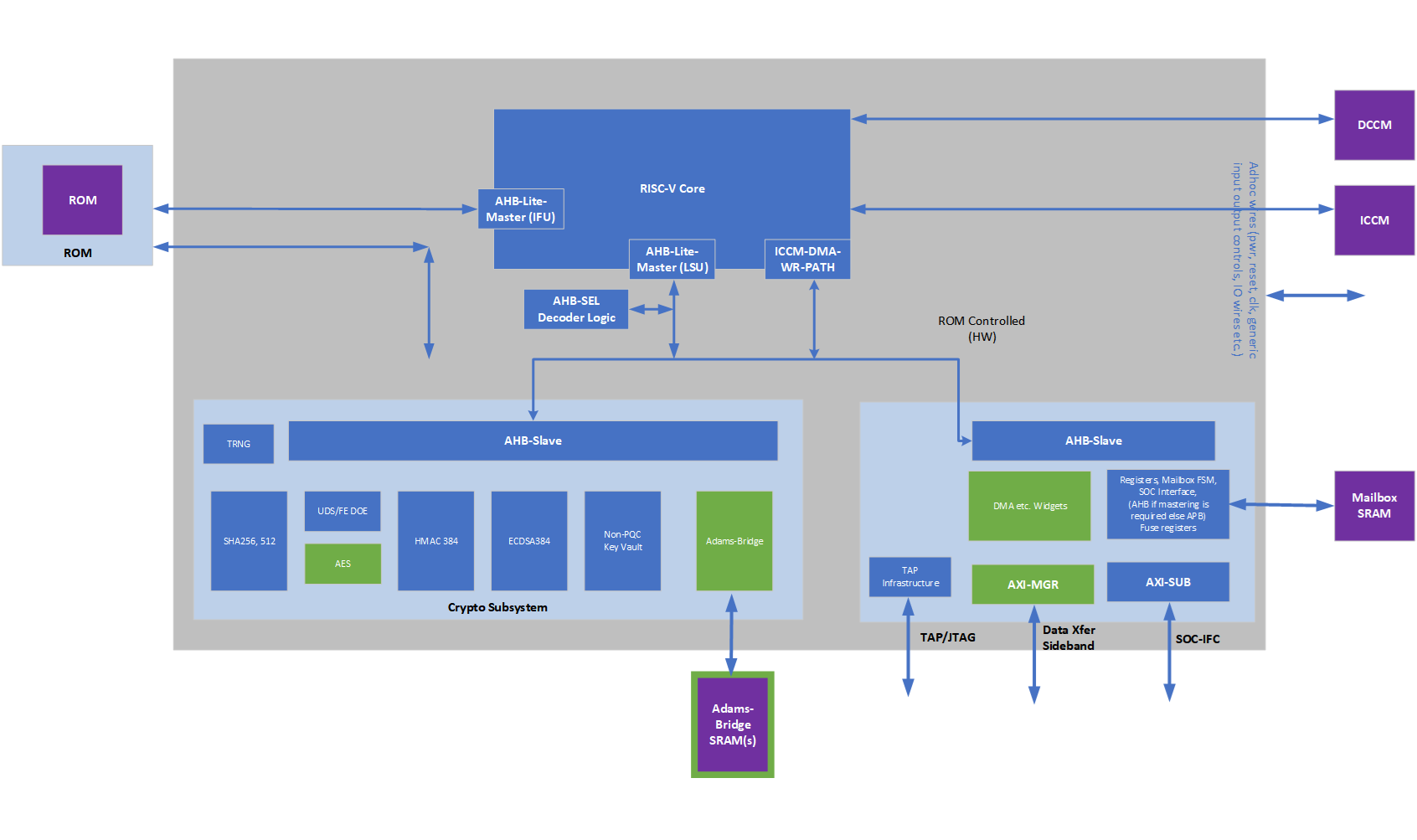
Observed. The official Caliptra 2.0 block diagram shows ROM, a RISC-V core, cryptographic subsystems, key-vault functions, mailbox SRAM, and SoC interfaces.
It describes an integratable root-of-trust block, not a named production deployment.
Copied unchanged from the CHIPS Alliance Caliptra repository under Apache License 2.0 .
Three conclusions follow from Table 5.2. First, the primitive layer exists in silicon: production-ready Earl Grey samples shipped for lab evaluation in February 2025, targeting Chromebooks first and datacenters afterward [3]. Second, Caliptra is the open architecture for datacenter GPUs and TPUs, backed by AMD, Google, Microsoft, and NVIDIA, yet remains a specification rather than demonstrated shipping silicon [4][6]. Third, commercial IP is converging on that interface: Rambus offers a “Caliptra DICE option” on its RT-6xx/16xx cores [7], showing vocabulary alignment rather than fleet deployment.
What the hyperscalers’ own roots of trust are certified to
The common claim that hyperscalers already deploy mature root-of-trust hardware everywhere fails against the public NIST/CCCS CMVP validation database (queried 2026-08-09 [16] and re-queried 2026-08-10 [17]).
| Module | CMVP record | Standard / overall level |
|---|---|---|
| AWS Nitro Card Security Engine SSMAE | Cert #5310, active, validated 2026-06-04 | FIPS 140-3, Level 1 |
| AWS Nitro Card Security Engine | Cert #3739, historical, validated 2020-10-29 | FIPS 140-2, Level 1 |
| Google Titan-D Chip | Cert #4367, active, validated 2022-11-15 | FIPS 140-2, Level 1 |
| Google Titan-BPN Cryptographic Module | Cert #5166, active, validated 2026-03-18 | FIPS 140-3, Level 1 |
| Google Titan Chip — “a custom secure micro-controller” | Cert #3382, historical, validated 2019-03-22 | FIPS 140-2, Level 1 |
| Google Titan Security Key, Chip Boundary | Certs #4574, #3851 and #3361, historical | FIPS 140-2, Level 1, physical security tested to Level 3 |
| Google Titan Key | Cert #3033, historical, validated 2017-10-02 | FIPS 140-2, Level 1 |
Hyperscaler in-house root-of-trust modules as they appear in the CMVP validated-modules database, queried 2026-08-09 and re-queried 2026-08-10.
Basic search returns the active validation list; advanced search returns the historical and revoked lists.
Every one of these carries an Overall Level of 1, the lowest of the four FIPS tiers, though the three security-key chip-boundary records add a Physical Security sub-level of 3.
First, the certified tier is Level 1. FIPS 140-3 Level 1 tests approved algorithms with minimal physical protection. Every AWS and Google RoT record above sits at Overall Level 1. Only three historical Titan Security Key chip-boundary records (#4574, #3851, #3361) carry a “Physical Security: Level 3” sub-rating [16][17]. Both AWS Nitro cards, both active Titan modules, and Google’s server-side part (#3382, “Titan is a custom secure micro-controller”) list no physical-security exception [16][17]. Rambus’s licensable RT-660 IP block is validated at Overall Level 2, one tier higher than either hyperscaler’s certified in-house parts [16].
Second, commonly cited part names do not appear in CMVP. Searching ModuleName=Nitro returns AWS’s #5310 (active) and #3739 (historical) alongside unrelated Marvell NITROX HSMs, with no “Nitro Security Chip” [17]. Searching ModuleName=Titan returns #5166, #4367, and five historical records, while a direct ModuleName=Titan M2 query returns “No certificates match the search criteria” on both basic and advanced forms [17].
Third, Titan validations cover security keys and handsets, not datacenter fleets. Server-side Certificate #3382 is a sunsetted FIPS 140-2 Level 1 record [17], and Titan M2 was introduced as Google’s discrete security chip for the Pixel 6 phone [18]. Google’s datacenter path is OpenTitan [3], which lacks an accredited fleet deployment record here. Hyperscalers may build strong internal hardware, but their public CMVP certifications establish algorithmic compliance at Level 1 rather than physical tamper assurance.
The two Microsoft roots of trust are not one part
Microsoft’s client and datacenter roots of trust address separate scopes.PreviousThis paragraph was added in this version.NowMicrosoft's client and datacenter roots of trust address separate scopes.
Pluton is a client CPU subsystem described as “a secure crypto-processor built into the CPU” providing “the functionality of the Trusted Platform Module (TPM)” on Windows [19]. Its sole active CMVP record is Certificate #4880 (Pluton Security Processor ROM, FIPS 140-3 Overall Level 2, interim validation sunsetting 11/13/2026), scoped to “a sub-chip cryptographic subsystem within the AMD Ryzen 6000 Series System on a Chip (SOC)” [17]. Moreover, Microsoft announced that “Beginning with 2026 silicon, Microsoft Pluton no longer serves as the TPM on AMD and Qualcomm platforms,” reverting those platforms to vendor fTPM or discrete TPMs [20].
Cerberus is the datacenter part. Microsoft states that “Azure Boost uses Cerberus as an independent HW Root of Trust to achieve NIST 800-193 certification” before workloads run [21]. However, NIST SP 800-193 (Platform Firmware Resiliency Guidelines, May 2018) is an implementer guideline built on firmware Protection, Detection, and Recovery rather than a validation program [22]. A CMVP search on Cerberus returns no certificates [17]. While SP 800-193 covers firmware on “graphics processing units” (written in 2018 when GPUs were framed primarily as client HIDs) [22], authenticating GPU firmware does not govern custody of plaintext model weights in memory. Neither Microsoft part is a certified weight custodian.
The gap this chapter hands forward
Root-of-trust primitives exist today, including OpenTitan production-silicon samples. What remains unproven is the last mile: binding weights to authorized chips at datacenter scale, the same missing device RAND calls an ML-specialized HSM (Chapter 7) and Chapter 9 addresses through governance hardware.PreviousThis paragraph was added in this version.NowRoot-of-trust primitives exist today, including OpenTitan production-silicon samples. What remains unproven is the last mile: binding weights to authorized chips at datacenter scale, the same missing device RAND calls an ML-specialized …
Certified general-purpose HSMs do exist, but they protect keys rather than adjacent accelerators. A CMVP basic search on ModuleName=nShield F3 across all certificate statuses returns exactly two Entrust FIPS 140-2 records validated Oct. 16, 2022 with a sunset date of Sep. 21, 2026: certificate #4338 at Overall Level 3 and certificate #4337 at Overall Level 2 (Physical Security Level 3) [23]. Both describe multi-chip embedded “tamper evident and tamper responsive Hardware Security Modules” [23]. As of September 2026, both carry status Historical (“Moved to historical list due to sunsetting”) [24], consistent with NIST’s transition rule keeping FIPS 140-2 modules active “until September 21, 2026, when the FIPS 140-2 validations will be moved to the historical list” while still permitting use in existing systems [25].
Two limits keep those certificates short of weight protection. First, they validate the nShield Connect+, Connect CLX and HSMi appliances [23], not the legacy 2008 PCIe card photographed below. Second, CMVP scope stops at the potted HSM boundary; nothing in those certificates reaches an adjacent GPU holding plaintext weights.
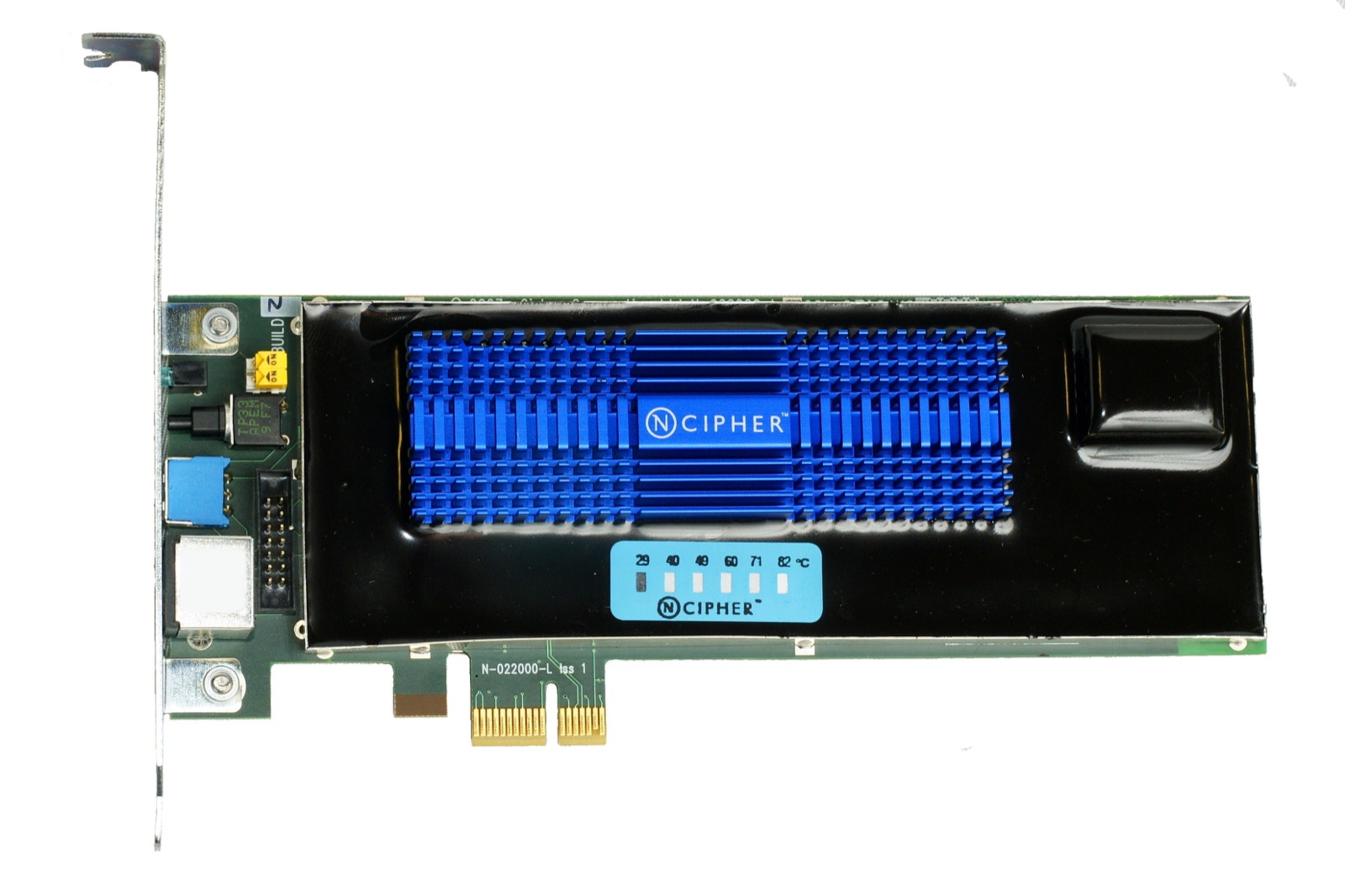
Observed. An nCipher nShield F3 hardware security module, out of the chassis: a PCI Express x1 card whose cryptographic boundary is the black potted block covering most of the board, with a finned heatsink, a temperature-indicator strip reading 29 to 82 degrees C, and the board marking N-022000-L iss 1.
The photograph shows the form factor and the potted boundary of the deployed cryptographic-module class.
It shows no FIPS certificate, no tamper-response event, and no AI accelerator, and being dated Dec. 17, 2008 it predates every accelerator this book is about.
Photograph by Alexander Klink , licensed CC BY 3.0 [26].
Modified for this book: resized from 3308 x 2205 to 1600 x 1066 and recompressed as JPEG; not cropped, retouched, or annotated.
General-purpose HSMs ship across multiple form factors, from legacy PCMCIA cards to network-attached rack appliances, all sharing the same key-only boundary.PreviousThis paragraph was added in this version.NowGeneral-purpose HSMs ship across multiple form factors, from legacy PCMCIA cards to network-attached rack appliances, all sharing the same key-only boundary.
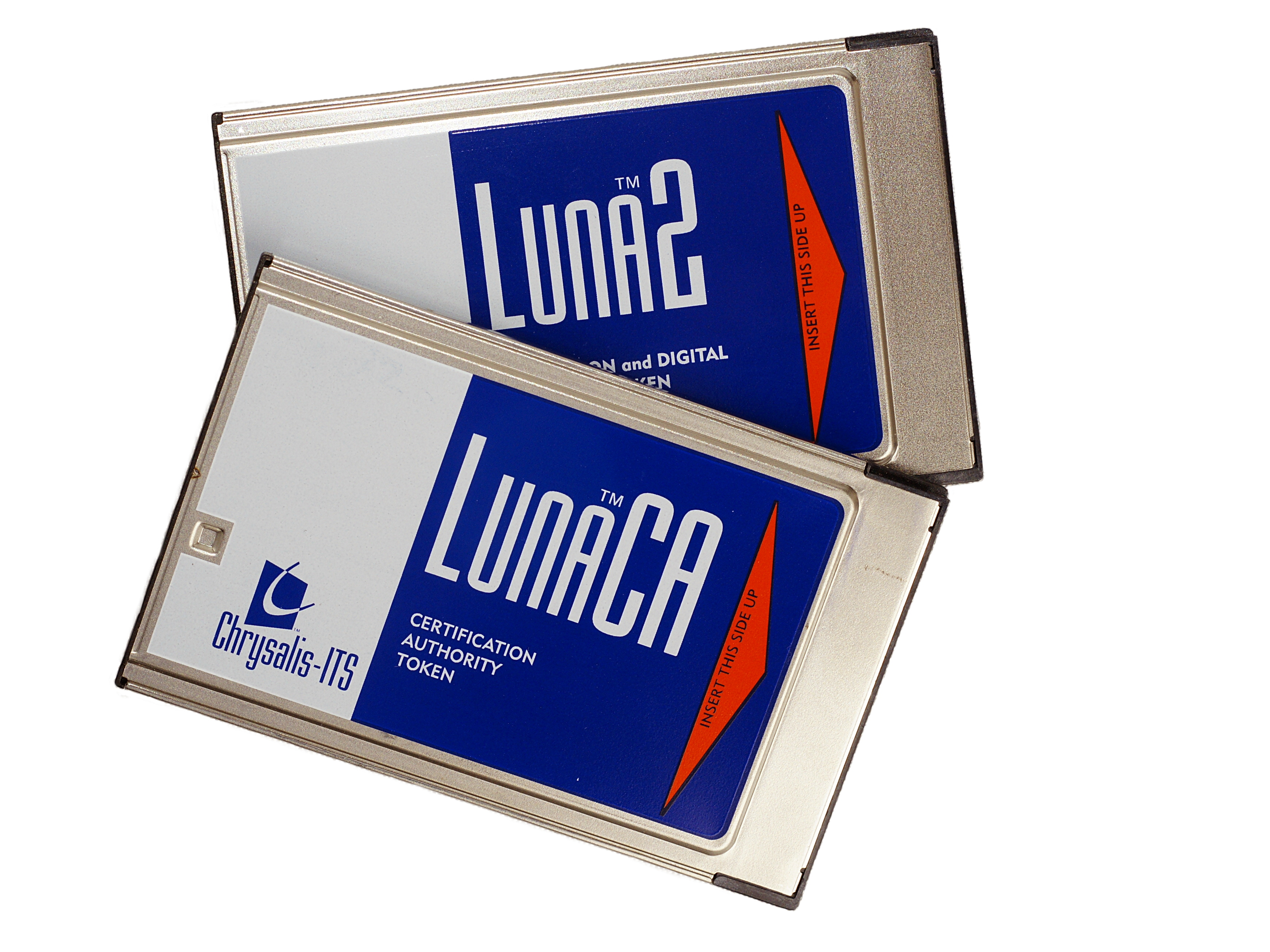
Observed. A Chrysalis-ITS Luna hardware security module in the legacy PCMCIA card form factor, photographed in 2008 — the laptop-slot HSM generation that predates the PCIe card above.
It shows one physical form key-protection hardware has taken; it does not show internal tamper-response mechanisms, a FIPS certificate, or any connection to current-generation HSM products.
Photograph by Alexander Klink , licensed CC BY 3.0 [27].
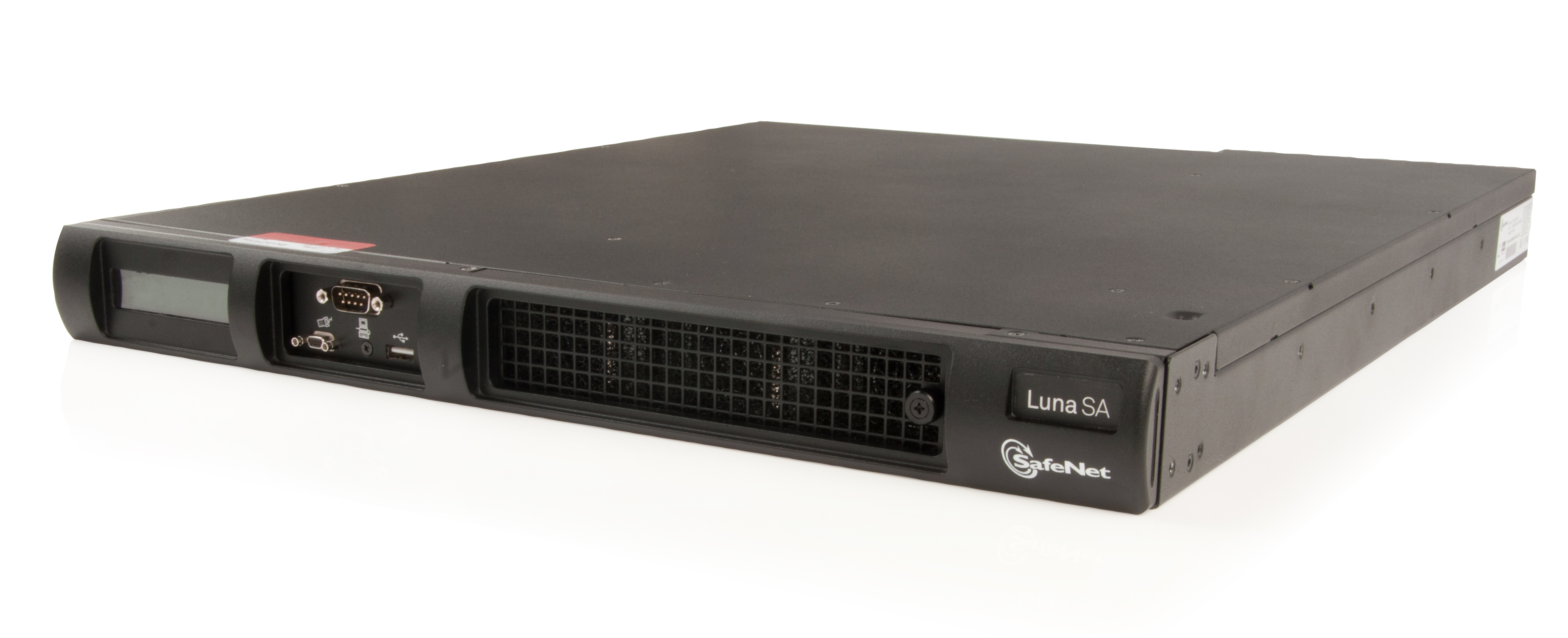
Observed. A Thales Luna SA 5 chassis, a network-attached rack-mount HSM, photographed in 2012 — the same certified-custodian role as the PCMCIA card above, moved into rack infrastructure serving multiple hosts over a network.
It shows the appliance form factor the market moved to; it does not show FIPS certification status, internal tamper-resistance mechanisms, or deployment scale.
Photograph by HelmSE1, Wikimedia Commons, licensed CC BY-SA 3.0 [28].
An emerging generic bridge: Project Tessera. On October 13, 2026, Microsoft, Marvell, and Oracle launched Project Tessera under an Open Compute Project working group, releasing open-source specifications, protocols, firmware, drivers, and RTL for an integrated datacenter HSM [29][30]. Microsoft and Marvell also reported a demonstration of partition cloning and resiliency rings between Tessera and Marvell’s LiquidSecurity 2 [29]. Crucially, Tessera’s DARC (Device-Attested Resource Control) draft specifies transferring designated private keys from a source HSM to verified accelerator-class devices without leaving a hardware-rooted boundary, enforcing validity-period expiry until refresh [31].
Tessera narrows the generic HSM-to-attested-device infrastructure gap, but it does not resolve conflict CL-C2 or deliver ML weight custody. Hardware availability remains future-tense through OCP and channel partners, the demonstration is publisher-reported, and NIST FIPS 140-3 Level 3 is a design target rather than a completed CMVP validation [29][30][31]. Moreover, the seven captured Tessera specifications (bcdb7539) contain no reference to model weights, GPUs, inference, machine learning, or output-rate limits [31].
Root of trust establishes chip identity and boot state. Whether a privileged operator inside that boundary can still read plaintext weights during execution is the question addressed by confidential computing in Chapter 6.PreviousThis paragraph was added in this version.NowRoot of trust establishes chip identity and boot state. Whether a privileged operator inside that boundary can still read plaintext weights during execution is the question addressed by confidential computing in Chapter 6.
References
[1] lowRISC and contributors, “OpenTitan: Open Source Silicon Root of Trust,” https://opentitan.org/ (accessed Jul. 2026).
[2] lowRISC C.I.C., “OpenTitan Introduces New Membership Tiers and Deliverables to Accelerate Deployment,” Jan. 23, 2026. https://lowrisc.org/news/opentitan-introduces-new-membership-tiers-and-deliverables-to-accelerate-deployment/ , accessed Aug. 14, 2026 (live fetch)
[3] C. Stoller and M. Osorio, “Fabrication begins for production OpenTitan silicon,” Google Open Source Blog, Feb. 6, 2025. https://opensource.googleblog.com/2025/02/fabrication-begins-for-production-opentitan-silicon.html , accessed Aug. 14, 2026 (live fetch)
[4] CHIPS Alliance / Open Compute Project, “Caliptra Reference Implementation and Specification,” https://github.com/chipsalliance/caliptra (accessed Jul. 2026).
[5] CHIPS Alliance, “CHIPS Alliance’s Caliptra Launches 2.1 RTL Release,” Oct. 15, 2025. https://chipsalliance.org/news/caliptra2-1/ , accessed Aug. 14, 2026 (live fetch)
[6] CHIPS Alliance, “Caliptra: A Datacenter System on a Chip (SoC) Root of Trust (RoT), Revision 2.1, Version 0.1,” specification, https://chipsalliance.github.io/Caliptra/doc/Caliptra.html (accessed Aug. 10, 2026).
[7] Rambus Inc., “Root of Trust IP Solutions,” vendor documentation, https://www.rambus.com/security/root-of-trust/ (accessed Jul. 2026).
[8] H. Birkholz, D. Thaler, M. Richardson, N. Smith, and W. Pan, “Remote ATtestation procedureS (RATS) Architecture,” RFC 9334, Internet Engineering Task Force, Jan. 2023, Category: Informational, accessed Aug. 11, 2026 (live fetch). https://www.rfc-editor.org/rfc/rfc9334.txt — source of the Attester, Relying Party and Verifier definitions, of the Endorser, Reference Value Provider, Verifier Owner and Relying Party Owner roles, of the § 2.2 “Confidential Machine Learning Model Protection” use case, and of the informational-status disclaimer; quoted from the RFC text file retrieved to disk, in which the string “auditor” does not occur.
[9] L. Lundblade, G. Mandyam, J. O’Donoghue, and C. Wallace, “The Entity Attestation Token (EAT),” RFC 9711, Internet Engineering Task Force, Apr. 2025, Category: Standards Track, accessed Aug. 11, 2026 (live fetch). https://www.rfc-editor.org/rfc/rfc9711.txt — cited for the abstract’s definition of the token and for the standards-track status only, not for any deployment claim.
[10] M. Larabel, “AMD To Integrate ‘Project Caliptra’ Into Products Beginning In 2026,” Phoronix, Oct. 11, 2024. https://www.phoronix.com/news/AMD-Project-Caliptra-2026 , URL resolved Aug. 14, 2026 (HTTP 200; cited content not confirmed)
[11] Open Compute Project, “Cloud Security: Integrating Trust into Every Chip,” OCP Blog, Oct. 17, 2022. https://www.opencompute.org/blog/cloud-security-integrating-trust-into-every-chip , accessed Aug. 14, 2026 (live fetch)
[12] D. Patel, “Caliptra – First Open-Source Silicon Going Into All Datacenter Chips,” SemiAnalysis, Oct. 25, 2022. https://newsletter.semianalysis.com/p/caliptra-first-open-source-silicon , accessed Aug. 14, 2026 (live fetch)
[13] R. Qi, X. Jiang, E. Dimitrova, J. Luo, Q. Cheng, and M. Saligane, “SILK: Closing the Time-of-Check-to-Time-of-Use Gap in RoT-Protected AI Systems,” arXiv:2608.26402, submitted Aug. 26, 2026. https://arxiv.org/abs/2608.26402 , accessed Sep. 3, 2026 (live fetch) — FPGA prototype (Xilinx ZCU102); load-time RoT auth leaves a documented weight-stream TOCTOU; not Caliptra production silicon.
[14] National Security Agency, Announcing the Commercial National Security Algorithm Suite 2.0, Cybersecurity Advisory U/OO/194427-22 | PP-22-1338, Sep. 2022, Ver. 1.0, accessed Aug. 11, 2026 (live fetch of the Internet Archive snapshot of Dec. 25, 2023). https://web.archive.org/web/20231225183852/https://media.defense.gov/2022/Sep/07/2003071834/-1/-1/0/CSA_CNSA_2.0_ALGORITHMS_.PDF — source of the software-and-firmware-signing timeline, the SP 800-208 LMS and XMSS designation for that use case, the hardware-signing condition, and the RSA/DH/ECC deprecation sentence; the canonical URL https://media.defense.gov/2022/Sep/07/2003071834/-1/-1/0/CSA_CNSA_2.0_ALGORITHMS_.PDF returned HTTP 403 to this project on Aug. 11, 2026, so every quotation is taken from the archived copy of the same document identifier.
[15] National Security Agency, The Commercial National Security Algorithm Suite 2.0 and Quantum Computing FAQ, accessed Aug. 11, 2026 (live fetch). https://web.archive.org/web/20250116073355/https://media.defense.gov/2022/Sep/07/2003071836/-1/-1/0/CSI_CNSA_2.0_FAQ_.PDF — source of the ML-KEM/FIPS 203 and ML-DSA/FIPS 204 clarification, the 2024 CNSSP 15 dates, and the explanation that “a quantum-resistant root of trust may be required in the firmware years before the rest of the system upgrades to quantum-resistance.” The canonical URL https://media.defense.gov/2022/Sep/07/2003071836/-1/-1/0/CSI_CNSA_2.0_FAQ_.PDF returned HTTP 403 to this project on Aug. 11, 2026; the Internet Archive CDX index reports three distinct digests, captured Sep. 8, 2022, Jul. 10, 2024, and Jan. 16, 2025, and the latest capture is cited here.
[16] National Institute of Standards and Technology and Canadian Centre for Cyber Security, Cryptographic Module Validation Program, validated-modules search and certificate records #4758, #5310, #3739, #4367, #5166, #4574, #3851 (queried Aug. 9, 2026). https://csrc.nist.gov/projects/cryptographic-module-validation-program/validated-modules/search , URL resolved Aug. 14, 2026 (HTTP 200; cited content not confirmed)
[17] National Institute of Standards and Technology and Canadian Centre for Cyber Security, Cryptographic Module Validation Program, certificate records #4880, #3382, #3361, #3033, re-checked records #4758, #5310, #3739, #4367, #5166, #4574, #3851, and basic and advanced searches on the tokens Pluton, Cerberus, Nitro, Titan and Titan M2 (queried Aug. 10, 2026). https://csrc.nist.gov/projects/cryptographic-module-validation-program/validated-modules/search , URL resolved Aug. 14, 2026 (HTTP 200; cited content not confirmed)
[18] Google, “Pixel 6: Setting a new standard for mobile security,” Google Online Security Blog, Oct. 27, 2021 (accessed Aug. 10, 2026). https://security.googleblog.com/2021/10/pixel-6-setting-new-standard-for-mobile.html
[19] Microsoft, “Microsoft Pluton security processor,” Microsoft Learn, May 27, 2026 (accessed Aug. 10, 2026). https://learn.microsoft.com/en-us/windows/security/hardware-security/pluton/microsoft-pluton-security-processor
[20] Microsoft, “Microsoft Pluton as Trusted Platform Module,” Microsoft Learn, Apr. 15, 2025, page updated Jul. 7, 2026 (accessed Aug. 10, 2026). https://learn.microsoft.com/en-us/windows/security/hardware-security/pluton/pluton-as-tpm
[21] Microsoft, “Overview of Azure Boost,” Microsoft Learn, Mar. 18, 2025 (accessed Aug. 10, 2026). https://learn.microsoft.com/en-us/azure/azure-boost/overview
[22] A. Regenscheid, Platform Firmware Resiliency Guidelines, NIST Special Publication 800-193, National Institute of Standards and Technology, May 2018, 45 pp., accessed Aug. 11, 2026 (live fetch). https://doi.org/10.6028/NIST.SP.800-193 (PDF: https://nvlpubs.nist.gov/nistpubs/SpecialPublications/NIST.SP.800-193.pdf ) — source of the Protection, Detection and Recovery principles and of the audience and device-scope statements, quoted from the Executive Summary and from § 2.1 “Platform Devices” of the retrieved PDF; a guidelines publication for implementers, which establishes no validation programme of its own.
[23] National Institute of Standards and Technology and Canadian Centre for Cyber Security, Cryptographic Module Validation Program, basic search on ModuleName=nShield F3 with CertificateStatus=Any, and the two certificate records it returned, #4338 and #4337, both “nShield F3 10+ 500+ 6000+ & nShield F3 500+ 1500+ 6000+ for nShield Connect+, Connect CLX and HSMi,” vendor Entrust, FIPS 140-2, module type Hardware, embodiment Multi-Chip Embedded, validation date Oct. 16, 2022, status Active, sunset date Sep. 21, 2026, accessed Aug. 12, 2026 (live fetch). https://csrc.nist.gov/projects/cryptographic-module-validation-program/validated-modules/search — the search result page states “2 certificates match the search criteria”; #4338 records Overall Level 3 and #4337 records Overall Level 2 with Physical Security, EMI/EMC and Design Assurance each at Level 3. The shared description reads “tamper evident and tamper responsive Hardware Security Modules.” Certificate pages: https://csrc.nist.gov/projects/cryptographic-module-validation-program/certificate/4338 and https://csrc.nist.gov/projects/cryptographic-module-validation-program/certificate/4337
[24] National Institute of Standards and Technology and Canadian Centre for Cyber Security, Cryptographic Module Validation Program, certificate records #4337 and #4338 (nShield F3, vendor Entrust, FIPS 140-2), retrieved Sep. 27, 2026 (captures sources/raw/cmvp-4337-historical-2026-09-27.html and sources/raw/cmvp-4338-historical-2026-09-27.html). https://csrc.nist.gov/projects/cryptographic-module-validation-program/certificate/4337 and /certificate/4338 — both pages show Status “Historical” and Historical Reason “Moved to historical list due to sunsetting.” Government record.
[25] National Institute of Standards and Technology, Computer Security Resource Center, “FIPS 140-3 Transition Effort,” NIST CSRC, page created Jul. 10, 2019, last reviewed Apr. 13, 2026, accessed Sep. 27, 2026 (capture sources/raw/nist-fips-transition-2026-09-27.html). https://csrc.nist.gov/projects/fips-140-3-transition-effort — source of the prose “until September 21, 2026, when the FIPS 140-2 validations will be moved to the historical list” and the transition timeline table entry “September 22, 2026 All FIPS 140-2 certificates are placed on the Historical List”; the page also states “Even on the historical list, CMVP supports the purchase and use of these modules for existing systems.” Government publication.
[26] A. Klink, “NCipher nShield F3 Hardware Security Module,” photograph, Wikimedia Commons, dated Dec. 17, 2008 on the file description page, accessed Aug. 12, 2026 (live fetch). https://commons.wikimedia.org/wiki/File:NCipher_nShield_F3_Hardware_Security_Module.jpg — the file page’s license template reads {{self|cc-by-3.0}} and renders as “This file is licensed under the Creative Commons Attribution 3.0 Unported license.”; license deed https://creativecommons.org/licenses/by/3.0/ . The original is 3308 x 2205 pixels; the copy reproduced in this book is resized to 1600 x 1066 and recompressed as JPEG, with no other change. Full notice: site/public/media/ncipher-nshield-f3-hsm.LICENSE.txt.
[27] A. Klink, “Luna Hardware Security Modules PCMCIA,” photograph, Wikimedia Commons, dated Dec. 17, 2008 on the file description page, accessed Sep. 9, 2026 (live fetch). https://commons.wikimedia.org/wiki/File:Luna_Hardware_Security_Modules_PCMCIA.jpg — the file page’s license template renders as “This file is licensed under the Creative Commons Attribution 3.0 Unported license.”; license deed https://creativecommons.org/licenses/by/3.0/ . Full notice: site/public/media/luna-hsm-pcmcia-2008.LICENSE.txt. The same photograph is reused in Chapter 7.
[28] HelmSE1, “Luna SA Hardware Security Module,” photograph, Wikimedia Commons, dated Jan. 23, 2012 on the file description page, accessed Sep. 9, 2026 (live fetch). https://commons.wikimedia.org/wiki/File:Luna_SA_Hardware_Security_Module.jpg — the file page’s license template renders as “This file is licensed under the Creative Commons Attribution-Share Alike 3.0 Unported license.”; license deed https://creativecommons.org/licenses/by-sa/3.0/ . Full notice: site/public/media/luna-sa-hsm-2012.LICENSE.txt. The same photograph is reused in Chapter 7.
[29] Microsoft Azure Blog, “Advancing hardware security with open-source integrated HSM technology,” Oct. 13, 2026, https://azure.microsoft.com/en-us/blog/advancing-hardware-security-with-open-source-integrated-hsm-technology/ , accessed 2026-10-13 (capture sources/raw/suppliers-microsoft-project-tessera-2026-10-13-captured-2026-10-13.html).
[30] Marvell Technology, “Marvell, Microsoft, and Oracle Establish OCP Working Group to Standardize Data Center Hardware Security,” Oct. 13, 2026, https://investor.marvell.com/news-events/press-releases/detail/1038/marvell-microsoft-and-oracle-establish-ocp-working-group-to-standardize-data-center-hardware-security , accessed 2026-10-13 (capture sources/raw/suppliers-marvell-ocp-integrated-hsm-2026-10-13-captured-2026-10-13.html).
[31] TesseraHSM, Tessera Integrated HSM Specifications (“Tessera - Definition.md,” “Tessera - DARC Specification.md,” and “Tessera – Deployment Models.md,” commit bcdb753953dbb0067a7764130e47b0d156adf6fb), Oct. 9, 2026, https://raw.githubusercontent.com/TesseraHSM/tessera-specs/bcdb753953dbb0067a7764130e47b0d156adf6fb/Tessera%20-%20DARC%20Specification.md and https://raw.githubusercontent.com/TesseraHSM/tessera-specs/bcdb753953dbb0067a7764130e47b0d156adf6fb/Tessera%20%E2%80%93%20Deployment%20Models.md , accessed 2026-10-13 (captures sources/raw/suppliers-tessera-darc-bcdb7539-captured-2026-10-13.md and sources/raw/suppliers-tessera-deployment-bcdb7539-captured-2026-10-13.md).